Table of contents

Quick answer: Move off manual CPC once conversion tracking is verified and the campaign records roughly 15–30 real conversions a month. Start with Target CPA set at your current measured CPA, change nothing for two to three weeks, then tighten in small steps.
Last verified: 2026-08-21
Why the question is really about data, not bidding
Smart Bidding sets a bid for every auction using signals no human can act on in real time — device, time, query context, audience, location. It does that by learning from your conversion data. So the honest framing is not "is automation better than me at bidding" (it is, at auction level) but "is my conversion data good enough to be worth learning from".
That is why accounts that switch too early get burned and blame the algorithm. If a campaign counts newsletter signups and purchases as one undifferentiated conversion, Target CPA will dutifully buy you newsletter signups at a lovely cost per acquisition and no revenue. Google's own conversion measurement documentation is the right starting point, and cleaning up what counts as a conversion is more valuable than any bid strategy decision you will make this quarter.
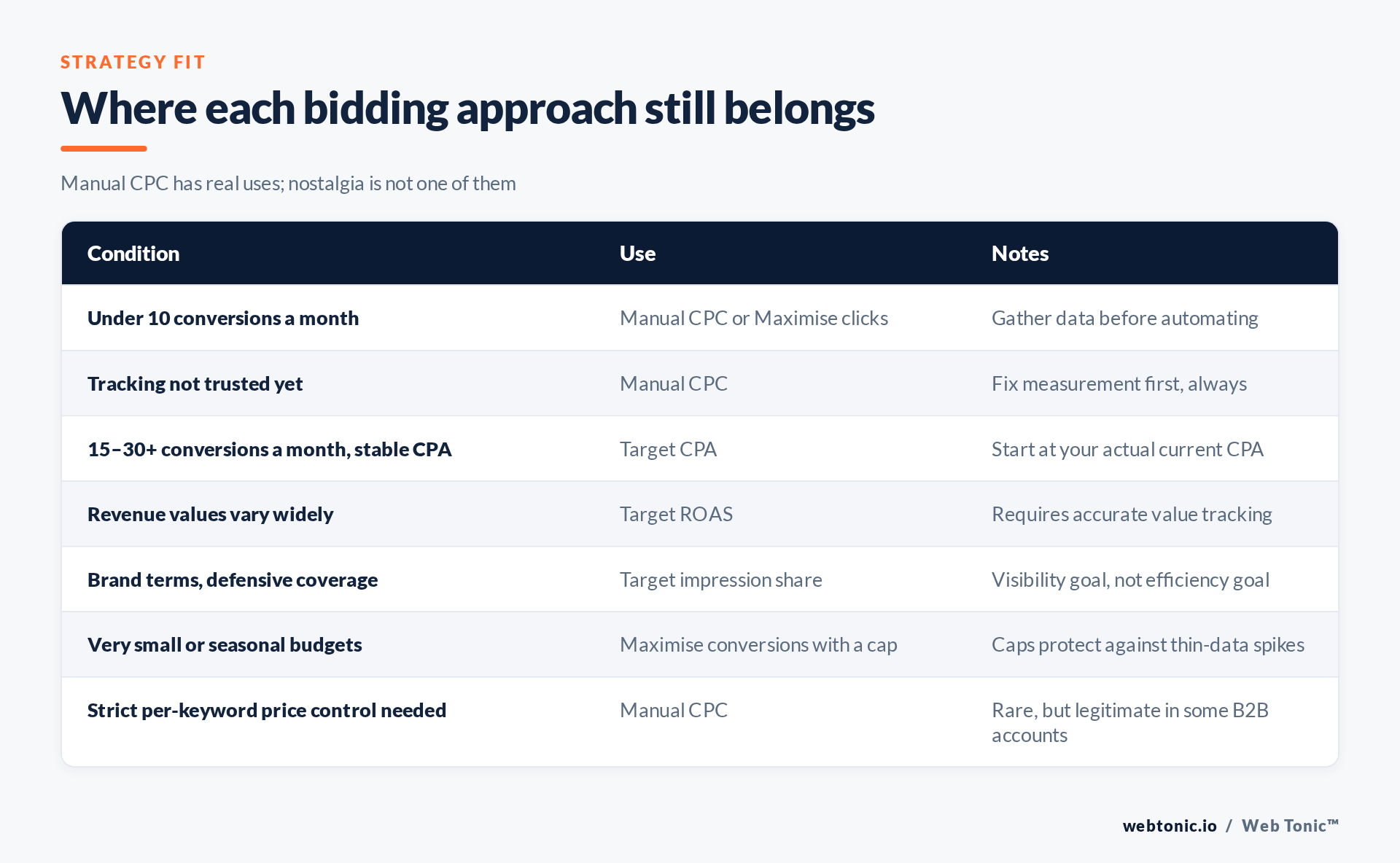
Manual CPC remains legitimate in a narrow set of cases: near-zero conversion volume, tracking you do not yet trust, and accounts where a stakeholder genuinely requires keyword-level price control. Outside those, keeping it is usually habit rather than strategy.
The readiness test
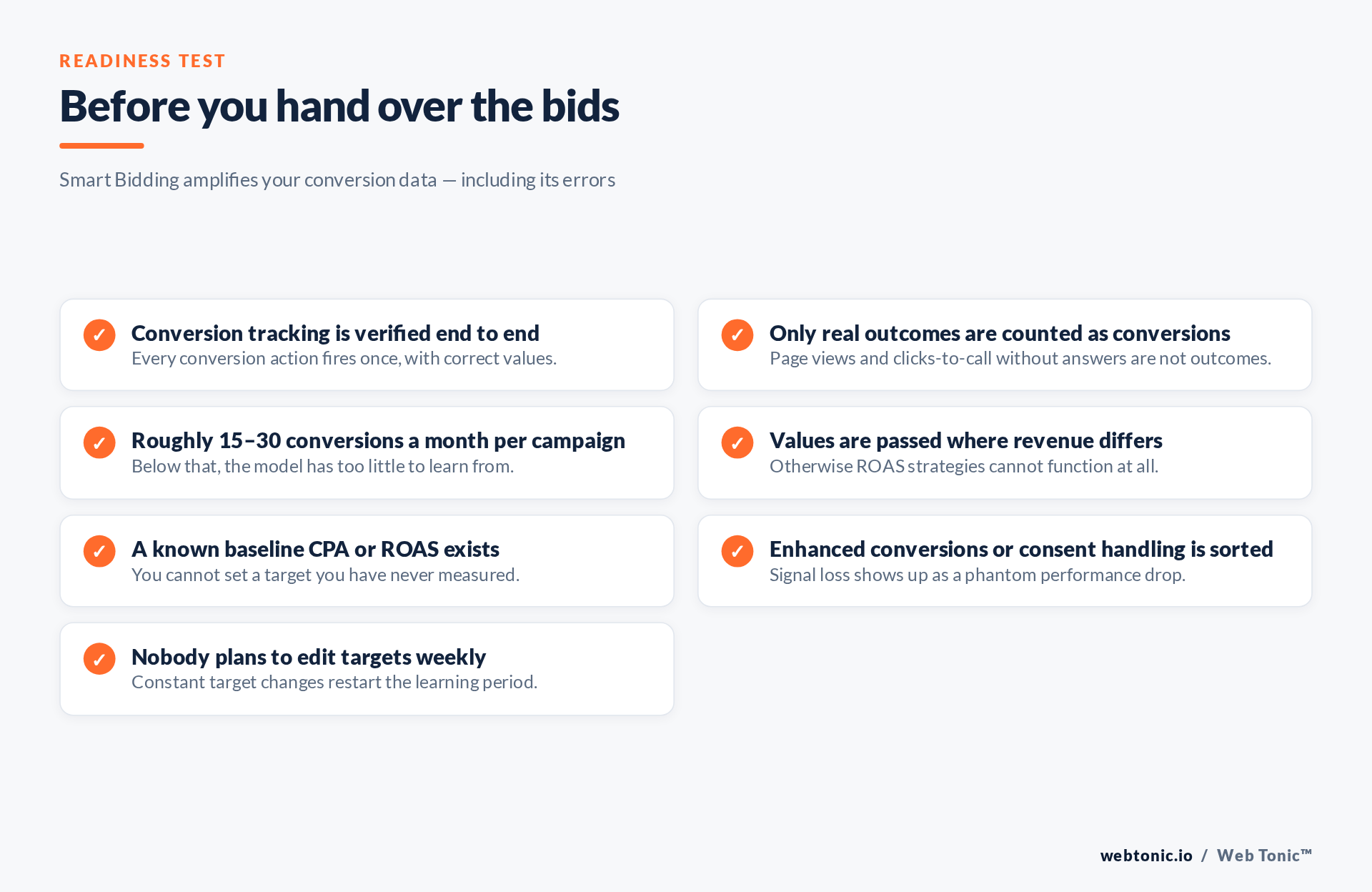
- Audit conversion actions. List every action, whether it is primary or secondary, how it counts, and whether it represents an outcome someone would pay for. Demote the rest to secondary.
- Verify each one fires once with the right value. Double-firing inflates volume and teaches the model to buy the wrong thing. This is the single most common cause of a "Smart Bidding does not work here" verdict.
- Count monthly conversions per campaign. Under about 10, stay manual or use maximise clicks while you build volume; 15–30 is a workable floor; 30+ is comfortable.
- Establish your baseline. Take a trailing 30–60 day CPA or ROAS. That number is your opening target — not the number your client wishes were true.
- Handle signal loss first. Consent handling and enhanced conversions materially change how many conversions the system sees, and changing them mid-migration makes the results unreadable.
- Agree a freeze window. Two to three weeks of no target edits after the switch, written down, so nobody panics on day four.
| Monthly conversions | Recommended strategy | What to fix meanwhile |
|---|---|---|
| 0–5 | Manual CPC or maximise clicks | Tracking, offer, landing pages |
| 5–15 | Maximise conversions, watch closely | Add micro-conversions as secondary signals |
| 15–30 | Target CPA at current CPA | Consolidate thin ad groups |
| 30–100 | Target CPA, tighten in 10–15% steps | Start passing conversion values |
| 100+ with varied values | Target ROAS | Value accuracy and margin data |
Migrating in the right order
Do not flip the whole account. Pick one campaign with the most conversion volume and migrate that first, because it will produce a readable answer fastest. Leave everything else on manual until it does.
Set the opening target at your measured baseline, not your goal. A target well below current performance is the classic self-inflicted wound: the system restricts delivery to hit an impossible number, impressions collapse, and everyone concludes automation failed. Tighten later, by 10–15% at a time, once performance is stable.
Then leave it alone. Target CPA and Target ROAS both re-enter a learning period after strategy or large target changes, so a weekly nudge means a campaign that is permanently learning and never performing. This exploration-then-exploitation behaviour is the same pattern described in reinforcement learning, and the practical rule it implies is dull but decisive: fewer, larger, planned changes.
Reading the first month honestly
Expect CPCs to move, sometimes sharply, and judge on cost per conversion instead. Smart Bidding will pay far more for an auction it believes converts and far less for one it does not, so average CPC becomes a much weaker diagnostic than it was under manual bidding. Impression share and Quality Score remain useful context.
Also check the search terms report, because automation changes which queries you buy. Migration is a good moment to refresh negatives: the strategy is optimising for conversions, not for whether a query belongs in your account at all. And if performance drops without any obvious cause, verify tracking before touching the target — signal changes look exactly like bidding failures in a dashboard.
Longer term, treat bid strategy as one component of an account that also needs structure, creative and measurement work. That is how we run conversion tracking and paid search inside growth marketing engagements, with the reporting layer in analytics. Further reading sits on our blog.
Frequently Asked Questions
How many conversions do I really need?
Around 15–30 a month per campaign is a workable floor and 30+ is comfortable. Fewer than 10 and you are asking a model to learn from noise.
Should I start with Target CPA or maximise conversions?
Maximise conversions with a CPA cap is a gentle entry at lower volume. Target CPA is better once you have a baseline you trust and want predictability.
Will my CPCs go up?
Often, on the auctions the system rates highly, and down elsewhere. Cost per conversion is the metric that matters after migration.
How long before I judge the switch?
Two to three weeks minimum, with no target edits in that window, then compare a full period against a matched period before the change.
Is manual CPC ever still the right answer?
Yes — at very low conversion volume, when tracking is not trustworthy, or where strict keyword-level price control is a genuine requirement.
Sources: Google Ads — About Smart Bidding; About manual CPC bidding; Target CPA; Target ROAS; conversion measurement; Google Ads API reporting; reinforcement learning. Last verified 2026-08-21.