Table of contents
Cost per click (CPC) is the amount an advertiser pays each time someone clicks an ad. It is the price of one visit in a pay-per-click auction, and in 2026 the average search CPC across industries is $5.42.
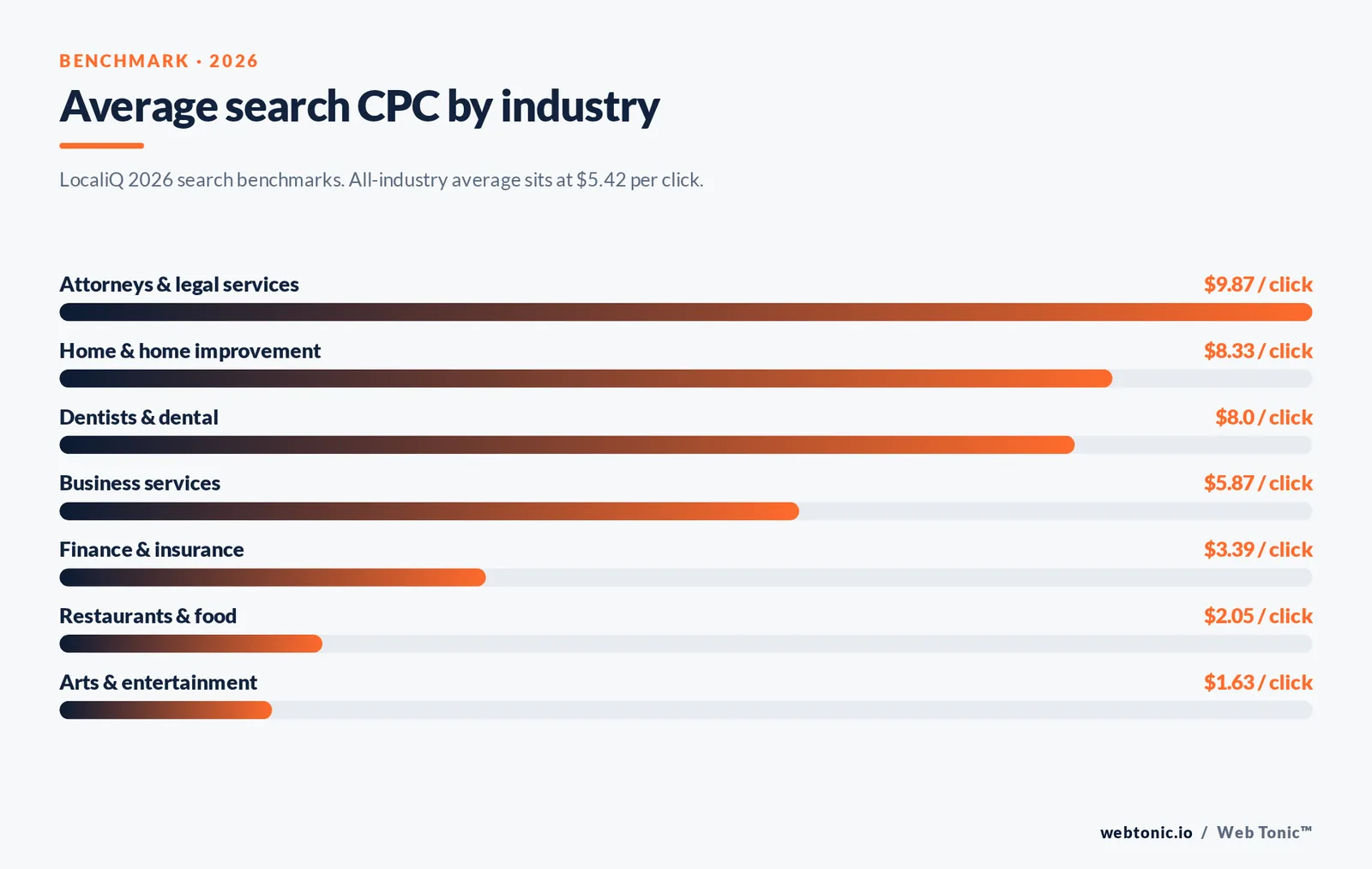
That single number hides an enormous spread: from $1.63 a click in arts and entertainment to $9.87 in legal services. This guide explains the formula, the auction behind it, current benchmarks, and the levers that actually move your CPC.
Key Takeaways
- Price per visit = total ad spend ÷ total visits. A $900 spend on 300 clicks is a $3.00 CPC.
- The 2026 all-industry average search CPC is $5.42, up from $3.53 in earlier benchmark cycles.
- You almost never pay your maximum bid — actual CPC is usually below your bid cap because ad quality discounts the price.
- The most expensive keywords in commercial databases clear $650–$1,351 per click, so keyword choice dominates cost.
- CPC is a health metric, not a goal: the 2026 average cost per lead is $66.69 at an 8.18% conversion rate.
- Improving relevance is the only lever that lowers CPC and raises volume at the same time.
What cost per click means (and the formula)
Cost per click is a pricing model in online advertising where the advertiser is billed for clicks rather than for impressions. Nothing is charged when the ad is merely shown; the meter starts when a person taps or clicks through to the destination. That makes this model the core billing mechanic of pay-per-click (PPC) advertising on Google Ads, Microsoft Advertising, Meta, LinkedIn Ads and Amazon Ads.
The calculation is deliberately simple:
CPC = total cost of the campaign ÷ total number of clicks. If a campaign spent $4,820 and produced 1,140 clicks, the average cost per click is $4.23. Divide the other way and you get the reverse planning question every media buyer asks: a $5,000 monthly budget at a $4.23 average CPC buys roughly 1,182 clicks, which at an 8% conversion rate is about 94 leads.
Two related terms are worth separating early. Maximum CPC is the highest amount you tell the platform you are willing to pay for a click. Average CPC is what you actually paid across all clicks. In Google Ads, bidding controls let you set that ceiling manually or hand it to an automated strategy that bids per auction. Both platforms also expose planning tools — the Google Keyword Planner and the Microsoft Advertising keyword planner — that publish forecast CPC ranges before you spend anything.
How the auction actually sets your CPC
Advertisers rarely pay what they bid. Search platforms run a second-price-style auction where your price depends on the competitor ranked immediately below you and on how relevant your ad is judged to be. The practical formula the industry uses is: the actual cost per click equals the ad rank of the advertiser below you divided by your own quality signals, plus one cent.
Three consequences follow, and they explain most of the CPC questions that land in an account review:
- Better ads pay less. Google's Quality Score documentation is explicit that expected click-through rate, ad relevance and landing page experience feed the auction, so a higher-quality ad can outrank a higher bid at a lower price.
- Your bid is a ceiling, not a price. Raising a max CPC from $4 to $6 does not raise the paid price to $6; it makes you eligible for auctions you previously lost.
- Competition is priced instantly. When one aggressive advertiser enters a niche, CPCs can move within days, which is why platform guides recommend reviewing bid strategies monthly rather than quarterly.
Google publishes the same logic in its ad position and Ad Rank guidance: position is not bought outright, it is earned by the combination of bid, quality and ad format expectations.
Average CPC benchmarks by industry in 2026
Benchmarks answer the "is my CPC bad?" question faster than any audit. The table below uses 2026 search advertising benchmark data covering Google and Microsoft search ads across 23 business categories, published by LocaliQ's benchmark study.
| Industry | Average CPC | Average CTR | Average CVR | Average CPL |
|---|---|---|---|---|
| Attorneys & legal services | $9.87 | 5.87% | 5.55% | $131.63 |
| Home & home improvement | $8.33 | 6.47% | 8.05% | $90.92 |
| Dentists & dental services | $8.00 | 5.66% | 10.67% | $72.97 |
| Personal services | $7.17 | 7.16% | 12.34% | $54.60 |
| Health & fitness | $6.17 | 5.81% | 6.94% | $67.36 |
| Business services | $5.87 | 6.10% | 4.85% | $93.69 |
| Education & instruction | $4.81 | 7.56% | 13.14% | $77.48 |
| Apparel, fashion & jewelry | $4.44 | 6.64% | 4.50% | $97.51 |
| Finance & insurance | $3.39 | 9.83% | 2.64% | $74.44 |
| Real estate | $3.22 | 7.61% | 3.70% | $102.51 |
| Sports & recreation | $2.77 | 8.75% | 7.69% | $44.26 |
| Travel | $2.14 | 9.32% | 5.83% | $44.70 |
| Restaurants & food | $2.05 | 6.83% | 8.05% | $30.57 |
| Arts & entertainment | $1.63 | 12.75% | 5.91% | $26.84 |
| All industries | $5.42 | 6.64% | 8.18% | $66.69 |
Read the rows across, not down. Legal services pay 6x the arts-and-entertainment click price, yet a signed case is worth thousands, so a $131.63 cost per lead can still be profitable. Finance and insurance shows the opposite trap: a comparatively cheap $3.39 CPC paired with the lowest conversion rate in the set, 2.64%, which pushes the cost per lead above the all-industry average anyway.
CPC vs CPM vs CPA vs CPL: which metric to steer by
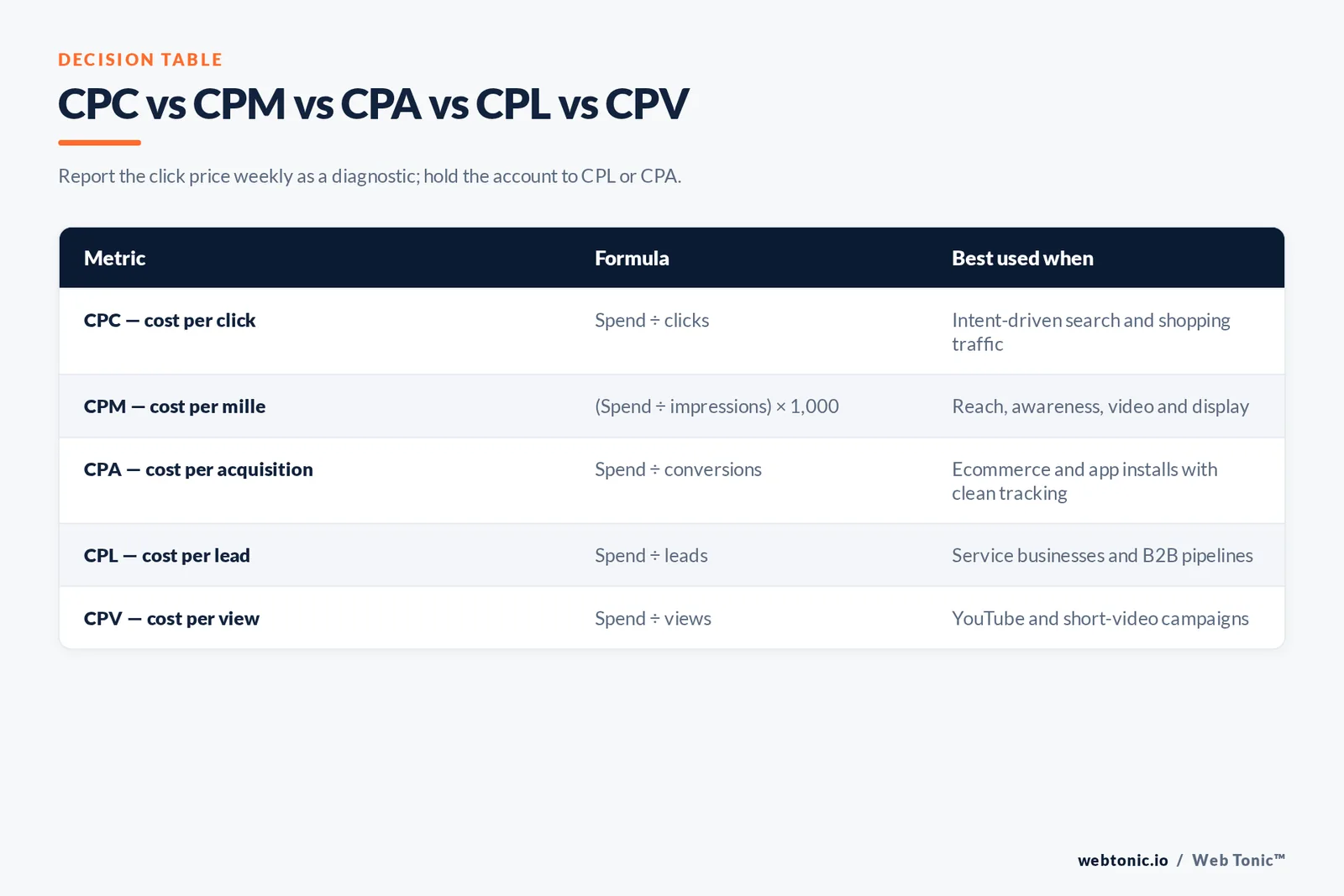
Cost per click sits in a family of pricing and reporting metrics that answer different questions. Confusing them is the most common reason a campaign looks cheap and performs badly.
| Metric | What you pay for | Formula | Best used when |
|---|---|---|---|
| CPC — cost per click | Each click through to your site | Spend ÷ clicks | Intent-driven search and shopping traffic |
| CPM — cost per mille | Every 1,000 impressions | (Spend ÷ impressions) × 1,000 | Reach, awareness, video and display |
| CPA — cost per acquisition | A completed conversion | Spend ÷ conversions | Ecommerce and app installs with clean tracking |
| CPL — cost per lead | A qualified enquiry | Spend ÷ leads | Service businesses and B2B pipelines |
| CPV — cost per view | A watched video segment | Spend ÷ views | YouTube and short-video campaigns |
A useful discipline: report the click price weekly as a diagnostic, but hold the account accountable to CPL or CPA. A campaign whose click price falls 20% while cost per lead rises 15% has not improved — it has bought cheaper, worse clicks. Our data intelligence team builds reporting that shows both side by side so the trade-off is visible in one screen.
CPC across advertising platforms
Every major advertising platform supports click-based billing, but the auctions differ in what they reward. Search platforms price intent; social platforms price attention; retail media prices proximity to a purchase.
| Platform | How the click is priced | What drives cost most | Typical use |
|---|---|---|---|
| Google Ads | Auction with quality discount | Keyword competition and Quality Score | High-intent search demand capture |
| Microsoft Advertising | Same auction model, smaller pool | Lower competition, older audience skew | Incremental search volume at lower CPC |
| Meta (Facebook & Instagram) | CPC or CPM within one auction | Creative quality and audience saturation | Demand creation and retargeting |
| LinkedIn Ads | Bid per click on professional targeting | Seniority, industry and company-size filters | B2B lead generation with high deal value |
| Amazon Ads | Keyword and product-targeting auction | Category competition and listing quality | Product discovery close to checkout |
Two platform notes matter for budgeting. First, search share still concentrates spend: Google held 91.25% of global search in mid-2026 according to StatCounter, which is why its auction sets the reference price. Second, LinkedIn Ads clicks routinely cost multiples of a search click because the targeting narrows to job titles and firm size — acceptable when one closed deal is worth five figures, punitive when it is not.
Seven factors that move your cost per click
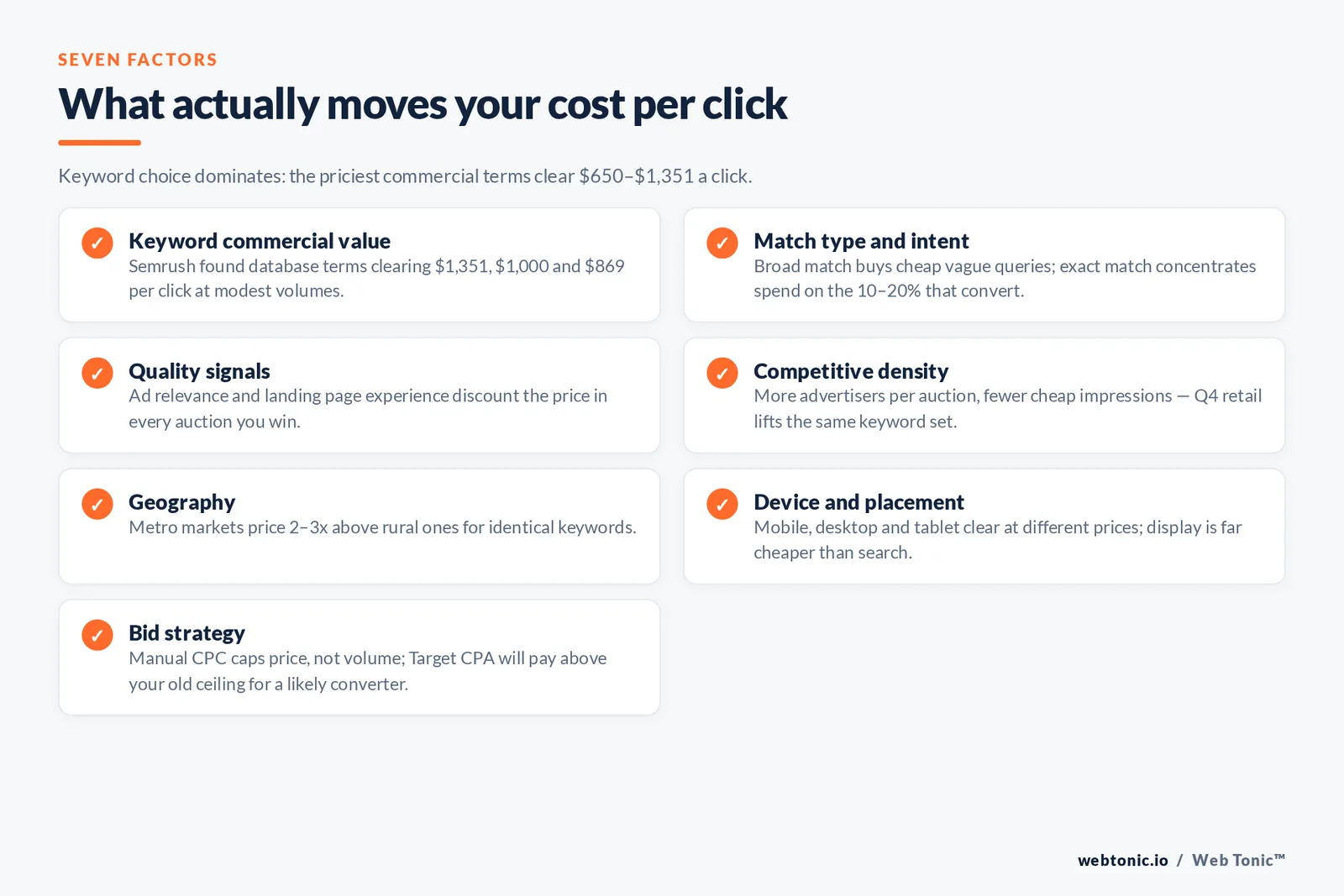
- Keyword commercial value. Semrush's analysis of its keyword database found terms clearing $1,351, $1,000 and $869 per click at modest search volumes — high-ticket categories where one conversion pays for hundreds of clicks (see Semrush's CPC research).
- Match type and search intent. Broad match reaches cheap, vague queries; exact match concentrates spend on the 10–20% of terms that convert.
- Quality signals. Ad relevance and landing page experience discount the price you pay in every auction you win.
- Competitive density. More advertisers per auction means fewer cheap impressions; seasonal spikes such as Q4 retail push CPCs up for the same keyword set.
- Geography. Metro markets price above rural ones for identical keywords, sometimes by 2–3x.
- Device and placement. Mobile, desktop and tablet clear at different prices, and display or in-app inventory is typically far cheaper than search.
- Bid strategy. Manual CPC caps the price but not the volume; Target CPA and Target ROAS will happily pay above your old ceiling for a click that the model expects to convert.
Structural context matters too. Search advertising remains the largest slice of digital budgets in both the IAB revenue reporting and eMarketer's search forecasts, and total digital ad spend continues to grow in Statista's advertising outlook. More money chasing a finite pool of high-intent queries is the long-run reason CPCs drift upward.
Mobile advertising and the price of a visit
Mobile changed the economics of the click twice over. Mobile clicks are frequently cheaper than desktop clicks in the same campaign because inventory is abundant and intent is more scattered — but they also convert differently. A click from a phone at 11pm on a comparison query is not the same asset as a desktop click on a "book a consultation" query at 2pm.
Three practical rules keep mobile numbers honest:
- Segment reporting by device before you judge any blended average. Blended numbers hide a cheap-but-idle mobile tail.
- Fix mobile page speed before bidding harder. Landing page experience is a scored auction input, so a slow page is charged twice — once in lost conversions, once in a higher click price.
- Use call and message conversions. On mobile, a tap-to-call is often the real conversion, and platforms cannot optimise toward what you do not track.
Automation amplifies whatever you feed it, which is the recurring theme in Google's automation guidance: clean conversion data first, bid strategy second.
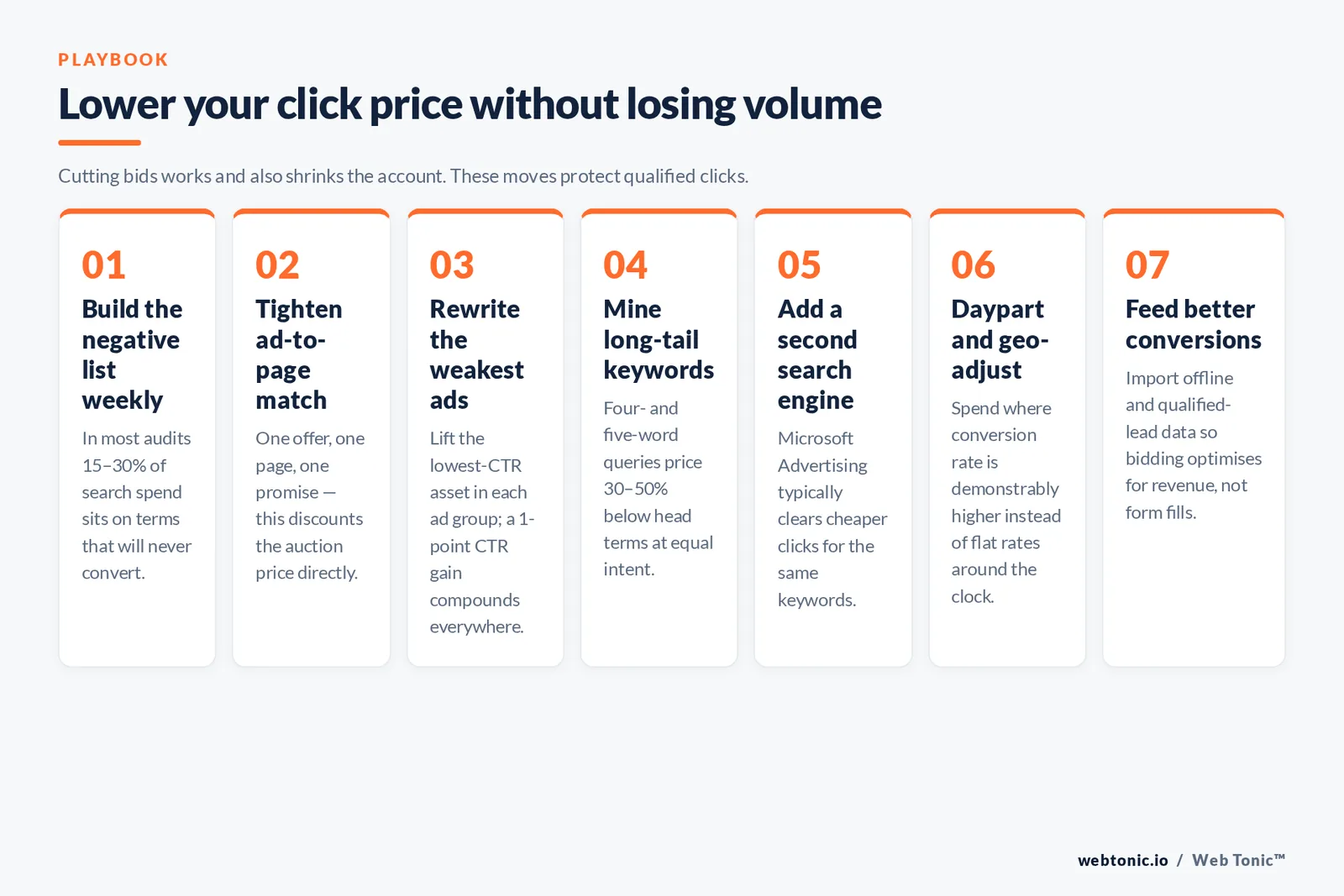
How to lower your click price without losing volume
Trimming the price you pay by simply lowering bids works and it also shrinks the account. These are the moves that lower spend while protecting or growing qualified clicks:
- Build the negative keyword list weekly. Removing irrelevant queries is the fastest way to cut wasted spend — in most audits 15–30% of search spend sits on terms that will never convert.
- Tighten ad-to-landing-page match. One offer, one page, one promise. This raises quality signals and directly discounts the auction price.
- Rewrite the weakest ads, not the best ones. Lift the lowest-CTR asset in each ad group; a 1-point CTR gain compounds across every auction.
- Mine long-tail keywords. Four- and five-word queries usually price 30–50% below head terms with equal or better intent.
- Add a second search engine. Microsoft Advertising typically clears cheaper clicks for the same keywords, as WordStream's platform comparison notes.
- Use dayparting and geo bid adjustments. Spend where and when conversion rate is demonstrably higher rather than paying flat rates around the clock.
- Feed the algorithm better conversions. Import offline and qualified-lead data so bidding optimises for revenue, not form fills.
If you would rather have this run for you, our growth marketing team manages paid search across these levers, and the performance creative side handles the ad-quality half of the equation. You can also browse more PPC explainers on the Web Tonic blog or talk to us about an account review.
FAQ: cost per click questions we get asked most
What is a good cost per click?
A good click price is one that produces a profitable cost per lead or acquisition for your margins. Judged against 2026 benchmark data, anything under the $5.42 all-industry average is competitive, but a $9 click in legal services is healthier than a $2 click in a category where nothing converts.
How is CPC calculated?
Divide total ad spend by total clicks. A $2,400 spend that generated 600 clicks equals a $4.00 average CPC. Platforms report this automatically as "Avg. CPC" alongside your maximum bid.
Do I always pay my maximum bid?
No. Your maximum CPC is a ceiling. The auction charges only what is needed to hold your position over the next advertiser, adjusted for your quality signals, so the average paid price usually sits well below the cap.
Why did my CPC suddenly increase?
The usual causes, in order of frequency: a new competitor entering the auction, a seasonal demand spike, a drop in Quality Score after an ad or landing page change, expanded match types pulling in pricier queries, or an automated bid strategy reacting to a conversion tracking gap.
Is CPC or CPM better?
Neither is universally better. Pay per click when you want traffic and the click is the valuable event; pay per 1,000 impressions when the goal is reach or brand recall and clicks are a poor proxy for value.
Sources
LocaliQ 2026 search advertising benchmarks · Semrush, "Cost Per Click: Definition, Why It Matters + How to Measure CPC" · Google Ads Help (Quality Score, bidding, Ad Rank) · Microsoft Advertising guides · LinkedIn Marketing Solutions · StatCounter Global Stats, search engine market share, June 2026 · IAB Internet Advertising Revenue Report · eMarketer search advertising insights · Statista digital advertising outlook · Think with Google automation resources · WordStream platform benchmarks. Figures cited as published at the time of writing.