Table of contents
A vanity URL is a short, deliberately readable web address built from words a person can remember and repeat — like brand.co/pricing instead of a long tracked link. It exists to be spoken aloud, printed, and clicked.
Key Takeaways
- Google holds 91.31% of worldwide search, so most link discovery still happens through crawled pages — but vanity URLs mainly serve the traffic that arrives off-search: podcasts, slides, packaging and DMs.
- A vanity URL is a redirect, not a page. The destination page keeps the SEO value when you use a 301.
- There are roughly 1,430 top-level domains in the IANA root zone, which is why short branded domains are still obtainable.
- Branded link tooling starts near $5–$15 per month and rises to $100–$150 per month for enterprise link management.
- 3 fields decide whether a vanity URL works: the domain, the slug, and the tracking layered underneath it.
What a vanity URL actually is
A vanity URL (also written "vanity link") is a custom web address chosen for human legibility rather than machine convenience. Technically it is almost always a 1-hop redirect: the vanity address receives the request and forwards the browser to a longer canonical URL that carries campaign parameters, session data or a deep app path.
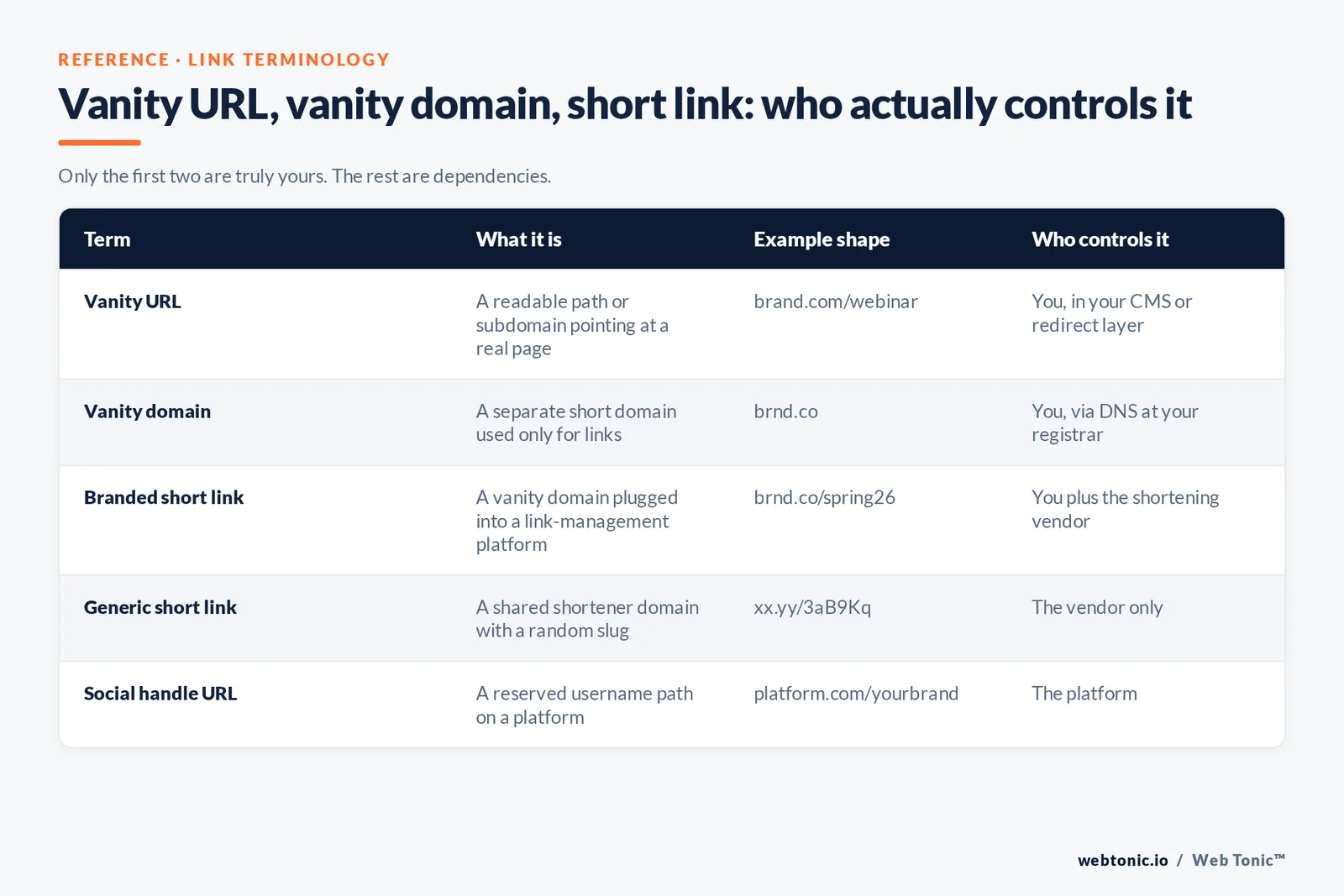
Three related terms get mixed up constantly:
| Term | What it is | Example shape | Who controls it |
|---|---|---|---|
| Vanity URL | A readable path or subdomain pointing at a real page | brand.com/webinar | You, in your CMS or redirect layer |
| Vanity domain | A separate short domain you own, used only for links | brnd.co | You, via DNS at your registrar |
| Branded short link | A vanity domain plugged into a link-management platform | brnd.co/spring26 | You + the shortening vendor |
| Generic short link | A shared shortener domain with a random slug | xx.yy/3aB9Kq | The vendor only |
| Social handle URL | A reserved username path on a platform | platform.com/yourbrand | The platform |
The distinction matters because only the first two are truly yours. A generic short URL is a dependency: if the vendor sunsets the service, every printed asset breaks. Google's own shortener was retired and its legacy links stopped resolving, which is the clearest available warning about renting your link infrastructure. Read the history of URL shortening and you will find the same failure pattern repeating across a decade.
How vanity URLs work under the hood
There are only four implementation routes, and picking the wrong one is the single most common mistake.
| Route | Mechanism | Best for | Watch out for |
|---|---|---|---|
| Route 1 — CMS redirect | 301 rule inside your site platform | Campaign paths on your primary domain | Rule lists grow unmanaged past 100 entries |
| Route 2 — Subdomain | DNS A or CNAME record to a host | Events, docs, help centres | Needs its own SSL certificate |
| Route 3 — Vanity domain + shortener | CNAME the short domain to the vendor | Social, QR codes, print, offline media | Vendor lock-in and per-click limits |
| Route 4 — Edge / reverse proxy | Rewrite at CDN or server level | High-volume, low-latency redirects | Requires engineering ownership |
Whatever the route, the redirect type decides the SEO outcome. Google documents that a permanent 301 redirect passes ranking signals to the destination, while temporary redirects signal that the original address should remain indexed. Google's URL structure guidance also favours simple, readable, word-based paths — which is exactly what a well-built vanity URL produces.
Rule 1 — never chain redirects. Each extra hop adds latency and risks dropping query parameters. Rule 2 — keep the destination canonical. The vanity address should never be the canonical tag on the landing page. Rule 3 — serve HTTPS on the vanity domain, because a link that throws a certificate warning converts at roughly zero.
Why marketers use them
The benefits are not cosmetic. A readable link changes behaviour in four measurable ways.
| Benefit | Why it happens | Where you see it |
|---|---|---|
| Benefit 1 — Recall | Words are easier to remember than 7-character hashes | Direct traffic after radio, podcast or stage mentions |
| Benefit 2 — Trust | The brand name is visible before the click | Higher click-through on social and email |
| Benefit 3 — Attribution | One link per channel, cleanly tagged | Campaign reports without "direct / none" gaps |
| Benefit 4 — Flexibility | The destination can be repointed after printing | Reused QR codes, packaging, business cards |
| Benefit 5 — Brand consistency | Link becomes part of the identity system | Slides, PDFs, bios, out-of-home creative |
Benefit 4 is the one most teams underuse. Because the vanity address is a redirect, the target can change without reprinting anything — a physical asset gains a software update path. Link-management vendors build their entire enterprise case on this, and both Bitly and Rebrandly publish the same argument from different angles.
Benefit 3 deserves care. The vanity URL is the human layer; UTM parameters are the machine layer, and they belong on the destination. Google's campaign URL parameter reference defines the five standard fields, and Google Ads' tracking template documentation shows how paid platforms append their own. If the redirect strips them, your reporting silently breaks.
Choosing the domain and the slug
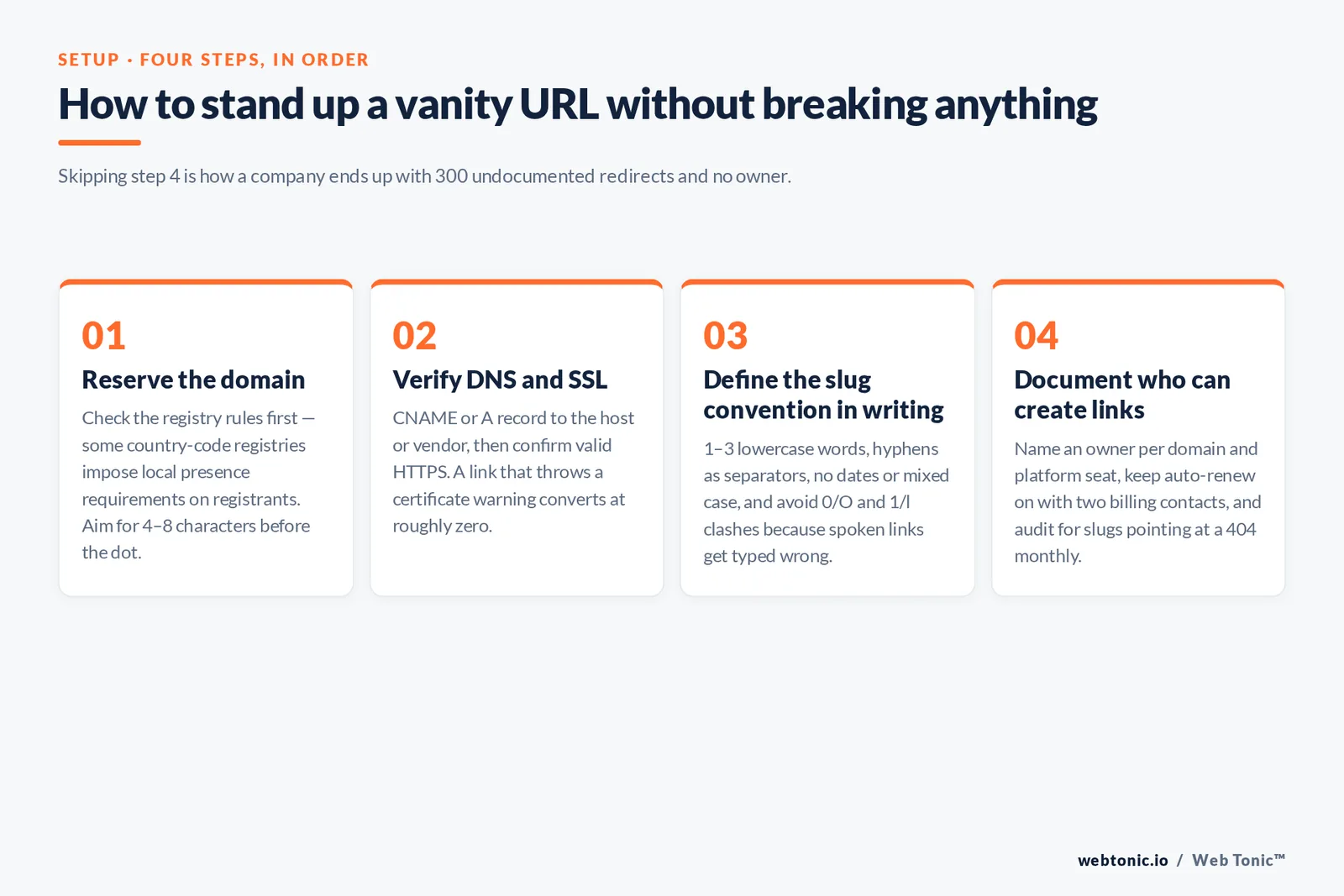
A vanity domain is a real domain purchase, subject to the same registry rules as any other. The IANA root zone database lists every delegated extension, and ICANN's TLD overview explains the difference between country-code and generic extensions — which matters, because some country-code registries impose local presence requirements on registrants. Registrar documentation on domain anatomy is worth reading before you commit a brand asset to a novelty extension.
| Decision | Do this | Avoid this | Reason |
|---|---|---|---|
| Domain length | 4–8 characters before the dot | Full brand name plus a word | Short domains survive being read aloud |
| Extension | A stable, recognisable TLD | Extensions confused with typos | Recognition drives trust at the click moment |
| Slug words | 1–3 lowercase words | Dates, IDs, mixed case | Case-sensitive slugs generate dead links |
| Separators | Hyphens if needed | Underscores or spaces | Hyphens are the documented word separator |
| Ambiguity | Avoid 0/O and 1/l clashes | Clever letter substitutions | Spoken links get typed wrong |
| Reuse | One slug per channel per campaign | Recycling last year's slug | Historic clicks pollute new reports |
On slug craft, two long-standing references still hold up: the W3C note on durable URIs argues that a good address should never need to change, and Moz's URL primer covers the readability trade-offs search marketers face. Step 1 — reserve the domain. Step 2 — verify DNS and SSL. Step 3 — define a slug convention in writing. Step 4 — document who can create links. Skipping step 4 is how a company ends up with 300 undocumented redirects and no owner.
What vanity URLs cost
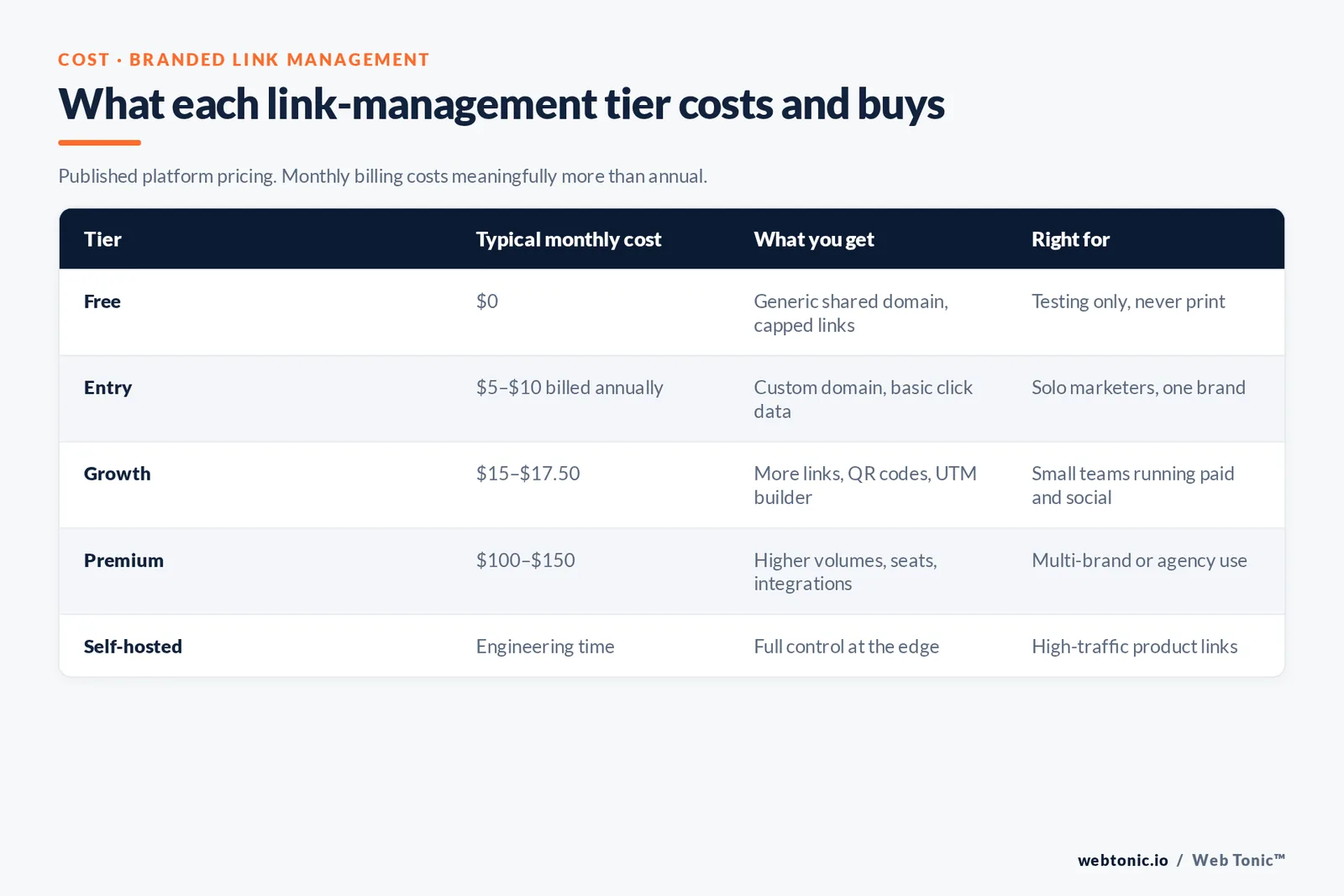
Two separate line items: the domain, and the software that manages links on it. Domain renewals for short extensions typically run higher than commodity registrations, and premium short domains are resold well above registry price. Link-management pricing is public and tiered.
| Tier | Typical monthly cost | What you get | Right for |
|---|---|---|---|
| Free | $0 | Generic shared domain, capped links | Testing only, never print |
| Entry | $5–$10 billed annually | Custom domain, basic click data | Solo marketers, one brand |
| Growth | $15–$17.50 | More links, QR codes, UTM builder | Small teams running paid + social |
| Premium | $100–$150 | Higher volumes, seats, integrations | Multi-brand or agency use |
| Self-hosted | Engineering time | Full control at the edge | High-traffic product links |
Published branded-link platform pricing confirms the shape of that ladder: $0 for a capped free tier, $5 per month billed annually at entry, $15 per month at the mid tier, and $100 per month at the top published tier — with monthly billing costing meaningfully more than annual. Self-hosting removes the licence but adds uptime responsibility: a redirect layer that goes down takes every printed asset with it.
Vanity URLs and search visibility
The honest answer: a vanity URL does not rank. It redirects. The ranking asset is the destination page, and the vanity address is a distribution wrapper around it. That is why the SEO question is really a plumbing question — does the redirect preserve signals, and does it stay one hop deep?
Context matters here. Search remains overwhelmingly concentrated: Statcounter's July 2026 data puts Google at 91.31% worldwide, with Bing at 4.47% and every other engine under 1.3%. Browser share is similarly concentrated, with Chrome at 68.22%. Practically, that means one crawler's redirect handling determines almost all of your organic risk — and it also means the traffic vanity URLs unlock is mostly the traffic search cannot reach: a stage mention, a printed pack, a Slack message, a voice note.
| Use case | Link shape that works | Where the click starts | Success metric |
|---|---|---|---|
| Podcast or radio read | brand.com/showname | Spoken word | Direct sessions in the 30 minutes after air |
| Conference talk | brnd.co/talk | Final slide | Clicks per attendee count |
| Packaging or QR | brnd.co/setup | Camera scan | Scan-to-activation rate |
| Social bio | brnd.co/now | Profile tap | Click-through on profile visits |
| Sales outreach | brand.com/company-name | Email or DM | Open-to-click on personalised links |
| Paid media | Destination URL, no shortener | Ad click | Tracking parity with the platform |
That last row is a hard rule: paid platforms want the real destination so their own tracking templates can append parameters. Shortening a paid link is how conversion data goes missing. For bio-link strategy specifically, Buffer's link-in-bio guidance covers the trade-off between a single vanity link and a routing page.
How to read your link data without fooling yourself
Click counts on a vanity URL are seductive and easy to misread. Four traps recur:
Trap 1 — bots inflate clicks. Preview crawlers in chat apps fetch links; unfiltered click totals can overstate humans by a wide margin on messaging channels. Trap 2 — clicks are not sessions. A click that bounces before the page loads never appears in analytics, so the two numbers will never reconcile exactly. Trap 3 — one slug, many placements. If the same link goes in a newsletter, a tweet and a slide, the report tells you nothing. Trap 4 — vanity metrics on vanity URLs. The number that matters is downstream conversion, not raw clicks.
The fix is a naming convention applied before launch: channel, campaign, asset, date. Two links per campaign is not overhead — it is the difference between attribution and guesswork. Teams that treat link hygiene as part of measurement infrastructure rather than a social-media chore get clean reports by default.
Vanity URL best practices checklist
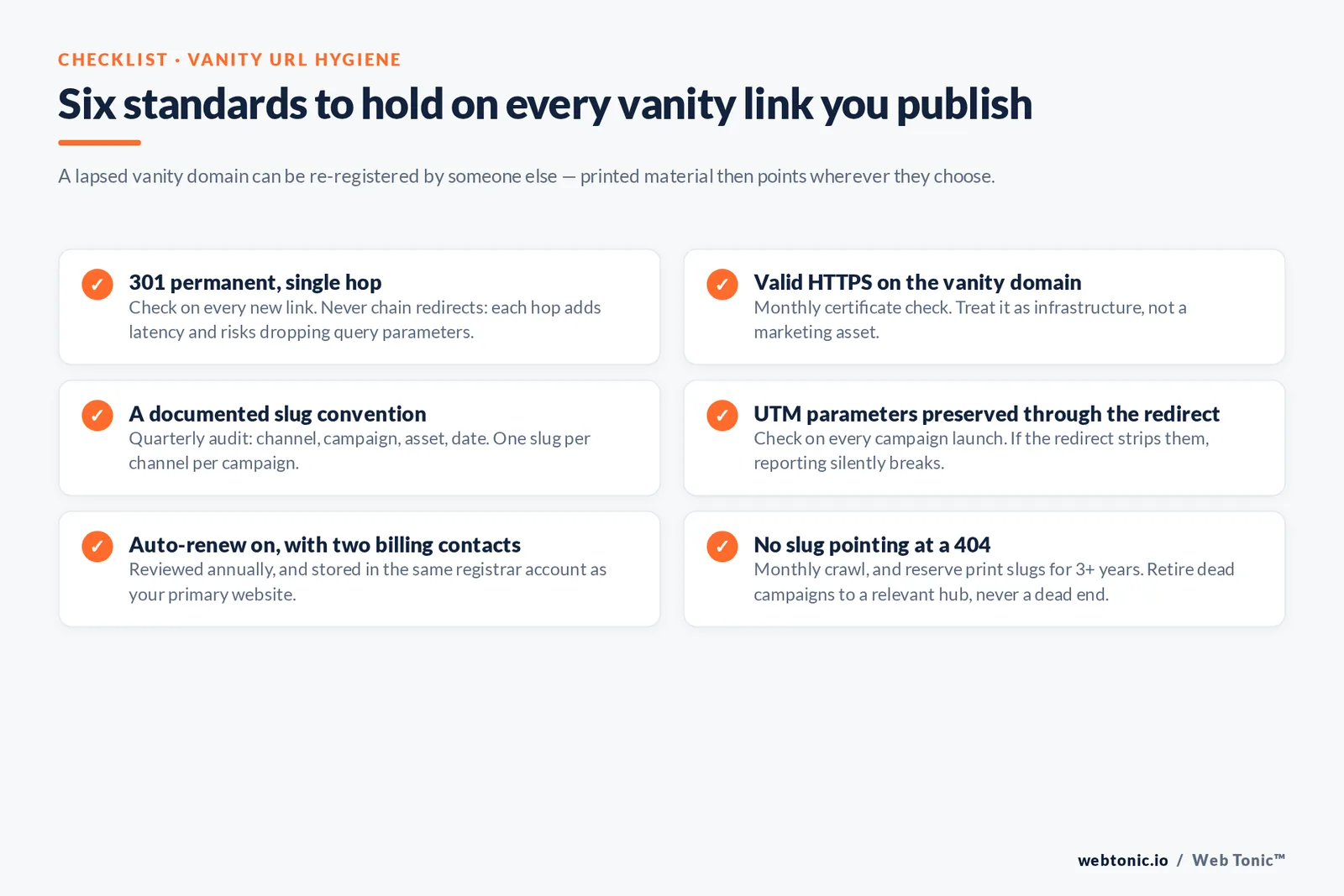
| Area | Standard to hold | Frequency of review |
|---|---|---|
| Redirect type | 301 permanent, single hop | On every new link |
| Security | Valid HTTPS on the vanity domain | Monthly certificate check |
| Naming | Documented slug convention | Quarterly audit |
| Ownership | Named owner per domain and platform seat | Quarterly |
| Renewals | Auto-renew on, with 2 billing contacts | Annually |
| Dead links | No slug points at a 404 | Monthly crawl |
| Parameters | UTMs preserved through the redirect | On every campaign launch |
| Print assets | Slug reserved for 3+ years | Before each print run |
The renewal row causes the most damage in practice. A lapsed vanity domain does not just break links — it can be re-registered by someone else, at which point printed material points wherever the new owner chooses. Treat short domains with the same care as a trademark asset, and keep them inside the same registrar account as your primary website infrastructure.
Common mistakes we see
Mistake 1 — building the vanity URL as a real page. Two live pages competing for the same intent creates a duplication problem where a redirect would have created none. Mistake 2 — using a generic shortener in print. Zero brand recognition, and the asset dies with the vendor. Mistake 3 — mixed-case slugs. Paths are case-sensitive on most servers; a capital letter on a poster generates 404s. Mistake 4 — nobody owns the list. Once a redirect table passes 200 rules with no owner, nobody dares delete anything. Mistake 5 — shortening paid links, which breaks platform tracking. Mistake 6 — no fallback. Every vanity URL should resolve to something useful even after the campaign ends; retiring it to a relevant hub beats a dead end.
If you are choosing between a redirect layer and new landing pages, the decision is usually about who maintains it. A team with an in-house developer can run edge redirects cheaply; a marketing team without engineering support is better served by a managed platform and a documented convention. Either way, the link is part of the campaign design, not an afterthought — which is how we treat it inside growth campaigns, and why link structure shows up in the first week of any engagement scope.
FAQ
Is a vanity URL the same as a short link?
Not quite. Every branded short link is a vanity URL, but a vanity URL can also be a readable path on your main domain, such as brand.com/pricing, with no shortener involved at all.
Do vanity URLs help SEO?
Indirectly. The redirect itself does not rank, but a 301 passes signals to the destination page, and readable word-based paths align with Google's URL structure guidance. The bigger gain is off-search traffic that would otherwise never arrive.
How do I create a vanity URL?
Pick the route first: a 301 rule in your CMS for paths on your main domain, or a short domain registered at a registrar and pointed by CNAME at a link-management platform. Then set HTTPS, define the slug convention, and confirm UTM parameters survive the redirect.
Can I change where a vanity URL points?
Yes, and that is one of its main advantages. Because the address is a redirect, you can repoint printed QR codes and packaging links to a new destination without reprinting anything.
What happens if the vanity domain expires?
Every link on it breaks, and the domain can be bought by someone else. Keep auto-renew enabled, list two billing contacts, and store short domains in the same registrar account as your primary domain.
Sources
Statcounter Global Stats, search engine and browser market share, July 2026 · Google Search Central documentation on 301 redirects and URL structure · Google Analytics campaign URL parameter reference · Google Ads tracking template documentation · IANA root zone database · ICANN TLD overview · W3C, "Cool URIs don't change" · Moz SEO Learning Center, URL · Bitly published pricing and branded-links guidance · Rebrandly branded-links guidance · Buffer link-in-bio resource · Wikipedia, URL shortening.