



Table of contents
Key Takeaways
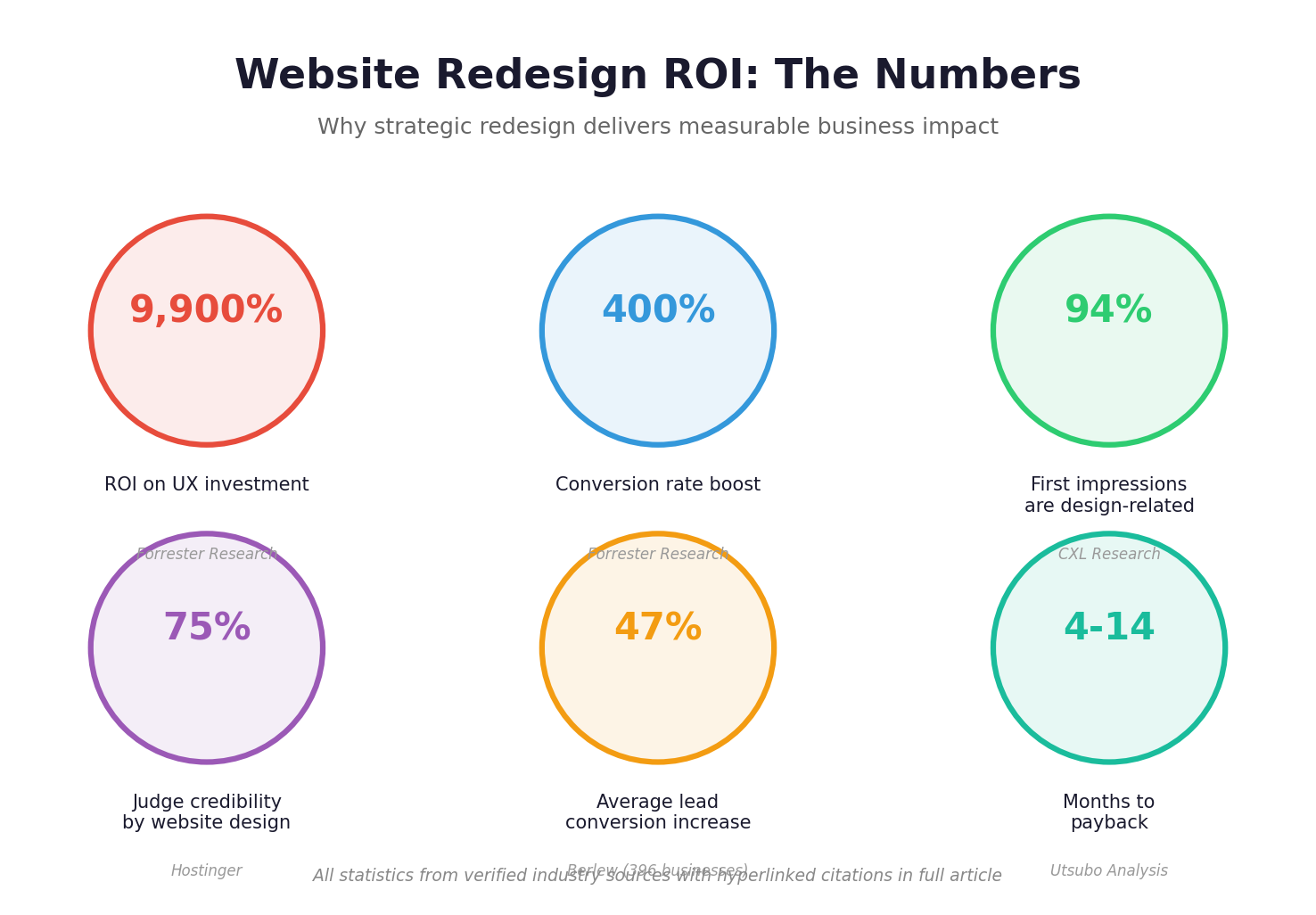
- Website redesign delivers measurable business impact when approached strategically, with Forrester research indicating potential ROI of 9,900% and conversion rate improvements up to 400% from UX-focused investments.
- Agency selection should prioritize strategic approach, relevant portfolio experience, SEO migration competency, and post-launch support capabilities over cost alone, as cheaper options frequently result in higher total cost of ownership.
- Performance indicators including conversion rates, bounce rates, Core Web Vitals, and mobile experience quality should trigger redesign decisions rather than arbitrary two-to-three-year timelines.
- Mobile-first design is essential for long-term success given user behaviour patterns and search engine prioritization, making mobile experience quality a primary evaluation criterion for agency selection.
- For organizations facing complex redesign requirements with significant business impact, partnering with specialized website redesign services can ensure strategic alignment, technical execution, and measurable results that justify the investment.
What are website redesign services?
Website redesign services cover the full process of updating, restructuring, and modernizing an existing website to improve its visual appearance, functionality, user experience, and business performance. Professional website renovation goes beyond cosmetic updates. It involves analyzing current website performance, user behaviour patterns, conversion pathways, and competitive positioning to create a strong online presence that actually drives business results.
Forrester research found that every dollar invested in enhanced user experience design yields approximately $100 in return (a 9,900% ROI). That same research shows improved UX design can boost conversion rates by up to 400% for businesses that prioritize user-centred redesign approaches.
For mid-market and enterprise companies, website redesign services go beyond new colours and fonts. Modern web design agencies handle technical infrastructure, content management system migrations, SEO preservation, mobile responsiveness, accessibility compliance, and integration with marketing technology stacks. The data backs this up: 94% of first impressions are design-related, and 75% of potential customers judge a company's credibility based on its website design alone.
Evaluating website refresh agencies: what to look for
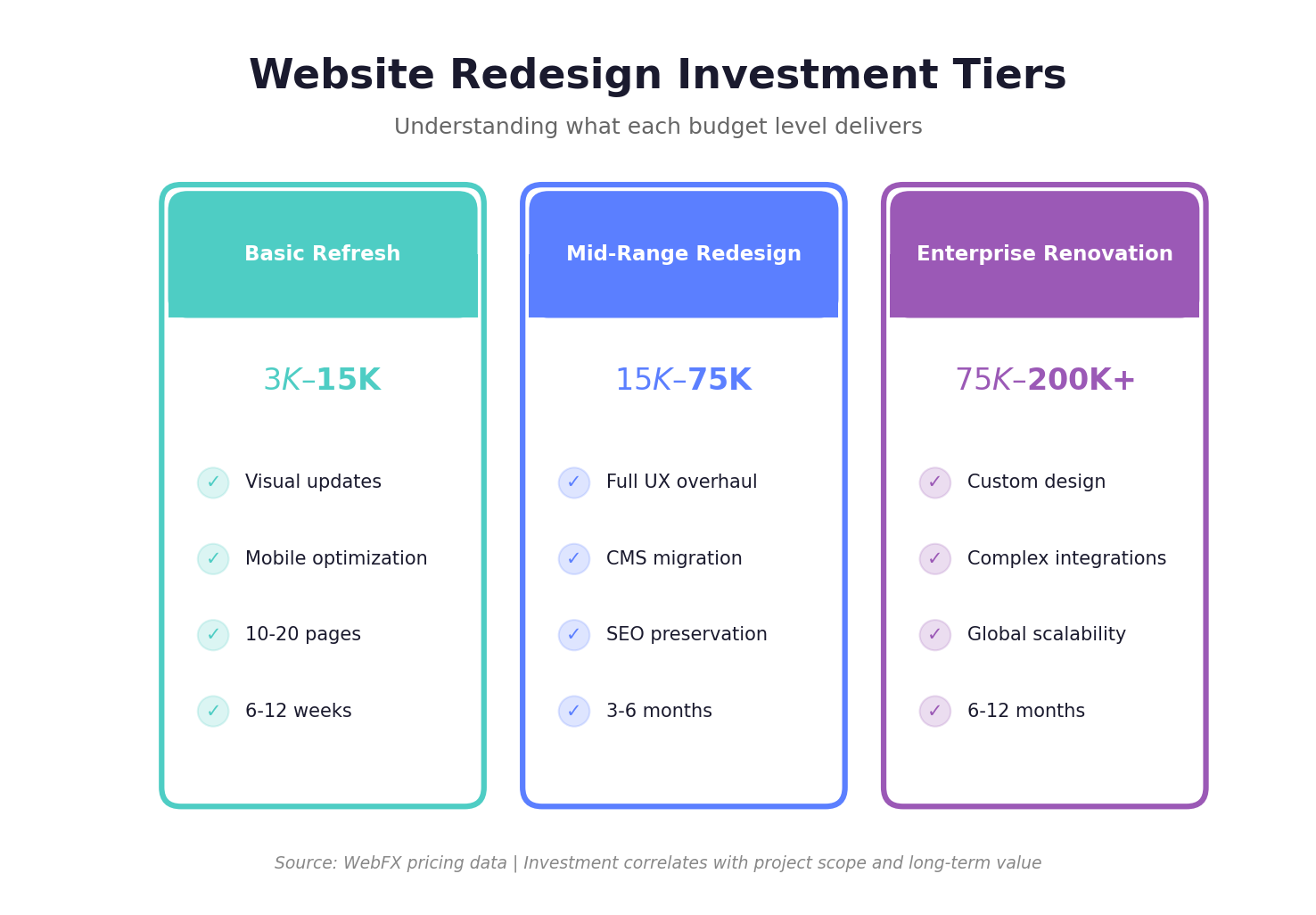
Selecting the right web redesign company means weighing several factors. The agency landscape ranges from boutique specialists to full-service partners, with costs varying from $3,000 for basic refreshes to $75,000 or more for enterprise-level website renovation projects.
Key evaluation criteria for site makeover services
| Criteria | What to Assess | Why It Matters |
|---|---|---|
| Strategic Approach | Discovery process, UX research methodology, conversion optimization focus | A redesign built on strategy delivers measurable ROI; purely aesthetic overhauls often fail to improve performance |
| Technical Capabilities | Platform expertise, web development experience, accessibility compliance | Technical execution determines whether the new website functions reliably and scales with business growth |
| SEO Migration Experience | Redirect strategy, content preservation, search engine rankings monitoring | Poor SEO migration can erase years of organic search progress overnight |
| Portfolio Relevance | Industry experience, project complexity, documented results | Past success with similar projects indicates capability to deliver on your specific requirements |
| Ongoing Support | Maintenance SLAs, optimization services, training programs | Website performance requires regular updates; launch is the beginning, not the end |
Budget considerations
Understanding realistic investment levels helps companies plan appropriately and avoid scope mismatches.
Basic Website Refresh ($3,000–$15,000): Visual updates, mobile devices optimization, minor functionality enhancements for sites with 10–20 pages.
Mid-Range Business Redesign ($15,000–$75,000): Full UX overhaul, content management restructuring, CMS migration, integration work for mid-sized businesses.
Enterprise Website Renovation ($75,000–$200,000+): Custom website design, complex integrations, multi-stakeholder governance, SSL certificates, accessibility compliance, and global scalability requirements.
Top 10 website redesign agencies for 2026
1. Clay
Clay builds premium web experiences for global brands out of San Francisco. They blend strategy, custom design, and engineering to help companies communicate complex ideas with clarity. Scalable systems, strong storytelling, and platforms built for long-term growth are their wheelhouse.
Their client list includes Meta, Google, Slack, Coinbase, Amazon, and Toyota. Webby Award recognition confirms their creative and technical expertise. Premium pricing puts them out of reach for budget-conscious buyers, though, and they're probably overqualified for simpler projects.
Works well for enterprise brands that need sophisticated web presence balancing creative ambition with measurable business goals.
2. WebFX
WebFX pairs ROI-driven professional web design with digital marketing integration. They combine website design services with search engine optimization, PPC, and social media marketing capabilities. Their transparent performance reporting appeals to teams that want clear accountability for search engine results.
The full-service approach works well for companies seeking an all-in-one partner. Some clients find the process more systematized than boutique alternatives, and you may end up paying for capabilities you don't need.
Good fit for mid-market companies prioritizing measurable growth who want a partner connecting website performance to revenue outcomes.
3. Digital Silk
Digital Silk delivers custom website design with the brand's identity integration at the core. They've earned recognition in Forbes and DesignRush for award-winning graphic design and digital innovation. Leadership experience includes work with Sony, Microsoft, and NASA.
Custom focus means longer timelines than template-based alternatives. Premium positioning may also exceed small businesses budgets. But for firms that need strong brand expression through their online presence, they deliver.
Strong match for businesses seeking sophisticated visual design that reinforces brand identity.
4. FINE
FINE has earned multiple WebAwards for professional website design excellence. Brand-led storytelling, elevated design, and intuitive web experiences define their approach. They work best when emotional connection drives customer engagement.
The narrative-focused methodology won't suit purely transactional business models. And the creative-forward positioning requires alignment on brand vision from the start.
Ideal for brands where storytelling and emotional connection help convert potential customers into loyal customers.
5. Goodface Agency
Goodface specializes in brand and digital transformation for financial services and fintech. Their work with Magnetiq Bank earned a Red Dot Award for Brands and Communication Design in 2025. Deep experience with complex stakeholder environments and design systems built for long-term scalability set them apart.
Specialized focus may limit relevance for some industries. European bases may present timezone considerations for North American clients.
Best suited for financial services, fintech, and other regulated industries requiring sophisticated design processes with compliance awareness.
6. eDesign Interactive
eDesign Interactive has operated for over 20 years, building business websites and campaigns that help brands engage their target audience and strengthen their online presence. They've earned Webby, W3, Davey, and CSS Design Awards along the way.
Two decades of continuous operation demonstrates stability. The established approach may feel less cutting-edge than newer digital agencies, though, and the full-service model includes capabilities not every client needs.
Works for teams seeking experienced partners with proven longevity and multi-discipline capabilities.
7. IT Monks
IT Monks delivers enterprise-grade WordPress solutions built for site speed, scalability, and long-term maintainability. Sixteen years of experience means deep technical expertise in custom builds, content management system migrations, and search engine optimization-driven web development. They also offer white-label services for agencies.
WordPress focus limits applicability for other platform requirements. Technical emphasis may feel less design-forward than creative agencies.
Good choice for firms committed to WordPress seeking enterprise-level execution and ongoing support.
8. Rounded Digital
Rounded Digital combines web design services with advanced SEO for small businesses and mid-sized companies. Data-driven approach, documented performance improvements, integrated SEO expertise that helps prevent common redesigned website ranking losses.
Scale may limit capacity for very large enterprise projects. Smaller team also means potential resource constraints during high demand periods.
Fits small businesses seeking affordable excellence with clear performance accountability.
9. Blue Fountain Media
Blue Fountain Media brings creative storytelling together with digital analytics. Their portfolio shows consistent delivery of improved engagement metrics, and they excel at creating distinctive web identities that give clients a competitive edge.
Creative-forward approach requires alignment on vision. May not suit highly regulated industries prioritizing compliance over creativity.
Right for startups and established brands seeking distinctive web identities that don't blend into the crowd.
10. Trajectory Web Design
Trajectory focuses specifically on B2B website redesign with emphasis on building compelling business cases and demonstrating ROI. Detailed frameworks for justifying redesign investments to stakeholders make this professional web designer team stand out in the digital landscape.
B2B focus limits relevance for consumer-facing projects. Specialized positioning narrows the service range.
Makes sense for B2B teams requiring sophisticated stakeholder management and clear business case development.
Common misconceptions about website redesign
Misconception 1: A redesign every two to three years is mandatory
The commonly cited two-to-three-year redesign cycle has become accepted wisdom. But evidence doesn't support arbitrary timelines. Per industry analysis from Huemor, the average lifespan of a business website is about 2 years and 4 months, but this varies wildly by industry. Design agencies typically redesign every 1 year and 8 months, while construction companies wait around 5 years and 5 months between redesigns.
The real trigger should be performance-based, not calendar-based. Declining conversion rates, elevated bounce rates, poor Core Web Vitals scores, outdated technology creating security vulnerabilities, or significant shifts in business goals—these justify redesign investment. Companies following arbitrary schedules often waste resources on unnecessary projects while those ignoring performance signals let problems compound.
Misconception 2: Redesigns primarily improve visual appearance
Aesthetics matter for first impressions and user trust. But research shows that the majority of redesign ROI comes from eliminating friction points and improving user experience fundamentals rather than visual updates. KrishaWeb research found that 73% of redesign ROI derives from addressing sluggish site speed and confusing navigation rather than aesthetic improvements.
Effective website renovation prioritizes conversion pathway optimization, mobile devices experience refinement, page speed improvements, and content architecture restructuring. Visual design updates support these functional improvements but rarely drive meaningful business results on their own.
Misconception 3: Cheaper options deliver comparable results
The wide range of website redesign costs reflects genuine differences in depth, technical execution, and long-term value. Budget redesigns frequently result in sites requiring replacement within two years, while investments in quality professional website design deliver value for five years or longer.
Companies sometimes achieve short-term savings through budget options only to discover search engine rankings collapsed due to poor migration. Or technical debt accumulated requiring expensive remediation. Or conversion rates declined due to inadequate UX research. The calculation should consider total cost of ownership and business impact, not initial investment alone.
Why mobile-first design determines long-term success
Mobile-dominant web usage has fundamentally changed redesign requirements. Google research cited by Trajectory Web Design shows 61% of users won't return to a mobile site if they had difficulties accessing it previously. And 40% will abandon to a competitor site instead. These behavioural patterns make mobile devices experience quality a primary driver of business outcomes.
Google's mobile-first indexing means mobile site quality directly impacts search engine results for all devices. Businesses ignoring mobile optimization during redesign risk both immediate user abandonment and long-term organic traffic decline.
Modern website design services address mobile requirements through responsive design, progressive web app capabilities, accelerated mobile pages, and extensive cross-device testing. Investment in mobile optimization typically delivers rapid returns through improved engagement metrics and better search engine rankings.
The hidden cost of delayed website renovation
Companies often postpone website redesign, prioritizing other investments while digital performance deteriorates gradually. The hidden costs accumulate across multiple dimensions that aren't immediately visible in financial reporting.
Credibility erosion occurs as competitors with modern sites capture market attention. Research confirms that potential customers judge business credibility based on website design. Outdated sites eliminate any competitive advantage you might have. The effect compounds as prospects increasingly compare options through digital research before engaging sales teams.
Conversion degradation accumulates over time as user expectations evolve faster than stagnant websites. Features considered innovative years ago become baseline expectations, then absent features become friction points. Conversion rates decline incrementally (almost invisibly), masking the total impact until comparison against redesigned competitors reveals the gap.
Technical debt increases maintenance costs and limits capability expansion. Older platforms require progressively more effort to update, patch, and secure while supporting fewer modern integrations. Eventually, minor updates become major projects. New feature requests become impossible without fundamental architecture changes.
Per Utsubo's industry analysis, redesigns typically deliver payback within 4 to 14 months, with focused projects recovering investment even faster.
Real-world examples and case studies
Plum Diamonds
Plum Diamonds focused their new website optimization on enhanced user experience improvements and conversion pathway refinement. Orbit Media documented the results: organic search engagement more than doubled and sales increased by 700% following the optimization project.
Majestic Wine
Majestic Wine, a UK-based wine retailer, wanted to improve submissions on their inquiry form. VWO's case study details how the project began with customer research (feedback from in-store staff and support teams revealed that the current website category pages failed to provide the details their target audience sought). After redesign, form field clicks improved by 101.68%.
Music and Arts
Music and Arts operates 150+ retail stores and 300+ affiliate locations. They had substantial eCommerce usability problems with their current website. Toptal's B2B UX case study compilation covers how their web development team focused on eliminating friction points in the purchase pathway. Conversion improvements followed.
Frequently asked questions
How long does a typical website redesign take?
Timeline varies significantly based on project scope and complexity. Basic website refreshes typically require 6 to 12 weeks. Mid-sized business redesigns span 3 to 6 months. Enterprise-level website renovation projects with complex integrations, multiple stakeholders, and extensive content management migration often require 6 to 12 months from discovery through launch.
Rushing timelines typically compromises quality and increases post-launch remediation costs.
Will a website redesign hurt my search rankings?
It can, if migration isn't handled properly. But a competent web designer or design agency will mitigate this risk through redirect strategies, metadata preservation, content migration planning, and post-launch monitoring.
Industry research suggests proper SEO migration preserves up to 98% of search engine rankings when executed with careful redirect mapping and schema preservation. Neglected migration? That can cause significant organic traffic loss within months of launch.
How do I know when my website needs a redesign?
Performance indicators provide clearer guidance than arbitrary timelines. Redesign consideration is warranted when:
- Bounce rates exceed industry benchmarks significantly (research suggests redesign first when bounce rates exceed 62%)
- Conversion rates decline consistently
- Core Web Vitals scores hurt search engine results
- Mobile experience frustrates users on mobile devices
- Technical limitations prevent business-required functionality
- Visual design no longer reflects current brand's identity
What's the difference between a website refresh and a full redesign?
A website refresh involves surface-level updates: visual refinements, content updates, minor functionality improvements, and performance optimizations. It doesn't fundamentally change site architecture, platform, or information hierarchy.
A full redesign addresses structural elements. Platform migration. Content management system restructuring. Navigation overhaul. UX transformation. Refresh projects typically cost 20 to 40% of full redesign investment.
How can I measure the ROI of a website redesign?
Start by establishing baseline metrics before redesign begins. Define clear success criteria aligned with business goals. Implement measurement infrastructure to track performance changes.
Key metrics typically include conversion rate changes, lead generation volume and quality, organic traffic performance, engagement indicators like time on site and pages per session, and revenue attribution where applicable. The basic formula: net gain from redesign divided by total redesign cost.
A study of 396 businesses found websites saw an average 47% increase in lead conversion rates after redesigns.


