



Table of contents

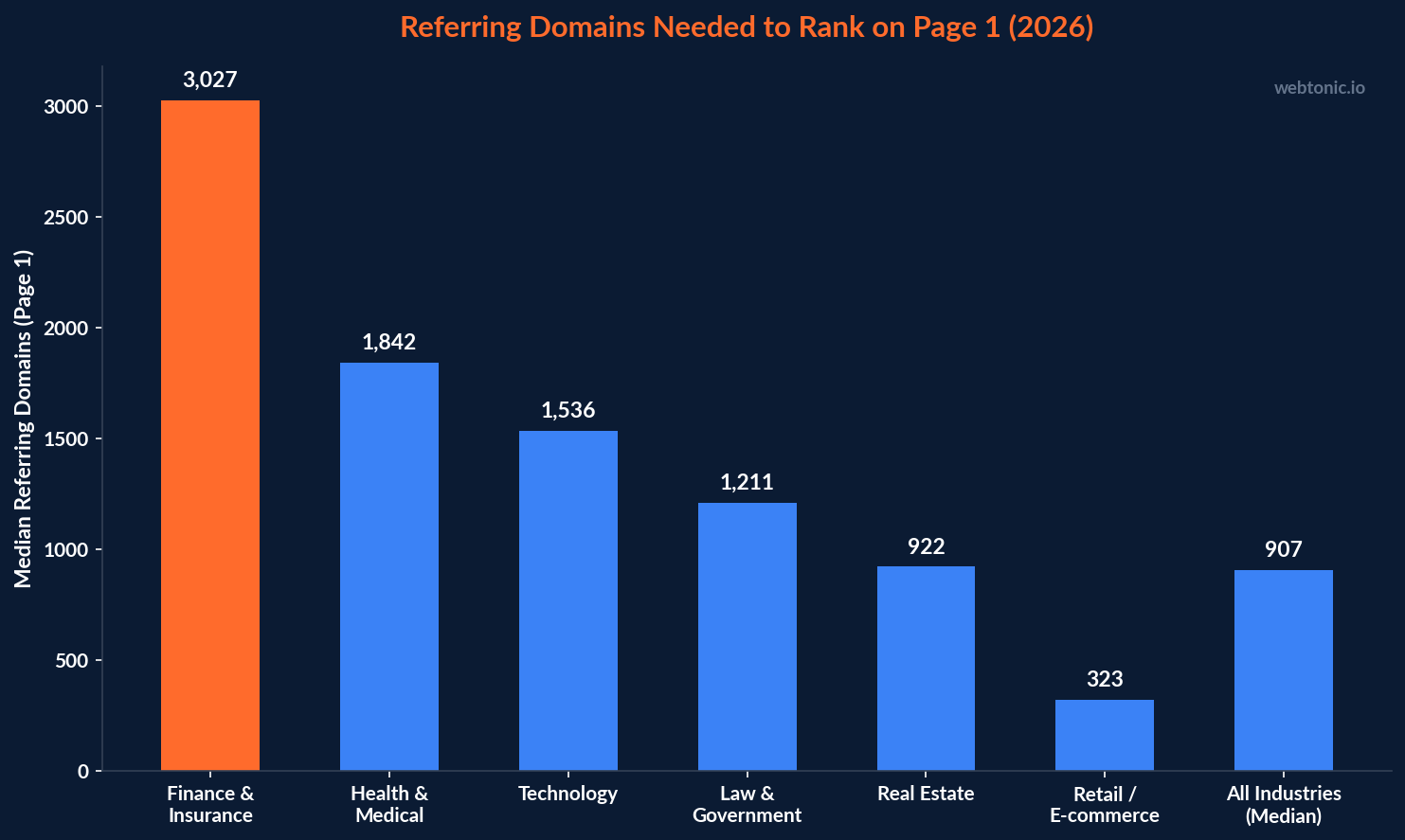
Finance and insurance websites need a median of 3,027 referring domains to reach page one of Google — the highest of any industry and more than 3× the all-industry median of 907. For wealth management firms competing for keywords that average $50–$100+ per click, a disciplined link-building program is one of the few levers that can reduce long-term client acquisition costs while compounding organic visibility year over year. Explore how growth marketing strategies integrate link building with broader acquisition channels.
Key Takeaways
- 96.6% of all published content earns zero external backlinks — wealth management firms must invest in linkable assets to beat the default (Ahrefs, 2026).
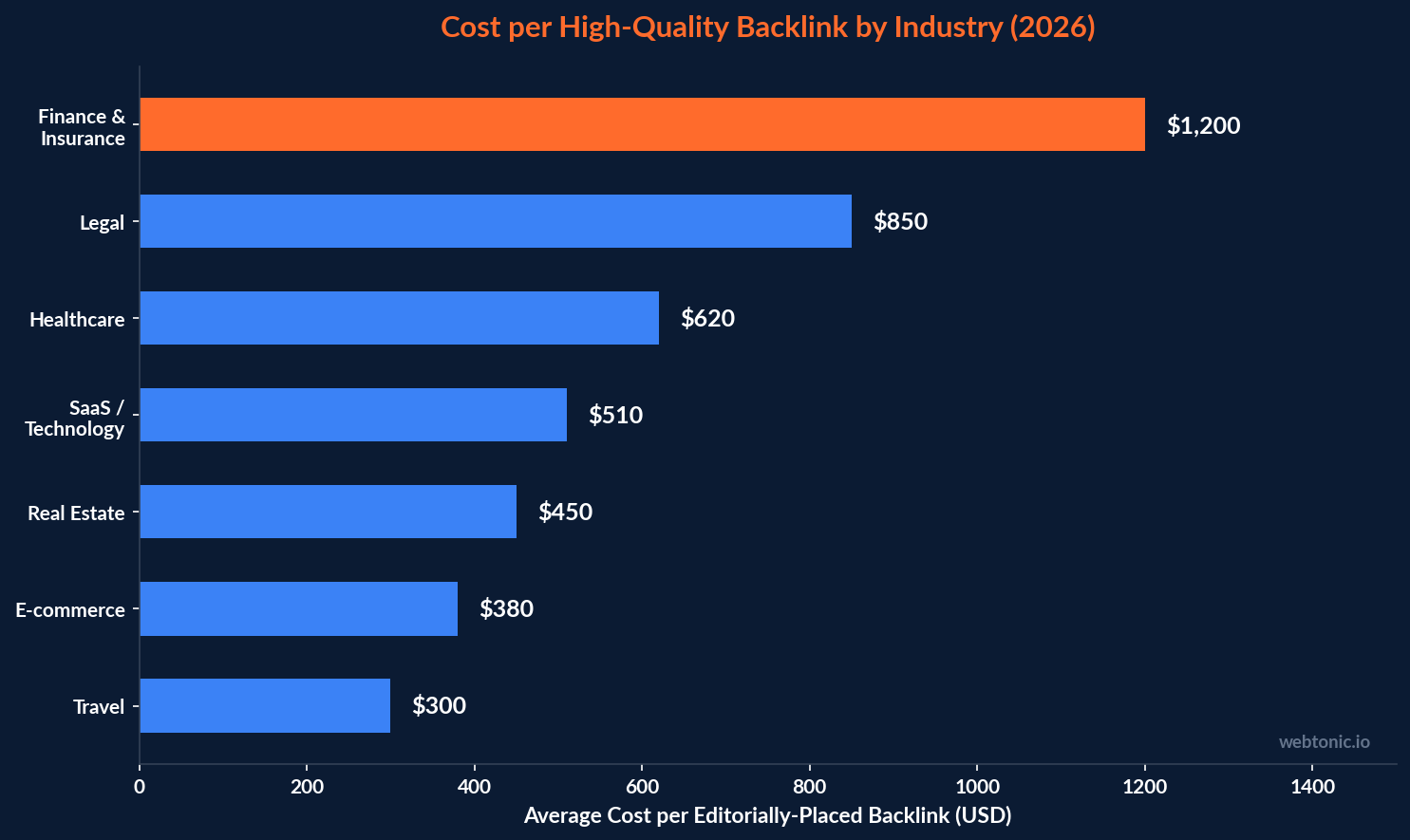
- Finance backlinks cost $1,200 on average for an editorially placed do-follow link — up from $850 in 2023 (uSERP, 2026).
- Pages with backlinks attract 3.8× more organic traffic than those without (Backlinko Ranking Factors Study).
- 91% of SEO professionals say link building is effective at improving rankings (Aira State of Link Building).
- The #1 Google result averages 3.8× more backlinks than positions #2–#10 (Backlinko, n = 11.8M SERPs).
- 65% of B2B firms — including financial services — rank guest blogging as their most effective link-building tactic (Sondhel Partners).
- Wealth management firms starting from DR 7–13 can reach DR 24+ within 6–12 months of structured link building (DYB Digital case study).
Wealth Management Link Building Benchmarks at a Glance
| Metric | Wealth Management / Finance | All-Industry Benchmark |
|---|---|---|
| Median referring domains (page 1) | 3,027 | 907 |
| Average cost per editorial link | $1,200 | $509 |
| Niche ranking difficulty | #2 hardest (after iGaming) | — |
| Average outreach response rate | 5–8% | 8.5% |
| Content that earns zero links | 96.6% | 96.6% |
| Guest post cost (finance niche) | $600–$1,500 | $300–$460 |
| Target backlinks (small-to-mid firm) | 50–150 quality links | Varies by vertical |
Why Link Building Is Critical for Wealth Management Firms
Wealth management operates in one of the toughest SEO environments. Google classifies financial advice as Your Money or Your Life (YMYL) content, which means the algorithm applies heightened scrutiny to expertise, authority, and trust signals — and backlinks remain the primary external trust signal.
According to Google's own internal documents revealed during the 2024 DOJ trial, links are confirmed as a core ranking signal. For wealth management specifically, the implications are clear:
- Keyword CPCs of $50–$100+ make organic ranking through link building a high-ROI alternative to perpetual ad spend (RankZ).
- Financial regulators create natural link barriers — YMYL scrutiny means low-quality link schemes carry heavier penalties, but compliant link building compounds over time.
- Competitor link velocity in finance averages 40–80 new referring domains per month for top-ranking firms, setting the pace you need to match or exceed (Authority Specialist).
Link Building Costs: Finance vs. Other Industries
The cost of acquiring a single high-quality backlink in the finance vertical far exceeds most other sectors. A 2026 uSERP State of Backlinks report puts the average finance editorial link at $1,200 — the same budget that buys 30 links in B2B SaaS only buys 8–10 in fintech or wealth management.
| Link Type | Finance Cost | Cross-Industry Average |
|---|---|---|
| Editorial / digital PR link | $1,200+ | $509 |
| Guest post placement | $600–$1,500 | $300–$460 |
| Resource page link | $200–$500 | $75–$250 |
| HARO / journalist outreach | $0–$200 (time cost) | $0–$150 |
| Niche directory / association | $0–$300 | $0–$100 |
Despite the higher cost, the ROI justifies the investment. One case analysis found that a single authoritative backlink in finance can generate $3,600–$7,200 in monthly gross profit through rankings improvement — a payback period measured in weeks, not years (Resourcera).
Referring Domains Required to Rank in Wealth Management
A 2026 WebFX study of 1,462 domains across 15 industries found that page-one websites in finance and insurance have a median of 3,027 referring domains — the highest of any sector analyzed. For comparison, real estate sits at 922, e-commerce at 323, and the all-industry median is just 907.
For small-to-medium wealth management firms, a target of 50–150 quality referring domains provides a solid foundation to begin ranking competitively in local and mid-size markets. Larger firms competing nationally need significantly more — leading RIA websites like wealthmanagement.com carry 16,740+ referring domains and a Domain Rating of 80 (Outreachz).
Anchor Text Distribution Best Practices for Financial Services
Anchor text optimization in wealth management requires particular care. Over-optimization with exact-match anchors triggers penalties faster in YMYL niches. Industry data shows the following preferred distribution:
| Anchor Type | Recommended Share | SEO Preference (2026 Survey) |
|---|---|---|
| Branded (firm name) | 30–40% | 20.5% prefer this type |
| Partial-match (topic + brand) | 25–35% | 41.7% prefer this type |
| Exact-match keyword | 10–15% | 25.1% prefer this type |
| Naked URL | 10–15% | — |
| Generic ("click here," "learn more") | 5–10% | — |
Pages with diverse anchor-text profiles perform better long-term, while exact-match anchor stuffing remains a penalty risk — a particularly dangerous outcome for YMYL financial content (QuickSEO).
Most Effective Link Building Tactics for Wealth Management
Not all link-building strategies work equally well in finance. The regulated nature of wealth management creates unique opportunities — and constraints — that shape which tactics deliver the best ROI.
- Digital PR and data-driven content — benchmark reports, financial calculators, and proprietary research earn editorial links naturally. One financial institution publishing annual savings benchmarks gave journalists a reason to reference their content year after year, compounding editorial authority (Link Building Journal).
- Guest posting on industry publications — 65% of B2B firms rank guest blogging as their most effective tactic. Guest posts on outlets like Investopedia drove 52% of referral traffic for wealth management firms (Gitnux).
- Professional directory listings — NAPFA, CFP Board "Let's Make a Plan," FPA, XY Planning Network, and FINRA BrokerCheck all provide high-authority backlinks. These are free and carry institutional trust signals.
- Local business and civic links — Chamber of Commerce memberships, local charity sponsorships, and community event co-hosting generate geo-relevant backlinks that boost both domain authority and local rankings.
- Compliance-safe journalist outreach — HARO, Qwoted, and Connectively let advisors respond to media queries as quoted experts, earning editorial backlinks from tier-1 publications at zero link cost.
Case Studies: Link Building ROI in Wealth Management
Real-world results demonstrate that structured link building delivers outsized returns for wealth management firms:
| Firm / Study | Starting Point | Results | Timeframe |
|---|---|---|---|
| AP Wealth Advisors | Low local visibility | $15M in qualified leads from organic search; #1 ranking for "Wealth Management Augusta" | 18 months |
| Bradford Financial Advisors | DR 7, 18 referring domains | 3× revenue; expanded keyword portfolio | 12 months |
| Loopex Digital client (WM firm) | Minimal local rankings | Top 10 for niche keywords; significant DR increase | 6–9 months |
| DYB Digital client (financial advisor) | DR 13 | DR 24; organic traffic 10× increase | 8 months |
| Uncommon Cents Investing | Minimal organic presence | 1,450% growth in organic traffic; meaningful lead increases | 32 months |
These case studies consistently show that firms starting from DR 7–18 can reach DR 24+ within 6–12 months of structured link acquisition, directly impacting keyword rankings and inbound lead volume (Advisor Rankings).
Content That Earns Backlinks in Wealth Management
Since 96.6% of all content earns zero backlinks, wealth management firms need to create deliberately linkable content. The most effective formats for attracting editorial links include:
- Original benchmark reports — proprietary survey data on HNW client preferences, retirement readiness scores, or fee comparisons give journalists and bloggers a reason to cite your firm.
- Financial calculators and interactive tools — retirement planners, tax-loss harvesting estimators, and estate-planning worksheets attract both backlinks and user engagement.
- Data visualizations and infographics — visual content is shared and linked to at higher rates; a single well-designed infographic on wealth inequality or market performance can generate dozens of editorial links.
- Expert commentary on market events — timely commentary on rate changes, regulatory updates, or market volatility earns media citations that compound into backlinks. Learn more about how paid and organic channels interact.
- Client education content — LinkedIn posts by advisors garner 3.2× more engagement from prospects than firm pages, amplifying link-earning potential. See our top Facebook Ads agencies for complementary paid social strategies (Cufinder).
YMYL Compliance and Link Building Risk Management
Wealth management sits squarely in Google's YMYL category, which makes link building both higher-stakes and higher-reward than in non-YMYL verticals. Key compliance considerations include:
- Links from regulated sources rank higher — a link from Charles Schwab's blog, the SEC, or a major wire house carries more weight than a link from a generic finance blog (Searchlab).
- PBN and link exchange schemes carry 2–3× the penalty risk in YMYL niches — Google's manual review teams prioritize financial content for link quality audits.
- SEC Marketing Rule 206(4)-1 governs testimonial use, which affects how advisors can solicit or display backlinks that feature client endorsements.
- E-E-A-T signals amplify link value — backlinks from pages with author bios, credentials (CFA, CFP, ChFC), and institutional affiliations transfer more authority than anonymous content.
Related reading
- Franchise Link Building Statistics: 2026 Backlink Benchmarks for Multi-Location SEO
- Health & Wellness Link Building Statistics & Benchmarks (2026)
- HVAC Link Building Statistics: ROI, Domain Authority & Case Studies (2026)
- Link Building Services services at Web Tonic
Frequently Asked Questions
How many backlinks does a wealth management firm need to rank on page one?
Page-one websites in finance and insurance have a median of 3,027 referring domains according to WebFX's 2026 study of 1,462 domains. However, small-to-medium wealth management firms can begin ranking in local and niche markets with 50–150 quality backlinks from relevant financial publications and authoritative business sites.
How much does a single backlink cost in the finance industry?
The average editorially placed, do-follow backlink in finance costs $1,200 in 2026 (uSERP State of Backlinks report), up from $850 in 2023. Guest post placements range from $600–$1,500, while resource-page links can be acquired for $200–$500. Free options like professional directory listings and journalist outreach exist but require significant time investment.
What is the best link building strategy for financial advisors?
Digital PR and data-driven content creation are the most effective approaches. Publishing original research and benchmark reports earns editorial backlinks from tier-1 publications. Guest posting on industry outlets like Investopedia, Kitces, and ThinkAdvisor is also highly effective — 65% of B2B firms rank it as their top tactic. Professional directory listings (NAPFA, CFP Board, XY Planning Network) provide free high-authority links.
How long does it take to see results from link building in wealth management?
Most wealth management firms begin seeing ranking improvements within 3–6 months of consistent link building. Case studies show firms moving from DR 7–13 to DR 24+ within 6–12 months, with corresponding increases in organic traffic and inbound leads. Full competitive positioning against established firms may take 18–32 months.
Does link building still work with AI search and Google SGE?
Yes. Google's own internal documents confirm links remain a core ranking signal. In AI search environments, brand mentions and editorial citations — both byproducts of link building — directly influence whether your firm appears in AI-generated overviews. Read our Google Ads strategy guide for the paid search complement to your organic link building program. Firms with strong backlink profiles are more frequently cited by AI search tools like ChatGPT, Perplexity, and Google AI Overviews.
Sources
Searchlab — Link Building Statistics 2026
Outreachz — Finance Backlinks: The Complete 2026 Strategy Guide
Link Building Journal — Link Building for Finance and Fintech Sites in 2026
Authority Specialist — Financial Advisor SEO: 2026 Benchmarks
Resourcera — Link Building Statistics 2026: Costs, ROI, and AI Trends
QuickSEO — Link Building Statistics 2026: 70+ Data Points
Gitnux — Marketing in the Wealth Management Industry Statistics 2026
Cufinder — Wealth Management Industry Marketing Benchmarks 2026
Advisor Rankings — Case Study: AP Wealth $15M in New Prospects
Sondhelm Partners — How Backlinks Power Lead Generation for Financial Firms


