



Table of contents
Key Takeaways
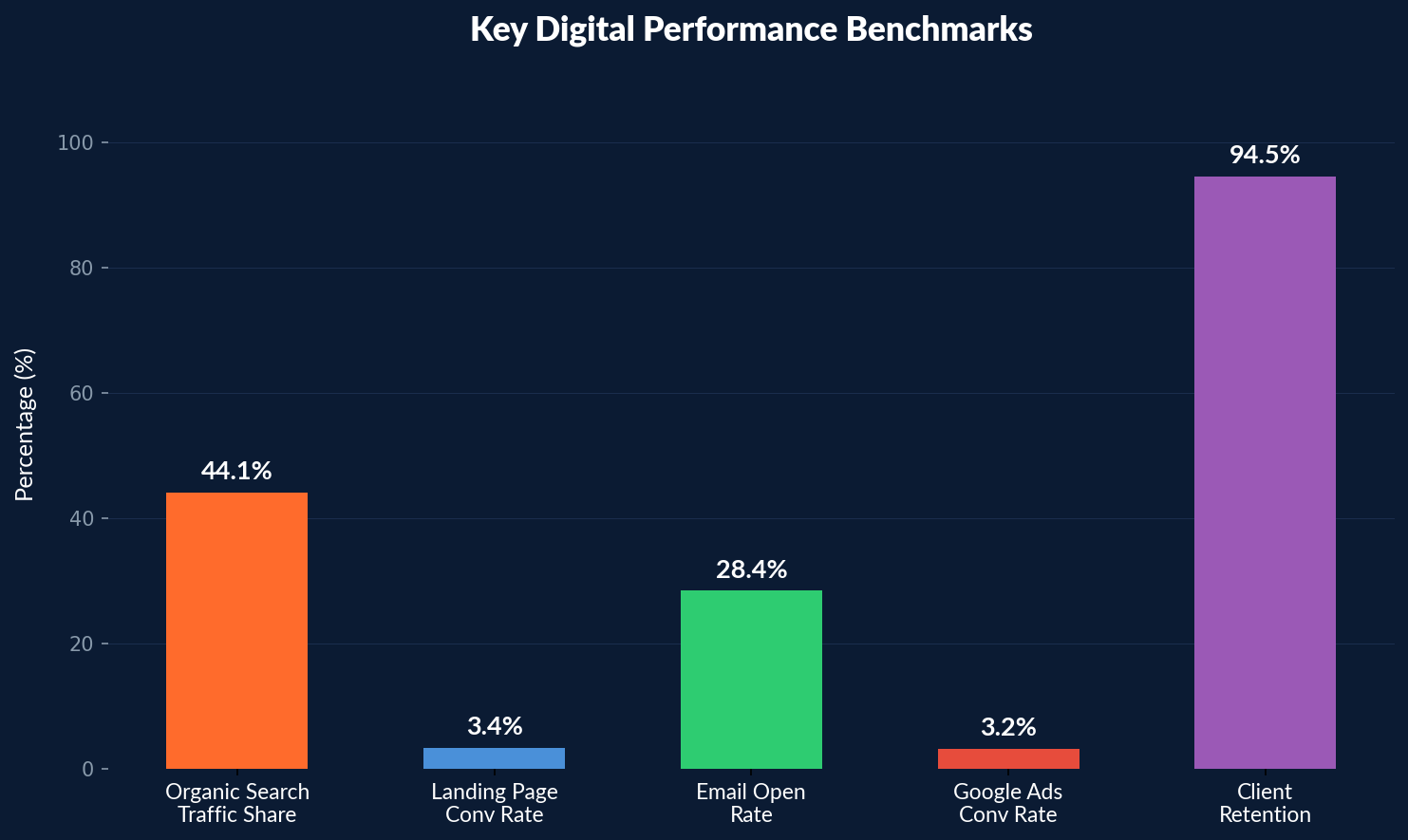
- Organic search drives 44.1% of all traffic to wealth management websites, making SEO the single largest acquisition channel for advisory firms.1
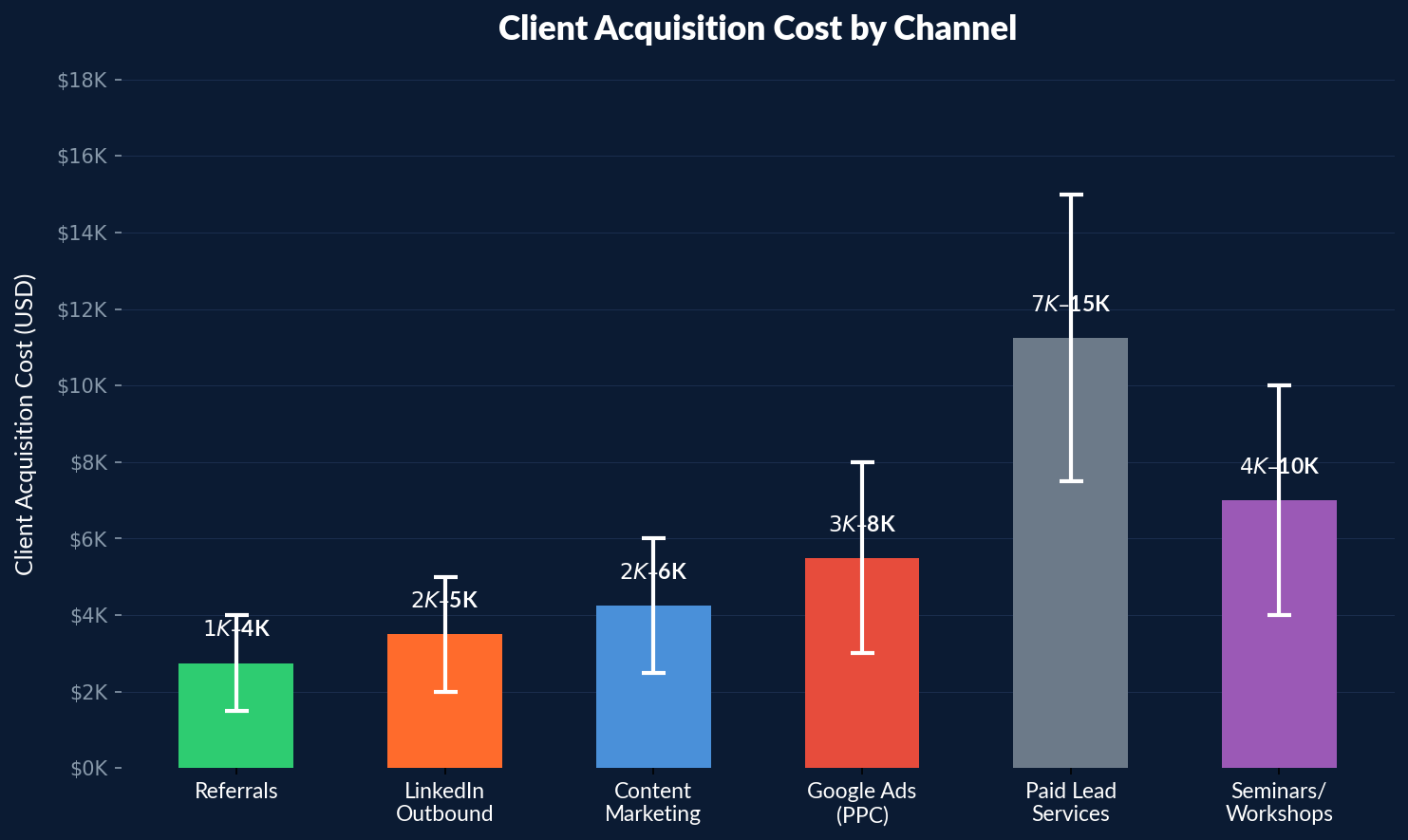
- Client acquisition cost for financial advisors ranges from $1,500 to $15,000 depending on channel, with referrals ($1,500–$4,000) being the most cost-efficient and paid lead services ($7,500–$15,000) the most expensive.2
- Google Ads CPC in the wealth management vertical averages $5.85, with high-intent keywords like "financial advisor near me" exceeding $20.1
- Client retention sits at 94.5%, proving that relationship marketing works and that the lifetime value of an acquired client far exceeds the initial acquisition cost.1
- Email open rates for advisory firms average 28.4%, well above the cross-industry benchmark of 21%, reflecting the high engagement of high-net-worth audiences.3
- Top-performing firms generate 2.4× more new assets than average firms, driven by 19% higher marketing spend and a digital-first acquisition strategy.4
Traffic Sources and Search Visibility Benchmarks
For wealth management firms and independent financial advisors, digital visibility has shifted from a differentiator to a necessity. High-net-worth individuals increasingly begin their advisory search online, comparing firms through organic search results, paid advertisements, and social media profiles before making contact. The data shows that firms investing in a comprehensive digital presence capture a disproportionate share of qualified prospects compared to those relying solely on referrals and traditional networking.
| Traffic Metric | Benchmark | Context |
|---|---|---|
| Organic search traffic share | 44.1% | Largest single traffic source for advisory websites globally |
| Mobile traffic share | 58.2% | Desktop converts 2× better (4.8% vs 2.1%) despite lower volume |
| Organic CTR for top-3 positions | 3.4–5.1% | Fee-only and fiduciary content outperforms generic financial pages |
| Average landing page conversion rate | 3.4% | Top performers achieve 6.5%+ with optimized forms and CTAs |
| Email open rate (advisory firms) | 28.4% | Significantly above cross-industry average of 21% |
| Client retention rate | 94.5% | Relationship-driven retention validates lifetime value calculations |
Sources: CuFinder Wealth Management Benchmarks 20261, Benchmarketing Wealth Management FS Benchmarks3, Authority Specialist Financial Advisor SEO 20265
Client Acquisition Cost and ROI by Channel
The economics of client acquisition in wealth management differ fundamentally from most industries because of the high lifetime value of each relationship. A single client with $500K in assets under management (AUM) at a 1% advisory fee generates $5,000 annually — and with the industry's 94.5% retention rate, that relationship often spans decades. This long-term value justifies higher upfront acquisition costs and makes digital marketing one of the most profitable investments an advisory firm can make.
| Acquisition Channel | Cost Per Client | Close Rate | Time to ROI |
|---|---|---|---|
| Referrals | $1,500–$4,000 | 25–40% | Immediate |
| LinkedIn outbound | $2,000–$5,000 | 15–35% | 6–12 months |
| Content marketing and SEO | $2,500–$6,000 | 10–20% | 12–24 months |
| Google Ads (PPC) | $3,000–$8,000 | 3–9% | 3–6 months |
| Paid lead services (SmartAsset, Zoe) | $7,500–$15,000 | 3–8% | 1–3 months |
| Seminars and workshops | $4,000–$10,000 | 10–20% | 3–6 months |
Sources: OJay Media Client Acquisition Cost 20262, OJay Media Marketing ROI 20266, OJay Media Advertising Guide7
Paid Search and Advertising Performance
Google Ads remains the primary paid acquisition channel for financial advisory firms seeking immediate pipeline visibility. The vertical commands premium click costs due to the high lifetime value of each client relationship, but the resulting 16×–62× ROAS on a $500K AUM client over 5 years makes paid search one of the most profitable advertising investments available to advisory firms.7
| PPC Metric | Wealth Management Avg | Notes |
|---|---|---|
| Google Ads CPC | $5.85 | High-intent keywords exceed $20; fiduciary terms run $15–$25 |
| Google Ads CTR | 2.64% | Above financial services average of 2.1% |
| Google Ads conversion rate | 3.2% | Landing page optimization can push this to 6.5%+ |
| Google Ads CPA | $284 | Cost per lead; cost per acquired client runs $3,000–$8,000 |
| Meta Ads CTR | 0.84% | Lower click intent but useful for awareness and retargeting |
| Meta Ads ROAS | 2.2× | Direct ROAS; true LTV-adjusted return is significantly higher |
Sources: CuFinder Benchmarks 20261, Benchmarketing3, BSPKN RIA Marketing Guide8
RIA firms running Google Ads campaigns with compliance-first creative — emphasizing fiduciary duty, fee transparency, and credential qualifiers — consistently outperform those using generic financial messaging. The click-to-inquiry conversion rate for compliant creative runs 3–9%, with a cost per qualified inquiry of $100–$400 depending on geographic targeting and keyword competition.8
Social Media and Content Marketing Performance
Among growth-focused advisory firms, social media has matured from an afterthought into a meaningful pipeline contributor. 54% of growth-focused advisors have landed a client directly through social media, and the advisors consistently getting results post an average of 35 times per month.9 Yet the average RIA still generates only about 6% of new business through digital channels, indicating massive untapped opportunity for firms willing to invest in content and community building.10
LinkedIn dominates the advisor social landscape, with engagement rates of 1.85% for wealth management content — the highest of any major platform in the financial services vertical.1 Advisors who combine educational content (market commentary, planning tips, regulatory updates) with personal storytelling see 3–4× higher engagement than those posting only corporate or product-focused material.
Content marketing offers the most compelling long-term economics for advisory firms. Publishing 2–4 high-quality articles per month on topics aligned with client concerns (retirement planning, tax optimization, estate strategies, ESG investing) builds organic search authority that compounds over time. The content cost per client acquired through this channel runs $2,500–$6,000, which is competitive with most paid channels and creates a durable asset that continues generating leads without ongoing spend.
Marketing Spend and Budget Allocation Trends
Top-performing wealth management firms — those generating 2.4× more new assets and 4.8× more assets from existing clients — invest 19% more in marketing than average firms.4 This correlation between marketing investment and growth holds across firm sizes, from solo practitioners to large RIA practices managing billions in assets.
The financial advisor advertising market has shifted decisively toward digital channels. Firms allocating 60–75% of their marketing budget to digital consistently outperform those maintaining traditional-heavy allocations. Within digital, the recommended allocation for most advisory firms follows a pattern of 35–40% to content and SEO, 25–30% to paid search advertising, 15–20% to social media, and 10–15% to email nurturing.
Fintech integration is reshaping how advisory firms approach digital marketing. The wealth management fintech market is projected to reach $5.75 billion in 2026, with 63% of firms adopting cloud-based solutions that integrate marketing automation with client relationship management.11 This convergence of marketing technology and advisory operations enables more precise targeting, better lead scoring, and ultimately lower client acquisition costs for firms that invest in the right technology stack.
High-Net-Worth Client Digital Behavior
Marketing to high-net-worth (HNW) individuals requires a distinct digital approach. These prospects are more likely to research advisors on desktop — which converts at 4.8% versus 2.1% on mobile1 — and they prioritize data-driven credibility signals such as published thought leadership, media appearances, and detailed methodology explanations over promotional messaging.
Email marketing to HNW audiences performs exceptionally well, with open rates hitting 36.5% among engaged subscribers1 — nearly double the cross-industry average. The key driver is relevance: advisory firms that segment their email lists by client tier, interest area, and lifecycle stage see significantly higher engagement than those sending undifferentiated newsletters. Combined with the industry's 94.5% client retention rate, these engagement metrics confirm that digital relationship nurturing directly supports the high-touch service model that wealthy clients expect.
Emerging Digital Trends for Advisory Firms
The Capgemini World Wealth Report 2026 highlights AI-powered wealth management as a transformative trend reshaping how advisory firms interact with clients and prospects.12 Firms integrating AI-driven content personalization, automated lead scoring, and predictive analytics into their digital marketing programs report 25–40% improvements in lead qualification accuracy and reduced time-to-close for new client relationships.
Short-form video content is gaining traction among advisors targeting younger high-net-worth individuals. Market commentary clips, quick planning tips, and client success stories distributed through LinkedIn and Instagram are generating 50–80% higher engagement rates than text-only posts. Compliance review processes for video content have also matured, with most broker-dealer compliance departments now offering streamlined pre-approval workflows for social media video.
Compliance Considerations in Advisory Digital Marketing
Financial advisory firms operating under SEC or FINRA oversight face unique compliance requirements that shape their digital strategy. Testimonial rules, performance advertising restrictions, and social media archiving requirements all influence the creative approaches available to wealth management marketers. Firms that build compliance review into their content production workflow — rather than treating it as an afterthought — produce more consistent output and avoid the regulatory delays that cause many advisory practices to abandon digital initiatives entirely. The most effective firms maintain a library of pre-approved creative templates, messaging frameworks, and disclosure language that enables rapid content production while maintaining full regulatory compliance across all channels.
Multi-Generational Wealth Transfer and Digital Implications
The ongoing great wealth transfer — estimated at $84 trillion shifting to younger generations over the next two decades — creates both urgency and opportunity for advisory firms to strengthen their digital presence. Inheritors are far more likely to change advisors than to stay with their parents' firm, and their advisor selection process is overwhelmingly digital-first. Firms that establish strong search visibility, thought leadership content, and an active social presence now position themselves to capture these transitioning relationships as the wealth transfer accelerates through the late 2020s and 2030s.
Related reading
- Veterinary Digital Marketing Statistics 2026: Budget, Channel & ROI Data
- SEO vs PPC: 2026 digital marketing data
- Digital Marketing Statistics Australia, by the Numbers (2026)
- Marketing Strategy Consulting services at Web Tonic
Frequently Asked Questions
What is the average client acquisition cost for financial advisors?
Client acquisition cost varies significantly by channel: referrals cost $1,500–$4,000, LinkedIn outbound runs $2,000–$5,000, Google Ads (PPC) costs $3,000–$8,000, and paid lead services like SmartAsset cost $7,500–$15,000 per acquired client. The wide range reflects differences in close rates — referrals close at 25–40% while paid leads close at just 3–8%.2
How much should a wealth management firm spend on digital marketing?
Top-performing firms invest 19% more in marketing than average firms and allocate 60–75% of total marketing budget to digital channels. For a mid-size RIA, this typically translates to $5,000–$15,000 per month across content, paid search, social media, and email, with the exact allocation depending on growth targets and current client acquisition costs.4,6
What digital marketing channels work best for financial advisors?
Organic search drives 44.1% of advisory website traffic and provides the most cost-efficient long-term acquisition channel. Google Ads delivers the fastest results with a $284 average CPA, while LinkedIn generates the strongest social media ROI with 1.85% engagement rates. The most effective firms combine all three channels: SEO for long-term pipeline, paid search for immediate leads, and LinkedIn for relationship building and thought leadership.1,3,5
What is the ROI of digital marketing for wealth management?
A single client with $500K AUM at a 1% advisory fee generates $5,000 annually. Given the industry's 94.5% retention rate, the lifetime value often exceeds $50,000–$100,000. This means even the most expensive digital acquisition channel — paid lead services at $7,500–$15,000 per client — delivers positive ROI within 2–3 years, while more efficient channels like content marketing and referrals can deliver 10–30× returns over a client relationship's lifetime.1,2,6


