Table of contents
Key Takeaways
- 75% of users never scroll past page one on Google, making backlinks a critical ranking signal for veterinary practices competing for visibility.
- Only 64.6% of veterinary websites use structured data (JSON-LD schema), leaving a significant competitive gap in search appearance.
- Organic search drives 51.2% of global veterinary website traffic, and link authority is one of the top three factors determining organic rankings.
- Practices in the Google Map Pack receive 2.1x more appointment requests than those ranking outside the top three local results.
- The average veterinary website scores 55/100 on PageSpeed, meaning technical SEO fixes often deliver faster ranking gains than content-only link building.
- Multi-location veterinary clinics with consistent citation profiles generate 2.7x more calls than those with NAP inconsistencies.
- Monthly SEO investment for veterinary practices ranges from $800 to $3,500, with link building typically consuming 30–40% of that budget.
Veterinary Link Building Benchmarks at a Glance
| Metric | Benchmark | Source |
|---|---|---|
| Organic Search Share (Global) | 51.2% | CUFinder, 2026 |
| Organic Search Share (U.S.) | 46.5% | CUFinder, 2026 |
| Vet Sites with Structured Data | 64.6% | Borah Labs, 2026 |
| Vet Sites with Canonical Tags | 70.9% | Borah Labs, 2026 |
| Vet Sites with Meta Descriptions | 71.3% | Borah Labs, 2026 |
| Average PageSpeed Score | 55/100 | Borah Labs, 2026 |
| Average LCP | 9.31s | Borah Labs, 2026 |
| Sites with SSL | 89.9% | Borah Labs, 2026 |
| Sites with No Sitemap | 35.1% | Borah Labs, 2026 |
| Map Pack Click Share | 42% | Backlinko, 2024 |
Why Link Building Matters for Veterinary Practices
Backlinks remain one of Google's most heavily weighted ranking signals. For veterinary practices competing in local search, link authority directly affects whether a clinic appears in the Map Pack or gets buried on page two where 75% of users never look. The connection between off-page authority and patient acquisition is not theoretical — practices with stronger backlink profiles consistently outperform competitors in organic visibility.
According to a 2026 audit of 34 veterinary practices by Authority Specialist, multi-location clinics capturing a top-three Google Maps position see 2.1x more new-client appointment requests than those ranking outside the local pack. Link building contributes to the "prominence" signal that Google uses alongside relevance and proximity to determine Map Pack rankings.
The veterinary industry sits in a unique position: organic search drives 51.2% of global veterinary website traffic (CUFinder, 2026), yet the majority of practices have thin backlink profiles. This creates an asymmetric opportunity — even modest link building efforts can move the needle significantly in less competitive local markets.
For practices investing in growth marketing, link building is one component of a broader off-page strategy that includes citation management, review acquisition, and local partnership signals.
Domain Authority and Backlink Profiles in the Veterinary Space
Domain authority varies dramatically across the veterinary industry. Corporate veterinary groups like VCA, Banfield, and BluePearl typically maintain domain ratings (DR) above 60, while independent single-location practices often operate with DR scores between 10 and 30. This gap has direct implications for keyword competitiveness and local visibility.
A 2025 Bubblegum Search benchmarking report on UK pet brands found that top-performing pet industry websites maintained referring domain counts 20–40% higher than their underperforming competitors. The study also noted that sub-DR 50 winners existed — brands winning on intent-match and schema rather than pure link authority — suggesting that link building alone is not the entire picture.
For independent veterinary practices, the realistic path to competitive authority involves:
- Building 15–30 quality referring domains from local organizations, veterinary associations, and pet-related publications
- Earning page-level authority through linkable content assets such as pet care guides, breed-specific health pages, and seasonal wellness content
- Maintaining consistent NAP citations across directories, which function as low-authority but high-trust link signals
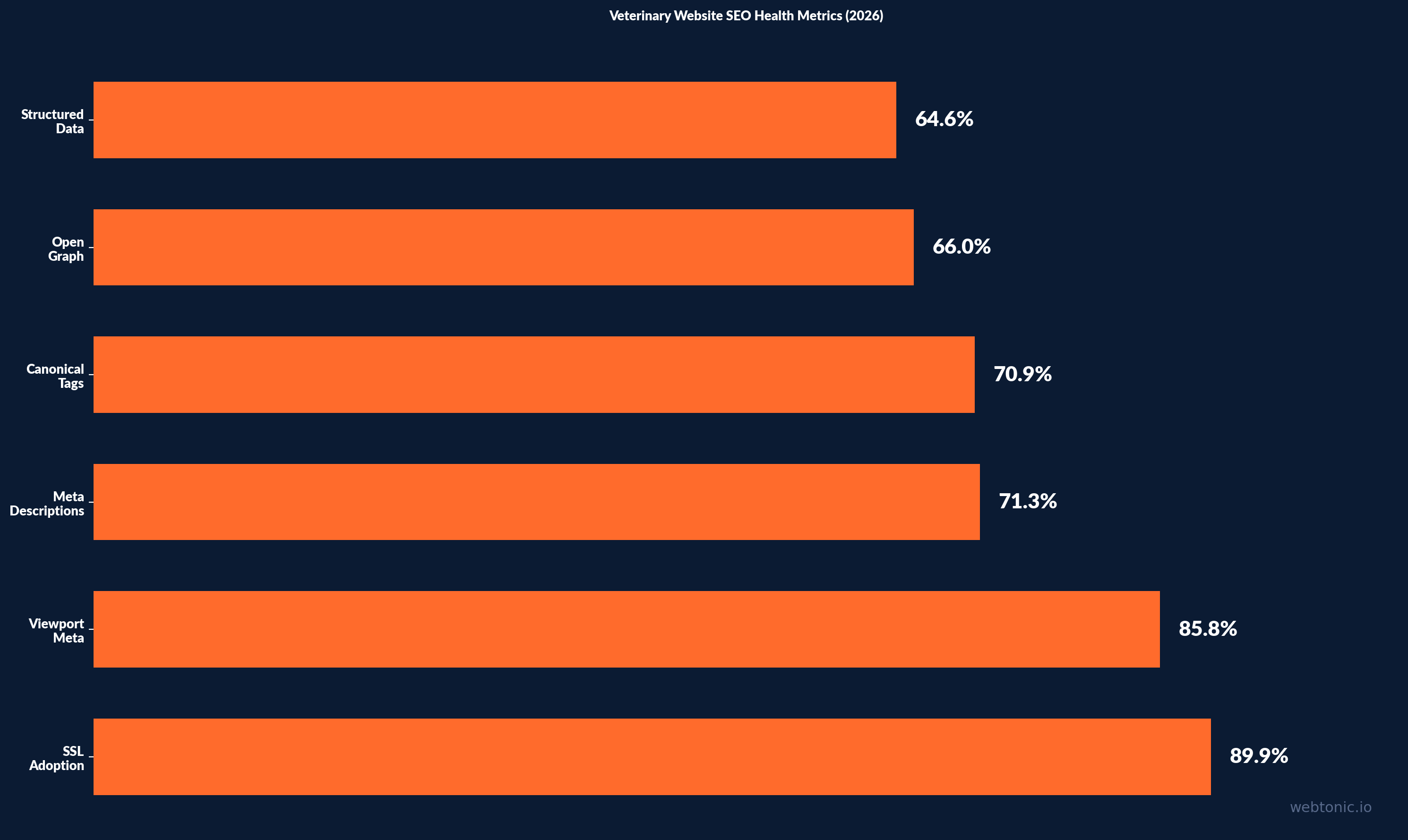
According to the Borah Labs 2026 veterinary website audit, only 64.6% of veterinary sites publish JSON-LD schema, and just 70.9% use canonical tags. These technical foundations amplify the value of every backlink by ensuring search engines can properly index and attribute authority.
Veterinary Link Building Performance by Strategy
| Link Building Strategy | Typical Results | Best For |
|---|---|---|
| Local Directory Citations | 30–50 citations in 2–3 months; 2.7x more calls with consistent NAP | All practices |
| Veterinary Association Links | DR 40–70 referring domains; high trust signals | AVMA/state-licensed practices |
| Local Community Partnerships | 5–15 local links per quarter; strong relevance signals | Community-focused clinics |
| Pet Care Content Marketing | 2–8 organic backlinks per published guide | Practices with blog resources |
| Local News & PR | DR 50–80 links; 1–3 per quarter typical | Emergency and specialty clinics |
| Shelter & Rescue Partnerships | 3–10 links with high local relevance | Practices offering rescue discounts |
| Guest Posts on Pet Blogs | $30 median cost per placement; 8.5% outreach reply rate | Broad authority building |
Technical SEO Foundations That Amplify Link Value
Link building without a technically sound website is like pouring water into a leaking bucket. The 2026 Borah Labs audit of 267 veterinary websites reveals widespread technical gaps that diminish the ranking impact of any backlinks earned:
- 82.8% of veterinary sites have main content that takes too long to appear (LCP issues)
- 79.5% share duplicate title tags across multiple pages
- 39.9% have at least two broken links
- 35.1% have no XML sitemap
- 31.3% have no robots.txt file
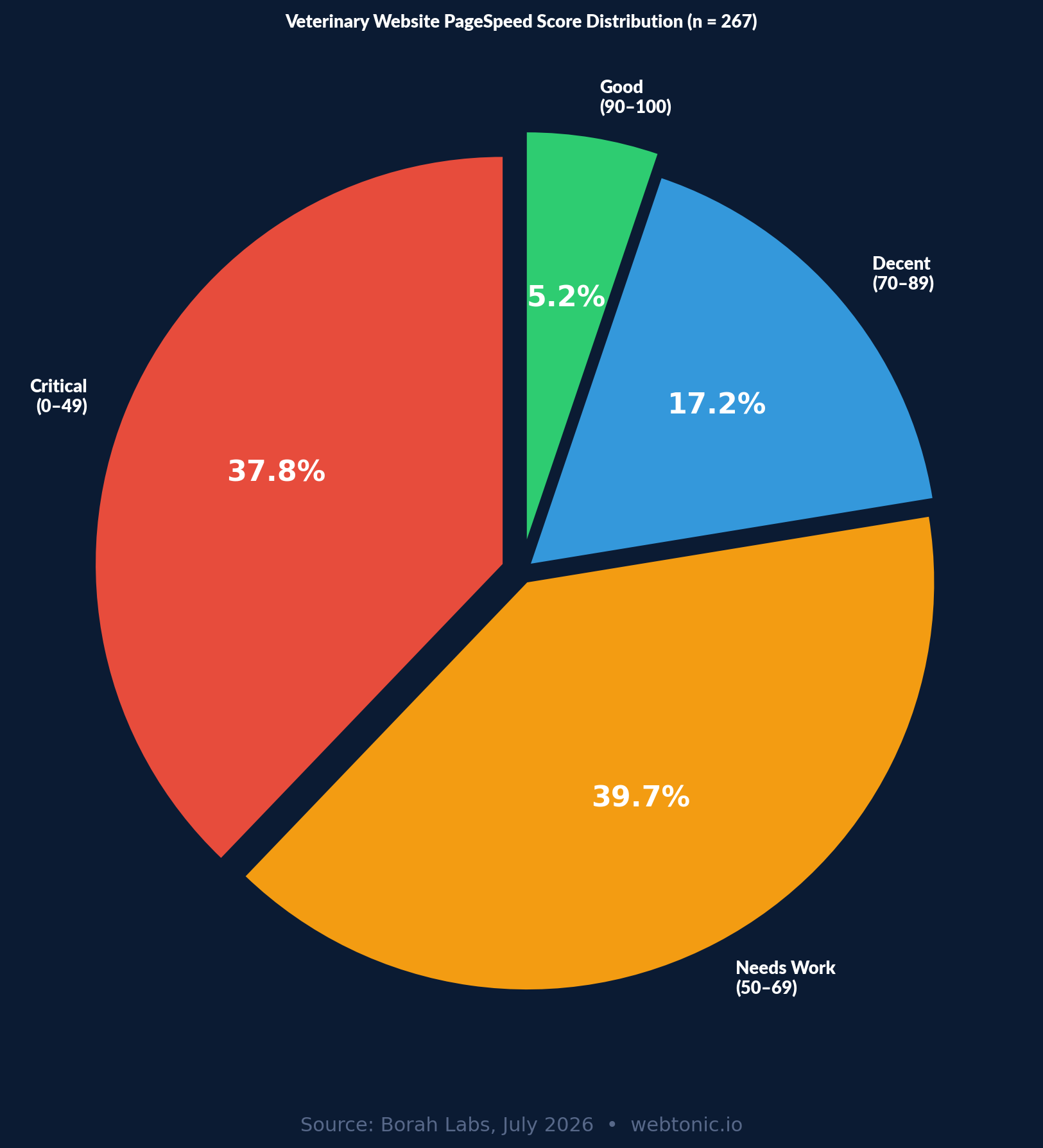
The average veterinary website scores just 55/100 on Google PageSpeed, with a Largest Contentful Paint of 9.31 seconds — nearly four times Google's 2.5-second threshold. Only 5.2% of veterinary sites score 90 or above on performance, while 37.8% fall into the critical 0–49 range.
These technical deficiencies mean that even quality backlinks from authoritative veterinary associations or local news outlets will underperform their potential. A practice investing in strategic digital marketing should address technical foundations before scaling link acquisition.
Citations vs. Traditional Backlinks for Veterinary Practices
Local citations (structured mentions of a business name, address, and phone number) serve a different function than traditional editorial backlinks. While backlinks transfer PageRank and domain authority, citations validate business legitimacy and directly influence Map Pack rankings.
The iVET360 Local SEO Statistics report (2026) found that 62% of consumers will avoid a business if they find incorrect information online. Practices with consistent citation profiles across directories generate 2.7x more calls than those with NAP inconsistencies.
For veterinary practices, the essential citation sources include:
- Google Business Profile — the single most important local listing
- Yelp, Facebook, and Apple Maps — high-authority platforms pet owners actually use
- Veterinary-specific directories — AVMA vet finder, VetFinder.com, and state veterinary medical association directories
- Data aggregators — Foursquare, Data Axle, and Localeze distribute NAP data to hundreds of smaller directories
The distinction matters for budget allocation: citation management typically costs $200–$500 per quarter and delivers rapid local ranking improvements, while link building campaigns require $500–$1,500 per month for sustained authority growth.
Link Building ROI and Timeline for Veterinary Practices
Link building is a compounding investment. Unlike paid advertising, where visibility stops when the budget runs out, backlinks continue to pass authority for years. Authority Specialist's 2026 benchmark data shows typical ranking improvement timelines for veterinary practices:
- Small markets (under 100K population): Map Pack entry achievable in 3–5 months with consistent optimization
- Mid-size markets: 4–7 months for consistent Map Pack presence
- Major metro areas: 6–12 months, particularly when competing against corporate veterinary groups
Monthly SEO investment for veterinary practices typically ranges from $800 to $3,500, with link building consuming approximately 30–40% of the total budget. For a practice spending $2,000 per month on SEO, that translates to $600–$800 dedicated to off-page authority building.
The ROI calculation depends on lifetime client value. According to industry data, the average pet owner spends $410 per dog and $283 per cat annually on veterinary care (APPA, 2026). With an average client retention rate of 78% (CUFinder, 2026), a single new client acquired through organic search represents $1,500–$2,500 in lifetime revenue.
Practices looking to accelerate results should consider combining link building with paid advertising during the organic growth phase.
Veterinary Link Building vs. Other Healthcare Verticals
| Metric | Veterinary | Dental | General Medical |
|---|---|---|---|
| Average PageSpeed Score | 55/100 | 52/100 | 48/100 |
| Sites with Schema Markup | 64.6% | 58.3% | 61.2% |
| Sites with SSL | 89.9% | 91.4% | 93.1% |
| LCP (seconds) | 9.31s | 8.74s | 10.12s |
| Sites Analyzed | 267 | 1,074 | 805 |
Source: Borah Labs Industry Benchmarks, 2026. Veterinary practices outperform dental and general medical sites on schema adoption — a signal that the industry's early adopters are already investing in technical SEO that amplifies link value.
Link Building Best Practices for Veterinary Practices
- Start with citation cleanup. Before building backlinks, audit your NAP consistency across the top 50 directories. Inconsistencies dilute authority and confuse search engines.
- Prioritize local relevance over domain rating. A link from a local pet adoption group often impacts rankings more than a generic high-DR directory listing (SERPs Growth, 2025).
- Create linkable veterinary content. Pet care guides, breed-specific health resources, and seasonal wellness checklists naturally attract backlinks from pet bloggers and local media.
- Leverage veterinary associations. AVMA membership, state veterinary boards, and specialty certifications often include directory listings that carry high trust signals.
- Partner with local shelters and rescue organizations. Offering discounted services in exchange for website mentions creates mutually beneficial backlink relationships.
- Monitor competitor backlink profiles. Tools like Ahrefs and SEMrush reveal where competitors earn links, providing a roadmap for replication and gap analysis.
- Fix technical foundations first. With 82.8% of veterinary sites having LCP issues, addressing site speed before link building ensures backlinks deliver maximum ranking impact.
- Track link acquisition alongside rankings. Connect new referring domains to organic traffic growth and appointment bookings, not just keyword position improvements.
Related reading
- HVAC Link Building Statistics (2026): Costs, ROI & Backlink Benchmarks
- Locksmith Link Building Statistics: 2026 Backlink & Citation Data
- Manufacturing Link Building Statistics (2026): Costs, ROI & Outreach Benchmarks
- Link Building Services services at Web Tonic
FAQ
How many backlinks does a veterinary practice need to rank locally?
The number varies by market competition. In small markets (under 100K population), 15–30 quality referring domains from local organizations and veterinary directories can be enough for Map Pack placement. In major metro areas competing against corporate groups like VCA or Banfield, practices may need 50–100+ referring domains combined with strong review profiles and technical optimization.
What types of backlinks are most valuable for veterinary websites?
The highest-value backlinks for veterinary practices come from local news outlets (DR 50–80), veterinary associations (DR 40–70), and pet care publications. Local citations from directories are lower authority but essential for Map Pack rankings. A single mention from a regional pet adoption group often impacts search rankings more than generic directory listings.
How long does it take for link building to improve veterinary search rankings?
Based on Authority Specialist's 2026 data, veterinary practices typically see measurable ranking improvements within 3–6 months of consistent link building. Map Pack entry in small markets may happen in 3–5 months, while major metro markets require 6–12 months of sustained effort. The compounding nature of link authority means results accelerate over time.
Should veterinary practices invest in link building or paid ads first?
The answer depends on timeline and budget. Paid ads deliver immediate visibility but stop when budget runs out. Link building compounds over time, with cost-per-acquisition decreasing as authority grows. Most practices benefit from running both simultaneously — paid ads for immediate patient flow, and link building for long-term organic dominance.
How much should a veterinary practice spend on link building?
Link building typically represents 30–40% of total SEO spend. With veterinary SEO budgets ranging from $800 to $3,500 per month, that translates to roughly $240 to $1,400 per month for off-page authority building. Practices in competitive metro markets should budget toward the higher end.
Sources
borahlabs.us/insights/veterinary
authorityspecialist.com — Veterinary SEO Benchmarks 2026
cufinder.io/blog/benchmarks/veterinarians
ivet360.com — Local SEO Stats for Veterinary Practices 2026
serpsgrowth.com — Link Building Strategies for Veterinarians
bubblegumsearch.com — UK Pet Brands Search Benchmarking Report
stethondigitalmarketing.com — 100+ Veterinary Marketing Statistics
americanpetproducts.org — APPA Industry Data