Table of contents
Family-medicine search ads convert at a median 11.63%, more than any other primary-care metric this page tracks, while the walk-in urgent care click behaves like a comparison shop. That gap, not a shared "healthcare" template, is the real design brief for the booking page behind either ad.
Key Takeaways
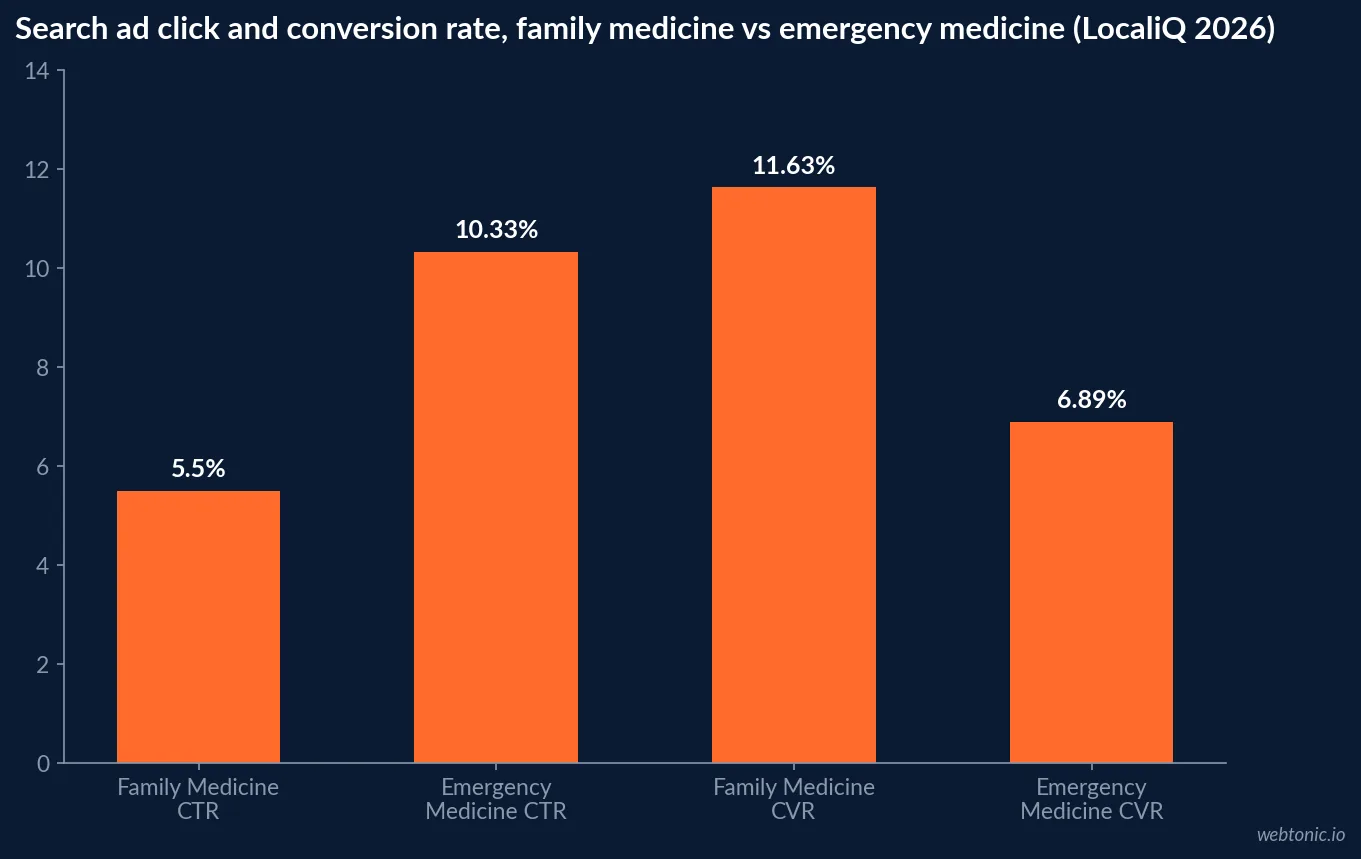
- General Practice & Family Medicine search ads convert at 11.63%, per LocaliQ's 2026 benchmark.
- Emergency Medicine, the closest urgent-care proxy, converts at 6.89% in the same dataset.
- Overall healthcare search ad conversion rate is 8.09% across 3,542 campaigns.
- Family-medicine cost per lead is $62.80 against $41.68 for Emergency Medicine.
- Family-medicine click-through rate is 5.50%, Emergency Medicine's is 10.33%.
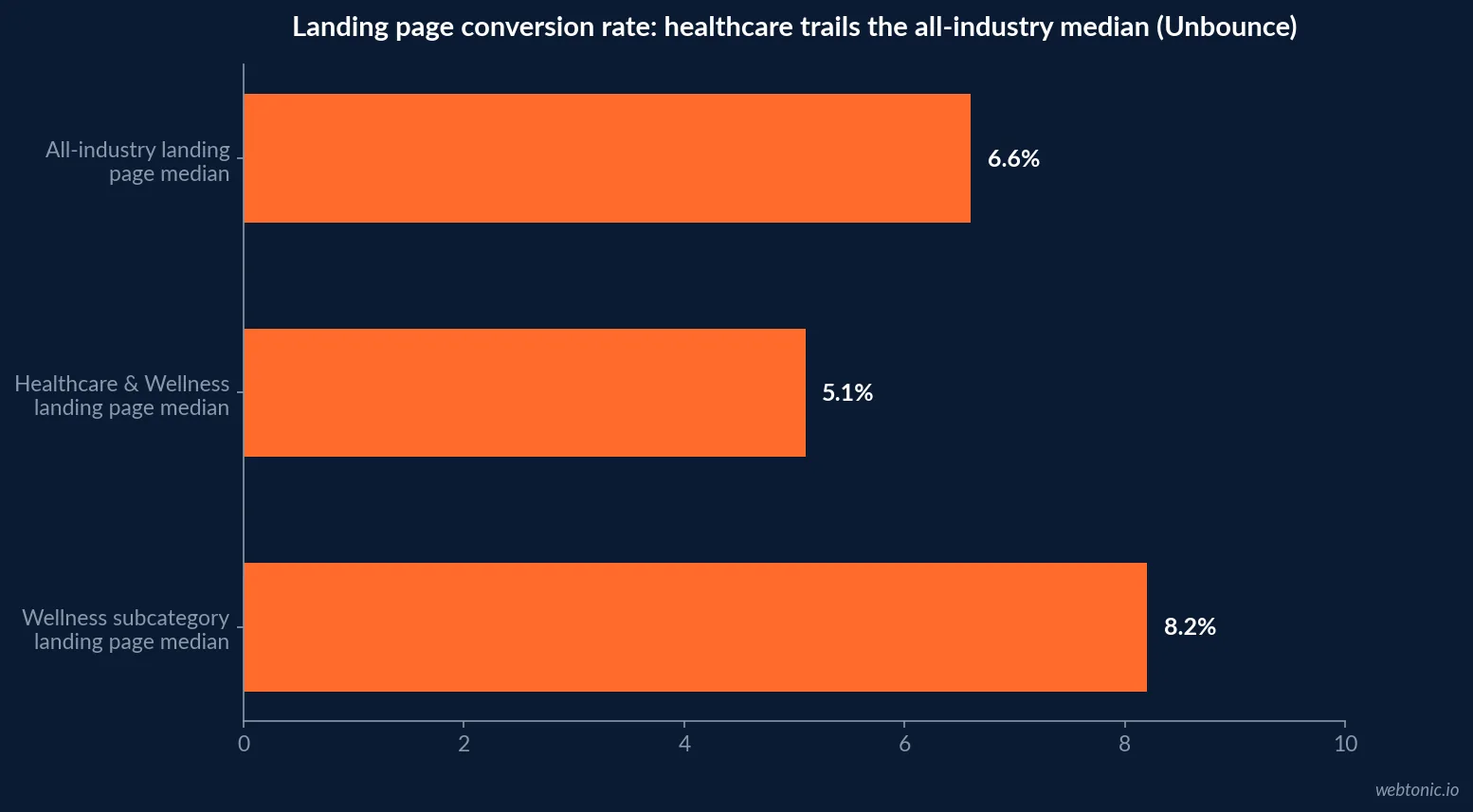
- Healthcare and Wellness landing pages convert at a 5.1% median, per Unbounce.
- The Wellness landing-page subcategory converts 38% higher, at 8.2%, than Healthcare's 5.1%.
- The cross-industry landing page median is 6.6%, so a plain healthcare page trails the average.
- Healthcare mobile traffic outnumbers desktop nearly 7 to 1, yet desktop still converts better.
- 89.4% of the US population is within a 20-minute drive of an urgent care center.
- Average urgent care visit time is 56 minutes against a median ED wait of 150 minutes.
- Average daily visit volume per urgent care center reached 33.96 in 2025, per UCA.
- 6% of US adults had at least one urgent care visit in the past 12 months, per CDC/NCHS.
- 19.0% had at least one retail health clinic visit in the same 2024 period.
- 8.6% of adults name an urgent care or drugstore clinic as their usual source of care, down with age.
- Healthcare CTR fell for 81% of subcategories year over year, LocaliQ's steepest reversal.
- Cost per lead fell 5.83% for healthcare overall even as it rose 5.13% across all industries.
- Only 7 of 16 healthcare subcategories saw conversion rate decline, unevenly split by specialty.
Two specialties, two very different clicks
LocaliQ's 2026 Healthcare Search Ads Benchmarks report, built from 3,542 US search campaigns running October 2024 to September 2025 with a minimum of 43 campaigns per subcategory, gives the cleanest read on how these two specialties actually perform. It does not carry an "urgent care" line item, so this page treats Emergency Medicine as the closest available proxy for walk-in, no-appointment demand and states that substitution plainly wherever it is used.
The two rows do not look alike. General Practice & Family Medicine pulls a 5.50% click-through rate, a $5.47 cost per click and an 11.63% conversion rate at a $62.80 cost per lead. Emergency Medicine pulls a much higher 10.33% click-through rate at a far cheaper $2.29 cost per click, but converts less than half as often, at 6.89%, for a $41.68 cost per lead.
| Metric (2026, LocaliQ) | General Practice & Family Medicine | Emergency Medicine (urgent-care proxy) | All 16 healthcare subcategories |
|---|---|---|---|
| Click-through rate | 5.50% | 10.33% | 6.07% |
| Cost per click | $5.47 | $2.29 | $5.64 |
| Conversion rate | 11.63% | 6.89% | 8.09% |
| Cost per lead | $62.80 | $41.68 | $66.02 |
Why the same template cannot serve both pages
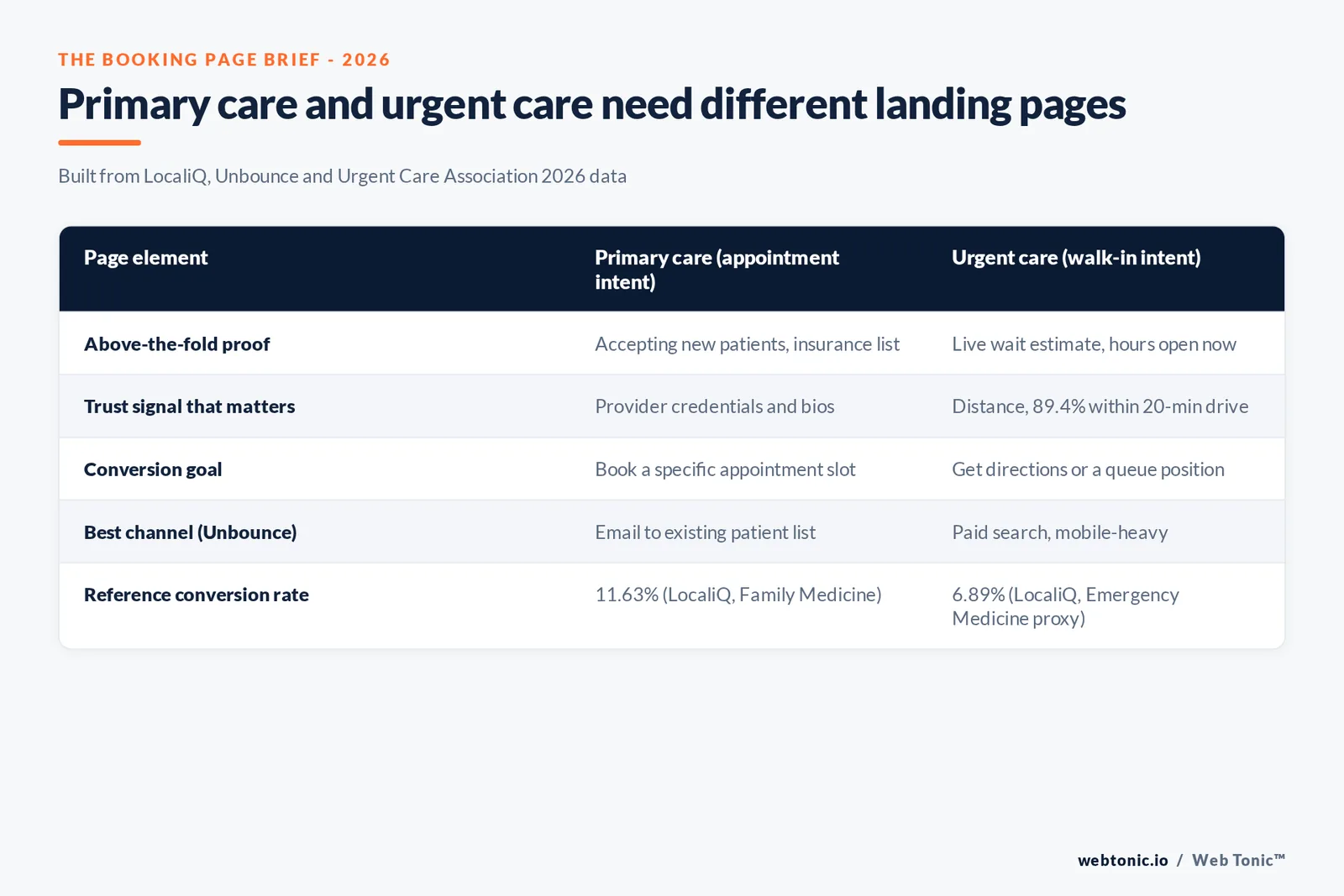
A family-medicine click is a considered decision: the searcher is choosing a doctor they intend to keep, so the page that wins shows accepted insurance, provider bios and next-available-appointment windows. An urgent care click is a live comparison: LocaliQ's own report notes that healthcare conversion rates fell for 7 of 16 subcategories in the same year cost per lead improved, partly because urgent-care-style search results pages are crowded with Local Services Ads, Maps listings and organic results all competing for the same "near me, open now" intent.
Building one landing page pattern for both and hoping the copy carries the difference is the single most common mistake this page's data argues against.
| Booking page element | Primary care (appointment intent) | Urgent care (walk-in intent) |
|---|---|---|
| Primary above-the-fold proof | Accepting new patients, insurance list | Live wait estimate, hours open now |
| Trust signal that matters most | Provider credentials and bios | Distance and drive-time to nearest center |
| Conversion action | Book a specific appointment slot | Get directions or a queue position |
| Best-performing channel (Unbounce) | Email to existing patient list | Paid search, mobile-heavy |
| Page length that tends to work | Longer, provider-detail heavy | Short, single-decision page |
What the landing page itself has to overcome
Unbounce's Conversion Benchmark Report, built from over 57 million conversions and 41,000 landing pages, puts the Health and Wellness median landing page conversion rate at 5.1% - below the 6.6% median across all industries the same report tracks. Inside that category, the Wellness subcategory alone converts at 8.2%, 38% higher than the broader Healthcare median, which suggests the drag comes from clinical pages, not the category as a whole.
Unbounce also flags that desktop visitors convert better despite mobile carrying almost seven times the traffic in this category, and that email consistently outperforms paid social as an organic channel. A healthcare landing page optimized only for the mobile paid-search session it gets the most of is optimizing for the wrong half of its own funnel.
| Landing page benchmark | Median conversion rate | Source |
|---|---|---|
| All industries (Unbounce, 41,000 pages) | 6.6% | Unbounce Conversion Benchmark Report |
| Healthcare & Wellness (Unbounce category) | 5.1% | Unbounce Conversion Benchmark Report |
| Wellness subcategory alone | 8.2% | Unbounce Conversion Benchmark Report |
| Family Medicine search-ad conversion (LocaliQ) | 11.63% | LocaliQ Healthcare Search Ads Benchmarks |
| Emergency Medicine search-ad conversion (LocaliQ) | 6.89% | LocaliQ Healthcare Search Ads Benchmarks |
The access and wait-time numbers a booking page should be built around
The Urgent Care Association's own data page reports 89.4% of the US population within a 20-minute drive of a center, an average urgent care visit of 56 minutes against a median emergency department wait it cites at 150 minutes, and an average daily visit volume of 33.96 patients per center in 2025, up from 33.13 in 2023. None of that is a landing-page metric on its own, but every one of those numbers is a conversion argument a booking page can make in one line that a hero photo cannot.
On the demand side, CDC/NCHS data brief 562 reports 6% of US adults had at least one urgent care visit and 19.0% had at least one retail health clinic visit in the prior 12 months (2024), while data brief 558 puts the share naming an urgent care or drugstore clinic as their usual source of care at 8.6%, a figure that declines with age as older adults settle into a fixed primary care relationship - the opposite audience curve from family medicine's appointment-book model.
| Access/volume fact (2024-2025) | Figure | Source |
|---|---|---|
| Population within a 20-minute drive of urgent care | 89.4% | Urgent Care Association |
| Average urgent care visit time | 56 minutes | Urgent Care Association / Experity data |
| Median emergency department wait time (cited by UCA) | 150 minutes | Urgent Care Association |
| Average daily visit volume per center, 2025 | 33.96 patients/day | Urgent Care Association |
| Adults with 1+ urgent care visit in past 12 months | 6% | CDC/NCHS Data Brief 562 |
| Adults with 1+ retail clinic visit in past 12 months | 19.0% | CDC/NCHS Data Brief 562 |
| Adults naming urgent care/drugstore clinic as usual source of care | 8.6% | CDC/NCHS Data Brief 558 |
Who the page is actually competing against
A booking page for either specialty rarely wins or loses against a single competitor's page - it loses against a crowded results screen. LocaliQ's own report notes that healthcare search results commonly stack Local Services Ads, standard search ads, Google Maps listings and organic results for the same "urgent care near me" or "family doctor near me" query, which is a structural reason conversion rate can fall even when cost per lead improves: the click that does land on your page has already compared three other options before arriving.
That context changes what the page needs to do. It is not competing to be discovered - the ad already won the click - it is competing to be the last tab still open when the visitor decides.
Who is actually landing on the page
The Urgent Care Association's age breakdown of who walks through the door is a useful proxy for who the landing page needs to speak to: 62.8% of visits are patients under 40, split across 14.3% under 10, 15.3% aged 11-20, 17.4% aged 21-30 and 15.8% aged 31-40, with older age bands shrinking steadily to 2% for patients over 80. A page written for a worried parent booking for a child, or a working-age adult fitting in a visit between commitments, is writing for the actual majority audience - a page written like a hospital system's institutional homepage is not.
| Urgent care visits by patient age band (UCA) | Share of total visits |
|---|---|
| Infant to age 10 | 14.3% |
| Age 11-20 | 15.3% |
| Age 21-30 | 17.4% |
| Age 31-40 | 15.8% |
| Age 41-50 | 11.8% |
| Age 51-70 combined | 18.4% |
| Age 71 and older | 7% |
Testing priorities ranked by expected lift
Given the LocaliQ and Unbounce numbers above, the highest-leverage tests are not the same for both specialties. Family medicine's conversion rate is already strong at 11.63%, so the page's job is protecting that rate against drop-off in the appointment picker itself. Urgent care's cheap, high-volume click at $2.29 CPC is the opposite problem - the traffic is efficient, but the post-click experience is where the 6.89% ceiling gets set.
| Test | Specialty it matters most for | What it is testing against |
|---|---|---|
| Real-time open appointment slots vs a request form | Primary care | Protecting an already-strong 11.63% CVR |
| Live wait-time estimate above the fold | Urgent care | A cheap click ($2.29 CPC) with a weaker 6.89% CVR |
| Insurance/accepted-plans checker | Primary care | Reducing pre-booking drop-off for a considered decision |
| Map/drive-time widget vs a static address | Urgent care | The 89.4%-within-20-minutes access advantage |
| Desktop-parity redesign of the mobile flow | Both | Closing the gap Unbounce flags between traffic share and conversion share |
What to test first on each page
For a family-medicine page, the highest-leverage test is usually the appointment picker itself - does it show real open slots, or a generic "request an appointment" form that adds a day of back-and-forth before the 11.63% conversion moment actually happens. For an urgent-care page, the test that tends to move the number fastest is a visible, current wait estimate above the fold, because the LocaliQ data shows this audience already converts on cost-efficient clicks (a $2.29 CPC) - the leak is post-click, not pre-click.
Our performance creative practice builds and tests exactly this kind of booking-intent page, and our breakdown of what search ads cost by industry is a useful companion read before setting a budget against either specialty. If the question is which channel should fund the test program in the first place, talk to our team about a structured landing page audit.
The compliance layer behind the page
Whatever the page promises about wait times or providers, the FTC's Health Products Compliance Guidance applies to health-related claims made on the page itself, not just in ads, and requires that any patient testimonial or review quote reflect a typical result, not a best-case outlier. A wait-time claim or a "most insurance accepted" statement should be current and defensible the day a patient reads it, not a number pulled once and left stale for a year.
Frequently Asked Questions
What is a good landing page conversion rate for an urgent care or primary care clinic?
There is no single number because the two specialties behave differently in the same 2026 LocaliQ dataset. General Practice & Family Medicine search ads convert at a median 11.63%, while Emergency Medicine - the closest LocaliQ subcategory to walk-in urgent care - converts at 6.89%. Unbounce's broader Health and Wellness landing page category sits at a 5.1% median across 41,000 pages, so a primary care booking page clearing 10% is doing well, and an urgent care page clearing 7% is too.
Why does primary care convert almost twice as well as urgent care on search ads?
Intent and page match. A family-medicine searcher is usually choosing a doctor to keep, so a page that answers 'is this provider accepting patients' converts a warm, considered click. An urgent care searcher is mid-symptom and comparing wait time against three competitors in a 20-minute radius - LocaliQ's own healthcare report notes conversion rates fell for 7 of 16 healthcare subcategories partly because results pages are crowded with Maps ads, Local Services Ads and organic listings competing for the same intent.
Does mobile or desktop convert better for this booking page?
Desktop, even though mobile brings far more visitors. Unbounce's Health and Wellness benchmark reports close to seven times more mobile traffic than desktop traffic, with desktop still converting at the higher rate. A booking page built mobile-first for traffic volume but desktop-tested for conversion rate is optimizing for the wrong session unless the mobile flow gets the same scrutiny.
What should the booking page actually show above the fold?
Wait time and same-day availability, not brand copy. The Urgent Care Association's own data puts the average urgent care visit at 56 minutes against a median emergency department wait of 150 minutes, and reports 89.4% of the US population within a 20-minute drive of a center - both are conversion arguments a static hero image cannot make. A live or recently-updated wait estimate, not a phone number buried in a header, is what a comparison-shopping urgent care visitor is looking for.
Is email or paid search the better channel to build the landing page for first?
Build for paid search intent first, but do not skip email. Unbounce's healthcare benchmark flags email as an unusually strong organic channel for the industry - patients already in a system convert well from a reminder or recall email - while paid social lags both. A clinic with an existing patient list is underusing a cheap, high-converting channel if every landing page is optimized only for a cold search click.
Sources
LocaliQ - Healthcare Search Ads Benchmarks for 16 Specialties, 2026
Unbounce - Healthcare, Wellness & Medical Services Conversion Rate Benchmarks
Urgent Care Association - Urgent Care Data
CDC/NCHS - Urgent Care Center and Retail Health Clinic Use: United States, 2024
CDC/NCHS - Source of Usual Health Care for Adults Age 18 and Older: United States, 2024
FTC - Health Products Compliance Guidance