Table of contents

No published benchmark prices Google Ads for "urgent care" or "primary care" as its own category — WordStream and LocaliQ track "Physicians and Surgeons" as the closest proxy, and in 2026 that category's cost per lead fell 29.64% year over year, the third-steepest drop of any tracked industry. This page builds the paid search picture from that proxy category, the Urgent Care Association's own visit and access data, and the ad policies that restrict how health-adjacent campaigns can target, stating clearly every place the data is cross-industry rather than urgent-care specific.
Key Takeaways
- Physicians and Surgeons cost per lead fell 29.64% year over year in 2026.
- That was the third-largest CPL decrease of any WordStream-tracked industry.
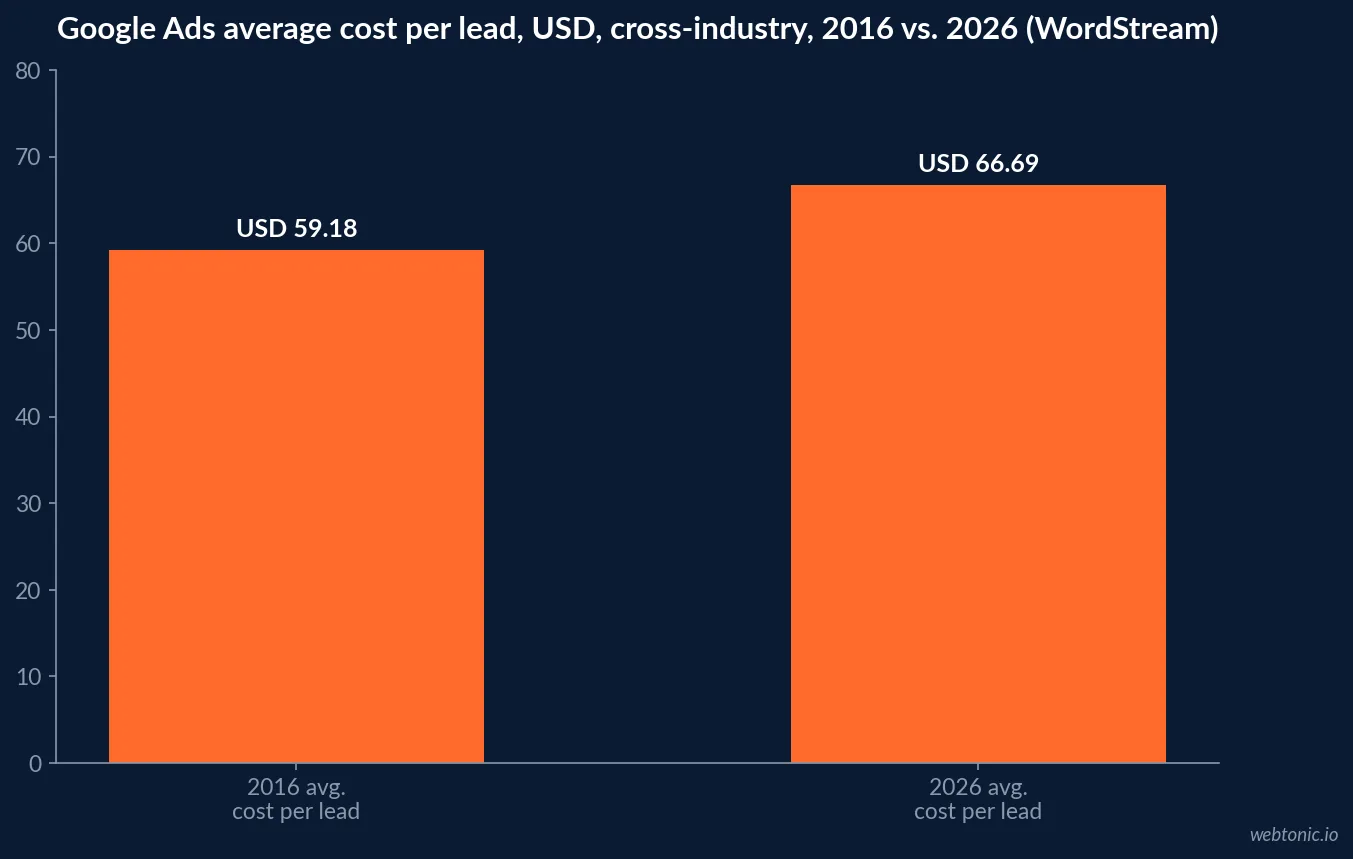
- The cross-industry average Google Ads cost per lead is USD 66.69 in 2026.
- The cross-industry average cost per click is USD 5.42.
- The cross-industry average click-through rate is 6.64%.
- The cross-industry average conversion rate is 8.18%.
- Conversion rate rose year over year for 87% of all tracked industries.
- There are 15,398 urgent care centers in the U.S., per UCA.
- 89.4% of Americans are within a 20-minute drive of an urgent care center.
- About 5 million urgent care visits occur after 5 p.m.
- Google fields more than 1 billion health-related searches daily, per LocaliQ.
- The U.S. needs up to 48,000 more primary care physicians by 2034, per AAFP.
- Average new-patient primary care waits hit 31 days across 15 metros in 2026.
- Primary care Health Professional Shortage Areas remain widespread as of December 2025, per KFF.
- Top 100 urgent care operators run 41.3% of all U.S. locations, per JUCM.
- Health is a sensitive interest category under Google's ad targeting policy.
- 40% of urgent care centers are hospital-owned or -affiliated.
- 81% of urgent care centers operate in metropolitan areas.
The closest available benchmark, and its limits
WordStream's 2026 Search Advertising Benchmarks, built from more than 13,000 campaigns across 23 industries, does not track "urgent care" or "primary care" as distinct categories. The nearest match is Physicians and Surgeons, and in 2026 that category posted a 29.64% year-over-year decline in cost per lead — the third-largest decrease of any tracked industry, behind only Travel (down 39.35%) and Beauty and Personal Care (down 34.95%). Every figure below carries this same label: cross-industry proxy data, not a study of urgent care or primary care campaigns specifically.
| Metric (2026, cross-industry average) | Figure | Source |
|---|---|---|
| Average cost per click, all industries | USD 5.42 | WordStream 2026 Benchmarks |
| Average cost per lead, all industries | USD 66.69 | WordStream 2026 Benchmarks |
| Average click-through rate, all industries | 6.64% | WordStream 2026 Benchmarks |
| Average conversion rate, all industries | 8.18% | WordStream 2026 Benchmarks |
| Physicians and Surgeons CPL, year-over-year change | -29.64% | WordStream 2026 Benchmarks |
| Industries with a CVR increase year over year | 87% | WordStream 2026 Benchmarks |
Why the CPL drop happened in a year costs mostly held flat
WordStream frames 2026 as unusually stable overall: cost per click and cost per lead moved only modestly across most industries, a sharp contrast to prior years that saw double-digit swings. Against that flat backdrop, a 29.64% drop for Physicians and Surgeons stands out, and the report's broader industry commentary points to categories tied to discretionary or postponable spending (Travel, Beauty and Personal Care) seeing the steepest declines — health services typically are not postponable in the same way, which may explain why competition (and therefore cost) eased even as conversion rates rose for 87% of tracked industries.
| Largest 2026 CPL decreases (WordStream, cross-industry) | YoY change |
|---|---|
| Travel | -39.35% |
| Beauty and Personal Care | -34.95% |
| Physicians and Surgeons | -29.64% |

What the shortage does to the value of a same-day click
AAFP projects the U.S. will need up to 48,000 more primary care physicians by 2034, and survey data cited via MGMA put the average new-patient wait across six specialties in 15 large metro areas at 31 days in 2026, up from 26 days the year the survey began. That gap is what makes a paid search click for same-day access valuable: the buyer is frequently choosing urgent care not out of preference but because the alternative, seeing a regular doctor, is weeks away. A campaign built around "same day" and "walk-in" search terms is selling against that real constraint, not against a category of interchangeable competitors.
The visit-volume backdrop paid search is competing for
The Urgent Care Association counts 15,398 centers nationwide, with 89.4% of the population within a 20-minute drive of one and roughly 5 million visits happening after 5 p.m. based on a survey of 13 million patient encounters. 40% of centers are hospital-owned or -affiliated, and 81% sit in metropolitan areas — meaning most paid search competition for this category is concentrated in dense urban and suburban markets where cost per click is set by both independent operators and well-funded health systems bidding on the same terms.
| Urgent care market fact (UCA) | Figure |
|---|---|
| Urgent care centers nationwide | 15,398 |
| Population within a 20-minute drive | 89.4% |
| Visits occurring after 5 p.m. | ~5 million |
| Centers hospital-owned or -affiliated | 40% |
| Centers in metropolitan areas | 81% |
Consolidation adds another layer to the paid-search cost picture: the Journal of Urgent Care Medicine's 2026 Top 100 ranking found 41.3% of the nation's urgent care locations are run by a Top 100 entity, and 55.9% of those carry a hospital-system affiliation. Combined with KFF's confirmation that primary care shortage areas remain widespread as of December 2025, independent operators are bidding against both larger consolidated competitors and a structurally growing demand pool at the same time.
What Google and Meta actually let a health campaign target
Google's Health in personalized advertising policy designates health as a sensitive interest category, meaning advertiser-curated custom audiences cannot be built around health interests or conditions; only Google's own predefined audiences are available for that purpose. This pushes urgent care and primary care campaigns toward geography, demographics and keyword intent rather than interest- or condition-based audience layering, and it means a search campaign built on "urgent care near me" style keyword intent is usually a more defensible structure than a display or video campaign built on inferred health interest.
| Campaign structure choice | Why it fits the policy constraints |
|---|---|
| Search campaigns on location + service keywords | Not classified as health-interest targeting |
| Local Services Ads / Google Business Profile | Surfaces proximity and hours, the real decision driver |
| Display or video with condition-based audiences | Restricted under the sensitive interest category rule |
| Broad demographic + geography targeting | Compliant fallback when interest targeting is restricted |
Where the search-intent data points the budget
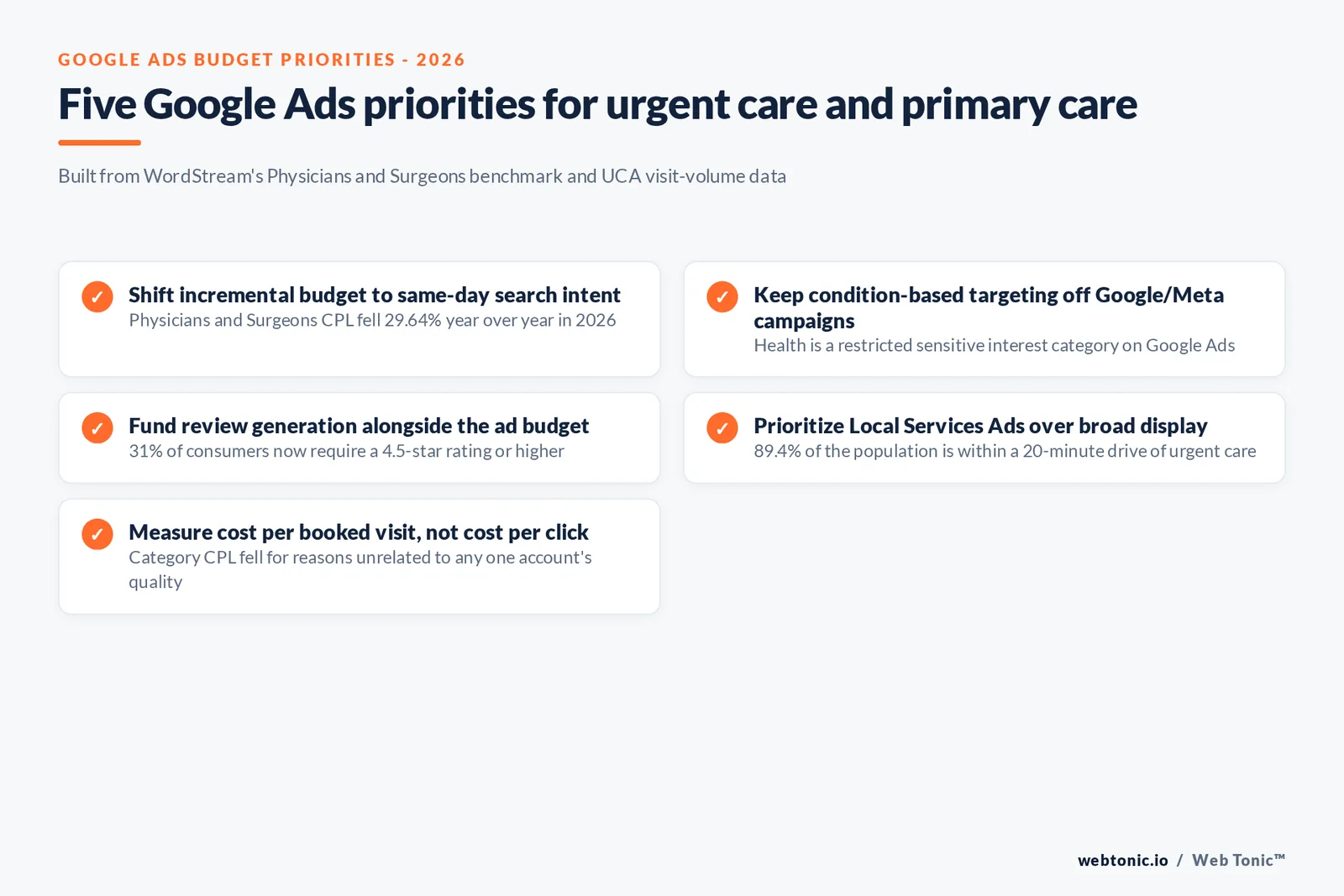
LocaliQ's healthcare benchmark research notes that Google fields more than 1 billion health-related searches a day, with 7% of all Google queries touching health in some way — a volume base large enough that even a narrow slice of "same day" and "walk-in" intent represents meaningful, biddable demand. Combined with the 29.64% CPL decrease in the closest tracked category, 2026 looks like a comparatively favorable year to test incremental budget into that exact-moment search intent rather than broader brand or condition-awareness campaigns that compete more directly with hospital-system budgets.
Our growth marketing practice builds that kind of intent-first campaign structure, and our Google Ads strategy guide covers the account structure fundamentals this category should start from. Talk to us before assuming the Physicians and Surgeons benchmark above applies to your exact market without adjustment.
What the review layer does to paid conversion rate
This part of the picture is cross-industry, but it applies with unusual force to a same-day medical decision: BrightLocal's 2026 Local Consumer Review Survey found 68% of consumers will not use a business rated below 4 stars, and 31% now require 4.5 stars or higher, up from 17% a year earlier. A Google Ads click that lands on a location page with a thin or dated review profile is competing on cost per click while losing on conversion rate before the visitor ever reads the ad copy — which means review management is functionally part of the paid media budget for this category, not a separate marketing workstream.
| Review threshold (BrightLocal, 2026, cross-industry) | Share of consumers |
|---|---|
| Won't use a business rated below 4 stars | 68% |
| Now require 4.5 stars or higher | 31% |
| More likely to use a business after positive reviews | 85% |
How to size the next incremental dollar
Put together, the data supports a specific test, not a blanket budget increase: hold brand and broad condition campaigns flat, and move incremental spend into geography-plus-hours search terms and Local Services Ads, on the logic that (1) the closest tracked proxy category got materially cheaper in 2026, (2) the population searching same-day access is structurally growing as the primary care shortage widens, and (3) the conversion ceiling on that spend is set by review profile quality as much as by ad copy. Measure the test against cost per booked visit, not cost per click, since click cost fell across the proxy category for reasons unrelated to any one advertiser's account quality.
Frequently Asked Questions
Is there a Google Ads benchmark specifically for 'urgent care' or 'primary care'?
No. WordStream and LocaliQ's 2026 benchmarks, built from a sample of more than 13,000 Google and Microsoft Ads campaigns, track "Physicians and Surgeons" as the closest matching category, not urgent care or primary care specifically. This page uses that category as a labeled cross-industry proxy and states plainly where the data does and does not map onto this exact business.
What happened to cost per lead in this category in 2026?
It fell, which was itself the year's headline. WordStream's 2026 benchmarks report that Physicians and Surgeons had the third-largest year-over-year cost-per-lead decrease of any tracked industry, down 29.64%, in a year where the overall average cost per lead across all 23 tracked industries actually dropped for the first time in five years. That is a favorable signal for practices that held or grew their paid search budget through 2025 into 2026, though it says nothing about how the category compares to Attorneys and Legal Services or Real Estate on absolute cost.
How does the primary care physician shortage change the Google Ads case?
It raises the ceiling on what same-day acquisition is worth. AAFP projects a shortfall of up to 48,000 primary care physicians by 2034, and MGMA-cited survey data puts the average new-patient wait across six specialties in 15 large metros at 31 days in 2026, up from 26 the year before. When waiting weeks for a regular doctor is the alternative, a paid search campaign selling same-day urgent care access is competing against a real, growing gap in supply, not against comparable same-day competitors.
What Google and Meta ad policies actually restrict these campaigns?
Google classifies health as a sensitive interest category, which blocks advertiser-curated audience targeting for health-related messaging and limits campaigns to predefined Google audiences. Meta applies its Special Ad Category framework to health and wellness advertising in similar spirit, restricting some targeting options and requiring age-18-plus targeting for health, weight, and wellness claims. Practically, this pushes urgent care and primary care advertisers toward broader, geography- and service-based targeting rather than condition- or symptom-based audience building.
Where should the next incremental Google Ads dollar go for this category?
Toward Local Services Ads and hours/availability-based search terms rather than broad brand or condition campaigns. UCA's own data shows 89.4% of the population already within a 20-minute drive of an urgent care center and roughly 5 million visits happening after 5 p.m., meaning the paid search opportunity is less about creating awareness of urgent care as a category and more about capturing the exact-moment, exact-location "open now" search that a scheduled primary care appointment can't answer.
Sources
WordStream - 2026 Search Advertising Benchmarks by Industry
LocaliQ - Healthcare Search Ads Benchmarks for 16 Specialties, 2026
Urgent Care Association - Urgent Care Data page, 2026
AAFP - Understanding the primary care physician shortage crisis
MGMA Stat - New-patient wait times largely hold flat in 2026
KFF - Primary Care Health Professional Shortage Areas (HPSAs)
Journal of Urgent Care Medicine - The 2026 Urgent Care Top 100 By Number Of Locations
BrightLocal - Local Consumer Review Survey 2026
Google Ads - Health in personalized advertising policy