Table of contents
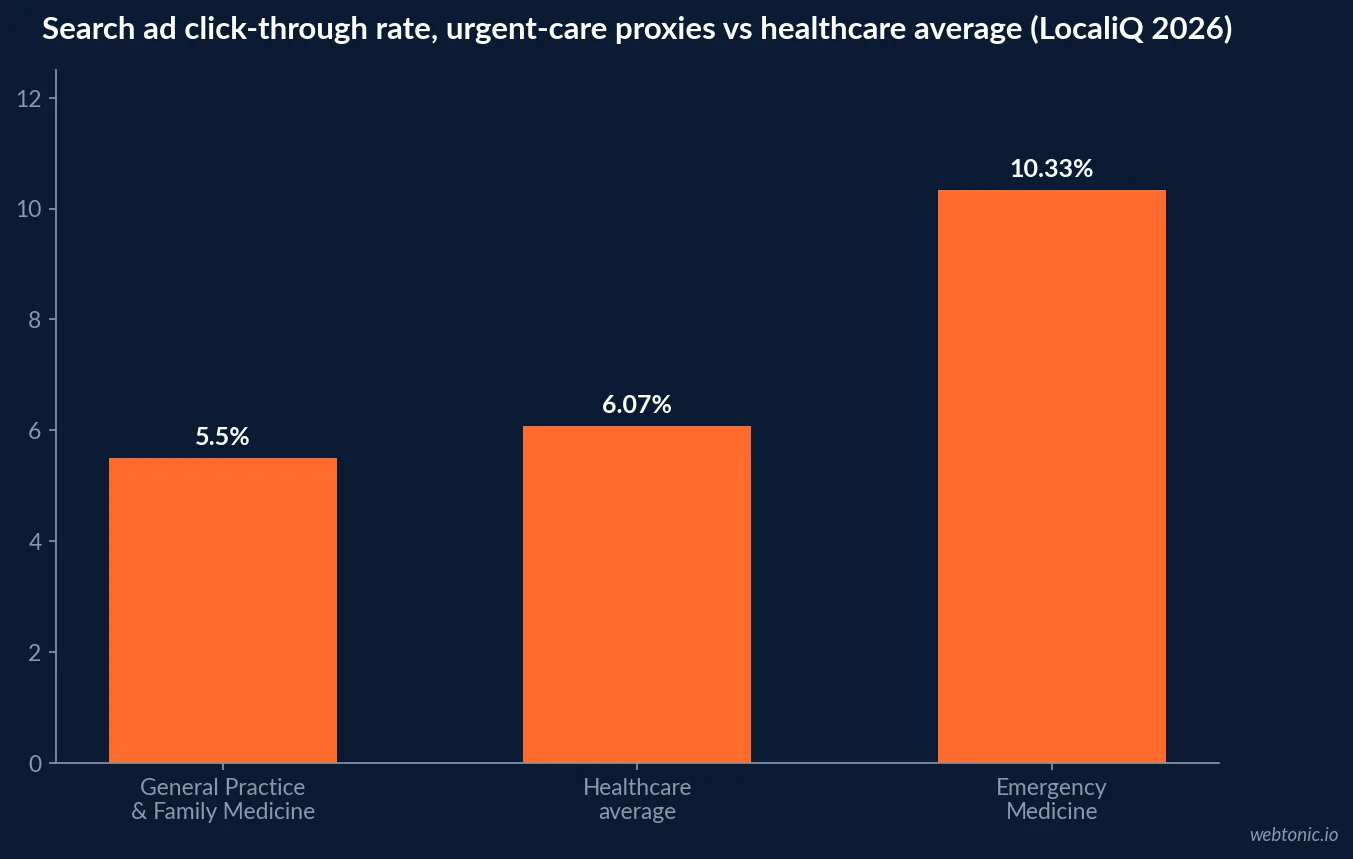
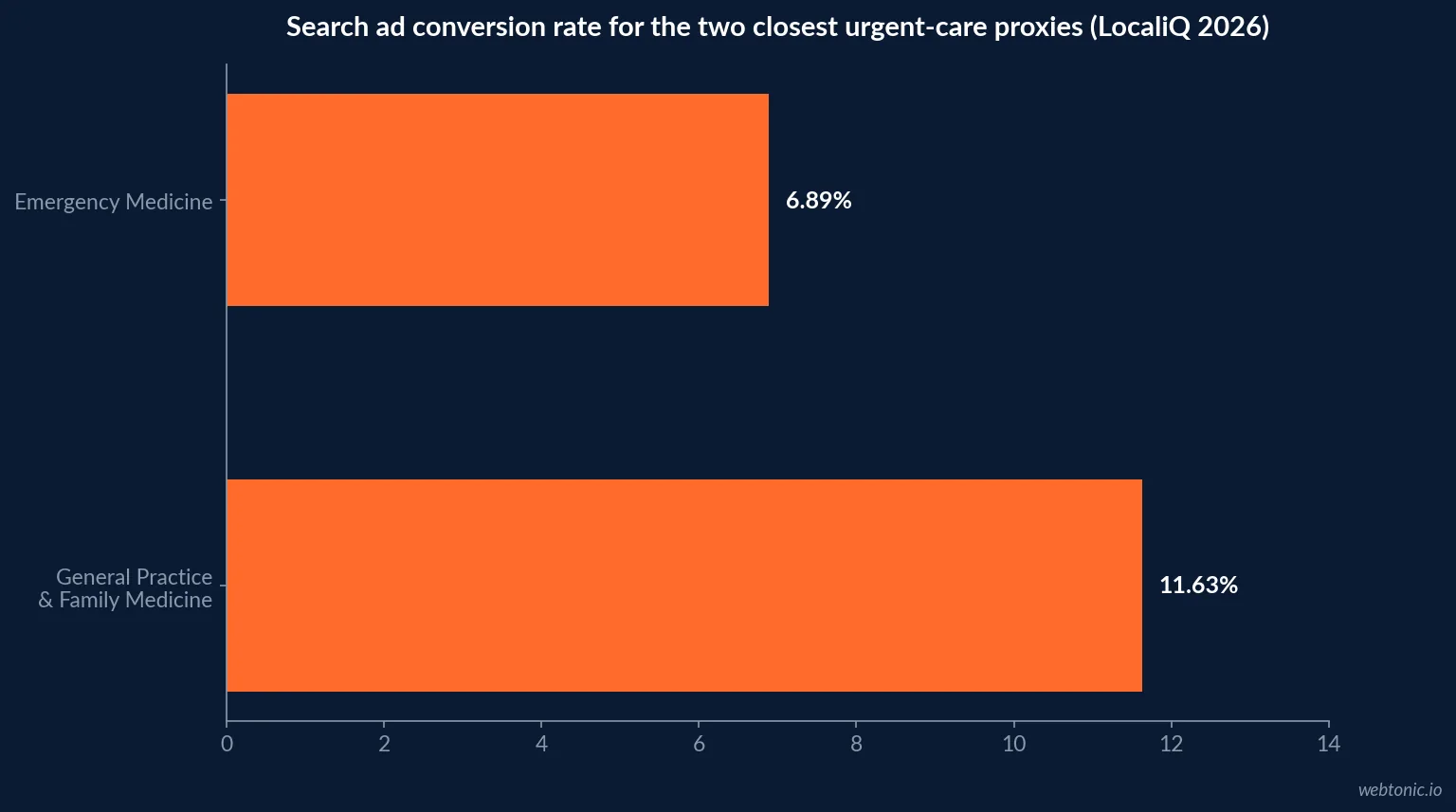
Emergency Medicine posts the highest search-ad click-through rate of sixteen healthcare subcategories at 10.33%, but General Practice & Family Medicine converts more than 70% better once clicked. Neither figure is specific to urgent care by name - LocaliQ's taxonomy does not report that line item - so this page treats both as the closest available proxies and builds a creative read from what the gap between them, plus UCA's own operational data, actually supports.
Key Takeaways
- Emergency Medicine's search-ad CTR is 10.33%, the highest of 16 healthcare subcategories.
- General Practice & Family Medicine converts at 11.63%, more than 4 points above the healthcare average.
- Emergency Medicine converts at only 6.89% despite the higher click-through rate.
- Emergency Medicine's cost per lead is USD 41.68, the cheapest of the two proxies.
- General Practice's cost per lead is USD 62.80, closer to the USD 66.02 healthcare average.
- The national average urgent care visit runs 56 minutes.
- Patient volume explains only 18% of visit-duration variance - staffing and process explain the rest.
- 15,032 urgent care centers were open as of January 2025, up 670 in a single year.
- Trust in online reviews fell to 42% of consumers in 2025, down from 79% in 2020.
- 67% of urgent care centers operate 7 days a week.
- 39% of urgent care centers are hospital/health-system affiliated.
- Urgent care and primary care are not Google Ads-restricted clinic types, unlike mental health or cosmetic surgery.
The click-through versus conversion gap that should shape the creative brief
Per LocaliQ's 2026 healthcare search advertising benchmarks, Emergency Medicine leads all sixteen healthcare subcategories on click-through rate at 10.33%, well above the healthcare average of 6.07%. But that same subcategory converts at only 6.89% once clicked, while General Practice & Family Medicine, with a much lower CTR of 5.50%, converts at 11.63% - the third-highest conversion rate of the sixteen. The practical read for creative: an urgency-framed ad headline earns the click for an emergency-adjacent search, but the landing page and offer behind it need to convert a more skeptical, comparison-shopping visitor, the same behavior General Practice's higher CVR reflects.
| Metric | Emergency Medicine | General Practice & Family Medicine | Healthcare average |
|---|---|---|---|
| Click-through rate | 10.33% | 5.50% | 6.07% |
| Cost per click | USD 2.29 | USD 5.47 | n/a (varies) |
| Conversion rate | 6.89% | 11.63% | 8.09% |
| Cost per lead | USD 41.68 | USD 62.80 | USD 66.02 |
What the network's own operational data supports in creative
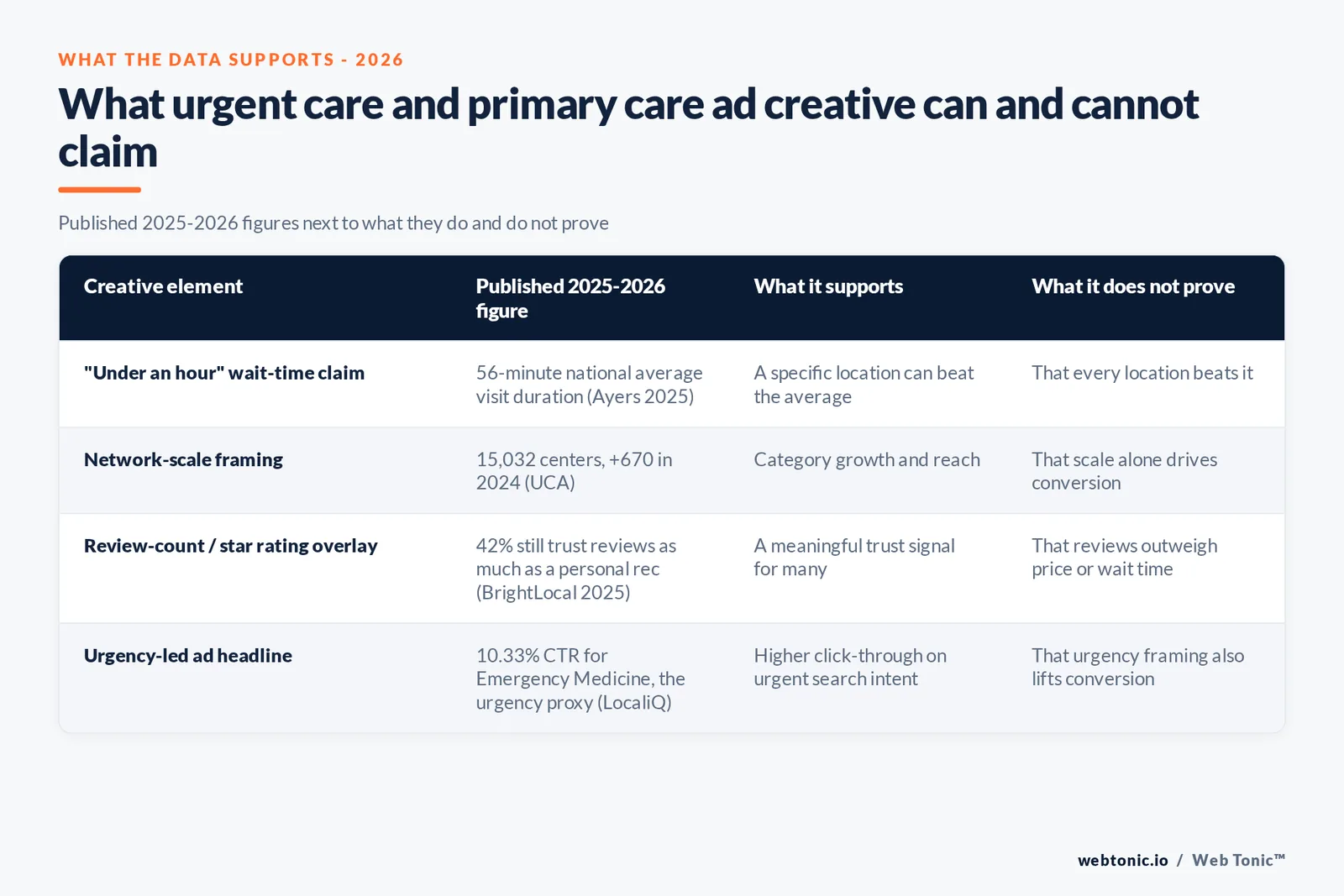
The Urgent Care Association's 2025 data counts 15,032 open centers as of January 2025, with 670 new centers opened in 2024 alone - a fast-growing, increasingly competitive category where creative differentiation matters. On the claim side, Experity EMR data covering 2,710 locations, presented at the 2025 Urgent Care Congress puts the national average visit duration at 56 minutes, with volume explaining only 18% of the variance - meaning a specific clinic with strong staffing can honestly claim a faster time than that average, but a generic "fastest in town" line is not something any of these sources support.
| Creative element | What the data supports | What it does not prove | Source |
|---|---|---|---|
| "See a provider in under an hour" | National average is 56 minutes; beatable with strong staffing | That every location beats the average | Alan Ayers Urgent Care Congress 2025 |
| "One of 15,000+ centers nationwide" (category framing) | Network scale and 2024 growth of 670 centers | That scale alone drives conversion | UCA State of Urgent Care 2025 |
| Star rating / review count in ad extensions | 42% of consumers still trust reviews as much as a personal rec | That reviews outweigh price or wait time | BrightLocal 2025 |
| Urgency-led headline for a same-day complaint | 10.33% CTR for the closest urgency proxy (Emergency Medicine) | That urgency framing improves conversion, not just clicks | LocaliQ 2026 |
| Considered, comparison-style landing page copy | 11.63% CVR for the closest primary-care proxy (General Practice) | That the same copy works for an urgent, same-day visit | LocaliQ 2026 |
Reviews still matter, just less absolutely than five years ago
BrightLocal's 2025 Local Consumer Review Survey found that 42% of consumers now trust online reviews as much as a personal recommendation - down sharply from 79% in 2020, though up 4 points from 2024. Read plainly: review-count and rating overlays in ad creative still move a meaningful share of the audience, but they are no longer the dominant trust signal survey data once showed. A creative brief that treats "4.8 stars, 2,000+ reviews" as an automatic conversion lever is overstating what current consumer research supports.
What the 2025 growth numbers mean for creative testing volume
With 670 new centers opened in 2024 and total network size at 15,032, an individual clinic's ad creative is competing against a fast-growing set of look-alike competitors, many opened in the last two years. That argues for a wider creative test set, not a single evergreen ad: category growth this fast means the creative that worked in 2023 is now competing against newer entrants running similar urgency and convenience messaging. Pair a broader test plan with our growth marketing approach to prioritize which variant to scale, rather than testing everything at once.
| Growth signal (UCA 2025) | Value | Creative implication |
|---|---|---|
| Centers opened in 2024 | 670 | New competitors are testing similar urgency/convenience angles |
| Total open centers, Jan 2025 | 15,032 | Category is crowded; differentiation matters more than volume |
| Centers open 7 days/week | 67% | Convenience-hours claims are now a category norm, not a differentiator |
| Hospital/health-system affiliated | 39% | Trust-by-affiliation messaging applies to a minority, not most centers |
Cost efficiency: the other half of the creative brief
Creative does not operate in a vacuum from cost. Emergency Medicine's cost per lead of USD 41.68 is the cheapest of the two proxies, and General Practice's USD 62.80 still undercuts the USD 66.02 healthcare average. That gives urgent care and primary care meaningfully more room to test creative variants within budget than a higher-CPL healthcare category, where the equivalent figure can run over USD 140 per lead. A lower cost per lead means more test cells can run concurrently without the budget strain a pricier vertical faces, which argues for a faster, more iterative creative testing cadence here than in higher-CPL healthcare categories.
| Vertical | Cost per lead | Relative budget room for creative testing |
|---|---|---|
| Emergency Medicine (urgent care proxy) | USD 41.68 | High - cheapest of the two proxies |
| General Practice (primary care proxy) | USD 62.80 | Moderate - still under the healthcare average |
| Healthcare average | USD 66.02 | Baseline |
| Highest-CPL healthcare subcategory (LocaliQ 2026) | USD 141.17 | Low - budget-constrained testing |
Why urgent care and primary care creative can lean on remarketing where mental health cannot
Unlike the mental health and counseling pages in this same research set, urgent care and primary care are not named categories under Google's Health sensitive-interest policy. The restriction on advertiser-curated audiences, including remarketing, only activates when a specific landing page discusses a flagged condition or procedure - a general "walk-in care" or "same-day appointments" page is not restricted. That gives urgent care and primary care creative more targeting freedom to retarget site visitors with a service-line offer than a mental health account has, a meaningful structural advantage worth building into the media plan alongside the creative brief.
Put together, the data argues for two distinct creative tracks rather than one generic urgent care ad: an urgency-led track for same-day, walk-in intent (closer to the Emergency Medicine pattern), and a considered, comparison-style track for primary-care-adjacent search (closer to General Practice). Rather than one generic ad group and one landing page trying to serve both search patterns, structuring the account around that split is the single change most supported by this data - more defensible than any individual headline or image choice. Our performance creative team can help build and test both tracks - reach out to scope it.
Frequently Asked Questions
Does a faster average visit time actually convert better in urgent care ads?
There is no published A/B test proving a wait-time claim alone lifts conversion rate, so treat that as an untested creative hypothesis, not a benchmark. What is measured is the underlying fact a creative could use honestly: the national average urgent care visit runs 56 minutes, and Alan Ayers's 2025 data shows patient volume explains only 18% of that duration - staffing and process explain the rest. A creative claiming a specific, verifiable wait time for one location is defensible; a generic "fastest care in town" claim is not backed by any of the sources here.
Why does Emergency Medicine have such a high click-through rate compared to General Practice?
LocaliQ's 2026 healthcare benchmarks put Emergency Medicine's search-ad click-through rate at 10.33%, the highest of sixteen healthcare subcategories measured, against 5.50% for General Practice & Family Medicine. The likely driver is urgency: someone searching an emergency-adjacent term is closer to a decision and clicks more readily. That does not mean Emergency Medicine converts better once clicked - its conversion rate, 6.89%, actually trails General Practice's 11.63% in the same dataset, which argues for urgency-led ad copy paired with a landing page built for a considered, not impulsive, decision.
Is Emergency Medicine or General Practice the closer proxy for urgent care specifically?
Neither is exact. LocaliQ's healthcare taxonomy does not report a distinct "Urgent Care" line, so this page labels Emergency Medicine and General Practice & Family Medicine as the closest available proxies and reports both rather than picking one. Emergency Medicine captures the urgency-driven search behavior a walk-in clinic shares; General Practice captures the primary-care-adjacent conversion pattern. An urgent care or primary care account's own numbers should be benchmarked against both, not treated as identical to either.
Do reviews still move the needle on urgent care ad creative in 2026?
Trust in reviews is declining, not disappearing. BrightLocal's 2025 Local Consumer Review Survey found that the share of consumers who trust online reviews as much as a personal recommendation fell to 42% in 2025, down from 79% in 2020, though it ticked up 4 points from 2024. That is still a meaningful minority for whom a review count or star rating in an ad's sitelinks or ad extensions carries real weight - it is simply no longer the dominant trust signal it was five years ago, and creative should not lean on it alone.
Can urgent care and primary care ads use remarketing the way most industries do?
Mostly yes, unlike mental health or cosmetic surgery ad accounts. Google's Health sensitive-interest category does not flag urgent care or primary care as clinic types; the restriction on advertiser-curated audiences (including remarketing) only activates on a specific page discussing a flagged condition or procedure. A general "walk-in care near you" landing page is not restricted, which gives urgent care and primary care creative more targeting freedom than the mental health and counseling pages in this same research batch.
Sources
LocaliQ - Healthcare search ads benchmarks for 16 specialties, 2026
Urgent Care Association - Urgent Care Data (visit volume 2023-2025)
Urgent Care Association - State of Urgent Care 2025
Experity EMR data (2,710 locations, 7/1/2024-6/30/2025), via Alan Ayers's Urgent Care Congress presentation, June 2025
BrightLocal - Local Consumer Review Survey 2025
Google Ads Help - Health in personalized advertising policy