Table of contents
Somewhere online right now, a journalist, a blogger, or a review site is writing your brand name into an article and not linking to you. Not because they don't like you. Because adding a link never crossed their mind, or their CMS made it easy to skip. That's an unlinked brand mention, and in 2026 it's become one of the more misunderstood assets in a company's off-page SEO toolkit: mostly ignored by teams chasing fresh backlinks, and increasingly important to the AI platforms that now decide what gets recommended.
This guide covers exactly what unlinked mentions are, why they've become more valuable than a lot of teams realize, how to actually find them, and how to convert the right ones into real backlinks without wasting outreach effort on the ones that don't matter.
Key takeaways
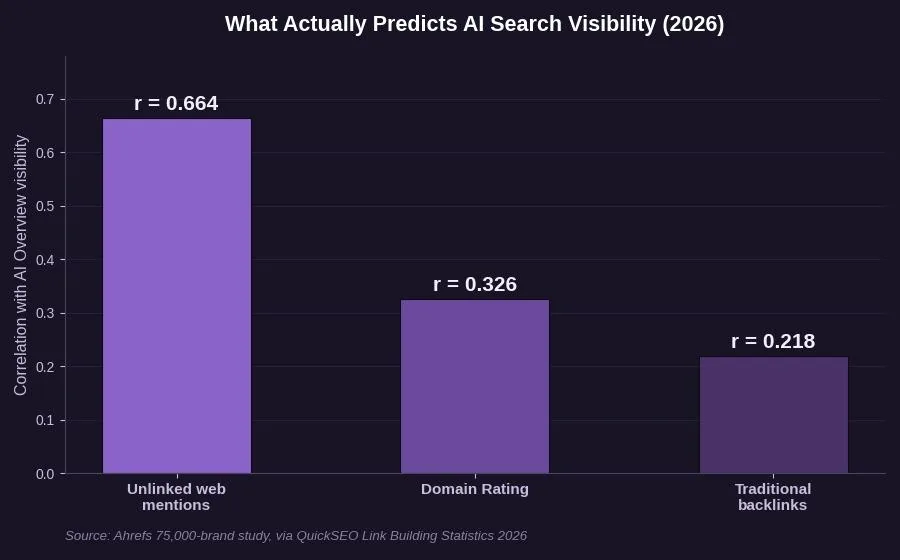
- Unlinked web mentions correlate more strongly with AI Overview visibility (r = 0.664) than traditional backlinks do (r = 0.218), based on Ahrefs' analysis of 75,000 brands.
- About 20% of digital PR placements arrive without a link on first publish, meaning a meaningful share of earned coverage never converts to link equity unless someone goes back for it.
- Warm mention reclamation outreach converts at 15-40%, compared to just 3-8% for cold link-building outreach — the author already knows and named your brand, which changes the entire dynamic of the ask.
- A 2012 Google patent describes something called an "implied link," but Google's own John Mueller has publicly clarified that Google does not use unlinked brand mentions as a direct ranking signal the way SEOs often assume.
- Ahrefs Content Explorer, Semrush Brand Monitoring, and free tools like Google Alerts are the standard ways to surface unlinked mentions at scale.
What is an unlinked brand mention?
An unlinked brand mention is any reference to your company, product, executive, or branded term in published content that doesn't include a clickable link back to your site. The brand name sits in plain text. The author already knows who you are and thought you were worth naming. No link, no referral traffic, no direct link equity.
In practice, this shows up in a few common shapes:
- A journalist writes "tools like [Your Brand] help teams track conversion rates" without linking.
- A roundup article lists your company among ten competitors and links to nine but not you.
- A podcast transcript names you as a source and the show notes don't link.
- An industry report cites your survey data but credits a competitor's URL instead.
- A reporter quotes your CEO and links to her LinkedIn profile instead of your company site.
All five are reclaimable in principle, though they convert at different rates depending on how much friction stands between the mention and an editable fix. Reporter Outreach's 2026 Unlinked Brand Mentions Reclamation Guide breaks down exactly why.
Why unlinked mentions matter more in 2026
The honest answer used to be "not much, directly." That's changed, and the shift has less to do with classic Google rankings and more to do with how AI platforms decide what to cite.
Ahrefs' analysis of 75,000 brands found that unlinked web mentions correlate with AI Overview visibility at r = 0.664, compared to just r = 0.218 for traditional backlinks and r = 0.326 for Domain Rating. In plain terms: when ChatGPT, Perplexity, and Google's AI Overviews decide which brands to reference in an answer, how often your brand gets talked about across the web now matters more than how many sites link to you.
This lines up with how large language models actually work. They read text and build statistical associations between brand names and topics; a link isn't required for that association to form. Contently's 2026 analysis of brand mentions and AI search frames it well: a brand named repeatedly across trusted, relevant publications builds the same kind of entity recognition that used to require a hyperlink.
A necessary caveat: what Google itself actually says
A lot of the SEO content on this topic overstates the claim, so it's worth being precise. A 2012 Google patent ("Ranking Search Results," US 8,682,892) introduced a concept called an implied link: a reference to a resource that isn't an actual hyperlink. The SEO community read this as confirmation that Google counts unlinked brand mentions the same way it counts links.
Google's John Mueller has since directly addressed this and said that's not accurate. Search Engine Journal's detailed breakdown of Mueller's comments lays out the nuance: the patent's "implied links" concept more likely refers to branded search queries (people searching your brand name directly), not on-page text mentions. Late SEO researcher Bill Slawski went further in his own technical analysis of the patent: the implied-link mechanism doesn't pass along ranking weight at all. It feeds a quality ratio that can trigger a penalty for low-quality pages, not a boost for well-mentioned ones.
The practical takeaway holds either way: don't chase unlinked mentions purely on the promise of a classic Google ranking boost. Chase them because the AI-citation correlation data is real and independently measured, and because converting a mention into an actual backlink still earns you conventional link equity once it has a link. Both things can be true at once.
Cold outreach vs. mention reclamation
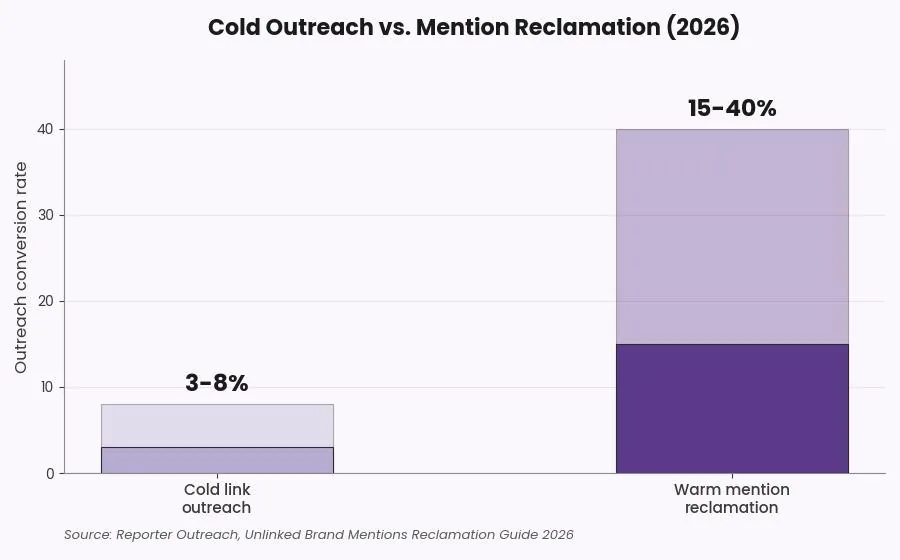
The single biggest reason to prioritize unlinked mention outreach over cold link building is the conversion math. Cold link requests, emailing a site that has never mentioned you and asking them to link to you anyway, convert at roughly 3-8%. Mention reclamation, asking a site that already named your brand to simply add a link to that existing text, converts at 15-40%.
The psychology is straightforward. A cold pitch asks someone to make an editorial decision about a brand they've never covered. A reclamation request asks someone to make a small edit to a decision they already made. Reporter Outreach's 2026 data puts real numbers behind that gap.
| Factor | Cold link outreach | Mention reclamation |
|---|---|---|
| Conversion rate | 3-8% | 15-40% |
| What you're asking for | A brand new editorial decision | A small edit to an existing one |
| Relationship status | No prior connection | Author already knows and named your brand |
| Typical time investment | High (pitch, follow-up, negotiate) | Lower (single email, light context) |
| Best for | Building net-new coverage and reach | Converting existing goodwill into link equity |
Figures reflect 2026 industry benchmarks (Reporter Outreach, Ahrefs, BuzzStream); actual conversion rates vary by brand recognition and outreach quality.
Where unlinked mentions come from

Unlinked mentions aren't rare edge cases. About 20% of digital PR placements arrive without a link on first publish, which means even an active, well-run digital PR program is quietly leaving link equity on the table unless someone runs a reclamation pass afterward. This is exactly why reclamation works best as the "back half" of an active PR program, not a standalone substitute for one: active campaigns generate the raw mentions, and reclamation converts a meaningful share of them into links.
Common sources worth monitoring:
- Industry publications and trade press
- News articles and press roundups
- Review and comparison sites (G2, Capterra, and similar)
- Podcast show notes and transcripts
- Reddit, Quora, and other forum or community platforms
- Competitor "alternatives to" and listicle content
How to find unlinked brand mentions
Finding mentions at scale requires more than checking your own inbox for compliments. A few standard approaches:
- Ahrefs Content Explorer. Search your brand name and use the "highlight unlinked domains" feature to isolate sites that mention you but have never linked to you.
- Semrush Brand Monitoring. Tracks mentions across the web and flags which ones already include a link versus which don't.
- Google Alerts. Free, real-time notifications for your brand name; best paired with a paid tool for full coverage since Alerts misses a lot.
- Manual search operators. A simple "[Your Brand]" -site:yourdomain.com search in Google surfaces mentions quickly for smaller brands or one-off checks.
How to prioritize which mentions to pursue
Not every unlinked mention deserves an outreach email. Prioritize based on:
- Domain Rating and organic traffic of the mentioning site, not just raw mention count.
- Recency. Reaching out within days or weeks of publication converts meaningfully better than reaching out to a mention that's a year old.
- Editorial context. A mention naming your product specifically in a positive light is worth more than a vague, indirect reference.
- Existing relationship. If the site already links to you elsewhere, a second link matters less than the first one.
Unlinked mention tool
Should you pursue this mention?
Score an unlinked mention you found to decide whether it's worth an outreach email.
Priority score
--
Adjust the fields above to see a recommendation.
Converting a mention into a backlink
Once you've prioritized a mention, the outreach itself should stay short and low-friction:
- Thank them for the mention specifically, referencing what they said.
- Ask, briefly, if they'd consider adding a link to the mention so their readers have a direct path to learn more.
- Offer something in return where genuine: a fresh statistic, a correction to something outdated on the page, or additional resources.
- Send one polite follow-up if you don't hear back within 5-7 business days, then let it go.
Common mistakes to avoid
- Treating every mention as equally valuable. A mention buried in a low-authority directory isn't worth the same outreach effort as one on a recognized industry publication.
- Being pushy about the ask. Demanding a link because a site "used your name" reads as entitled, not persuasive, and can damage a relationship you'd rather keep.
- Fighting a strict no-follow policy. Some major publications never add dofollow links regardless of the ask. A nofollow mention still contributes to the AI-citation entity signal discussed above, so it isn't wasted effort even without classic link equity.
- Waiting too long to reach out. Response rates drop sharply for content that's several months old, since the author has moved on and the page is no longer top of mind.
- Ignoring mentions without a URL at all (podcast audio, print coverage) that could still be surfaced and referenced elsewhere, even without a direct reclamation path.
Frequently asked questions
Do unlinked brand mentions actually help SEO?
They don't pass direct link equity the way a backlink does, and Google's John Mueller has said Google doesn't use them as a direct ranking signal. What they do reliably contribute to is entity recognition and, increasingly, AI citation likelihood, since AI platforms read the mention itself rather than the link graph around it.
What's the difference between a linked and an unlinked mention?
A linked mention includes a clickable hyperlink back to your site. An unlinked mention names your brand in the text without one. Both can build brand awareness and entity association; only the linked version passes conventional SEO link equity and referral traffic.
How do I find unlinked mentions of my brand?
Ahrefs Content Explorer and Semrush Brand Monitoring are the most efficient paid tools, both offering features that isolate mentions without an existing link. Google Alerts and manual search operators ("[Your Brand]" -site:yourdomain.com) work as free starting points for smaller-scale monitoring.
What's a good conversion rate for mention reclamation outreach?
Industry data puts warm mention reclamation at roughly 15-40%, well above the 3-8% typical for cold link-building outreach. Personalizing each email and reaching out within days or weeks of publication pushes conversion toward the higher end of that range.
Should I bother with mentions on sites that never add dofollow links?
Generally yes, if the context and authority are strong. A nofollow mention doesn't pass classic link equity, but it still feeds the same entity-recognition and AI-citation signals discussed earlier in this guide, so it isn't wasted effort even without a follow link.
Turning silent mentions into measurable authority
An unlinked brand mention isn't a missed opportunity in the way a lot of link-building content frames it, and it isn't the guaranteed ranking to win some of that same content overstates either. It's something more specific: proof that someone already found your brand worth naming, sitting in text that AI platforms are increasingly reading to decide who to cite. The brands treating mention monitoring and reclamation as a standing habit, rather than an occasional audit, are the ones quietly building both link equity and AI visibility from coverage they already earned.
More from Web Tonic: growth marketing services, data & analytics, performance creative.
Sources: developers.google.com · ahrefs.com · semrush.com · moz.com · google.com