Table of contents
No study prices "trucking video marketing" as its own category, so this page splits the real budget question in two: what a walkaround video costs against equipment-sale decisions, and what a driver-recruiting video costs against a hiring decision. Both are priced from the closest verified 2026 data - Wyzowl's cross-industry video survey and vendor-reported CDL recruiting campaign data - with every number labeled for its actual source.
Key Takeaways
- 91% of businesses use video as a marketing tool in 2026, per Wyzowl's cross-industry survey.
- 85% of video marketers say video has helped generate leads, and 83% say it directly increased sales.
- 93% of marketers say video has helped increase brand awareness, down from 96% the year before.
- 85% of consumers say a video convinced them to buy a product or service.
- Targeted CDL-recruiting YouTube ads run about $0.05 to $0.15 per view in published vendor data.
- Typical CDL video budgets of $500-$2,000/month reach 10,000-50,000 impressions, per the same vendor data.
- Median cost per applicant for a Class A CDL driver is reported at $13.57, rising to $21.13 for specialized routes.
- One documented recruiting campaign cut cost per hire 29.1% while raising hires 36.8% year over year.
- That same campaign saw video views grow over 1,154%.
- Combined driver wages and benefits hit $1.028 a mile in 2025, the first year above a dollar.
- Median heavy and tractor-trailer driver pay is $28.19 an hour, per 2025 wage data.
- ATA's last published driver-shortage estimate is 80,000, projected toward 160,000 by 2030.
- 82% of video marketers say video increased web traffic and dwell time.
- 57% say video reduced support queries, a smaller but real share.
- 84% of consumers want to see more brand video in 2026, consistent for eight straight years.
- Roughly 2.1 million heavy and tractor-trailer drivers are employed in the U.S., the audience recruiting video targets.
Two very different videos, two very different budgets
"Trucking video marketing" collapses two jobs that do not share a buyer, a distribution channel, or a cost base. A walkaround video sells a specific truck or trailer to a fleet purchasing manager or owner-operator, gets distributed on a dealer's YouTube channel, and is found through organic search when someone is already shopping. A driver-recruiting video sells a job and a lifestyle to a driver candidate, gets distributed as paid social and pre-roll against a demographic, and is judged on cost per applicant, not search rank. Pricing both from one blended "trucking video" number hides which one is actually working.
| Video type | Buyer | Distribution | What it is judged on |
|---|---|---|---|
| Walkaround / equipment | Fleet purchasing manager, owner-operator | Dealer YouTube channel, organic search | Time on unit page, inquiry rate |
| Driver recruiting | CDL driver candidate | Paid social, pre-roll, targeted YouTube ads | Cost per applicant, cost per hire |
| Brand / customer trust | Shipper, broker, existing customer | Website, LinkedIn, sales enablement | Time on site, quote-form starts |
What video is doing for marketers generally, in 2026
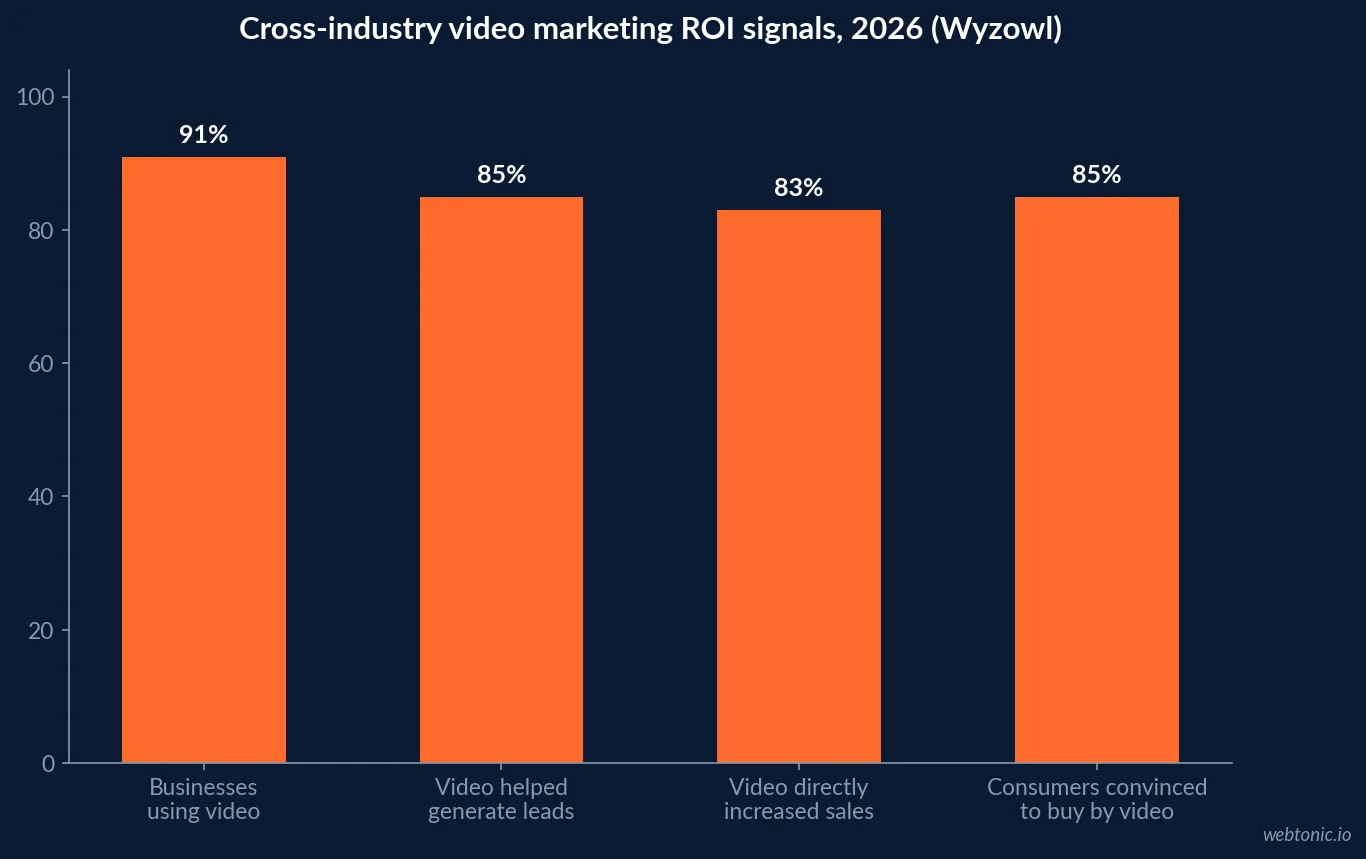
Wyzowl's 2026 State of Video Marketing survey - 266 respondents surveyed in late 2025, the 12th consecutive year of the study - reports 91% of businesses use video as a marketing tool, back near its all-time high after a dip in 2025. Among marketers who use it, 85% say video has helped generate leads, 83% say it directly increased sales, and 93% say it helped increase brand awareness (down slightly from 96% the year before). On the consumer side, 85% say they have been convinced to buy a product after watching a video, and 84% want to see more brand video in 2026, a figure Wyzowl says has stayed within 8 points for eight straight years.
None of that is trucking-specific. It is the baseline case for treating video as a real budget line at all, which is a fair starting point before pricing the two trucking-specific jobs separately.
Pricing a driver-recruiting video campaign
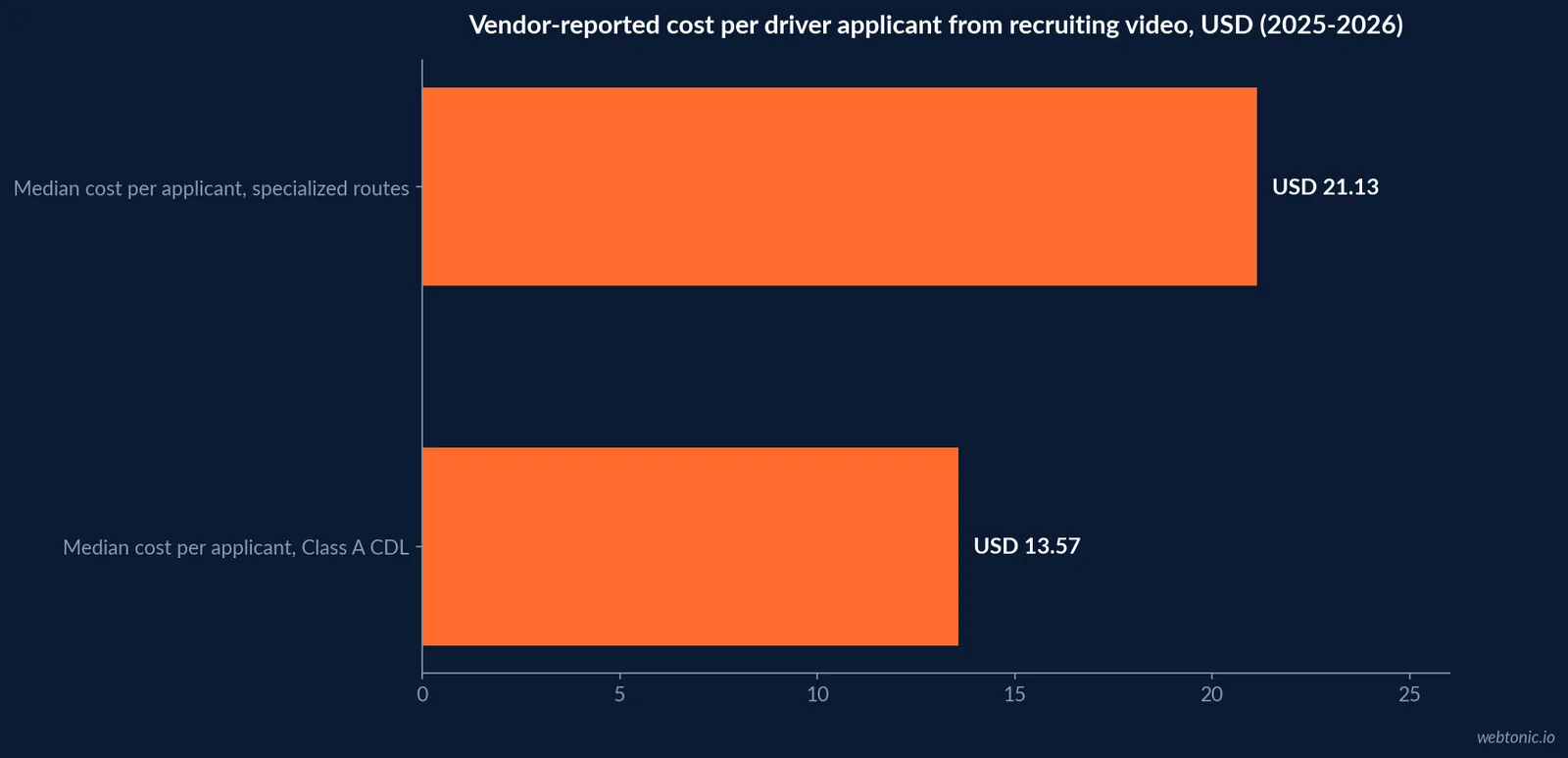
No trucking association tracks recruiting-video cost data, so the numbers here come from marketing vendors that publish their own CDL-recruiting campaign data - useful, but explicitly vendor-reported rather than an industry census. One vendor's published figures put targeted YouTube video ads aimed at CDL drivers in specific geographic markets at $0.05 to $0.15 per view, with typical campaigns of $500 to $2,000 a month reaching 10,000 to 50,000 targeted impressions. A separate recruiting-marketing vendor's 2025-2026 campaign data puts the median cost per applicant for a Class A CDL company driver at $13.57, rising to about $21.13 for specialized rural or agricultural routes.
A single documented case adds a directional outcome number: one carrier's rebuilt recruiting-video program, per an agency case study, delivered a 36.8% year-over-year increase in hires and a 29.1% reduction in cost per hire, alongside video views growing over 1,154%. That is one company's reported result, not a benchmark to plan a budget around, but it is consistent with the direction of the cross-industry Wyzowl data above.
| Recruiting video cost data (vendor-reported, 2025-2026) | Figure | Source |
|---|---|---|
| Targeted CDL YouTube ad cost per view | $0.05-$0.15 | Trucking-recruiting marketing vendor |
| Typical monthly budget / reach | $500-$2,000 for 10,000-50,000 impressions | Trucking-recruiting marketing vendor |
| Median cost per applicant, Class A CDL | $13.57 | CDL recruiting benchmark vendor, 2025-2026 data |
| Cost per applicant, specialized/rural routes | ~$21.13 | CDL recruiting benchmark vendor, 2025-2026 data |
| One documented campaign's hire increase | 36.8% YoY | Agency-reported case study |
| Same campaign's cost-per-hire change | -29.1% | Agency-reported case study |
The pay economics a recruiting video is arguing against
A recruiting video's job is to make a real offer sound competitive, so the offer has to be checked against real driver-pay data first. The American Transportation Research Institute's 2026 operating-cost update, reported by Heavy Duty Trucking, found combined driver wages and benefits reached $1.028 a mile in 2025 - the first year that figure passed a dollar. Separately, O*NET's mirror of BLS wage data puts the median wage for heavy and tractor-trailer truck drivers at $28.19 an hour, or roughly $58,640 a year, in 2025, across an estimated workforce of about 2.1 million drivers nationally. American Trucking Associations' most recently published driver-shortage estimate is 80,000, from an October 2021 release projecting a shortfall that could reach 160,000 by 2030.
A video that leads with lifestyle and skips pay specifics is competing against carriers whose videos lead with the number. Given the per-mile compensation data above, that is the harder video to win with.
| Driver economics fact (verified year) | Figure | Source |
|---|---|---|
| Combined driver wages + benefits, per mile | $1.028 (2025) | ATRI, reported by Heavy Duty Trucking |
| Median heavy/tractor-trailer driver wage | $28.19/hr, ~$58,640/yr (2025) | O*NET (BLS OEWS data) |
| U.S. heavy/tractor-trailer driver workforce | ~2.1 million | O*NET (BLS OEWS data) |
| ATA's last published driver shortage estimate | 80,000 (Oct. 2021) | American Trucking Associations |
| Projected shortage by 2030 (2021 estimate) | Up to 160,000 | American Trucking Associations |
Walkaround video: the other half of the budget
Equipment walkaround video is judged by different mechanics entirely - it is closer to real estate or auto listing video than to recruiting media. There is no published trucking-specific ROI figure for walkaround content, so the honest anchor is the same cross-industry Wyzowl data: 82% of video marketers say video helped keep visitors on their website longer, and 80% of people say they have bought or downloaded something after watching a demo-style video. A dealer's inventory walkaround is functionally a demo video, and the buyer decision it supports (does this specific unit meet my spec) is closer to that pattern than to the lead-generation numbers used for recruiting video above.
How to brief the two videos differently
Production crews often reuse the same shot list for both jobs, which is where budgets quietly blend back together. A walkaround brief should prioritize spec accuracy - VIN-specific details, mileage, maintenance history - because the buyer is comparing units line by line. A recruiting brief should prioritize pay transparency and home-time specifics, because Wyzowl's data shows video's biggest reported lift is in generating leads and driving action, not just impressions, and a driver candidate acts on specifics faster than on tone.
| Brief element | Walkaround video | Recruiting video |
|---|---|---|
| Opening 5 seconds | Unit identification: year, make, spec | Pay range or home-time stated on screen |
| Core content | Walkthrough of condition, mileage, maintenance | Driver testimonial, day-in-the-life footage |
| Call to action | Contact dealer, schedule inspection | Apply now, text-to-apply number |
| Success metric | Time on unit page, inquiry rate | Cost per applicant, cost per hire |
| Distribution | Dealer YouTube channel, organic search | Paid social, targeted pre-roll |
Where the budget conversation usually breaks down
Most disputes over a trucking video budget are really disputes over which job the video was supposed to do. A walkaround video judged on cost-per-applicant will always look like a failure, because that was never its metric. A recruiting video judged on organic search traffic will look underpowered, because paid social distribution was the point. Naming the job before the brief is written removes most of that argument before it starts.
What the equipment side of the budget still needs
Wyzowl's survey also reports that 80% of people have bought or downloaded an app after watching an app demo video, and 96% have watched an explainer video to learn more about a product or service. Those two figures are the closest cross-industry proxy for how a fleet buyer treats a walkaround video: it functions as a demo, not an ad, and gets judged on whether it answered the spec questions a buyer already had rather than on whether it was persuasive.
| Cross-industry video ROI signal (Wyzowl 2026) | Figure |
|---|---|
| Businesses using video as a marketing tool | 91% |
| Video marketers reporting increased leads | 85% |
| Video marketers reporting direct sales increase | 83% |
| Consumers convinced to buy after watching a video | 85% |
| Consumers who bought/downloaded after a demo video | 80% |
| Consumers who watched an explainer to learn about a product | 96% |
A compliance note for recruiting video specifically
A recruiting video is a job ad, and job ads carry the same anti-discrimination exposure as any other hiring content. The EEOC's 2025 suit against a Class A carrier over an age-based hiring policy is a reminder that on-screen talent age, framing around "young energetic drivers," or footage that implies a physical requirement not tied to the actual job should get the same legal review as the written job posting, not a pass because it is video rather than text.
Two budget lines, not one
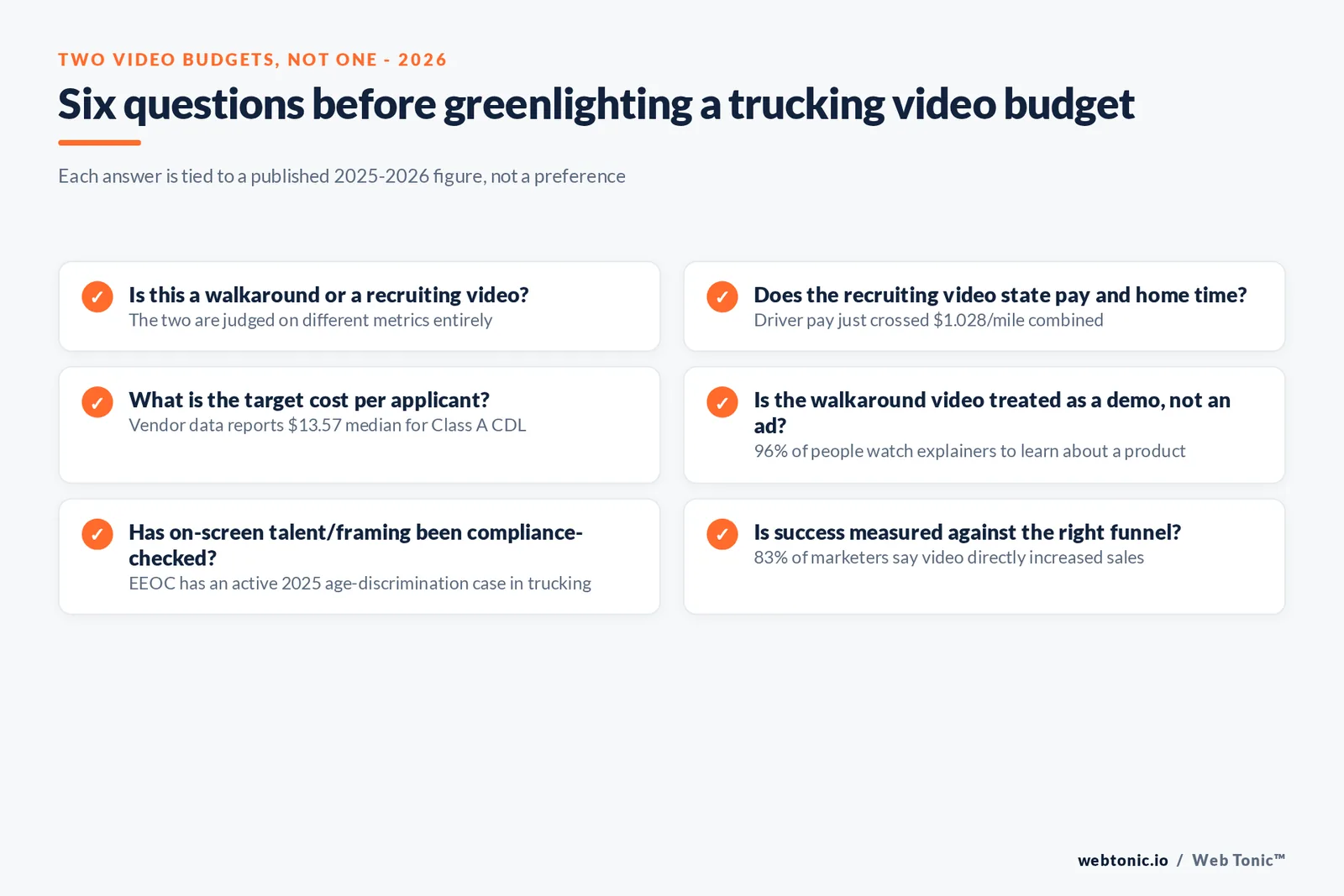
The practical takeaway is structural: a fleet or dealer marketing budget should carry a walkaround-video line item measured on time-on-page and inquiry rate, and a separate recruiting-video line item measured on cost per applicant and cost per hire, checked against the $13.57-$21.13 range above rather than a general "video marketing" cost per lead. Blending the two into one number under-credits whichever one is actually converting. Our growth marketing team builds that split before touching a script, our data and analytics practice sets up the separate tracking each funnel needs, and if the current setup is running both off one number, talk to us about separating the two.
Frequently Asked Questions
Is there a trucking-specific video marketing benchmark?
No. Wyzowl's annual survey, the largest published video-marketing dataset, does not break results out by industry, and no trucking trade body publishes a video ROI study. What exists instead is Wyzowl's 2026 cross-industry data - 266 marketer and consumer respondents - plus CDL-recruiting cost data published by marketing vendors that specialize in driver hiring. Both are usable if labeled for what they are.
What should a fleet manager expect to pay for a driver-recruiting video?
Published vendor data (not a trucking-wide survey) puts targeted YouTube video ads aimed at CDL drivers at roughly $0.05 to $0.15 per view, with typical monthly budgets of $500 to $2,000 reaching 10,000 to 50,000 targeted impressions. Separately, one recruiting-marketing vendor's 2025-2026 campaign data put the median cost per applicant for a Class A CDL company driver at $13.57, rising to about $21.13 for specialized rural or agricultural routes. Treat both as vendor-reported ranges, not an audited industry average.
Does video actually move driver applications, or just views?
The honest answer is that no trucking-specific outcome study exists, so the closest evidence is directional. Wyzowl's 2026 survey reports 85% of video marketers say video has helped generate leads and 83% say it has directly increased sales, across all industries surveyed. A recruiting case study reported alongside a driver-focused video campaign showed a 36.8% year-over-year increase in hires and a 29.1% cut in cost per hire, with video views up over 1,154% - a single case, not a benchmark, but consistent with the direction.
What is a walkaround video, and does it need a different budget than a recruiting video?
A walkaround video shows a truck or piece of equipment for a sale or lease decision - the buyer is a fleet purchasing manager or owner-operator evaluating a specific unit, not a driver evaluating a job. Recruiting video sells the job and the lifestyle to a driver candidate. Both use similar production but different distribution: walkaround videos live on a dealer's YouTube channel and get found through search, recruiting video is distributed as paid social and pre-roll aimed at a demographic, which is why the cost bases above do not transfer between the two.
How does the driver-pay data affect the recruiting-video budget conversation?
It sets the floor the video has to argue against. ATRI's 2026 operating-cost update found combined driver wages and benefits reached $1.028 a mile in 2025, the first year that figure passed a dollar, and heavy and tractor-trailer drivers earned a median $28.19 an hour as of the 2025 BLS wage data. A recruiting video that cannot credibly speak to pay, home time and equipment quality against those real numbers is competing on production value against carriers competing on pay.
Sources
Wyzowl - Video Marketing Statistics 2026
U.S. Equal Employment Opportunity Commission - EEOC v. Gamer Logistics
Heavy Duty Trucking - ATRI 2026 operating cost update
O*NET Online - Heavy and Tractor-Trailer Truck Drivers (BLS OEWS data)
American Trucking Associations - Driver shortage estimate, October 2021
Boostpoint - CDL driver recruiting costs and channels, 2025-2026 data
LACED Agency - System Transport driver recruiting case study (own client data, +36.8% YoY hires)