Table of contents
No study publishes a trucking-and-logistics SEO budget figure, so the honest way to answer this page's title is to combine what does exist: The CMO Survey's Transportation-sector spending breakouts, and the FMCSA/ATA carrier data that decides how much organic-search competition that budget actually has to beat.
Key Takeaways
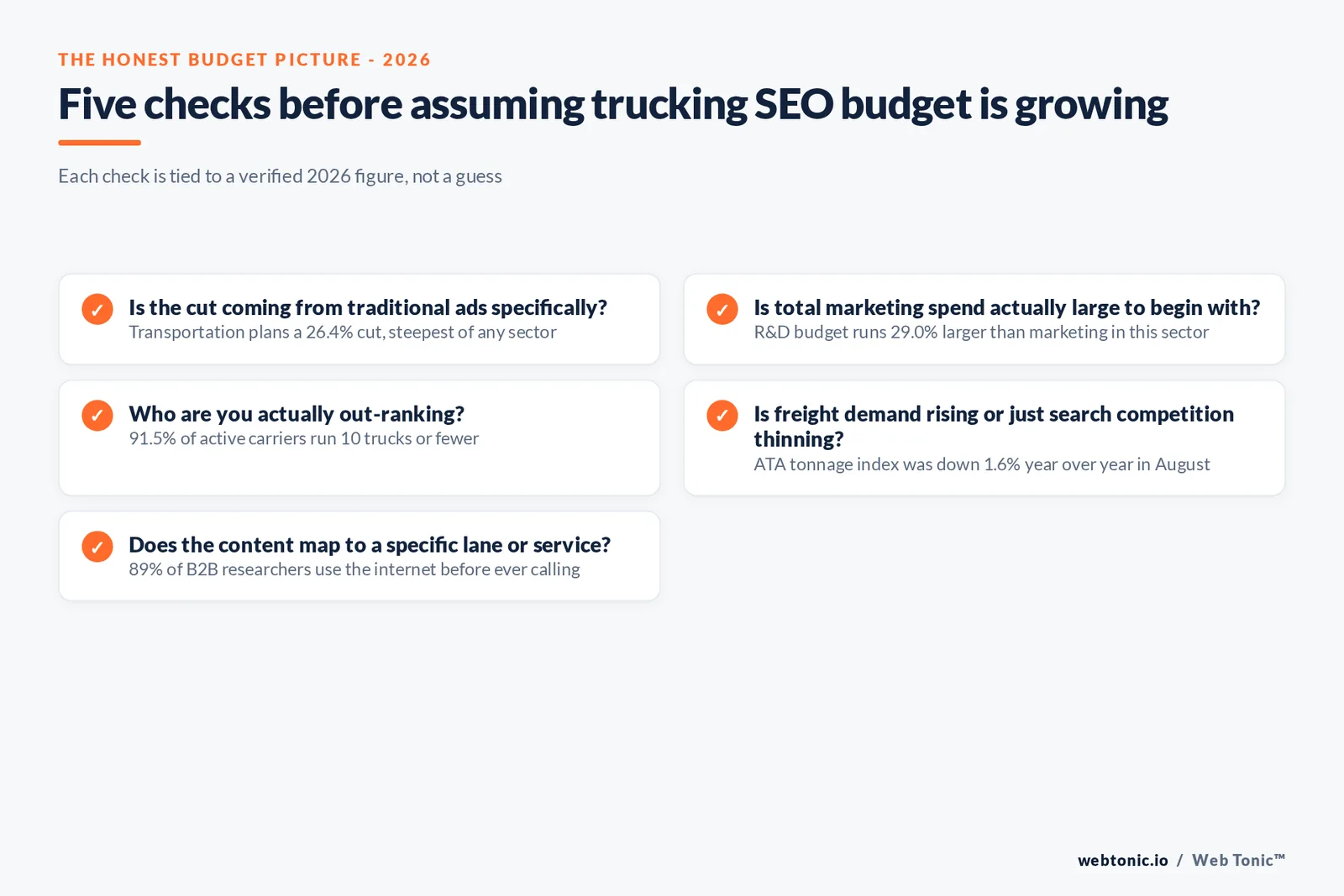
- Transportation marketers plan a 26.4% cut to traditional advertising in the next 12 months, the steepest of any sector The CMO Survey tracks.
- The cross-industry average traditional-ad cut is just 1.5% by comparison.
- Digital marketing spending grew 8.2% industry-wide versus 1.7% overall marketing growth in 2026.
- Transportation's R&D budget runs 29.0% larger than its marketing budget, one of the widest gaps The CMO Survey measures.
- Cross-industry marketing budgets sit at 9.0% of revenue and 9.6% of overall company budget.
- Almost 580,000 active US motor carriers owned or leased at least one tractor as of June 2025, per FMCSA data cited by the ATA.
- 91.5% of those carriers operate 10 trucks or fewer; 99.3% operate 100 or fewer.
- Trucks moved 72.7% of the nation's freight by weight in 2024.
- The industry's gross freight revenue was USD 906 billion in 2024.
- The ATA's Truck Tonnage Index fell 0.5% in August 2026, down 1.6% year over year.
- Industrial & Commercial paid search averages a USD 5.87 cost per click, the closest LocaliQ category to freight and logistics buyers.
- 64% of C-suite decision-makers say thought leadership directly influenced an award-of-business decision, per Edelman and LinkedIn's B2B research.
- 89% of B2B researchers use the internet during the buying process, per Google's long-running B2B research.
The clearest signal: money is leaving traditional ads faster here than anywhere else
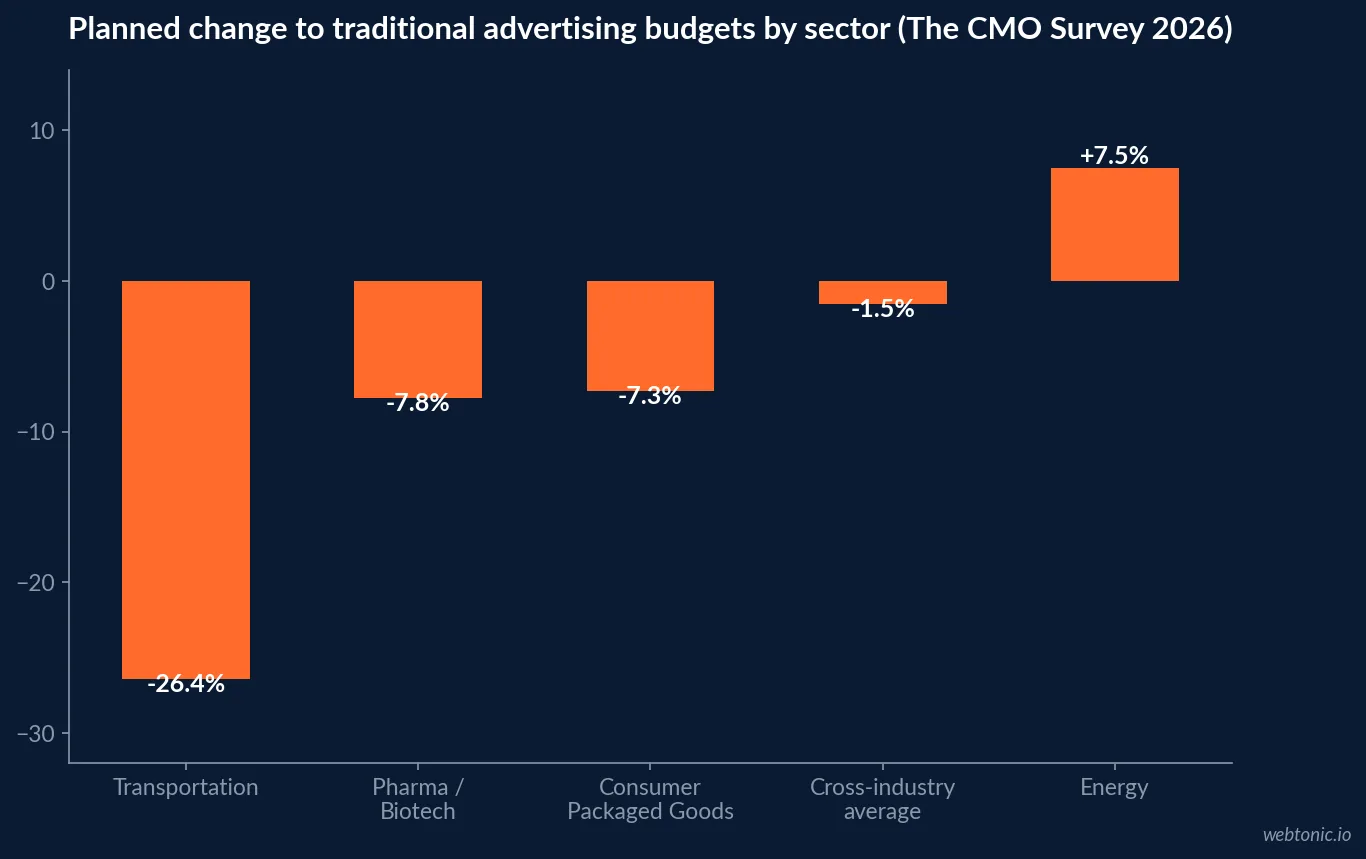
The CMO Survey, Duke University's marketing-spend benchmark run since 2008, surveyed 308 marketing leaders in January 2026 and asked how their traditional advertising budgets would change over the next 12 months. Transportation reported the steepest planned cut of any sector at -26.4% - more than seventeen times the -1.5% cross-industry average, and far beyond the next steepest cuts in Pharma/Biotech (-7.8%) and Consumer Packaged Goods (-7.3%).
At the same time, overall digital marketing spending grew 8.2% industry-wide against just 1.7% overall marketing spend growth. The survey does not break digital growth out by sector, so this page will not claim a Transportation-specific digital number that does not exist - but the direction of the two verified numbers together is unambiguous: trucking and logistics dollars are exiting print, trade-show and broadcast line items faster than any other industry, into a marketing mix where digital is already absorbing the growth.
| Sector, planned traditional-ad budget change (2026) | Figure | Source |
|---|---|---|
| Transportation | -26.4% | The CMO Survey 2026 |
| Pharma / Biotech | -7.8% | The CMO Survey 2026 |
| Consumer Packaged Goods | -7.3% | The CMO Survey 2026 |
| Cross-industry average | -1.5% | The CMO Survey 2026 |
| Energy (largest increase) | +7.5% | The CMO Survey 2026 |
Why the cut is dramatic but the dollars are still small
Context matters here. The CMO Survey also asked companies to compare their marketing budget with their R&D budget, and Transportation reported R&D running 29.0% larger than marketing - one of the widest gaps of any sector, behind only Energy (-40.0%) and Tech/ Software/Platform (-39.8%). Cross-industry, marketing budgets average 9.0% of company revenue and 9.6% of overall company budget. A 26.4% cut inside a marketing line that was already thin relative to R&D is a large percentage move on a modest base, not a sudden collapse in an otherwise big spender.
| CMO Survey 2026 metric (cross-industry unless noted) | Figure | Read for trucking & logistics |
|---|---|---|
| Marketing budget, % of revenue | 9.0% | Cross-industry baseline; Transportation not broken out |
| Marketing budget, % of overall company budget | 9.6% | Lowest level since 2021 |
| Overall marketing spending growth | 1.7% | Weakest growth rate since 2021 |
| Digital marketing spending growth | 8.2% | Where the growth is actually happening |
| Transportation R&D vs. marketing budget gap | R&D +29.0% larger | Marketing starts from a small base in this sector |
Who the SEO dollar actually has to compete against
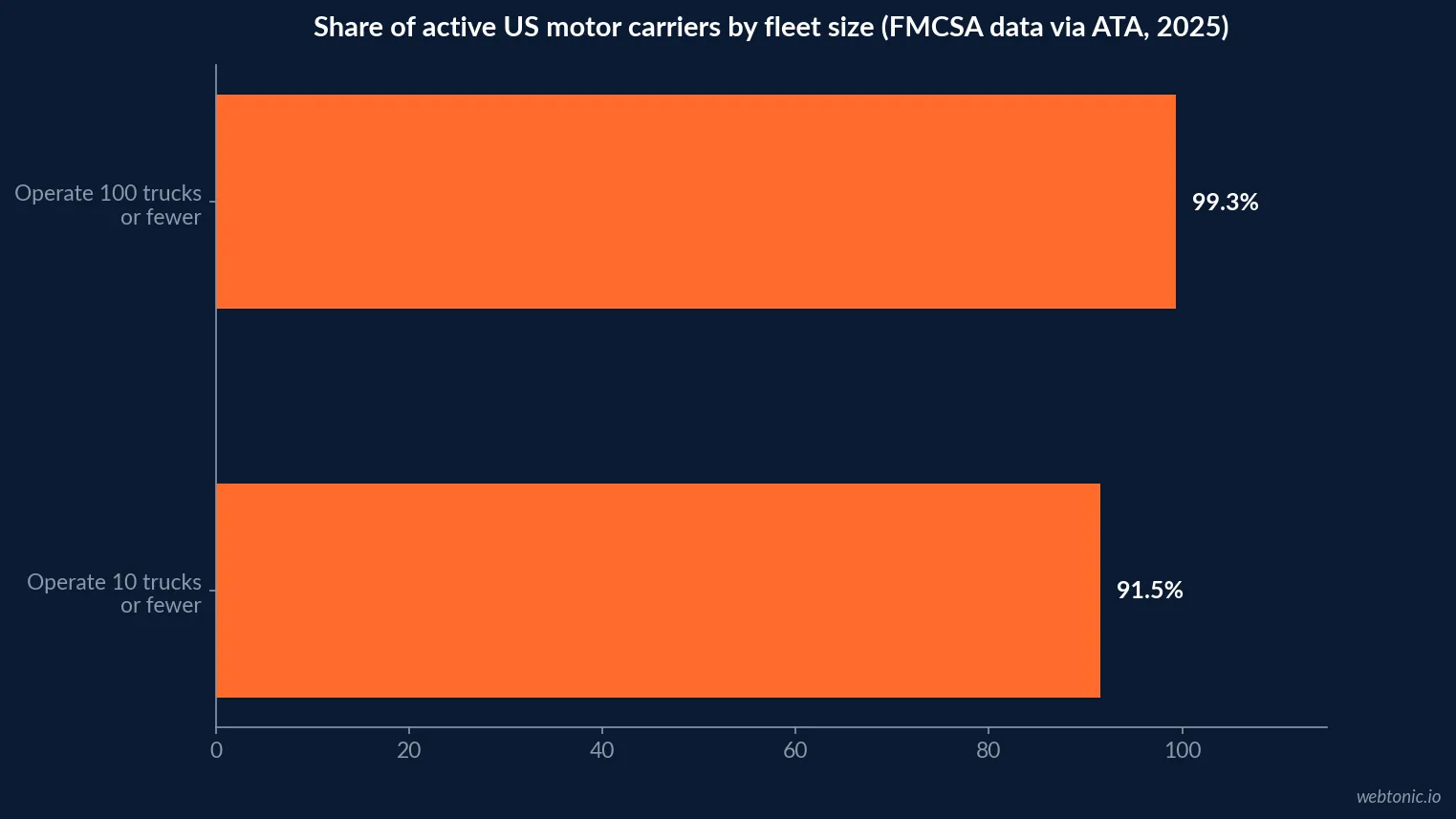
The American Trucking Associations' own economics data, sourced from FMCSA registrations, states that as of June 2025 there were almost 580,000 active US motor carriers registered with FMCSA that own or lease at least one tractor. Of those, 91.5% operate 10 trucks or fewer, and 99.3% operate 100 or fewer. Trucks moved 72.7% of the nation's freight by weight in 2024, on a gross freight bill of USD 906 billion.
A fleet running ten trucks or fewer is very unlikely to be running a dedicated marketing function, let alone an SEO program. That concentration means the actual organic-search competitive set in trucking and logistics is a small fraction of the almost 580,000 registered carriers - which is the real reason a modest SEO budget can move a search results page in this sector faster than in a consumer category crowded with well-funded competitors.
| FMCSA/ATA carrier landscape metric (as of June 2025 / 2024) | Figure | Source |
|---|---|---|
| Active US motor carriers with 1+ tractor | ~580,000 | FMCSA data via ATA |
| Operate 10 trucks or fewer | 91.5% | FMCSA data via ATA |
| Operate 100 trucks or fewer | 99.3% | FMCSA data via ATA |
| Share of US freight moved by weight (2024) | 72.7% | American Trucking Associations |
| Gross trucking freight revenue (2024) | USD 906 billion | American Trucking Associations |
What buying visibility costs while organic is being built
Trucking and logistics buyers do not map cleanly onto any single LocaliQ category, but Industrial & Commercial is the closest published proxy: an average cost per click of USD 5.87, a 6.57% click-through rate, an 8.20% conversion rate, and a cost per lead of USD 75.19 in LocaliQ's 2026 benchmark study of 13,000-plus US search campaigns. That is the paid-search cost of the visibility an SEO program is trying to earn for free - useful context for building the case that redirected traditional-ad dollars belong in organic content and technical SEO, not only in more paid clicks.
| Industrial & Commercial paid search (LocaliQ 2026 proxy) | Figure |
|---|---|
| Average cost per click | USD 5.87 |
| Average click-through rate | 6.57% |
| Average conversion rate | 8.20% |
| Average cost per lead | USD 75.19 |
The demand backdrop the SEO budget is actually working against
None of this is happening against a growth market. The ATA's seasonally adjusted For-Hire Truck Tonnage Index fell 0.5% in August 2026 after a 1.2% July decline, and stood 1.6% below the same month in 2025. ATRI's 2026 Analysis of the Operational Costs of Trucking found the industry-average cost to operate a truck reached USD 2.336 per mile in 2025, up 3.4%, while operating margins in the truckload and refrigerated sectors stayed below 1.0%. Carriers cut truck counts 2.4% and non-driver staffing 7.8% to manage it.
An SEO budget in this environment is competing for a flat-to-shrinking pool of freight search volume, not riding rising demand. That reframes the "where is the budget going" question: it is moving toward digital and organic content because the traditional-ad alternative is being cut hardest of any sector, not because logistics search demand is expanding.
Where the B2B research says the redirected budget should land
Two cross-industry B2B studies point toward content and organic search specifically, even though neither is trucking-specific. Edelman and LinkedIn's 2026 B2B Thought Leadership Impact Report found 64% of C-suite decision-makers say thought leadership directly influenced their decision to award business to an organization. Google's long-running B2B research puts 89% of B2B researchers using the internet during the buying process before ever speaking to a sales rep. Both point the same direction: content that ranks and reads as credible is doing work in the freight-buying decision long before a quote request happens.
Our growth marketing team builds that kind of lane-and-service-specific content program for logistics clients, and our Google Ads strategy guide covers how to run paid search alongside SEO while the organic build-out catches up.
The honest summary
Trucking and logistics SEO budgets are not tracked by name in any published survey. What is tracked, and verified, is that Transportation marketers are cutting traditional advertising faster than any other sector (-26.4%), that digital spend is where cross-industry growth is concentrated (+8.2%), and that the carrier landscape those dollars have to out-rank is overwhelmingly small operators without a marketing function. Read together, that is the closest honest answer to where the budget is headed - toward digital content, against thin organic competition, inside a still-soft freight market. If you want the lane-specific content build-out itself, talk to us.
Frequently Asked Questions
Is there a study that tracks trucking and logistics SEO budgets specifically?
No. The CMO Survey, Duke University's long-running marketing budget study, breaks results out by a Transportation sector but does not isolate SEO as its own line item, and no trucking-specific trade body publishes a marketing-spend survey. This page states that limitation up front and builds its answer from the closest verified data: Transportation's overall budget behaviour and the carrier landscape that decides how competitive organic search actually is.
So where is trucking and logistics marketing money actually moving?
Away from traditional advertising faster than any other sector The CMO Survey tracks. Transportation marketing leaders expect their traditional advertising budgets to fall 26.4% in the next 12 months, compared with a cross-industry average decline of just 1.5%. Meanwhile overall digital marketing spending grew 8.2% industry-wide against 1.7% overall marketing growth - money leaving print, trade show and broadcast budgets in trucking has somewhere to go, and digital channels including SEO are the direction the aggregate data points.
Is trucking and logistics actually a big marketing spender to begin with?
No, and that matters for the budget-shift number. The CMO Survey also finds Transportation firms report their R&D budget running 29.0% larger than their marketing budget, one of the widest gaps of any sector measured (behind only Energy at -40.0% and Tech at -39.8%). The -26.4% cut is happening inside an already small marketing line, not a large one - the dollar amount is modest even where the percentage shift is dramatic.
Why would SEO specifically benefit from carriers that barely spend on marketing?
Because most competitors for a trucking or logistics keyword are not investing in search at all. FMCSA data cited by the American Trucking Associations put active US motor carriers with at least one tractor at almost 580,000 as of June 2025, and 91.5% of them operate 10 trucks or fewer. A fleet running six trucks with no marketing department is not competing for search rankings, which leaves organic visibility concentrated among the small number of carriers and brokers who do invest.
What is the honest ceiling on this opportunity?
It is a competitive-gap argument, not a demand argument. Freight tonnage itself is soft - the ATA's seasonally adjusted For-Hire Truck Tonnage Index fell 0.5% in August 2026 and was down 1.6% year over year - so SEO investment in this sector is about winning a larger share of a flat-to-shrinking search pool, not riding rising demand the way a growth-industry SEO push would.
Sources
The CMO Survey - Highlights and Insights Report 2026
American Trucking Associations - Economics and Industry Data
American Trucking Associations - ATA Truck Tonnage Index Fell 0.5% in August (2026)
American Transportation Research Institute - 2026 Analysis of the Operational Costs of Trucking
LocaliQ - Search Advertising Benchmarks for Every Industry (2026 data)
Edelman and LinkedIn - 2026 B2B Thought Leadership Impact Report (announcement)
Think with Google - The changing face of B2B marketing