Table of contents

How we vet every listicle
Every agency featured on Web Tonic passes our 84-point editorial review before a single listicle goes live. This is how we vet each pick:
Verified client outcomes: We require real case studies with measurable KPIs — revenue, ROAS, CPA, retention — tied to the exact category being ranked. No cherry-picked wins, no unverifiable numbers.
Independent reputation: We cross-check Clutch, Google, G2, and Trustpilot ratings, and screen for review-bombing or suspicious patterns. Only operators with a consistent, verifiable track record make the cut.
Beyond that, every listing goes through a quarterly re-audit. We check 84 criteria across 6 pillars to make sure it still holds up — here are some of the checks we run:
Key Takeaways
- Professional ecommerce web design agencies deliver specialized expertise in conversion optimization, user experience, and platform-specific technical implementation that general design firms cannot match
- Mobile-first design represents a non-negotiable requirement, with mobile commerce accounting for 59% of global retail ecommerce sales in 2025 and growing to 63% by 2028, representing $2.51 trillion in transaction volume
- Conversion rate improvements deliver exponential revenue impact: increasing conversion from 2% to 4% doubles revenue from identical traffic without additional marketing costs
- Template-based DIY platforms create hidden opportunity costs exceeding $400,000 annually for mid-market businesses through lower conversion rates and SEO performance limitations
- Platform selection should align with business requirements and growth objectives, with Shopify excelling for small to mid-market businesses, Magento for enterprise operations, and WooCommerce for content-heavy brands
- Consider partnering with specialized ecommerce agencies whose success directly aligns with your revenue outcomes, prioritizing proven expertise in conversion optimization, mobile-first design, and long-term partnership capabilities over portfolio aesthetics or low pricing
What Are Ecommerce Web Design Agencies?
Ecommerce web design agencies specialize in creating, optimizing, and scaling online retail platforms that convert browsers into buyers. Unlike general web design firms, these agencies focus specifically on the unique challenges of digital commerce including streamlined checkout processes, product page optimization, mobile-first experiences, and conversion rate optimization.
They combine visual design, user experience expertise, and technical development to build online stores that generate measurable revenue growth.
Why does this specialization matter? Ecommerce design requires knowledge that general agencies simply don't have. According to Forrester Research, a seamless user experience can boost conversion rates by up to 200%. Design quality directly translates to business outcomes. Research examining website design factors and conversion rates confirms that usability, system quality, and information quality significantly impact ecommerce performance.
For mid-market and enterprise businesses, selecting an agency with proven ecommerce expertise means partnering with specialists who understand online retail psychology, platform-specific technical requirements (Shopify's Liquid templating, Magento's XML layout system, WooCommerce's hook architecture), and data-driven optimization strategies.
The ecommerce design landscape has evolved significantly. Mobile commerce is projected to represent 59% of total retail ecommerce sales in 2025, reaching approximately $2.51 trillion globally. This fundamental shift requires expertise that traditional design firms simply cannot provide.
How to Select the Best Ecommerce Web Design Agency
Choosing the right agency partner requires examining specific criteria that separate effective ecommerce specialists from generalist design firms. The evaluation process should focus on measurable outcomes rather than aesthetic preferences alone. Look for transparent communication, proven project management capabilities, and comprehensive web development expertise.
Core Selection Criteria Comparison
| Evaluation Factor | What to Look For | Red Flags | Expected Evidence |
|---|---|---|---|
| Platform Expertise | Official certifications (Shopify Partner, Adobe Solution Partner), 50+ completed projects | Generic web design portfolio, no platform specialization | Case studies with specific platform metrics |
| Conversion Focus | Documented conversion rate improvements of 30%+ | Vague claims about "boosting sales" | Before/after metrics with client attribution |
| Mobile Optimization | Mobile-first design philosophy, PWA capabilities | Desktop-only portfolios, slow mobile load times | Mobile conversion rates, page speed scores |
| SEO Integration | Technical SEO from project inception, schema markup | SEO as add-on service or afterthought | Organic traffic growth case studies |
| Full-Service Offering | CRO, analytics, ongoing optimization | Design-only services, no post-launch support | Retainer client retention rates |
Platform Expertise and Technical Capabilities
The best ecommerce agencies demonstrate deep proficiency across major platforms including Shopify, Magento, WooCommerce, and BigCommerce.
Platform specialization matters. Each system has distinct technical requirements, optimization opportunities, and limitations. Agencies should provide official certifications (Shopify Partner, Adobe Solution Partner, BigCommerce Elite Partner) along with documented case studies proving platform-specific results.
Technical capabilities extend beyond basic website development. Leading agencies integrate complex systems—ERP platforms like NetSuite or SAP, CRM tools such as Salesforce or HubSpot, inventory management systems including TradeGecko or Cin7, and shipping solutions like ShipStation or Shippo. They implement advanced features such as personalized product recommendations (using tools like Nosto or Dynamic Yield) and multi-currency support for international expansion. Research from McKinsey shows that companies implementing advanced personalization can increase conversion rates by 10-15% while improving marketing efficiency by 10-30%.
Proven Track Record with Conversion-Focused Design
Portfolio analysis reveals an agency's true capabilities.
Examine completed projects for businesses similar to yours in size, industry, and target market. Strong portfolios show measurable improvements in conversion rates, average order values, site speed metrics, and organic traffic growth.
Case study quality matters more than quantity. Here's the uncomfortable truth: most agencies pad their portfolios with client logos they barely worked with. Detailed case studies should include specific before-and-after metrics and verified client results—not just "we redesigned their site." The global average ecommerce conversion rate hovers between 2-3%, with top-performing stores achieving 3.5-5% or higher. Agencies should document concrete improvements rather than vague claims.
Mobile-First Design Philosophy and Performance Optimization
Mobile optimization is non-negotiable for modern ecommerce.
With smartphones accounting for 62.3% of ecommerce site traffic and mobile commerce generating $2.51 trillion in sales globally, agencies must prioritize mobile user experience. Progressive Web App capabilities, responsive design frameworks (like Bootstrap 5 or Tailwind CSS), and touch-optimized interfaces all contribute to superior mobile performance.
Performance optimization drives conversion success. Research from Portent shows sites loading in 1 second achieve conversion rates approximately 2.5 times higher than sites loading in 5 seconds.
Every additional second? A 0.3% drop in conversion rates.
Technical optimization encompasses image compression (using tools like TinyPNG or ImageOptim), code minification, content delivery networks (Cloudflare, Fastly, or Amazon CloudFront), and database query optimization.
Comprehensive Service Offerings
Full-service agencies offer several advantages. Integrated strategy ensures design, development, and marketing work harmoniously toward revenue goals. A single point of accountability eliminates finger-pointing between multiple vendors. Ongoing support and optimization delivers compounding improvements over time rather than one-time project completion. Deep client relationships enable strategic guidance beyond tactical execution, while cost efficiency comes through bundled services versus hiring multiple specialists.
The tradeoffs? Higher initial investment compared to specialized design-only firms (expect $50,000-$150,000 for mid-market ecommerce website development projects versus $15,000-$40,000 for design-only work). Full-service agencies may have weaker expertise in specific areas versus focused specialists, while larger agency overhead can increase costs. You'll also find less flexibility to switch individual service providers.
But here's the real question: can you afford to coordinate five different vendors (designer, developer, SEO specialist, CRO expert, ongoing maintenance) when a single partner could own the entire outcome? Agencies following best practices for project management and client communication typically deliver better results than fragmented vendor teams.
Long-term partnership capabilities matter equally. Ecommerce platforms require continuous optimization, feature updates, and strategic refinements. Agencies offering retainer-based optimization services deliver better long-term results than one-time design projects.
Common Misconceptions About Ecommerce Web Design
Misconception 1: Template-Based Designs Perform as Well as Custom Solutions
Many business owners believe that using pre-built templates from Shopify, WooCommerce, or BigCommerce delivers equivalent results to custom design at a fraction of the cost.
Wrong. Templates provide a starting point but lack the strategic customization that drives superior conversion performance.
Custom designs allow agencies to optimize every element based on your specific audience behaviour, product characteristics, and competitive positioning. They can craft unique brand identity elements, align design with specific business goals, and implement conversion strategies tailored to your online store. Templates impose limitations on checkout flow customization, product page layouts, and mobile optimization strategies. Data from multiple ecommerce platforms shows that top-performing stores using custom designs consistently outperform template-based competitors in conversion rates, with the top 20% of Shopify stores achieving conversion rates of 3.2% or higher compared to platform averages around 1.5-1.8%.
Misconception 2: Ecommerce Design Is Primarily About Visual Aesthetics
Business stakeholders often evaluate agency proposals based primarily on portfolio visual appeal, missing the strategic elements that actually drive revenue.
Professional design builds credibility and trust. But conversion performance depends more heavily on user experience architecture, checkout flow optimization, and strategic persuasion elements.
Research examining website design factors confirms that usability, system quality, and information quality have the most significant impact on conversion performance. Elements like simplified navigation, clear calls-to-action, strategic trust signals (verified customer reviews via Trustpilot or Yotpo, security badges from Norton or McAfee, money-back guarantees), and optimized checkout processes matter more than color schemes or typography choices. Users form opinions about website quality within 50 milliseconds. But conversion decisions? Those depend on the entire user journey.
Misconception 3: Lower Pricing Always Indicates Better Value
Price-sensitive buyers often select the least expensive agency proposal, assuming comparable quality across providers.
This approach typically results in higher total costs through project delays, poor performance outcomes, and expensive redesigns within 12-24 months.
Agency pricing reflects expertise, service comprehensiveness, and expected outcomes. Premium agencies charge more because they deliver measurable results including higher conversion rates, better SEO performance, and superior technical implementation. A $15,000 website generating $500,000 in annual revenue at a 2% conversion rate delivers less value than a $45,000 website generating $1.2 million at a 4.5% conversion rate. The math is simple: the cheaper site costs you $700,000 in lost revenue over the first year alone.
Why Mobile-First Design Drives Ecommerce Revenue
Mobile commerce has fundamentally transformed online retail. Yet many businesses continue treating mobile as a secondary consideration.
In 2025, mobile commerce sales reached $2.51 trillion globally, representing 59% of all retail ecommerce transactions. By 2028, this share is projected to grow to 63%, with total mobile commerce revenue reaching $3.35 trillion.
Consumer behaviour shifts explain this transformation. Approximately 76% of U.S. adults use smartphones for online shopping, with 91% of Americans aged 18-49 making mobile purchases. Shopping apps grow 48% faster than average apps (Sensor Tower data from Q3 2024), and mobile users check their phones an average of 96 times daily. Multiple purchase opportunities throughout the day.
However, mobile commerce faces distinct challenges that require specialized design approaches.
Desktop users still convert at approximately 4.8% compared to mobile's 1.8%. A significant performance gap. This disparity comes from mobile usability issues—smaller screens, more difficult input methods, security concerns, and checkout friction. Smart agencies address these challenges through touch-optimized interfaces, one-click checkout solutions (like Shop Pay or Apple Pay), mobile wallet integration, and streamlined navigation.
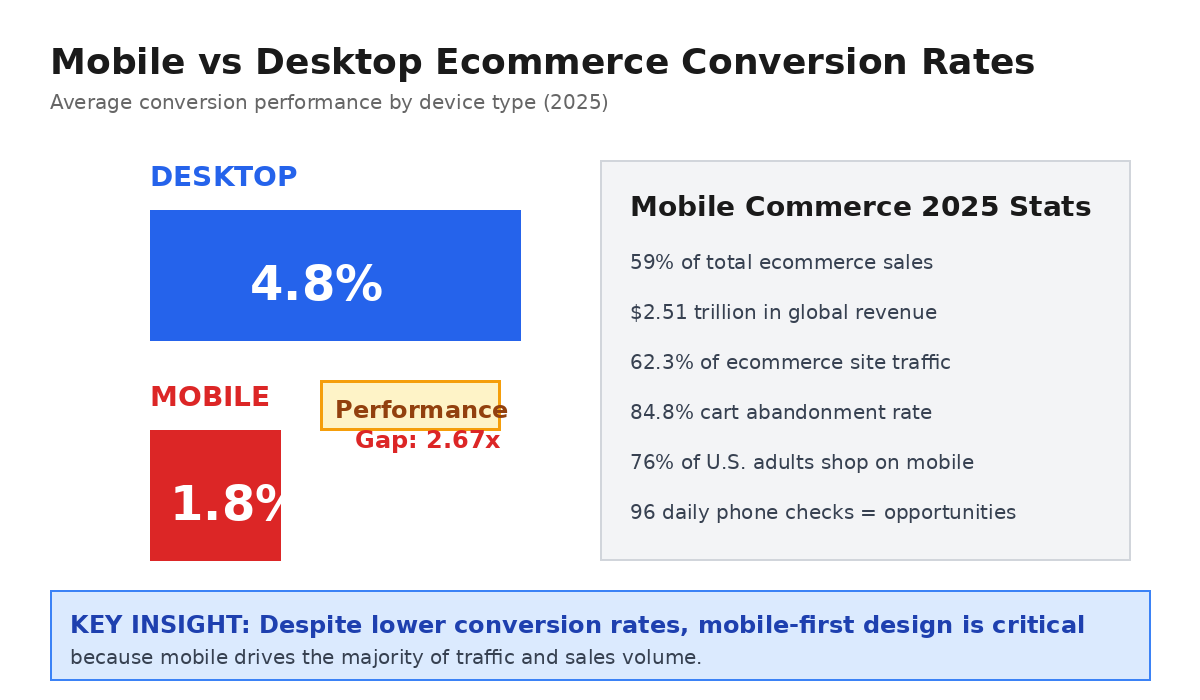
The revenue implications are substantial. Businesses prioritizing mobile optimization capture disproportionate market share as competitors neglect mobile user experience.
Mobile commerce growth rates exceed desktop ecommerce by significant margins. Mobile is growing at a compound annual growth rate of 12.76% between 2024 and 2028. Companies investing in mobile-first strategies position themselves to capture this explosive growth rather than watching competitors claim market share.
According to McKinsey research, retailers implementing advanced personalization strategies report a 10-15% revenue lift, with mobile personalization contributing significantly to these gains. Mobile-first design enables real-time personalization based on location, browsing behaviour, and purchase history, creating competitive advantages that desktop-centric competitors cannot match.
The Hidden Cost of DIY Ecommerce Website Builders
Pre-built website builders and template-based platforms promise easy, affordable ecommerce site creation without agency costs.
The reality proves far more complex and expensive than marketing materials suggest. While DIY platforms serve micro-businesses effectively (those doing under $100,000 in annual online sales), they create substantial limitations for growing companies pursuing sustainable competitive advantages across digital channels.
Technical limitations represent the most significant hidden cost. Pre-built platforms restrict customization capabilities, limiting your ability to optimize conversion funnels, implement advanced features, or differentiate from competitors using identical templates. Integration with enterprise systems often proves difficult or impossible. Custom checkout flows, personalization engines (like Monetate or Optimizely), and sophisticated product recommendation systems require development expertise beyond platform constraints. DIY platforms also struggle with comprehensive content strategy implementation and social media integration for your online store.
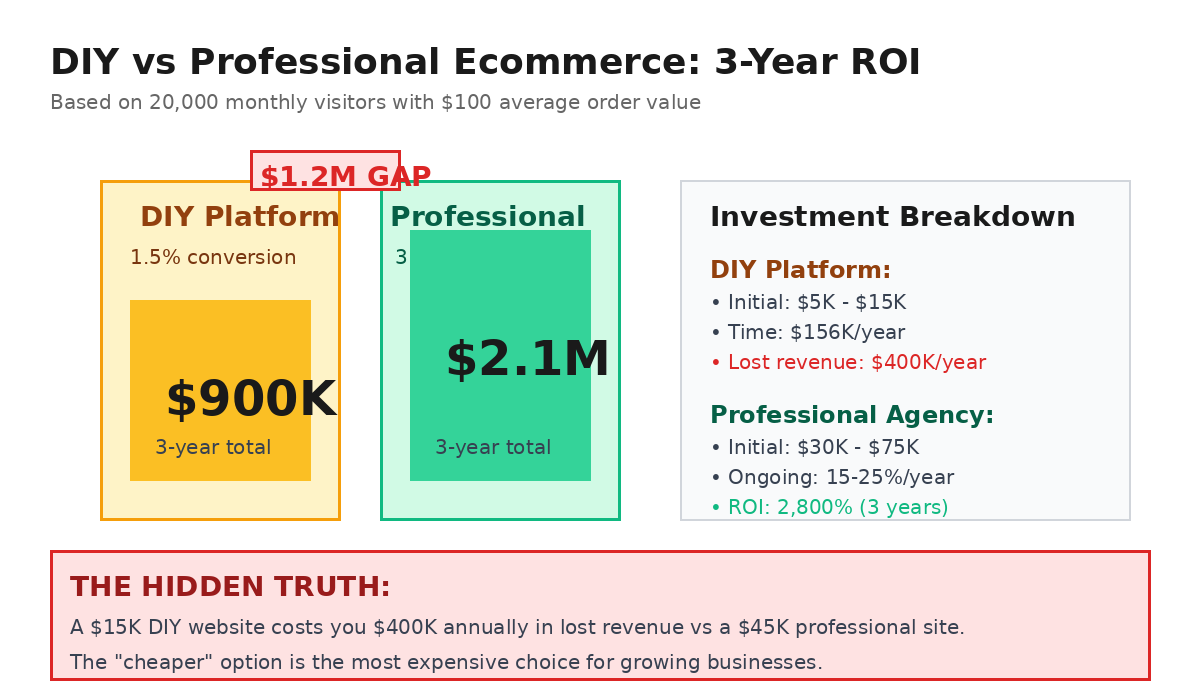
Opportunity costs accumulate silently. A DIY site converting at 1.5% generates $300,000 annually from 20,000 monthly visitors with a $100 average order value. An optimized professional site converting at 3.5% generates $700,000 from identical traffic—a $400,000 annual opportunity cost.
Over three years? That gap exceeds $1.2 million, dwarfing agency fees of $30,000-$75,000.
Time investment creates additional hidden costs. Business owners spending 20 hours weekly managing DIY platforms (updating products, troubleshooting plugins, fixing mobile display issues) forfeit time better spent on product development, customer relationships, and business strategy. At a conservative $150/hour opportunity cost, this represents $156,000 annually in founder time diverted from high-value activities.
SEO performance suffers on template-based platforms. Generic code structure, limited technical optimization capabilities, and slower page speeds harm search engine rankings. Professional agencies implement clean code architecture, comprehensive schema markup, and performance optimization that drives organic traffic growth. A robust SEO strategy combined with performance marketing tactics can deliver sustained results. The difference between ranking positions 1-3 versus positions 6-10 on search engines can represent hundreds of thousands in annual revenue for competitive keywords.
Professional ecommerce agencies deliver strategic advantages that DIY platforms cannot match: conversion rate optimization expertise, data-driven testing programs, UX research capabilities, and proven optimization frameworks developed across hundreds of successful projects. A skilled ecommerce design agency combines digital marketing services with brand strategy development. These advantages compound over time, creating sustainable competitive moats.
Real-World Examples and Case Studies
OuterBox and Aviya: 404% Revenue Growth
OuterBox partnered with Aviya to expand ecommerce customer acquisition through integrated digital marketing campaigns. The challenge involved low website traffic (under 5,000 monthly visitors) and limited online revenue generation (approximately $180,000 annually). OuterBox launched comprehensive organic search marketing, PPC advertising campaigns targeting high-intent keywords, and affiliate programs designed to increase qualified traffic while optimizing conversion paths. The focus centered on improving customer experience to convert potential customers more effectively.
Results exceeded expectations.
404% increase in online revenue (from $180,000 to $907,200 annually). 35% conversion rate improvement (from 1.8% to 2.43%). 311% website traffic growth (from 5,000 to 20,550 monthly visitors). The success came from treating design and marketing as integrated elements rather than separate initiatives. Conversion rate optimization turned traffic increases into revenue growth rather than simply generating additional browsers who failed to purchase.
Dazze Studio and Gentlewench: Premium AOV Performance
Dazze Studio collaborated with Gentlewench to create an ecommerce website extending their successful physical retail presence. The project required full-range ecommerce development including API integrations (Stripe for payments, Klaviyo for email marketing), wireframing and prototyping in Figma, UI and UX development, hosting on AWS, and platform updates.
The completed website achieved $526 average order value. Substantially higher than typical ecommerce benchmarks ($100-150 for fashion retailers).
Thoughtful design elevates transaction values beyond basic conversion optimization. The focus on user experience, brand consistency, and seamless functionality created an online presence matching the quality of their physical retail locations in Brooklyn's DUMBO neighbourhood.
Digital Silk and FieldEdge: B2B Platform Optimization
Digital Silk redesigned FieldEdge's field service software platform targeting business customers. The challenge involved creating user journeys pushing B2B visitors toward conversion decisions while showing software capabilities through interactive elements.
The redesigned website achieved 19% traffic increase shortly after launch. Engagement metrics improved across all user segments.
Strategic use of motion elements and interactive dashboards helped potential buyers understand complex software features without overwhelming them. Messaging specifically targeted decision-makers while visual elements maintained engagement throughout consideration processes.
Mobikasa and Versace: Luxury Brand Digital Transformation
Mobikasa delivered a high-performance ecommerce platform for luxury fashion brand Versace. The project required mobile-first design, ADA compliance (WCAG 2.1 Level AA standards), and seamless integration with existing inventory management systems. The implementation prioritized visual storytelling with fast load times (under 2 seconds on 4G connections) and intuitive navigation.
The resulting platform showed luxury brands can maintain their premium positioning while delivering the seamless digital experiences modern consumers demand. Mobile optimization ensured consistent brand experience across all devices. Performance optimization prevented the slow load times (5+ seconds) that plague many image-heavy luxury sites.
The 6-month project launched in Q4 2023.
Absolute Web: Enterprise-Scale Custom Development
Absolute Web has delivered custom ecommerce solutions for Fortune 500 brands requiring complex integrations and high-volume transaction capabilities (handling 10,000+ orders per hour during Black Friday/Cyber Monday).
Their approach combines visually compelling design with performance-driven architecture capable of handling traffic spikes during promotional periods.
Case studies show their ability to implement sophisticated personalization engines (Adobe Target, Monetate), multi-currency support for international operations (supporting 40+ currencies with real-time exchange rates), and complex B2B pricing structures with volume discounts and contract-specific pricing. Their 20+ years of experience provides a deep understanding of enterprise requirements. Security compliance (PCI DSS Level 1), disaster recovery, and scalability.
Frequently Asked Questions
How much should I expect to invest in professional ecommerce web design?
Professional ecommerce website projects typically range from $15,000 for basic Shopify stores to $250,000+ for enterprise Magento implementations. The investment should align with business scale and revenue goals rather than following arbitrary budgets.
A useful framework evaluates cost against expected revenue: a website generating $2 million annually justifies investments of $60,000-$120,000 (3-6% of revenue), while one generating $200,000 might allocate $10,000-$20,000 (5-10% of revenue). Factor in platform choice (Shopify Plus starts at $2,000/month in platform fees alone), customization requirements, integration complexity (add $5,000-$15,000 per major system integration), and ongoing optimization needs when budgeting.
How long does an ecommerce website design project take from start to launch?
Timeline varies based on project complexity, platform selection, and customization requirements. Basic Shopify stores using pre-built themes with minimal customization launch in 4-8 weeks (6-12 weeks if including custom branding and content creation). Custom-designed Shopify or WooCommerce sites typically require 8-16 weeks (add 2-4 weeks for complex product catalogues with 500+ SKUs). Complex Magento implementations with extensive customization, integrations, and custom features often need 16-24 weeks or longer (enterprise projects with ERP integration can extend to 30-40 weeks).
Rushing projects compromises quality and creates technical debt requiring expensive fixes later.
Should I choose an agency specializing in my industry or a general ecommerce specialist?
Industry specialization offers advantages including understanding of sector-specific customer behaviour, regulatory requirements, and competitive dynamics. However, general ecommerce specialists bring diverse perspectives and proven frameworks applicable across different industries.
The best approach examines portfolio quality rather than industry focus alone. An agency with strong ecommerce fundamentals and demonstrated results in adjacent industries often outperforms industry specialists lacking ecommerce expertise. Evaluate their web design project portfolio carefully to see if they understand your specific needs. Prioritize conversion optimization capabilities, platform mastery, and strategic thinking over industry familiarity.
What ongoing costs should I budget for after the website launch?
Post-launch costs include hosting and platform fees (Shopify Plus: $2,000/month, Magento Cloud: $2,000-$10,000/month, WooCommerce hosting: $50-500/month), security updates and website maintenance ($200-500/month for managed services), conversion rate optimization testing ($1,000-5,000/month for active programs), content updates and new product additions ($500-2,000/month), content marketing initiatives, and marketing integration and analytics ($500-1,500/month for tools like Google Analytics 360, Hotjar, and A/B testing platforms).
Budget approximately 15-25% of initial development costs annually for maintenance and optimization. Growing businesses often invest more heavily in ongoing optimization (30-40% of initial costs), recognizing that continuous improvement delivers better returns than static websites.
Consider retainer arrangements.
How do I measure if my ecommerce website redesign was successful?
Success measurement requires establishing baseline metrics before redesign and tracking improvements across multiple dimensions. Key performance indicators include conversion rate (percentage of visitors making purchases), average order value (revenue per transaction), bounce rate (percentage of single-page visits), page load speed (time to interactive, measured with Google PageSpeed Insights or GTmetrix), organic traffic growth (SEO performance tracked in Google Search Console), and mobile conversion rates separately from desktop.
Establish measurement periods of 60-90 days post-launch for meaningful comparisons. Account for seasonal variations (Q4 typically converts 20-30% higher than Q1) and traffic source changes.
Beyond metrics? Qualitative feedback from customers about user experience provides valuable insights into design effectiveness.