Table of contents
The TikTok algorithm is a ranking system that predicts how likely you are to enjoy each video, then fills your For You feed with the highest-scoring candidates. It is not random, and it is not a follower-count contest.
Here is what TikTok has actually confirmed about the signals, what 2026 benchmark data says about reach, and how to work with the system instead of guessing.
Key Takeaways
- TikTok's own documentation names three signal families: user interactions, video information and device/account settings — the last of which gets the lowest weight.
- Neither follower count nor a past hit is a direct ranking factor, which is why a first video can out-reach a 100,000-follower account.
- Completing a longer video is a strong interest signal; watch time and rewatches outrank a passive like.
- Engagement rate by views fell to 3.85% in Q2 2026 after holding 4.20%–4.30% for five straight quarters.
- Views are down 23% year on year while brand posting frequency is up 40% — the feed is more crowded, not less generous.
- Shares are the growth metric: up 13% overall and 44% for the largest accounts, with comments up 3% and likes up 9%.
- Follower growth is down 33%, hitting the smallest accounts hardest — so reach now comes from content quality, not audience size.
How the TikTok algorithm actually works
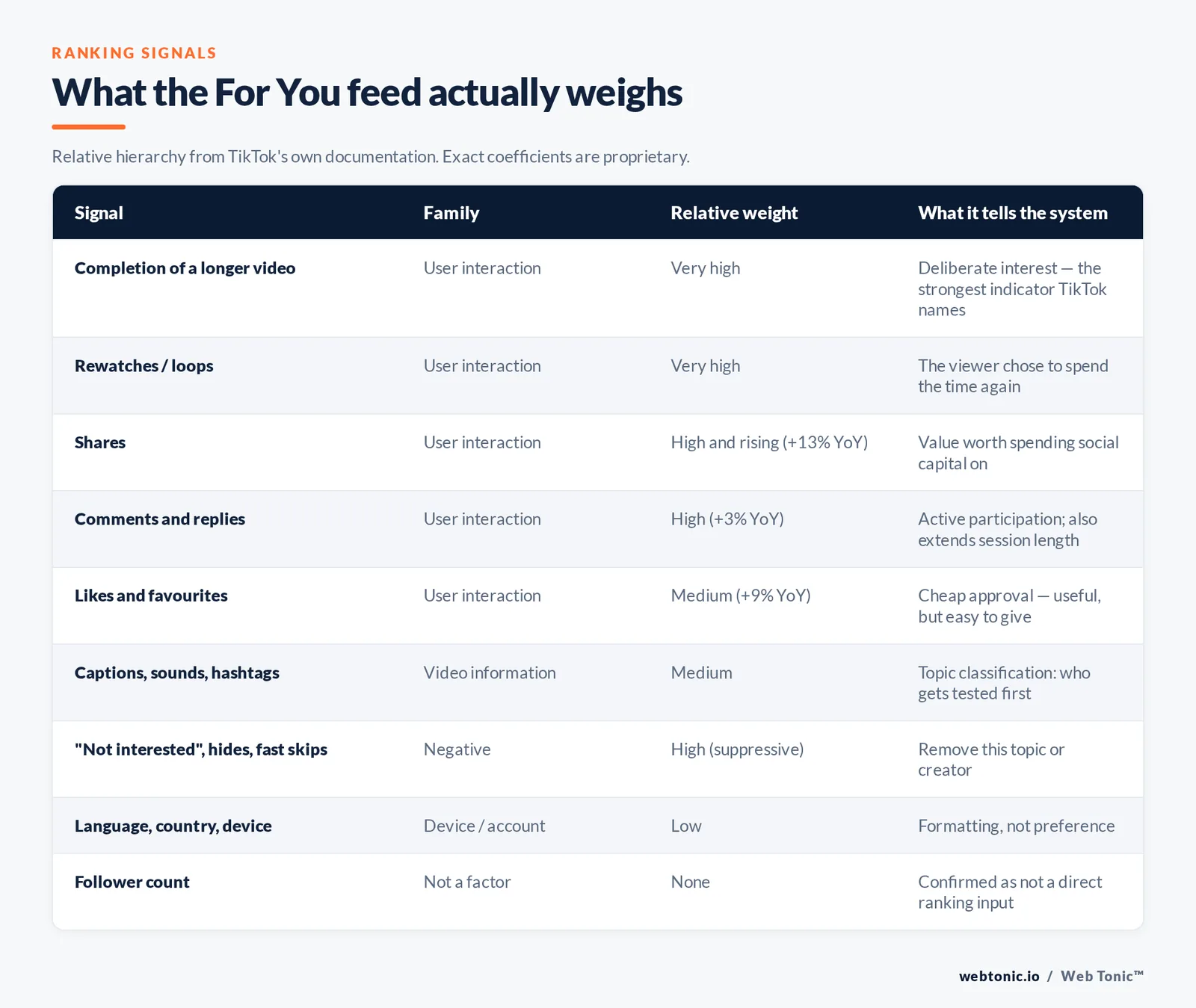
TikTok's official explainer on For You recommendations describes a recommendation engine that scores every candidate video for a specific user, then ranks them. Each score is built from weighted signals, and the weights reflect how strongly a behaviour indicates genuine interest. Finishing a long video is a strong signal. Sharing a country with the creator is a weak one.
Two clarifications from that documentation kill most of the folklore. First, follower count is not a direct ranking factor — larger accounts get more views mainly because they have a larger base to seed into. Second, having produced a previous high-performing video does not carry forward as a ranking input. Every upload is scored on its own merits, which is exactly why "the algorithm hates me this week" is usually a content problem.
New users are asked to pick interest categories so the system has a starting point; users who skip that get a generalised feed of popular videos, and the first likes, comments and replays begin personalisation. Negative signals matter just as much: "Not interested", hiding a creator and skipping early all feed back into ranking. TikTok's support centre and its transparency site document the user-facing controls, and its transparency and accountability posts cover how ineligible content is filtered out of recommendations entirely.
The ranking signals, ranked by weight
The exact coefficients are proprietary, but the relative hierarchy is consistent across TikTok's public statements and independent testing by teams such as Sprout Social and Buffer.
| Signal | Family | Relative weight | What it tells the system |
|---|---|---|---|
| Completion of a longer video | User interaction | Very high | Deliberate interest — the strongest single indicator TikTok names. |
| Rewatches / loops | User interaction | Very high | The viewer chose to spend time again, not once. |
| Shares | User interaction | High and rising (+13% YoY) | Value strong enough to spend social capital on. |
| Comments and replies | User interaction | High (+3% YoY) | Active participation; also extends session length. |
| Likes and favourites | User interaction | Medium (+9% YoY) | Cheap approval — useful, but easy to give. |
| Follows after watching | User interaction | Medium | Interest in the creator, not just the clip. |
| Captions, sounds, hashtags | Video information | Medium | Topic classification, so the right 1% of users get tested first. |
| "Not interested", hides, fast skips | Negative interaction | High (suppressive) | Actively remove this topic or creator. |
| Language, country, device type | Device / account settings | Low — TikTok states these are weighted lower | Performance and formatting, not preference. |
| Follower count | Not a direct factor | None | Confirmed by TikTok as not a direct ranking input. |
What 2026 benchmark data says about reach
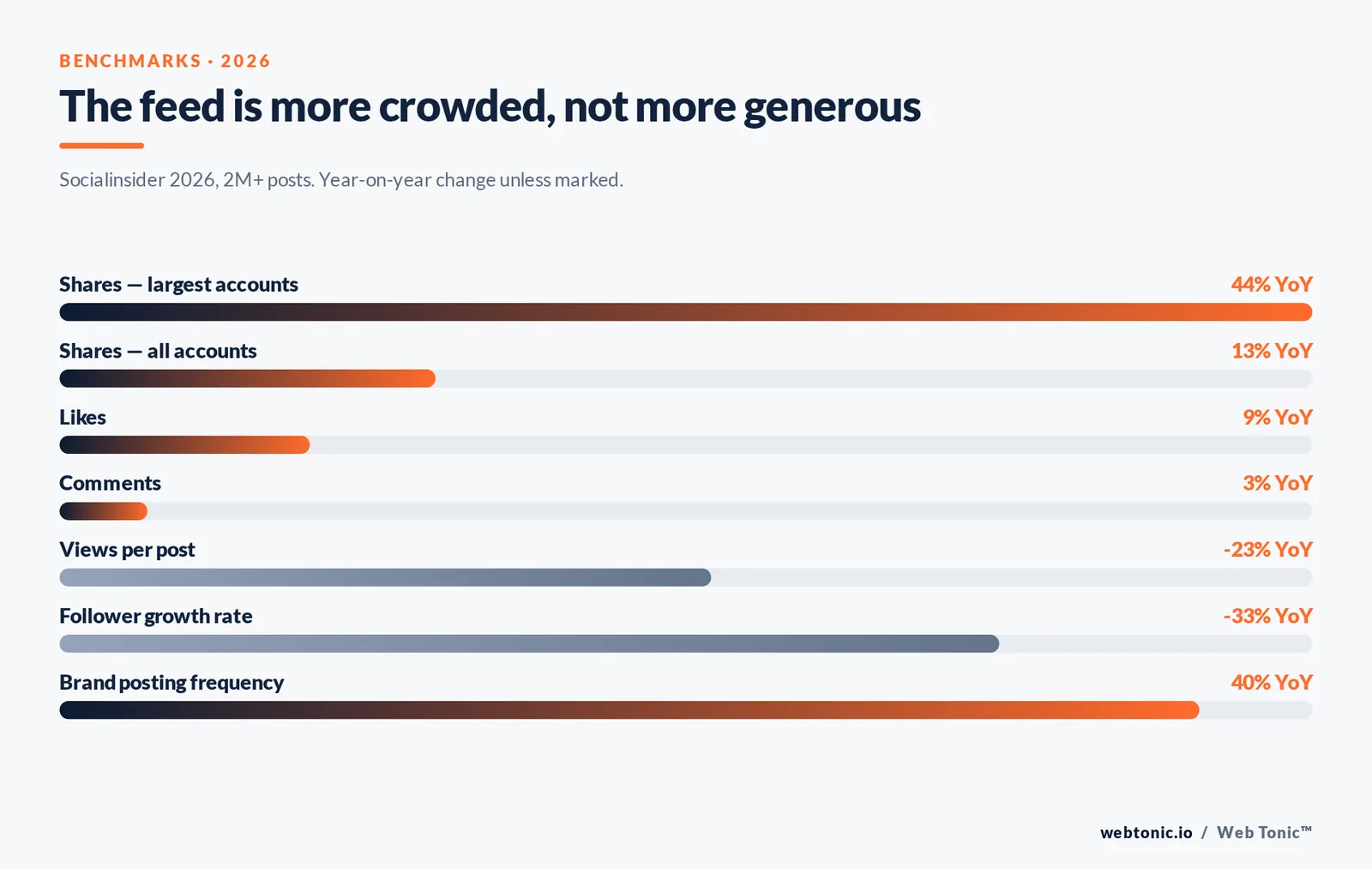
Understanding the mechanics matters less than calibrating your expectations. Socialinsider's 2026 TikTok benchmarks, drawn from more than 2 million posts, show a platform that is more demanding than it was two years ago.
| Metric | 2026 reading | Direction | Implication |
|---|---|---|---|
| Engagement rate by views | 3.85% in Q2 2026 | Down 8% QoQ | Stop benchmarking against 2024's 4.2% figures. |
| Views per post | Declining platform-wide | Down 23% YoY | Flat view counts year on year are actually a win. |
| Shares | Fastest-growing signal | Up 13% (+44% for the largest accounts) | Brief for shareability explicitly. |
| Brand posting frequency | Sharply higher | Up 40% | More supply chasing the same attention. |
| Follower growth rate | Compressed | Down 33% | Small accounts should optimise for views, not followers. |
| Engagement by page size | 4.40% at 1–5K vs 3.75% at 50–100K | Inverse to size | Smaller communities still engage harder. |
Context helps too. DataReportal's Digital 2026 puts daily social use at 2 hours 40 minutes across an average of 6.75 platforms per user, and Pew Research tracks how concentrated short-video use is among younger US adults. Attention is not expanding; distribution is being redistributed.
Inside the distribution funnel: how one video earns views
It helps to picture the TikTok algorithm as a funnel rather than a switch. When you post, the video is classified from its caption, on-screen text, sound and hashtags, then shown to a small test pool of users whose interaction history suggests they might care. That first cohort produces the numbers that decide everything after it: how many watch to the end, how many rewatch, how many comment, how many share. Those interactions become the score that qualifies the video for a larger pool, and the process repeats. A video does not "go viral" in one step — it clears a sequence of increasingly wide audience tiers, and it can stall at any of them.
This is why the same content can behave differently on two consecutive days. If the early test pool happens to be people who watch a lot of similar videos, watch time is high and the video moves up. If the classification is vague, the pool is loosely matched, and viewers skip in the first second. Vague captions and generic hashtags are therefore not a cosmetic issue: they weaken the topic signal the system uses to choose the users who see you first.
It also explains the shape of most creators' analytics. A large share of videos plateau at a few hundred views because they never cleared the first gate, while a small number keep compounding for weeks as new user cohorts keep finishing them. Old posts resurfacing months later is not a glitch; the system can re-test evergreen content when it finds a new audience whose interests match. That is one of the few genuinely durable advantages on the platform, and it rewards content with a long shelf life over content pegged to a trend that expires in 7 days.
For brands, three operational consequences follow. First, judge a post at 48 hours and again at 30 days, because the second window is where evergreen videos separate themselves. Second, treat each video as an independent experiment — one variable per upload, so you learn whether the hook, the format or the topic moved completion rate. Third, keep a written record of every video's completion rate, share count and comment count in one sheet; the pattern across 20 or 30 posts is far more informative than any single result, and it is the only reliable way to tell a content problem from ordinary volatility in how the feed distributes attention.
How to work with the algorithm: 8 practical moves
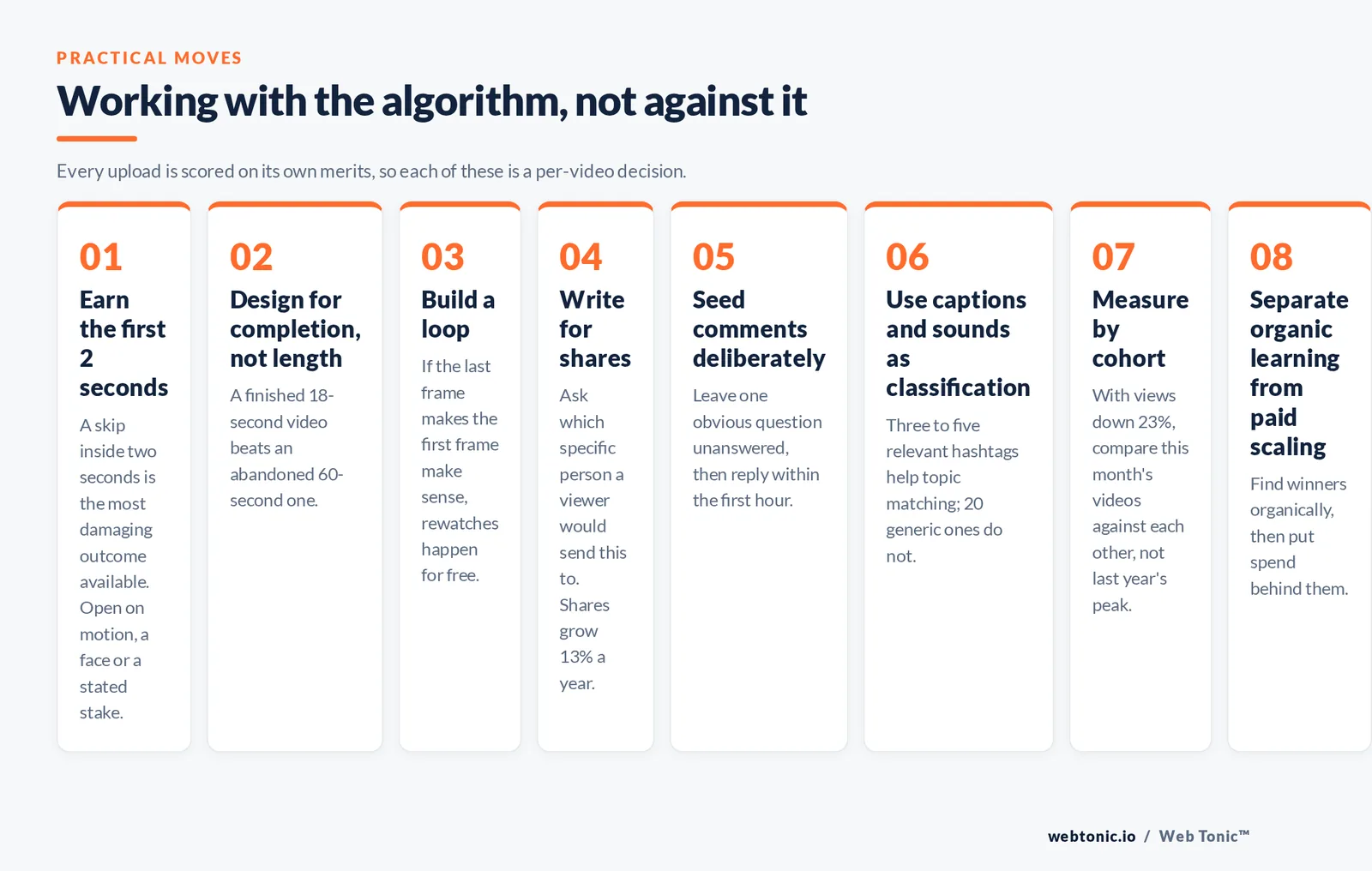
1. Earn the first 2 seconds. A skip inside two seconds is the most damaging outcome available. Open on motion, a face or a stated stake.
2. Design for completion, not length. A finished 18-second video beats an abandoned 60-second one, because completion of a longer video is only a strong signal if it happens.
3. Build a loop. If the last frame makes the first frame make sense, rewatches happen for free.
4. Write for shares. Ask which specific person a viewer would send this to. "Useful to a friend" outperforms "impressive to strangers" — and shares are the metric growing 13% a year.
5. Seed comments deliberately. Leave one obvious question unanswered, then reply to comments within the first hour.
6. Use captions and sounds as classification, not decoration. Three to five relevant hashtags help topic matching; 20 generic ones do not.
7. Post consistently, then measure by cohort. With platform views down 23%, compare this month's videos against each other, not against last year's peak.
8. Separate organic learning from paid scaling. Find the winners organically, then push spend behind them through TikTok's ads platform. This is the core of how we run performance creative testing for clients.
Hashtags, captions and the metadata that classifies your content
Hashtags are the most over-discussed and least understood part of the TikTok algorithm. A hashtag is a classification signal: it helps the system decide which users should see the video first, and nothing more. Adding 30 popular hashtags to a niche video does not add views; it blurs the topic and sends the post to a loosely matched audience that will skip it. Three to five precise hashtags plus a caption that names the topic in plain language do more for distribution than any hashtag strategy sold in a course.
The same logic applies to sounds and on-screen text. A trending sound places your video in a pool of users who react well to that sound; that helps when the content genuinely fits and hurts when it does not. Write captions people will actually read, because a caption that provokes a comment converts a passive view into an engagement signal, and comments are one of the interactions that lifts a post's score.
Profile-level basics still matter for the second click. When a video works, users open the profile: a clear niche, a readable bio and a pinned best-performing post decide whether that visit becomes a follow. The algorithm does not reward a tidy profile directly, but people do, and follows are an interaction signal.
Posting strategy: turning algorithm mechanics into a weekly system
A working TikTok strategy is a posting system plus a scoring habit. Decide how many videos you can create each week and protect that number — most brands find 3 to 5 posts a week sustainable, and consistency beats a burst of 10 videos followed by three quiet weeks. Then choose one metric to optimise per month. Completion rate first, shares second, comments third; likes are the least informative of the four.
Keep a simple sheet with one row per post: date, time posted, hook type, length, views, completion rate, likes, comments, shares, follows. After 30 rows you will see which format your audience finishes, and that pattern is worth more than any general advice about the best time to post. Cross-post the winners to Instagram Reels and YouTube Shorts, but re-cut for each platform — a video that ranks well on one social network can flop on another because the user base and the reaction it expects are different.
Do not chase virality as a goal. A viral video is a lucky outcome of a good system; a good system produces a steady stream of posts that clear the first audience tier, and a small share of them keep earning views for months. If a topic performs, make more content on that topic rather than a totally new one — the fastest way to help the algorithm is to be legible about what you are for. And when a format stops working, retire the format, not the channel: creators who quit usually quit during an ordinary dip in how the feed distributes attention across the platform.
Reactions, scores and how TikTok compares to other feeds
Every reaction a person gives a video becomes part of a score, and the score is what will decide whether the next batch of users ever sees your post. It helps to think in terms of cost to the viewer: a like costs almost nothing, a comment costs a few seconds, a share costs social credit, and a follow costs a commitment. The more a reaction costs the person giving it, the more it is worth to the ranking system. That is the whole model in one sentence, and it is a good filter for any tactic you read about online.
People also forget the negative side of the ledger. A "not interested" tap, a hide, or a skip in the first second is a reaction too, and those signals will suppress a topic for that user quickly. If you create content that baits a click and does not pay it off, you do not just lose the view — you teach the system that this audience does not want you.
Compared with other social media networks, TikTok is unusual in how little your account history counts. On Instagram, follower relationships still shape a lot of distribution; on TikTok, interest matching leads and the account starts closer to level on every upload. That is good news if you are starting from zero and bad news if you assumed a big audience would carry weak content. Cross-platform teams should plan for that difference rather than reusing one posting strategy everywhere.
Where do paid ads fit? TikTok ads run through a separate auction, but they lean on the same creative reality: an ad that people watch to the end and react well to gets cheaper distribution. Many brands add paid budget only after an organic post proves it earns views on its own — a well-tested organic winner is the safest ad you will ever create, and it removes most of the guesswork from a launch. Do not add spend to a video with a weak completion rate and hope the auction fixes it.
Finally, be honest about time. It takes a lot of posts to learn what your audience finishes, and there is no shortcut that skips that work. Start with a small, repeatable format, keep a view of your own numbers based on your own history rather than on a competitor's screenshots, and let the pattern across dozens of videos tell you what to make more of.
Myths the data does not support
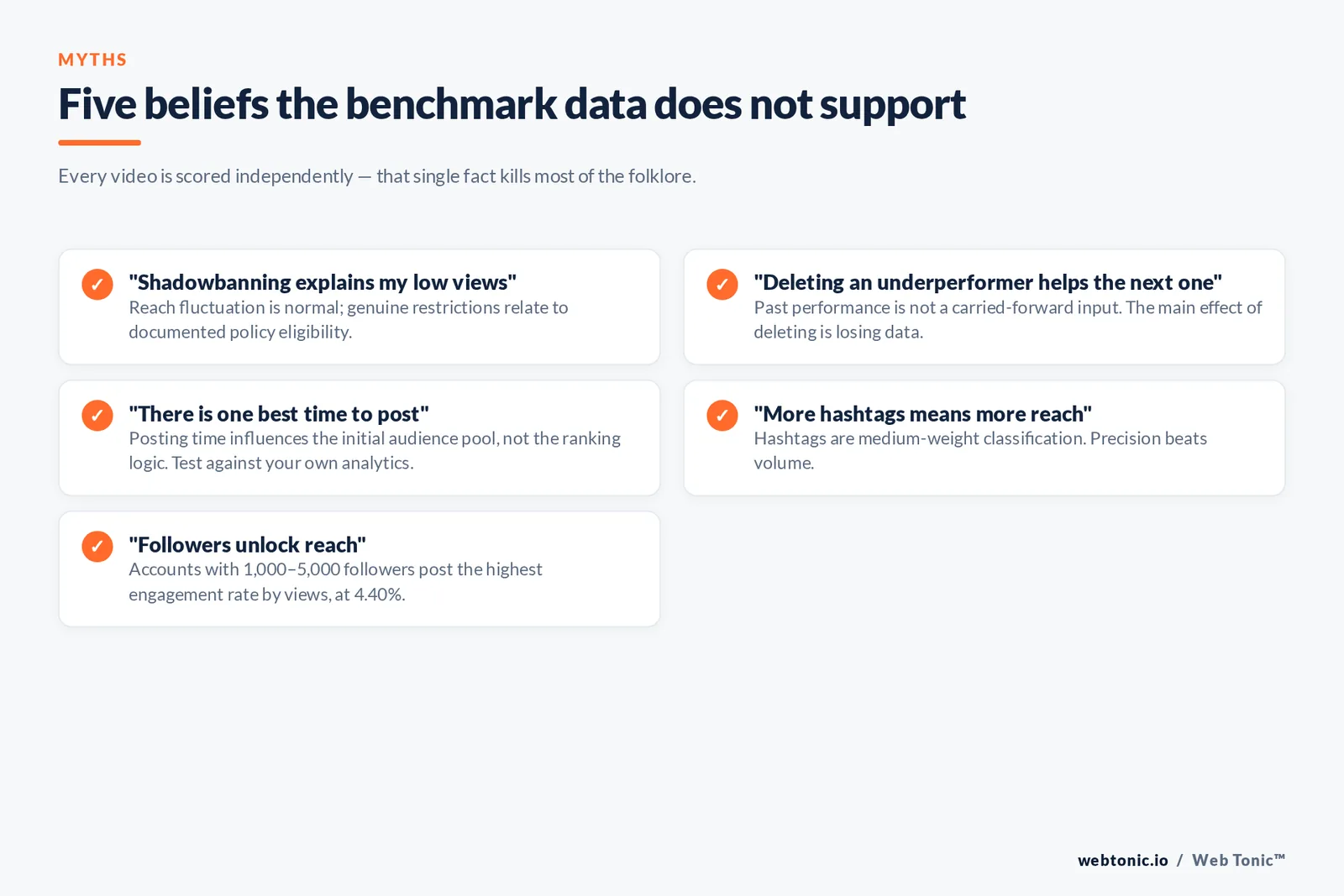
"Shadowbanning explains my low views." Reach fluctuation is normal because every video is scored independently; genuine restrictions relate to policy eligibility, which TikTok documents publicly. Coverage from The Verge and TechCrunch tracks actual policy and product changes if you want to verify a rumour before acting on it.
"Deleting an underperformer helps the next one." Past performance is not a carried-forward ranking input, so the main effect of deleting is losing data.
"There is one best time to post." Posting time influences the initial audience pool, not the ranking logic. Test windows against your own analytics instead of importing a generic schedule.
"More hashtags means more reach." Hashtags sit in the medium-weight video-information family and work as classification. Precision beats volume.
"Followers unlock reach." The benchmark data says the opposite: accounts with 1,000–5,000 followers post the highest engagement rate by views at 4.40%.
Turning algorithm knowledge into a content system
Once you accept that each video is scored alone, the operating model changes. You need a repeatable pipeline: a hook bank, a shooting cadence that produces enough attempts, a scoring sheet tracking completion rate and shares rather than likes, and a monthly review that kills formats instead of individual videos. Brands that treat short video as a testing programme rather than a publishing calendar are the ones compounding through a 23% view decline.
That is also where measurement discipline earns its keep — attributing TikTok's contribution properly needs data intelligence work, not last-click screenshots. More short-video teardowns and platform explainers live on the Web Tonic blog, and if you want a second pair of eyes on your content system, get in touch.
FAQ
Is the TikTok algorithm random?
No. It is a ranking system that scores each candidate video against a specific user's predicted interest, using weighted signals such as watch completion, rewatches, shares, comments, likes and video metadata. Feeds feel unpredictable because every upload is scored independently rather than inheriting your account's past performance.
How does watch time influence TikTok rankings?
Watch time is the closest thing to a master signal. TikTok states that finishing a longer video is a stronger indicator of interest than weak signals like sharing a country with the creator, so completion rate and rewatches carry more weight than a passive like.
Does follower count affect TikTok reach?
Not directly. TikTok has confirmed that neither follower count nor previous high-performing videos are direct ranking factors. Larger accounts tend to get more views because of their existing base, but 2026 benchmark data shows accounts with 1,000–5,000 followers achieving the highest engagement rate by views at 4.40%.
What type of content performs best under the TikTok algorithm?
Content that is finished, rewatched and shared. In practice that means a hook inside two seconds, a length matched to the payoff, a loop-friendly ending, and a reason for one viewer to send it to one specific person. Shares are the fastest-growing engagement signal on the platform.
Why did my TikTok views suddenly drop?
Platform-wide views are down about 23% year on year while brand posting volume is up 40%, so part of any drop is structural. Beyond that, check completion rate first: if viewers are skipping earlier than before, the hook is the problem, not a penalty.
Sources: TikTok Newsroom (How TikTok recommends videos #ForYou; transparency and accountability) · TikTok Support · TikTok Transparency Center · TikTok for Business · Socialinsider 2026 TikTok Benchmarks · Sprout Social · Buffer · DataReportal Digital 2026 · Pew Research Center · The Verge · TechCrunch.