Table of contents

Video testimonials are better at showing a person and a product; text reviews are easier to scan and accumulate. The 2026 evidence does not support a universal format winner: Wyzowl reports that 63% of consumers prefer short video to learn about products, while PowerReviews’ 2025 survey found ratings and reviews influential to 96% of shoppers.
Key Takeaways
- 63% prefer a short video when learning about a product or service, Wyzowl reports in 2026.
- 12% prefer text-based articles as a product-learning format in the same survey.
- 96% say ratings and reviews influence purchase decisions, PowerReviews’ June 2025 survey found.
- 78% name customer photos and videos as influential in the same PowerReviews comparison.
- 89% say video quality affects trust in a brand, Wyzowl reported in 2026.
- 85% have been convinced to buy after watching a video, according to Wyzowl’s 2026 consumer sample.
- 46% say short-form video affects their buying choices in Bazaarvoice’s 2025 study of 5,658 social-content-influenced shoppers.
- 47% trust testimonials and peer reviews when shopping on social, Bazaarvoice’s 2025 preference report found.
- 62% of U.S. TikTok users say product reviews are a reason they use TikTok, Pew reported in 2024.
- Format preference is not the same as conversion lift; study design and comparison matter.
First, separate a testimonial from a review
A testimonial is usually a selected customer story presented by a brand. It may be a filmed interview, a short creator-style clip, a quote on a landing page, or a case study. A product review is feedback submitted by a buyer, commonly attached to a product page or review platform. The two can overlap, but they do not have the same selection process or representativeness.
That distinction matters when reading a number. A branded testimonial can explain a use case in a memorable way; an open review corpus can reveal patterns across many customers, including complaints. A survey that asks what people prefer does not tell us whether one particular testimonial converted more visitors. Before comparing performance, state whether the asset is curated, verified-purchase, incentivized, edited, or part of an independent rating-and-review system.
Here, “video proof” includes customer-shot clips and brand-published testimonial video, while “text proof” includes written reviews and testimonials. Where a cited source measures reviews broadly rather than testimonials specifically, the article labels it that way rather than treating the measures as equivalents.
What consumers say they want to watch
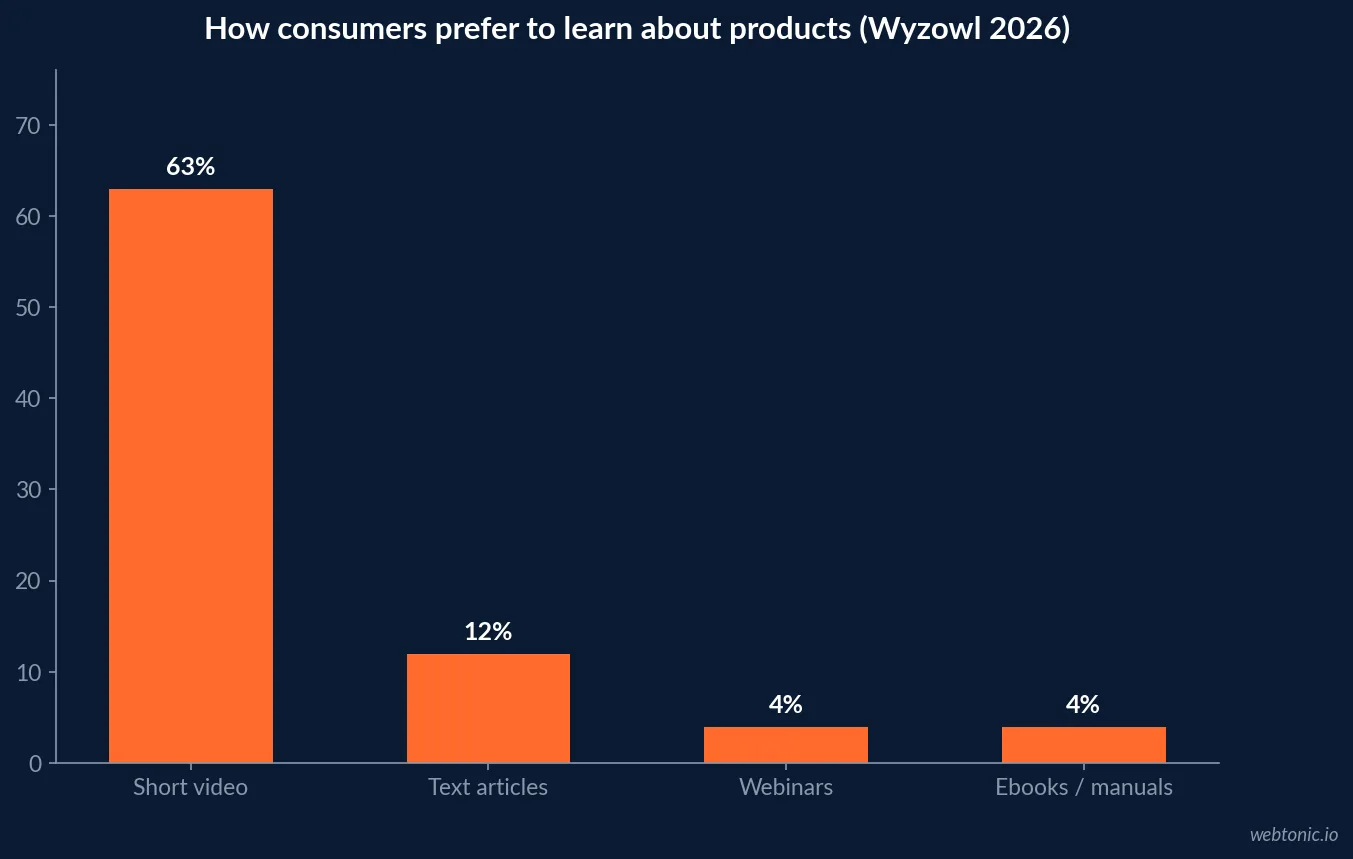
Wyzowl’s 2026 State of Video Marketing survey separates consumer respondents from marketing professionals. It reports that 63% would most like to learn about a product or service through a short video, compared with 12% through text-based articles, 7% through infographics, and 4% each for ebooks/manuals and webinars. The statistic is a stated learning preference; it is not evidence that every customer needs a video review.
Its consumer findings also say 96% have watched an explainer video to learn about a product or service, 85% have been convinced to buy by watching a video, and 89% say video quality affects trust in a brand. Explainer videos are not all testimonials. The data helps benchmark video as a format, but a testimonial’s performance still depends on the speaker, proof, relevance, distribution and creative quality.
A practical use is to test customer video where demonstration or emotion helps resolve uncertainty, and keep concise text evidence close to the product details, pricing or decision point. The visitor should not have to choose between a useful clip and the specifications they came to verify.
| Learning / content signal | Figure | Study scope | What it does not prove |
|---|---|---|---|
| Prefer short video to learn | 63% | Wyzowl 2026 consumer survey | Not a conversion-rate comparison |
| Prefer text articles | 12% | Wyzowl 2026 consumer survey | Not a statement against reviews |
| Watched an explainer video | 96% | Wyzowl 2026 consumer sample | Explainer content, not testimonials only |
| Convinced to buy after a video | 85% | Wyzowl 2026 consumer sample | Self-reported influence |
| Video quality affects brand trust | 89% | Wyzowl 2026 consumer sample | Does not isolate testimonial format |
What reviews contribute beyond video
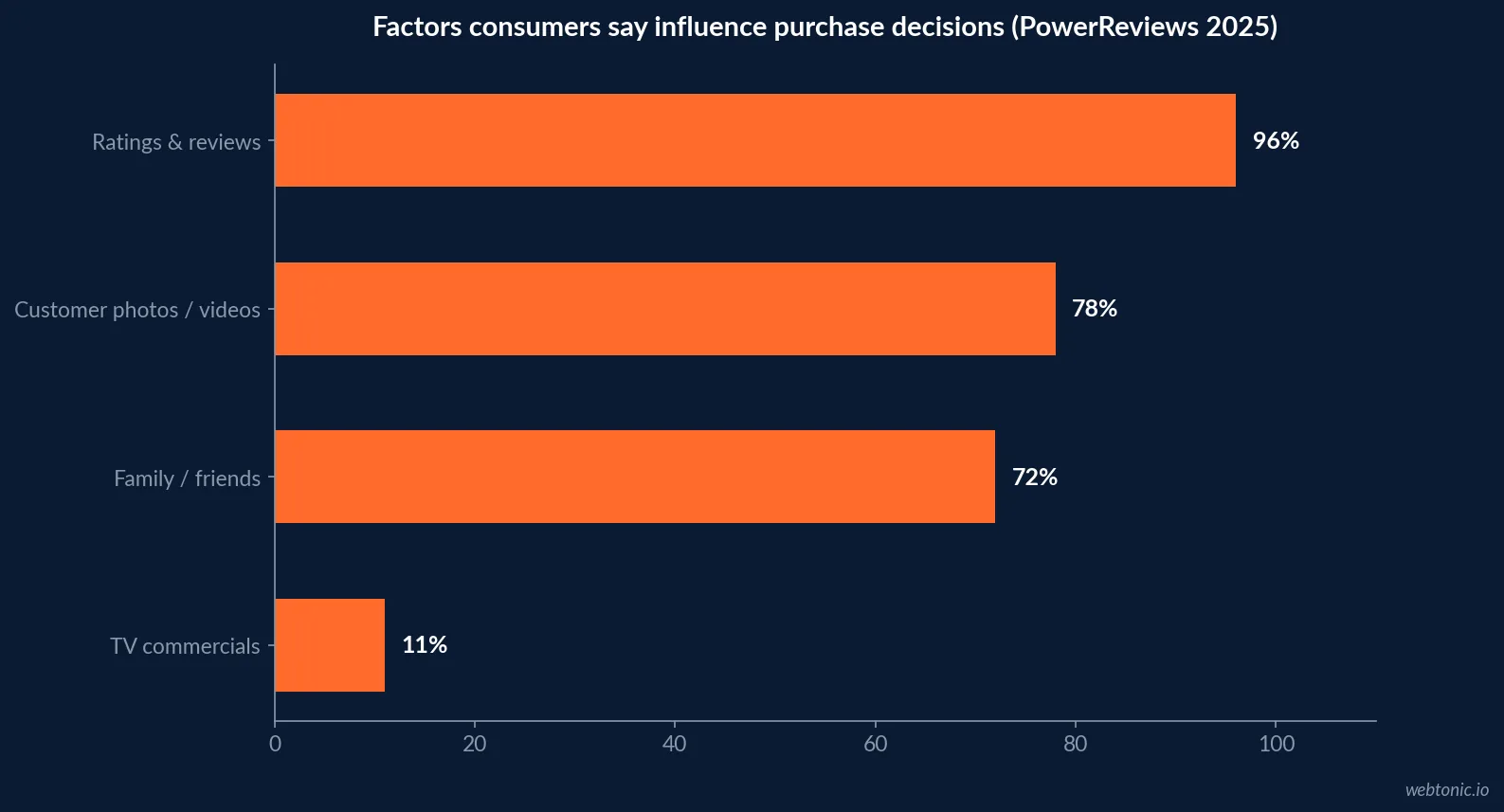
PowerReviews’ June 2025 consumer research surveyed 21,279 people about the influence of product reviews. It found 95% regularly read product reviews, and 96% said ratings and reviews were influential in purchase decisions. In its comparison of marketing inputs, customer photos and videos scored 78%, family and friend recommendations 72%, and traditional TV commercials 11%.
The key lesson is not that written reviews beat video. The report groups ratings and reviews together and treats customer photos and videos as another category; it does not compare one video testimonial against one written testimonial under controlled conditions. Reviews deliver breadth, structured ratings and searchable detail. Video supplies motion, tone and a richer demonstration. Each can reinforce the other.
The absence of review content can be a problem in itself: in the same PowerReviews material, 85% of shoppers said they were less likely to buy a product with no ratings or reviews. A page with an excellent video but no customer feedback may therefore still leave a verification gap. On the other hand, a large collection of thin text reviews may not answer the question a specific shopper has.
The evidence on visual customer content
PowerReviews’ earlier UGC Visual Content survey, based on 15,870 U.S. consumers surveyed in December 2023 and published in 2024, found 91% were more likely to buy a product when reviews included customer photos or video alongside text. The split is important: the study tested visual content added to review text, not a video replacing a written review.
In that same report, 23% said they would not purchase a product without customer photos or videos, rising to 36% among Gen Z respondents. That suggests the format decision may depend on category and shopper cohort. Apparel, home goods, appliances and beauty often benefit from showing fit, size, color or use in real settings, while text can explain durability, compatibility, service or edge cases with precision.
Visual UGC may also be more credible when it looks like a customer’s experience rather than a polished advertisement. Keep the story specific: what the customer needed, what changed, and what a prospective buyer should know. Avoid scripting a claim the company cannot substantiate.
| Evidence layer | Video / visual format | Text / review format | How to use it |
|---|---|---|---|
| First impression | Face, voice, demonstration | Headline, rating, skim-friendly quote | Match format to attention context |
| Detail | Shows movement, scale, use | Searchable specifics and caveats | Pair video with written summary |
| Coverage | Fewer selected stories | Many submissions and ratings | Use breadth to expose patterns |
| Trust cues | Natural delivery, context, disclosure | Verified purchase, date, helpfulness | Show provenance and recency |
| Accessibility | Captions, transcript, controls | Readable layout and contrast | Make both usable without sound |
Social discovery makes peer proof visible
Bazaarvoice’s 2025 Shopper Preference Report says 47% of consumers trust customer testimonials and peer reviews while shopping on social media. It also found that 39% gain confidence from the volume of reviews and that 47% rely primarily on organic sources—customer reviews and ratings plus peer recommendations—in social shopping. These are shopper-attitude findings, not direct estimates of revenue caused by creator or testimonial videos.
A separate Bazaarvoice analysis of 5,658 shoppers whose browsing or purchases are influenced by social content found that over 46% said short-form video content impacts buying choices. Its takeaway distinguishes inspiration from validation: a short clip can attract attention, while a customer’s specific experience can help a shopper decide. The research supports sequencing formats rather than choosing a winner.
Platform context matters. Pew Research Center’s 2024 survey found 62% of U.S. adult TikTok users used the platform for product reviews or recommendations. That is the share of TikTok users, not of all adults, and it measures a reason to use the platform. For marketers, it suggests that review-like content sits naturally within discovery feeds, but reach and purchase outcomes still need to be measured for a campaign.
What a format comparison can and cannot claim
Published sources rarely compare text and video testimonials with the same product, message, placement, audience and exposure. A preference survey can tell a team how respondents say they like to learn; an observational platform report can show content behavior; an A/B test can estimate performance in a specific context. They should not be stitched together into a universal conversion uplift.
For example, Wyzowl’s 63% short-video preference and PowerReviews’ 96% ratings-and-reviews influence are not opposing votes. One is a preference about learning format; the other concerns an aggregate content category that includes star ratings and written reviews. Likewise, the 85% “convinced by video” statistic is self-reported and applies to videos broadly, not specifically to customer testimonials.
When a vendor presents an uplift claim, ask for baseline conversion, sample size, run dates, statistical uncertainty, audience composition and whether the result was replicated. A relative percentage lift without a baseline can make a small change sound substantial. Ask whether the test changed only format or also the claim, length, placement and creative polish.
| Reported finding | Value | Source / year | Correct interpretation |
|---|---|---|---|
| Prefer short video for learning | 63% | Wyzowl 2026 | Stated preference, not purchase lift |
| Ratings/reviews influence purchase | 96% | PowerReviews 2025 | Broad review content category |
| Visual reviews raise purchase likelihood | 91% | PowerReviews 2024 | Photos/video added alongside text |
| Short-form video affects shopping choices | 46%+ | Bazaarvoice 2025 | Social-content-influenced sample |
| Trust peer reviews on social | 47% | Bazaarvoice 2025 | Social-shopping context |
Design a fair video-versus-text test
- Choose one decision. Test whether video improves product comprehension, qualified lead rate, add-to-cart or completed purchase—not a vague notion of engagement.
- Keep the proof constant. Use the same customer, claim, offer and disclosure across both versions where feasible.
- Match placement and audience. Avoid showing video to warm audiences and text to cold ones.
- Set a meaningful run length. Include enough traffic and time to account for weekly patterns; state the sample and uncertainty.
- Track the full interaction. Record starts, completion, captions, clicks, page depth, review exposure and the final outcome.
- Report the absolute result. Give baseline and variant rates, not just a relative lift.
Where a controlled test is not possible, use an orderly before/after or matched-page analysis, be explicit about confounds, and treat the result as directional. The performance creative team can help structure the asset and testing plan; the data intelligence service can support measurement design.
How video and text proof serve different stages. A buyer may use video to recognize a product, hear how a customer describes a problem, or see a demonstration. Later, the same shopper may search written reviews for sizing, compatibility, delivery, durability or service. Text is easier to query and compare; video can carry voice, timing and nonverbal context. Effective design lets the customer move between them rather than making one format a gate to essential information.
The role also varies by category. A garment video may help convey drape and fit; a software case study may explain onboarding and team context; a home product demonstration may show assembly. A written review can tell a shopper about a specific edge case or how long an item lasted. Ask the customer which question their story answers, then organize the evidence around those questions.
| Decision stage | Video can help with | Text can help with | Useful success signal |
|---|---|---|---|
| Discovery | Hook and quick demonstration | Search snippet and specific claim | Qualified product visits |
| Evaluation | Voice, context, real-world use | Features, fit, compatibility, detail | Review interaction and comparison |
| Risk reduction | Show setup or result | Explain caveats and service terms | Fewer unresolved objections |
| Purchase | Customer story beside CTA | Rating, review count, return terms | Conversion with baseline |
| Post-purchase | Share use tips | Care, troubleshooting, Q&A | Returns, support and repeat |
Operational benchmarks for collecting proof
A format strategy depends on a reliable collection workflow. Invite customers after they have had time to use the product; make the process low-friction; ask a neutral question about the experience; obtain clear permission for use; and disclose incentives where applicable. The goal is representative proof, not a pile of rehearsed endorsements.
For text reviews, maintain product-level coverage, prompt for useful specifics, and make dates and verification status visible. For video, offer accessible recording instructions, captions, a transcript and a way to update or withdraw permission. Consider a range of use cases and customer types rather than featuring only the most enthusiastic or polished speaker.
Store the original asset, permission record, approved edits, claim substantiation and placements together. Track how long it takes to collect usable material, percentage approved, content reuse, and performance by placement. This operational scorecard is more actionable than counting total testimonial assets alone.
Make the proof credible and accessible. Authenticity is not an excuse to remove context. Identify the customer and their relationship to the product where permission allows; preserve the meaning of the original statement; disclose incentives and material connections; and substantiate any measurable claim in the video. Do not edit a clip to imply a typical outcome if it represents an unusual result.
Caption video, provide a transcript, avoid autoplay with sound, and ensure controls work by keyboard and screen reader. Pair star ratings with a written explanation of how they are calculated. A visitor should be able to understand the proof without being forced to play a video, and a user should not be forced to rely on visual or audio cues alone.
Where to place each format
Use short video near a high-friction claim when a person’s experience or product demonstration resolves uncertainty. Keep it skippable, captioned and concise. Put a transcript or key quote nearby for people browsing without sound, seeking details, or using assistive technology.
Use written reviews where shoppers compare multiple options, search for precise attributes, or need a quick answer. Display ratings and review counts transparently, surface recent feedback, and allow visitors to filter for the attribute relevant to them. On a service page, a short customer story can sit alongside detailed written outcomes, process and qualifications.
On social, customer proof can be part of discovery. On a product detail page, it can be part of validation. On a high-value service landing page, a video testimonial may add context, but the supporting written case should state the actual problem, process and result with appropriate evidence. Always use permissioned content and avoid implying typical outcomes from an exceptional case.
Explore Web Tonic’s creative production and testing, see the growth marketing practice, or contact the team about building a measurable proof library.
Frequently Asked Questions
Are video testimonials more effective than text testimonials?
Not universally. Wyzowl’s 2026 survey found 63% of consumers prefer short video when learning about a product, while PowerReviews’ 2025 survey found 96% consider ratings and reviews influential in purchase decisions. The studies measure different things and show why the format should match the job.
Do customers trust video testimonials more than written reviews?
There is no single comparable 2026 trust score that proves video testimonials always outperform text. Wyzowl reported that 89% say video quality affects trust in a brand; PowerReviews found 96% cite ratings and reviews as influential. Trust depends on authenticity, relevance, detail and disclosure.
Should a brand replace written reviews with video?
No. Text reviews create searchable, scannable volume and help buyers compare specifics. Video adds voice, product demonstration and human context. A balanced system collects both and makes each easy to find.
What do video testimonial statistics actually measure?
Check whether a study measures stated preference, video exposure, purchase influence, trust, conversion or recall. Those are not interchangeable outcomes. Survey responses indicate what respondents say; controlled tests or transaction data are needed to estimate actual incremental lift.
How can a business measure testimonial performance?
Tag assets by format and placement, then compare qualified engagement and conversion against an appropriate baseline. Where possible, test equivalent claims and audiences, record sample sizes, and separate review volume and freshness from whether a testimonial is video or text.
Sources
Wyzowl — Video Marketing Statistics 2026
Wyzowl — Original video marketing data and methodology
PowerReviews — Ratings & Reviews consumer research, 2025
PowerReviews — UGC Visual Content & Shopper Behavior Survey
Bazaarvoice — Shopper Preference Report 2025
Bazaarvoice — Short-form video and testimonials, 2025
Pew Research Center — TikTok users and product reviews
Nielsen — 2025 media planning guide
Federal Trade Commission — Revised Endorsement Guides, 2023
Google / Kantar — Future of Video study, 2025
Northwestern University Spiegel Research Center — Online reviews and sales