Table of contents
Testimonial advertising is paid promotion built around the recorded words of real customers — a review, a filmed interview, a screenshot, a quote — used as the main persuasive element instead of brand copy.
It works because buyers discount claims a company makes about itself and accept claims made by people who already paid. This guide covers the formats, the sourcing process, the legal rules and the numbers.
Key Takeaways
- 7 formats dominate testimonial advertising: written quotes, video testimonials, review screenshots, UGC clips, case studies, peer/expert endorsements and celebrity endorsements.
- Trust is the mechanism: roughly 60% of consumers now use social platforms for product discovery, where creator and customer content sits alongside ads, according to Sprout Social's 2026 data.
- Testimonial ads are cheapest at the bottom of the funnel — they resolve doubt, so they belong on retargeting, product pages and high-consideration purchases.
- The FTC's 16 CFR Part 255 requires testimonials to reflect honest opinions and typical results, and requires clear disclosure of any material connection.
- Specificity beats praise: a testimonial naming a number, a timeframe or an objection converts better than "great product, love it".
- Video is the highest-effort, highest-return format — around 76% of companies that invest in video publish monthly, per Wistia's benchmark data.
- You need a pipeline, not a campaign: 4 to 8 fresh testimonials per quarter keeps creative from fatiguing.
What testimonial advertising actually is
A testimonial is a statement about a product or service made by someone other than the advertiser, presented as their own experience. Testimonial advertising is what happens when you put media budget behind that statement — a paid social ad built from a customer's video, a search ad extension carrying a review rating, a landing page whose hero is a quote rather than a headline.
The distinction that matters is between a testimonial and a claim. A claim is the brand's assertion ("the fastest onboarding in the category"). A testimonial is a person's account ("we were live on a Thursday and had our first order that weekend"). Buyers process the second as evidence, and evidence is what closes high-consideration purchases.
Social proof is the underlying psychology: when a decision is uncertain, people look at what similar people did. That is why the most effective testimonial advertising is not the most flattering — it is the one from the customer who most resembles the person seeing the ad. A logistics manager believes another logistics manager. A parent believes another parent.
Three conditions have to hold for a testimonial ad to do any work at all:
- Credibility — the person looks and sounds real, with a name, a role, a face or a verified-purchase marker.
- Relevance — the objection they resolve is the objection the viewer holds.
- Specificity — at least one concrete detail: a number, a timeframe, a before-and-after, a "fits true to size" style observation.
The 7 types of testimonial advertising
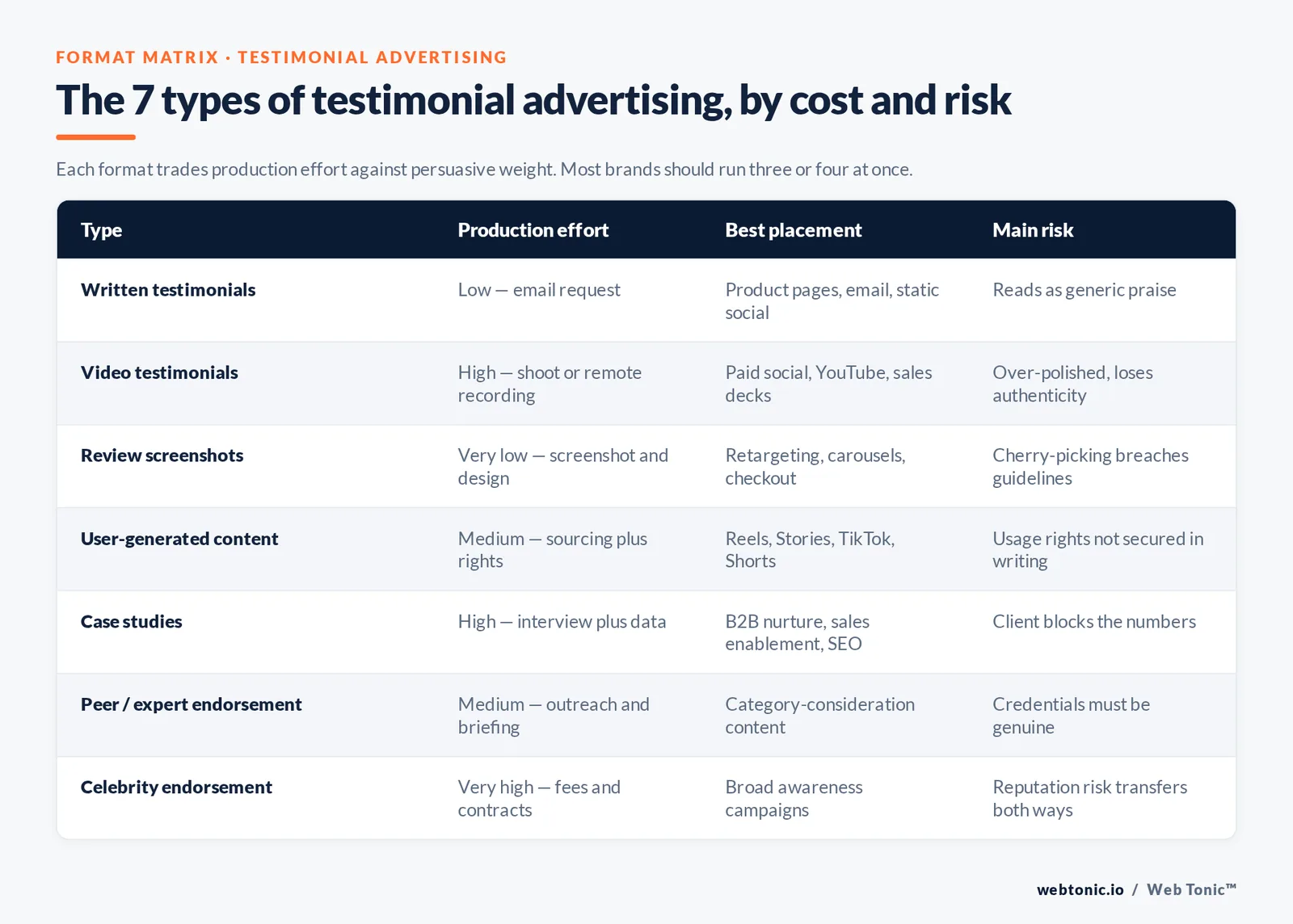
Each format trades production cost against persuasive weight. Written testimonials are nearly free and scale infinitely; video testimonials cost a shoot and convert far harder. Most brands should run three or four of these simultaneously rather than betting everything on one.
| Type | What it looks like | Production effort | Best placement | Main risk |
|---|---|---|---|---|
| Written testimonials | A named quote with role, company or city | Low — email request | Product pages, email, static social ads | Reads as generic praise |
| Video testimonials | 30–90 seconds of a customer speaking to camera | High — shoot or remote recording | Paid social, YouTube, sales decks | Over-polished, loses authenticity |
| Review screenshots | Verified reviews from a third-party platform | Very low — screenshot and design | Retargeting, carousels, checkout | Editing or cherry-picking breaches guidelines |
| User-generated content (UGC) | Customer-filmed clips and photos, often vertical | Medium — sourcing plus rights | Reels, Stories, TikTok, Shorts | Usage rights not secured in writing |
| Case studies | Problem, action, measured result, quote | High — interview plus data | B2B nurture, sales enablement, SEO | Client blocks the numbers |
| Peer and expert endorsements | A practitioner or specialist vouching publicly | Medium — outreach and briefing | Category-consideration content | Expert credentials must be genuine |
| Celebrity endorsements | A known figure attached to the brand | Very high — fees and contracts | Broad awareness campaigns | Reputation risk transfers both ways |
The two cheapest rows carry more of the load than most teams expect. Review screenshots are effectively free, and because people scan rather than read — Nielsen Norman Group found only about 16% of users read word by word while 79% scan — a single highlighted sentence from a real review often outperforms a paragraph of brand copy. That research also found concise, scannable, objective writing improved measured usability by 124% when combined.
Testimonial advertising examples worth studying
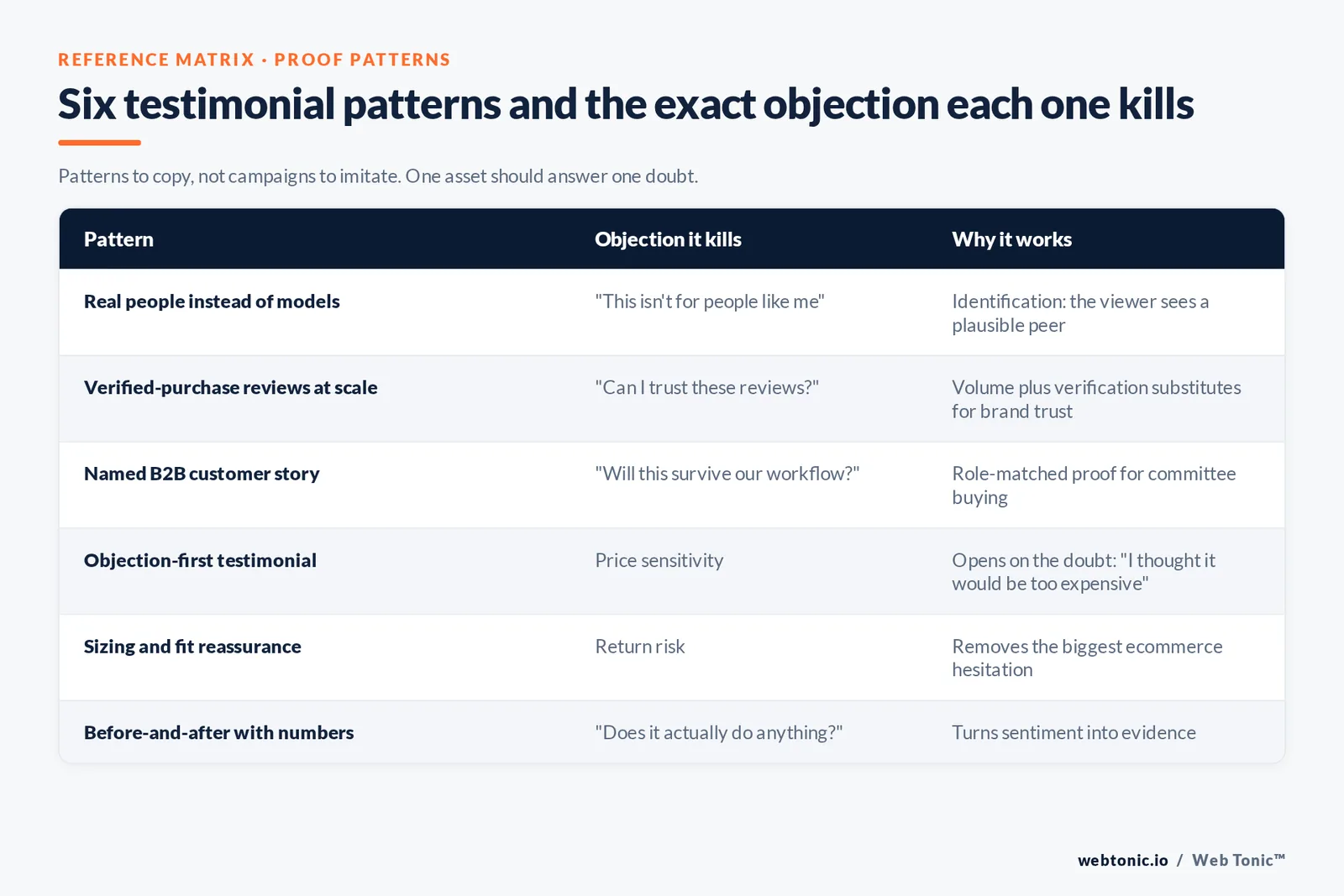
These are patterns you can copy, not campaigns to imitate literally. Each one solves a different objection.
| Pattern | Example approach | Objection it kills | Why it works |
|---|---|---|---|
| Real people instead of models | Dove's Real Beauty work built entire campaigns around unretouched, non-model participants | "This isn't for people like me" | Identification: the viewer sees a plausible peer |
| Verified-purchase reviews at scale | Amazon-style verified badges and rating counts surfaced next to the buy button | "Can I trust these reviews?" | Volume plus verification substitutes for brand trust |
| Named B2B customer story | A software vendor filming an operations lead describing their rollout week | "Will this survive our workflow?" | Role-matched proof for committee buying |
| Objection-first testimonial | Opening line is the doubt: "I thought it would be too expensive" | Price sensitivity | Pre-empts the scroll-stopping thought |
| Sizing and fit reassurance | Apparel ads carrying customer lines such as "fits true to size, ordered my normal medium" | Return risk | Removes the single biggest ecommerce hesitation |
| Before-and-after with numbers | A service brand pairing a customer quote with a measured result | "Does it actually do anything?" | Turns sentiment into evidence |
| UGC posted then licensed | Reposting customer clips from social media as paid creative | "This is just an ad" | Native format, lower production tells |
| Community as testimonial | Loyalty communities where members review publicly for each other | "Nobody I know uses this" | Continuous supply of fresh proof |
| Expert plus customer stack | A specialist explains the mechanism, a customer confirms the outcome | Technical scepticism | Authority and experience in one asset |
| Support-ticket praise | Screenshots of unsolicited thank-you messages | "What happens when it breaks?" | Unprompted praise reads as unstaged |
Ecommerce teams have the easiest supply problem: shipping confirmations and post-purchase flows already touch every buyer. Shopify's guidance on customer testimonials points the same direction — ask automatically, ask soon after delivery, and make the ask one click.
Why testimonial advertising is effective
Three mechanisms are doing the work, and they are worth separating because they are optimised differently.
Risk reduction. Every purchase carries a chance of wasted money, wasted time or social embarrassment. Testimonials do not make a product better; they make the downside feel smaller. This is why the format is disproportionately effective on high-consideration purchases — mattresses, software, home services, medical, education — and roughly neutral on impulse buys.
Source credibility. A customer has nothing to gain, so their statement is treated as a more reliable signal than identical words in the brand's voice. That credibility is fragile: one detected staging cue, one obviously scripted line, and the entire asset flips into a negative.
Concreteness. Roughly 1 in 3 usable testimonials contain a number you can put on screen. Customers describe products the way other customers search for them. They mention the specific use case, the annoyance they had before, the thing they compared it to. That vocabulary is also excellent input for search and content work — Semrush's content marketing benchmarks report a majority of B2B marketers linking content programmes to revenue lift, and testimonial language is the cheapest source of the phrasing those programmes need.
The channel effects compound. HubSpot's marketing statistics library and Sprout Social's UGC research both show customer-created content earning engagement rates that brand-produced assets rarely match,. Short-form video in particular reports the strongest ROI of any social format at around 41%, and social ad spend is on track for roughly $317 billion in 2026.
How to run a testimonial advertising campaign
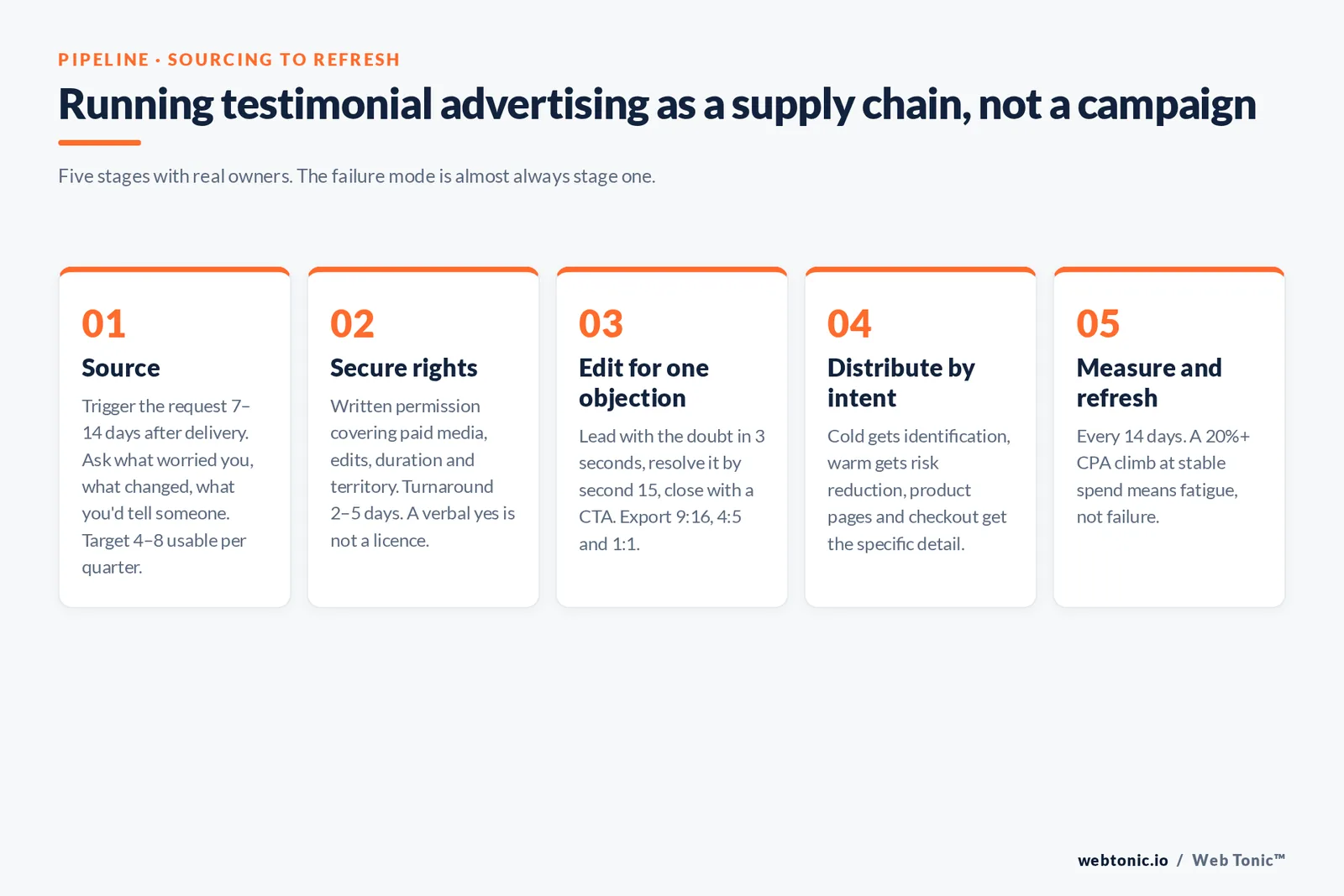
Treat this as a supply chain with five stages. The failure mode is almost always stage one.
- Source. Trigger a request 7 to 14 days after delivery or after the first success moment in a product. Ask three questions, not one: what were you worried about, what changed, what would you tell someone considering it. Volume target: 4 to 8 usable testimonials per quarter.
- Secure rights. Get written permission covering paid media, edits, duration and territory. A verbal yes is not a licence, and this is where UGC campaigns most often die.
- Edit for one objection. One asset, one doubt. Lead with the objection in the first 3 seconds, deliver the resolution by second 15, close with a call to action. Burn in captions — most feed views start muted.
- Distribute by intent. Cold audiences get the identification angle; warm audiences get the risk-reduction angle; product pages and checkout get the specific-detail angle. Search campaigns can carry ratings through Google Ads extensions and assets, and local businesses should be feeding Google Business Profile reviews in parallel.
- Refresh. Rotate assets before performance decays. If cost per acquisition climbs 20% or more over two weeks at stable spend, the testimonial has fatigued rather than failed.
| Stage | Owner | Typical timeline | Output | Failure signal |
|---|---|---|---|---|
| Source | Lifecycle or CS | Continuous | Raw quotes, clips, reviews | Fewer than 2 new per month |
| Secure rights | Legal or ops | 2–5 days | Signed usage permission | Assets stuck unusable |
| Edit | Creative | 3–7 days | 3 crops: 9:16, 4:5, 1:1 | One aspect ratio only |
| Distribute | Media buyer | Launch day | Objection-matched ad sets | Same asset to cold and warm |
| Measure and refresh | Analytics | Every 14 days | Fatigue and CPA report | No refresh queue |
The legal rules: FTC endorsement guidelines
Testimonial advertising is one of the more regulated corners of marketing in the United States, and the rules are not obscure. The FTC's endorsement guides FAQ is the practical reference. Four principles cover most situations:
- Honest opinion. An endorsement must reflect the endorser's genuine views and actual experience with the product. You cannot write the words and attribute them to a customer.
- Typical results. If you feature an exceptional outcome, you must not imply it is typical. Disclaimers such as "results not typical" are not a cure for a misleading overall impression.
- Material connections. Payment, free product, discounts, contest entries, employment and family relationships all count and must be disclosed clearly and conspicuously — the FTC's disclosures guidance for creators spells out placement and wording.
- No review manipulation. Suppressing negative reviews, buying reviews, or editing a quote so it changes meaning creates liability for the advertiser, not just the reviewer.
Two operational habits keep you clean: keep the raw, unedited source file for every testimonial you run, and keep a dated record of the permission. Review platforms help here: invite 100% of buyers rather than a hand-picked subset, so the sample is not biased. If your testimonials include video, ship captions and a transcript with every asset — assume 80%+ of feed views start muted.
Measuring testimonial ads
Testimonial creative should be judged on doubt-resolution metrics, not just reach. The useful set is narrow:
- Hold rate (3-second to 15-second retention) tells you whether the objection hook landed. Below 25% on paid social, rewrite the opening line.
- Click-to-purchase rate isolates persuasion from attention. Testimonial ads typically win here even when they lose on click-through rate.
- Return and refund rate should fall when testimonials set accurate expectations. A rising return rate alongside strong conversion is a warning that the ad is overselling.
- Assisted conversions matter because testimonials often do mid-funnel work. Judge them across a 7-day click, 1-day view window rather than last click alone.
Benchmark against your own history first over at least 90 days, then against category data. If you want this instrumented properly, our data intelligence team builds the attribution layer, while performance creative handles the sourcing-to-edit pipeline and growth marketing maps assets to funnel stage. More background reading sits on the Web Tonic blog, and you can talk to us if you would rather not build the pipeline in-house.
Common mistakes
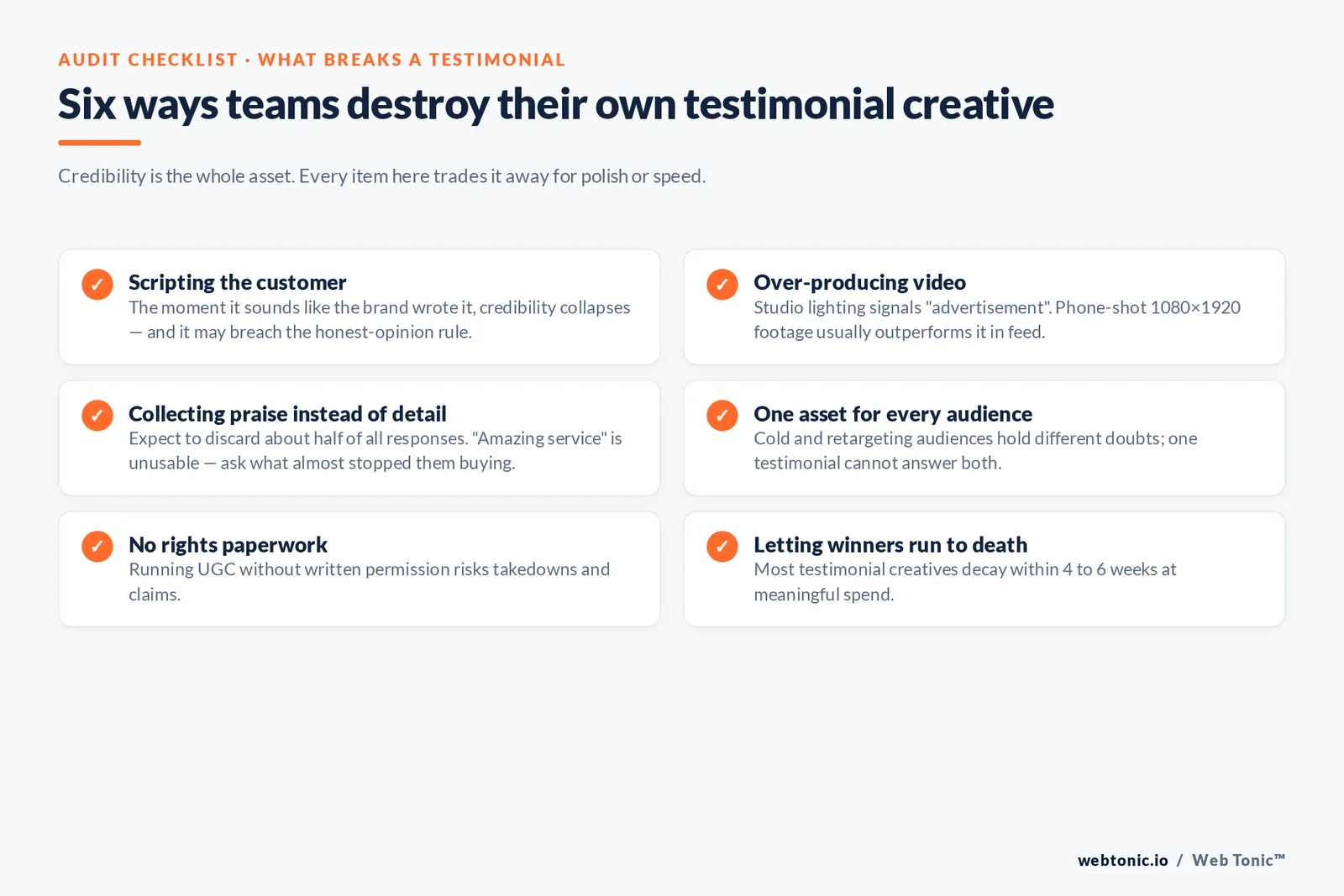
- Scripting the customer (mistake 1 of 7). The moment a testimonial sounds like the brand wrote it, credibility collapses — and it may breach the honest-opinion rule.
- Over-producing video. Studio lighting and a colour-graded grade signal "advertisement". Phone-shot footage at 1080×1920 usually outperforms it in feed.
- Collecting praise instead of detail. Expect to discard 50% of responses. "Amazing service" is unusable. Ask what almost stopped them from buying.
- One asset for every audience. Cold and retargeting audiences hold different doubts; a single testimonial cannot answer both.
- No rights paperwork. Running UGC without written permission risks takedowns and claims.
- Letting winners run to death. Most testimonial creatives decay within 4 to 6 weeks at meaningful spend.
- Hiding the negatives. A profile of only 5-star reviews reads as fake; a visible 4.6 average with real criticism converts better.
FAQ: testimonial advertising
What is testimonial advertising in simple terms?
It is advertising where the main message comes from a customer rather than the brand. Instead of the company claiming a product works, a real buyer describes their own experience with it, and that statement is used as the creative in a paid ad, landing page or email.
Is testimonial advertising effective for every business?
It is strongest for high-consideration purchases where buyers carry real risk — software, home services, health, education, furniture, high-ticket ecommerce. For low-cost impulse products it still helps but adds less, because there is little risk for the testimonial to reduce.
Do I need legal permission to use a customer review in an ad?
Yes. Written permission covering paid media, editing, duration and territory is the safe standard, and any material connection such as payment or free product must be disclosed under the FTC endorsement guides. Keep the unedited original file and a dated record of consent.
How many testimonials should a campaign use?
Run at least three at once so each can answer a different objection, and add four to eight new ones per quarter so you always have replacements ready. Single-asset testimonial campaigns fatigue quickly and give you nothing to compare against.
Are video testimonials better than written ones?
Video usually persuades harder because tone and face add credibility, but written testimonials and verified review screenshots cost almost nothing and can be deployed everywhere. The practical answer is to run both: written proof on product pages and email, video in paid social and sales conversations.
Sources: FTC 16 CFR Part 255 endorsement guides · FTC endorsement guides FAQ · FTC disclosures guidance for social media influencers · Nielsen Norman Group, how users read on the web · Sprout Social social media statistics and UGC research · HubSpot marketing statistics · Semrush content marketing statistics · Wistia video marketing statistics · Shopify customer testimonials guidance · Google Ads help · Google Business Profile help. Figures reflect the most recent published data at time of writing.