Table of contents

Only 28% of marketers across industries call their automation strategy best-in-class, and tax and accounting firms are not exempt from that gap between buying the tool and running it well. This page prices the tools from named vendor pages and checks the adoption and revenue evidence before answering whether the category is actually worth it.
Key Takeaways
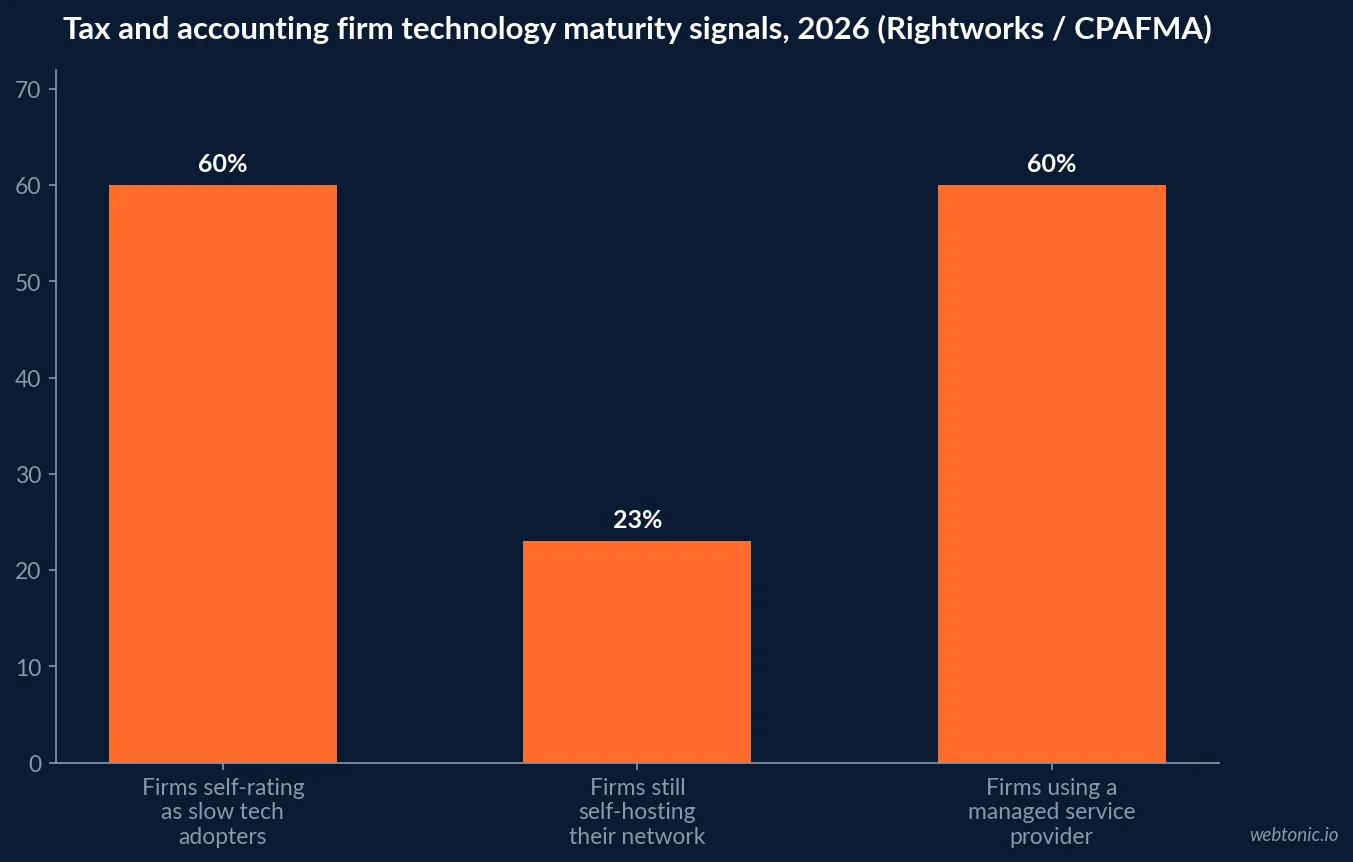
- 60% of accounting firms self-identify as slow technology adopters (Rightworks, 2024).
- Tech-advanced firms report up to 39% more revenue per employee in the same survey.
- High-growth accounting firms grow at 29% a year, about 5x low-growth peers at 5.79% (AAM/Hinge).
- Only 23% of firms still self-host their own network, down from 77% a decade ago (CPAFMA, 2026).
- 60% of firms now use a managed service provider for their infrastructure.
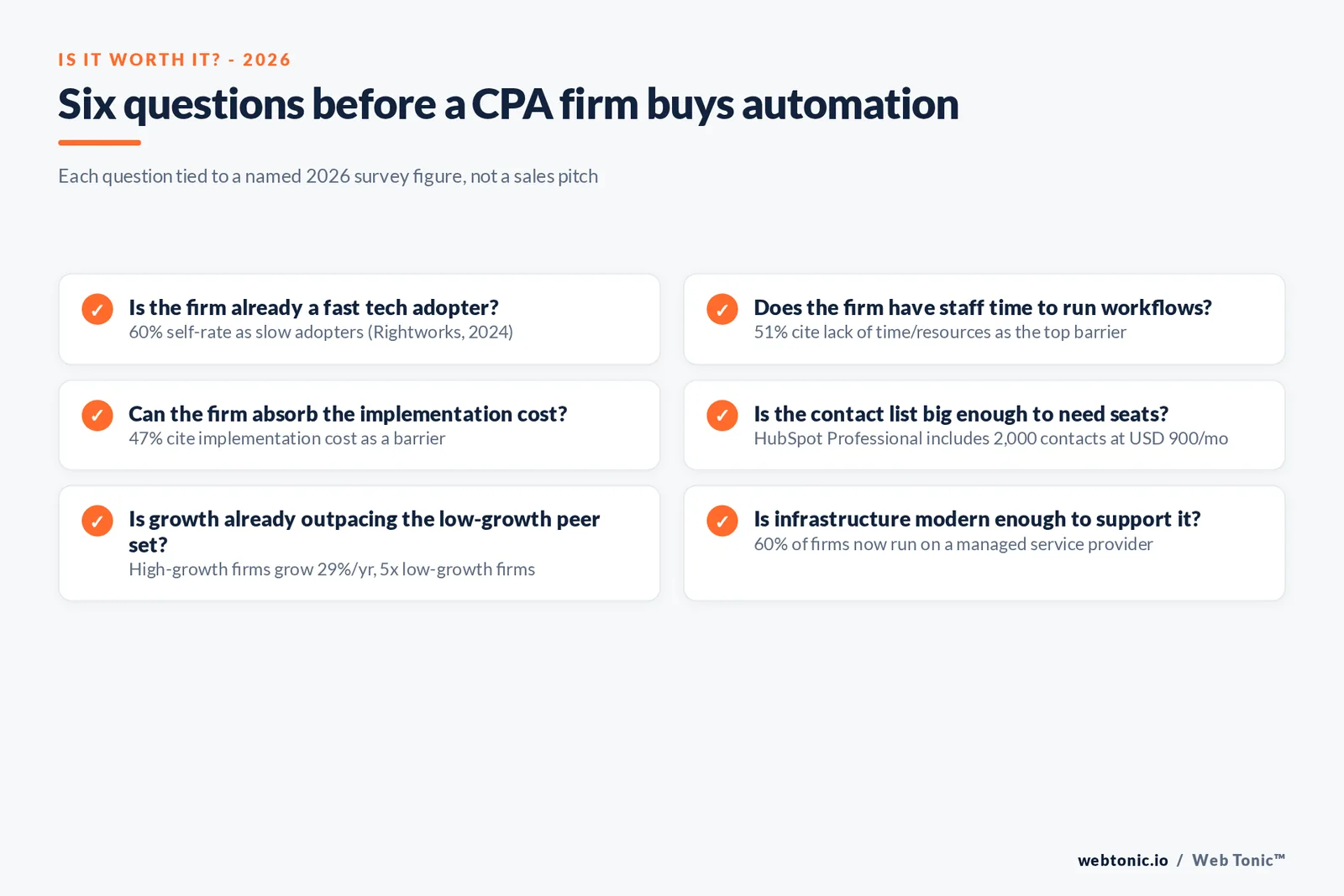
- 51% cite lack of time and resources as the top barrier to more automation (Thomson Reuters, 2026).
- 47% cite implementation cost as the second-largest barrier.
- 52% name efficiency as their top strategic priority, up from 44% a year earlier.
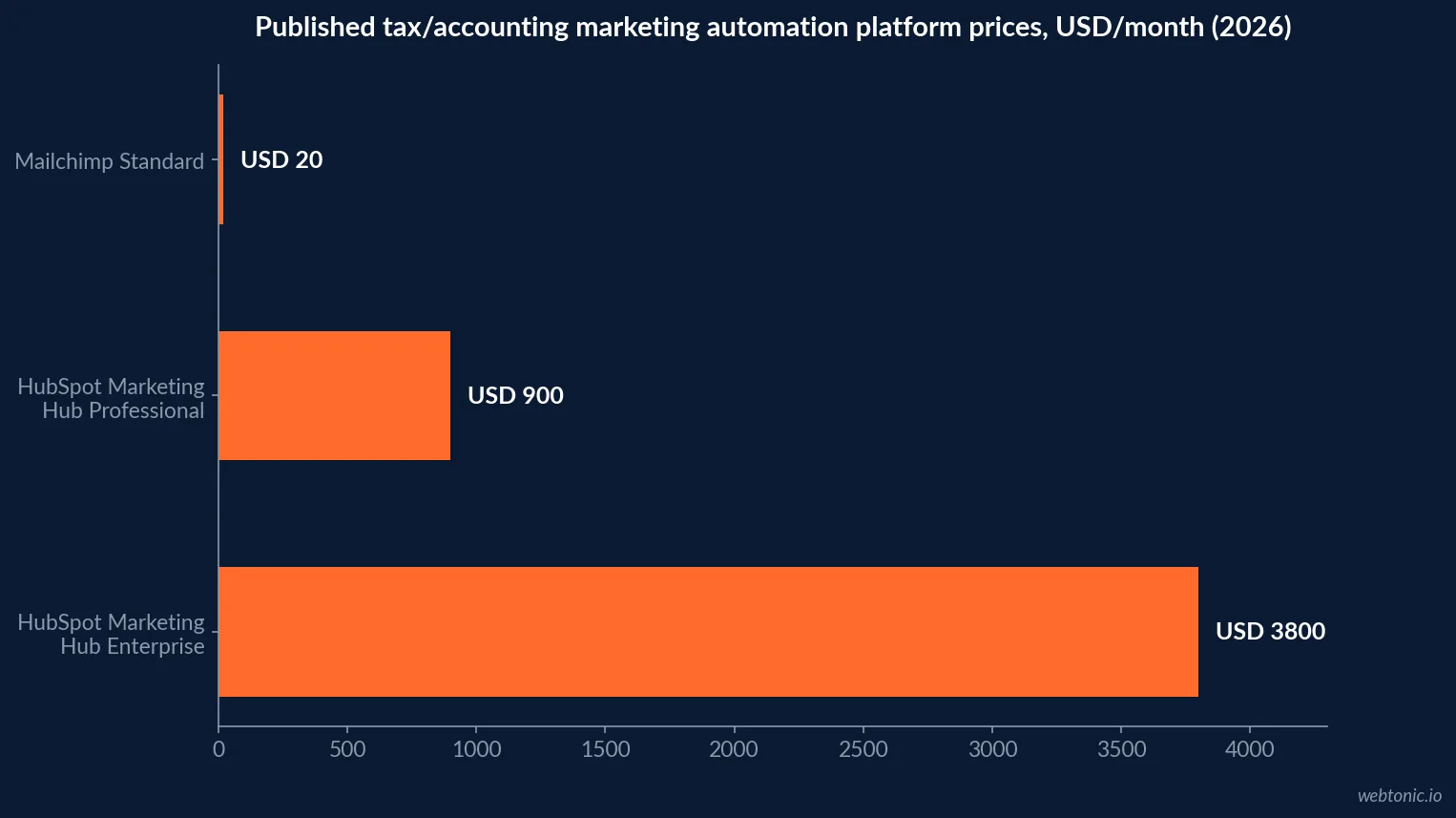
- HubSpot Marketing Hub Professional lists at USD 900 a month for three seats.
- HubSpot's onboarding fee alone runs USD 3,000 to USD 7,000 depending on tier.
- Mailchimp's Standard plan starts at USD 20 a month for up to 500 contacts.
- ActiveCampaign publishes no flat rate - every plan is quoted on request.
- Business + Finance email opens average 31.35% against a 35.63% all-industry rate (Mailchimp).
- Email returns roughly USD 36 for every USD 1 spent, per Litmus's own analysis.
- 28% of marketers rate their own automation strategy best-in-class (Ascend2, 2024).
- A lead contacted within an hour converts about 7x more often than a delayed one (HBR, 2011).
The honest starting point: adoption is still catching up
Rightworks' 2024 Accounting Firm Technology Survey, fielded among almost 500 decision-makers and influencers at accounting, tax and bookkeeping firms nationwide, found that nearly 60% identified their own firm as a slow adopter of new technology. The same survey is the source of the number that makes the case for closing that gap: firms that self-rated as more technology-advanced reported up to 39% more revenue per employee than slower peers. That is a correlation across a firm's whole technology stack, not an isolated marketing-automation result - no published study prices the marketing-automation slice of that gap alone.
| Adoption signal (own source, year stated) | Figure | Source | What it measures |
|---|---|---|---|
| Firms self-rating as slow tech adopters | ~60% | Rightworks 2024 (n~500) | Baseline maturity across the profession |
| Revenue-per-employee gap, advanced vs. slow adopters | up to 39% | Rightworks 2024 | Associated lift, not isolated to marketing tools |
| Firms still self-hosting their own network | 23% | CPAFMA 2026 (n=162) | Down from 77% a decade earlier |
| Firms using a managed service provider | 60% | CPAFMA 2026 | Infrastructure maturity, a precondition for automation |
| High-growth firm annual growth rate | 29% | AAM/Hinge 2023-2024 | Roughly 5x the 5.79% low-growth rate |
What the tools actually cost, from their own pricing pages
General marketing automation platforms price on seats and contacts, not on being an accounting firm. HubSpot's own Marketing Hub pricing guide lists Professional at USD 900 a month for three core seats and 2,000 marketing contacts, with additional seats at USD 45 a month and a one-time USD 3,000 onboarding fee; Enterprise runs USD 3,800 a month for five seats with a USD 7,000 onboarding fee, and crossing a contact tier boundary on Professional adds roughly USD 250 a month automatically. Mailchimp's own pricing page starts its Standard plan at USD 20 a month for up to 500 contacts and 6,000 sends, with a free tier capped at 500 contacts and 1,000 sends. ActiveCampaign's own pricing page publishes no flat number at all - every tier is quoted against contact volume and channel mix on request, which makes it the hardest of the three to comparison-shop without a sales call.
| Platform (own pricing page, 2026) | Entry-level published price | Onboarding / setup fee | Notes |
|---|---|---|---|
| Mailchimp Standard | USD 20/mo, 0-500 contacts | None published | Free tier caps at 500 contacts, 1,000 sends |
| HubSpot Marketing Hub Professional | USD 900/mo, 3 seats, 2,000 contacts | USD 3,000 one-time | +USD 45/mo per extra seat |
| HubSpot Marketing Hub Enterprise | USD 3,800/mo, 5 seats, 10,000 contacts | USD 7,000 one-time | +USD 75/mo per extra seat |
| ActiveCampaign | Quote-based, no published flat rate | Not published | Priced by contact count and channel mix |
What firms say is actually stopping them
Thomson Reuters' 2026 State of Tax Professionals Report, surveying 600 tax, audit and accounting professionals worldwide, found 51% citing lack of time and resources and 47% citing implementation cost as the two biggest barriers to further automation. 52% named efficiency their top strategic priority for the year, up from 44% in the prior survey - the internal argument firms are making for automation even before a marketing-specific dollar figure is attached to it. The same report found 65% of firms expecting revenue growth in the coming year, so the barrier is capacity and budget competing with growth, not doubt that the growth is coming.
| Barrier or priority (2026, own source) | Share of firms | Source | Reading |
|---|---|---|---|
| Cite lack of time/resources as automation barrier | 51% | Thomson Reuters 2026 (n=600) | Capacity, not skepticism |
| Cite implementation cost as automation barrier | 47% | Thomson Reuters 2026 | Upfront spend competes with other priorities |
| Name efficiency as top strategic priority | 52% | Thomson Reuters 2026 | Up from 44% the prior year |
| Expect revenue growth in the coming year | 65% | Thomson Reuters 2026 | Growth confidence funds the case for tooling |
The growth evidence: correlation, named honestly
The Association for Accounting Marketing's 2023-2024 Marketing Budget Benchmark Study, produced with Hinge, classifies firms into growth tiers by three-year growth rate and finds High Growth firms expanding at 29% a year - roughly five times the 5.79% annual rate reported by Low Growth firms. The study's own framing credits digital maturity broadly - analytics, automation, social and content marketing together - alongside that growth gap, not marketing automation as an isolated cause. Read the correlation as "high-growth firms tend to use more of this stack," not as "buying this stack causes 29% growth."
What to expect from the email layer specifically
No public benchmark separates CPA or tax-firm email performance from the broader financial-services category. The closest labeled proxy, Mailchimp's own Business and Finance benchmark, last updated December 2023, puts opens at 31.35% and clicks at 2.78%, against an all-industry average of 35.63% open and 2.62% click. On return rather than engagement, Litmus's own analysis puts average email ROI at roughly USD 36 for every USD 1 spent - the number most often cited to justify keeping email inside an automation stack even when a firm's own open rate sits below the category average.
So: worth it, or not?
The honest answer is conditional. The revenue-per-employee and growth-rate evidence above is real but correlational, tied to a firm's overall technology maturity rather than to marketing automation in isolation, and every platform's price scales hard with seats and contact volume - a five-partner firm on HubSpot Professional is paying a materially different bill than a two-person practice on Mailchimp Standard. The case for the category is strongest where a firm already has the lead volume and staff capacity to act on what the workflow produces; Thomson Reuters' own barrier data - time, resources and implementation cost - says that precondition, not the software's list price, is what most firms are actually missing in 2026. Our growth marketing practice can help size that gap before a platform purchase, and our data and analytics practice can benchmark the resulting pipeline once a tool is live; see also our breakdown of paid search costs for the channel most CPA firm automation workflows are built to nurture.
Frequently Asked Questions
Is marketing automation actually worth it for a tax and accounting firm?
The evidence is directional, not a guaranteed return. Rightworks' 2024 Accounting Firm Technology Survey, fielded among almost 500 decision-makers at accounting, tax and bookkeeping firms, found that firms self-rating as more technology-advanced reported up to 39% more revenue per employee than slower adopters - though the same survey found nearly 60% of respondents still call their own firm a slow adopter. Separately, the Association for Accounting Marketing's 2023-2024 benchmark study with Hinge found high-growth firms - defined as the top quartile by three-year growth rate - expanding at 29% a year, roughly five times the 5.79% rate of low-growth firms, and named technology use as one factor distinguishing them. Neither study isolates marketing automation alone from the rest of a firm's tech stack, so treat the lift as associated with broader digital maturity, not proven to be caused by any single tool.
What does marketing automation software actually cost a CPA firm?
It depends entirely on scale. HubSpot's own Marketing Hub pricing guide lists Professional at USD 900 a month for three seats and 2,000 contacts, plus a one-time USD 3,000 onboarding fee; Enterprise runs USD 3,800 a month for five seats with a USD 7,000 onboarding fee. Mailchimp's own pricing page starts its Standard plan at USD 20 a month for up to 500 contacts, rising with list size, with a free tier capped at 6,000 sends a month. ActiveCampaign publishes no flat rate on its own pricing page - plans are quoted against contact count and channel mix on request. A solo practitioner and a 100-person regional firm are not shopping in the same price band, and neither figure includes staff time to run the workflows.
Are tax and accounting firms actually adopting this technology, or is it still mostly manual?
Mostly still building toward it. The CPA Firm Management Association's 2026 Digitally Driven Firm survey of 162 firms, with 51% reporting 26 to 100 staff, found 60% relying on a managed service provider for infrastructure and only 23% still self-hosting their own network, down from 77% a decade earlier - a broader technology-maturity signal that marketing automation adoption tends to track. Thomson Reuters' 2026 State of Tax Professionals Report, surveying 600 tax, audit and accounting professionals worldwide, found 51% citing lack of time and resources and 47% citing implementation cost as the two biggest barriers to further automation - cost and capacity, not skepticism about the return.
What email performance should a tax and accounting firm actually expect from automated campaigns?
The closest labeled proxy on Mailchimp's own benchmark page, last updated December 2023, is its Business and Finance category: a 31.35% open rate and a 2.78% click rate, against an all-industry average of 35.63% open and 2.62% click. No public benchmark separates CPA firms from the broader financial-services category, so state that limitation whenever the figure is used. Litmus's own analysis separately puts email's average return at roughly USD 36 for every USD 1 spent across the brands it surveyed - the most-cited reason firms keep email inside an automation stack even when open rates look average.
Does automating client communication actually save time during tax season?
The most durable evidence for automated follow-up generally, not tax-specific, is still the 2011 Harvard Business Review study by Oldroyd, McElheran and Elkington: contacting a lead within an hour made a company roughly seven times more likely to qualify it than a same-day-later contact. Thomson Reuters' 2026 survey adds a tax-specific data point on the barrier side rather than the outcome side: 52% of respondents cited efficiency as their top strategic priority for the year, up from 44% the year before, which is the internal case firms are making for automation even where a hard time-saved figure has not been published.
Sources
Rightworks - 2024 Accounting Firm Technology Survey
CPA Firm Management Association - 2026 Digitally Driven Firm Survey
Thomson Reuters Institute - 2026 State of Tax Professionals Report
Association for Accounting Marketing / Hinge - 2023-2024 Marketing Budget Benchmark Study
HubSpot - Marketing Hub pricing guide
Mailchimp - Marketing pricing
Mailchimp - Email marketing benchmarks by industry
ActiveCampaign - Pricing
Litmus - Email marketing ROI
Harvard Business Review - The Short Life of Online Sales Leads, 2011
Ascend2 - The State of Marketing Automation 2024