



Table of contents
Google Ads remains the primary paid acquisition channel for tax and accounting firms, capturing high-intent prospects at the exact moment they search for services. Benchmarketing’s 2026 accounting data shows that tax services achieve a 7.2% conversion rate on Google Ads — nearly double the cross-industry average. With CPCs ranging from $8 for bookkeeping to $35+ for forensic accounting, understanding cost dynamics by service type is critical for budget allocation. Here are the numbers defining the landscape in 2026.
Key Takeaways
- Tax services average $8.84 CPC on Google Ads, while accounting broadly averages $4.44 (Benchmarketing, 2026)
- Conversion rate for tax services hits 7.2%, well above the 4.4% cross-industry average
- CPC varies 4x by service type — bookkeeping at $8 versus forensic accounting above $35
- Average CPA for accounting services is $48, with tax-specific CPAs ranging from $60 to $120
- Seasonal CPC swings reach 150% — from $7 in July to $20 in April
- Google Ads ROAS for tax services averages 3.2x with a 45–60 day payback period
- Quality Scores of 7+ reduce effective CPC by 20–40% versus the category average of 5–6
Google Ads Cost Benchmarks for Tax & Accounting
The cost landscape for accounting Google Ads splits sharply between general bookkeeping and specialized tax services. Benchmarketing reports that accounting services broadly average $4.44 CPC with a 4.40% conversion rate, while tax-specific services carry a $8.84 CPC but achieve a stronger 7.2% conversion rate. The higher tax CPC is justified by higher conversion rates and larger client lifetime values. Uncle Kam’s payback analysis confirms a 45–60 day payback period for Google Ads leads in the tax vertical.
| Metric | Accounting (General) | Tax Services | CPA Firms | All Industries Avg. |
|---|---|---|---|---|
| Avg. CPC | $4.44 | $8.84 | $6.50 | $2.69 |
| CTR (Search) | 2.84% | 4.68% | 3.40% | 3.17% |
| Conversion Rate | 4.40% | 7.2% | 5.8% | 4.40% |
| Cost per Lead | $101 | $48–$60 | $65 | $53 |
| ROAS | 2.8x | 3.2x | 3.0x | 2.0x |
| Quality Score (Avg.) | 5.5 | 6.2 | 5.8 | 5.0 |
The standout metric is the 4.68% CTR for tax services — substantially above both the accounting average and the cross-industry benchmark. This high CTR reflects the strong commercial intent behind tax-related searches: people searching for “tax preparer near me” or “CPA for small business” are actively looking to hire, not just researching. Combined with the 7.2% conversion rate, this makes tax services one of the most efficient verticals on Google’s search advertising platform.
CPC by Service Type
Not all accounting services compete at the same price point on Google. Benchmarketing’s analysis and WordStream’s industry benchmarks provide service-level CPC data showing a 4x range between bookkeeping ($8) and forensic accounting ($35+). The variation follows a clear pattern: services with higher client lifetime values and greater legal complexity command higher CPCs because more firms compete for those high-value clients.
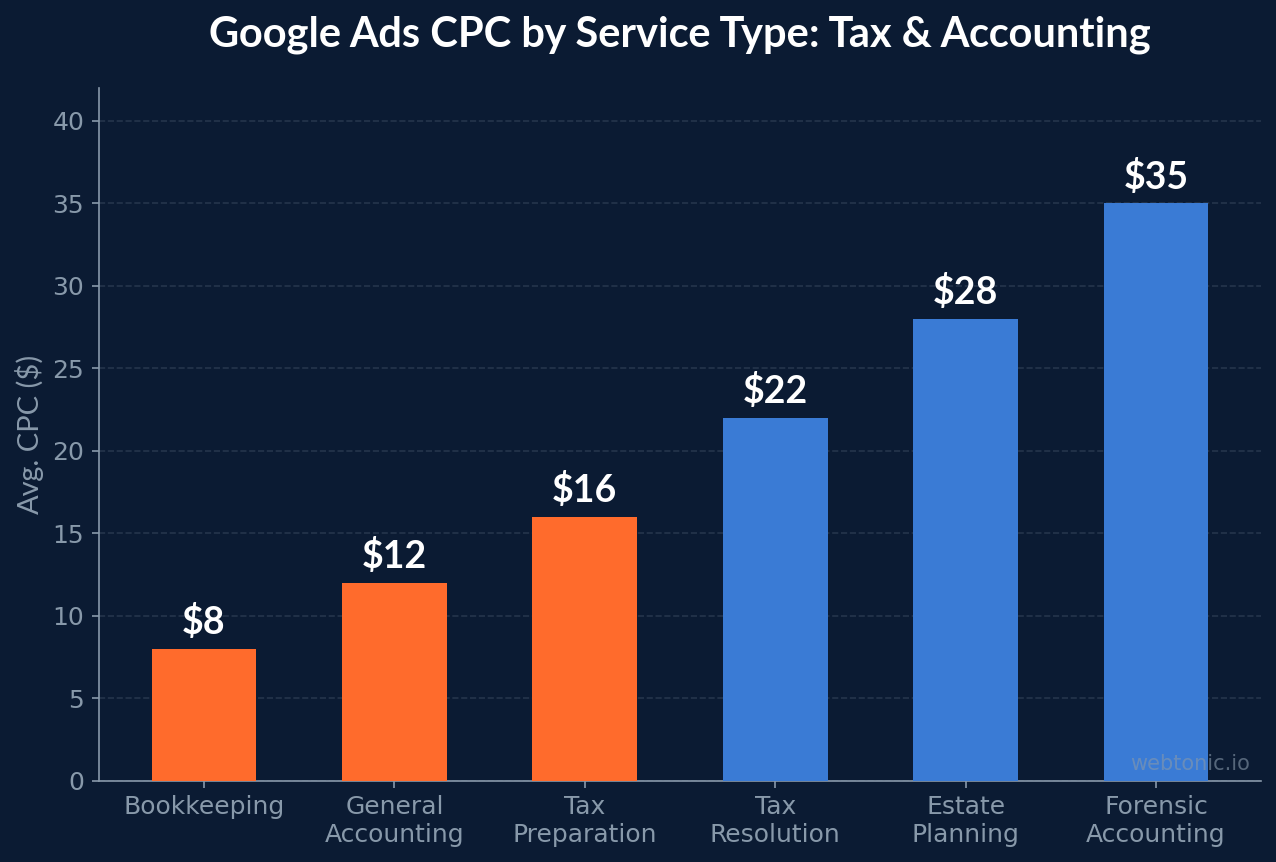
| Service Type | Avg. CPC | Avg. CVR | Typical CPA | Client LTV Estimate |
|---|---|---|---|---|
| Bookkeeping | $8 | 5.2% | $154 | $2,000–$5,000 |
| General Accounting | $12 | 4.8% | $250 | $3,000–$8,000 |
| Tax Preparation (Individual) | $16 | 7.8% | $205 | $2,500–$6,000 |
| Tax Resolution / IRS Issues | $22 | 6.5% | $338 | $5,000–$15,000 |
| Estate & Trust Planning | $28 | 4.1% | $683 | $8,000–$25,000 |
| Forensic Accounting | $35+ | 3.8% | $921+ | $15,000–$50,000+ |
When evaluated against client lifetime value, the seemingly expensive $35+ CPC for forensic accounting actually represents the best value proposition in the vertical. A $921 CPA against a $15,000+ LTV yields a 16:1+ return, far exceeding the ratios for lower-CPC services. Tax preparation, at $16 CPC and 7.8% CVR, offers the highest conversion efficiency — making it the sweet spot for firms seeking volume-based growth through Google Ads strategy optimization.
Quality Score and Landing Page Performance
Quality Score remains one of the most impactful levers for reducing Google Ads costs in the accounting vertical. Firms with Quality Scores of 7 or above pay 20–40% less per click than those sitting at the category average of 5–6. CuFinder’s data shows that CPA firm landing pages convert at 3.6% on average, but WordStream’s research shows that dedicated service-specific landing pages reach 6–10% conversion rates — the key differentiator being page relevance and specificity.
| Quality Score Range | CPC Impact | Est. Share of Advertisers | Key Drivers |
|---|---|---|---|
| 1–4 (Below Average) | +25–50% CPC premium | 30–35% | Poor landing page, generic ads |
| 5–6 (Average) | Baseline CPC | 35–40% | Decent relevance, moderate CTR |
| 7–8 (Above Average) | −20–30% CPC discount | 20–25% | Strong landing pages, high CTR |
| 9–10 (Excellent) | −30–40% CPC discount | 5–10% | Perfect ad-to-LP alignment |
The most common Quality Score improvement for accounting firms is building dedicated landing pages for each service type rather than sending all traffic to the homepage or a generic services page. A firm advertising “tax preparation for small businesses” should land users on a page specifically about small business tax preparation — not a general “our services” page that mentions tax prep alongside ten other offerings. This single change typically improves Quality Score by 2–3 points and reduces CPC by 15–25%.
Seasonal CPC and Conversion Trends
Tax seasonality creates the most dramatic CPC swings in any professional services vertical. Uncle Kam’s seasonal analysis shows that Google Ads CPCs for tax services roughly triple between July ($7) and April ($20). However, conversion rates spike even more dramatically during the same period, meaning that despite higher CPCs, the effective cost per acquired client actually drops during tax season. This counterintuitive dynamic is what makes front-loaded budget strategies so effective.
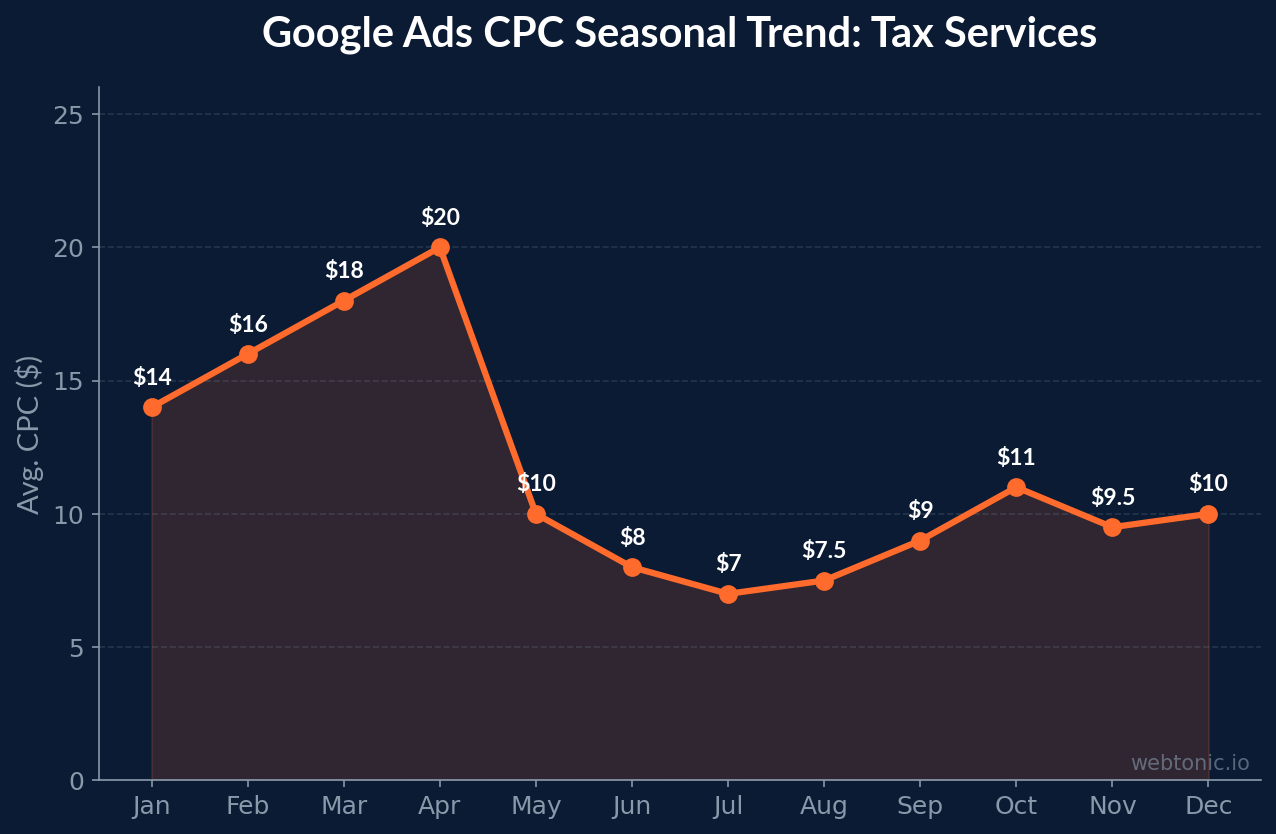
| Period | Avg. CPC | CVR | Effective CPA | Strategic Implication |
|---|---|---|---|---|
| Jan–Feb (Early Filers) | $14–$16 | 8.5% | $165–$188 | Highest-efficiency window |
| Mar–Apr (Deadline Rush) | $18–$20 | 9.2% | $196–$217 | Volume spike, strong intent |
| May–Aug (Off-Season) | $7–$8 | 4.1% | $171–$195 | Low volume, advisory focus |
| Sep–Oct (Extension Window) | $9–$11 | 6.8% | $132–$162 | Often the best CPA of the year |
| Nov–Dec (Year-End) | $9.5–$10 | 5.5% | $173–$182 | Planning prospects, Q1 warmup |
The September–October extension window often delivers the best cost per acquired client of the entire year at $132–$162 CPA. CPCs remain moderate while conversion rates jump because the audience is highly specific: people who filed extensions and must act before October 15. Competition is lower because most firms focus their budgets on Q1. Firms that allocate a meaningful portion of budget to this window — typically 15–20% of annual spend — can acquire clients at 25–35% lower CPA than during the crowded January–April peak.
Campaign Structure and Budget Allocation
Select Advisors Institute recommends that accounting firms allocate 60–70% of Google Ads budget to branded and high-intent service keywords, with the remaining 30–40% directed toward broader awareness and competitor terms. Firms spending less than $2,000 per month on Google Ads should focus exclusively on high-intent keywords to maximize every click. Only firms with budgets exceeding $5,000 per month have enough volume to test broader match types and awareness campaigns without diluting their core conversion performance.
| Monthly Budget Range | Recommended Structure | Expected Monthly Leads | Typical ROAS |
|---|---|---|---|
| $1,000–$2,000 | Single campaign, exact/phrase match only | 8–18 leads | 2.0–2.5x |
| $2,000–$5,000 | 2–3 campaigns by service type | 18–45 leads | 2.5–3.5x |
| $5,000–$10,000 | Full funnel: brand + service + competitor | 40–90 leads | 3.0–4.0x |
| $10,000+ | Search + display + YouTube + LSA | 80–180+ leads | 3.5–5.0x |
The ROAS improvement at higher budget levels reflects both economies of scale and the ability to run full-funnel campaigns. At $10,000+ monthly spend, firms can layer search campaigns with display retargeting, YouTube brand awareness, and Local Services Ads to capture prospects at every stage of the decision journey. The compounding effect of multi-channel presence is what drives the 3.5–5.0x ROAS at scale, compared to the 2.0–2.5x achievable with a single search campaign at low budgets.
Match Type Strategy and Keyword Performance
Match type selection significantly impacts both cost efficiency and lead quality for accounting Google Ads campaigns. Exact match keywords for specific services like “tax preparer near me” or “CPA for small business” deliver the highest conversion rates at 8–12% but capture limited volume. Phrase match broadens reach while maintaining relevance, with conversion rates averaging 5–7% across accounting service terms. Broad match with smart bidding can unlock significant volume at scale but requires at least 30 conversions per month per campaign to optimize effectively.
Negative keyword management is particularly important in the accounting vertical because many related searches carry zero commercial intent. Terms like “accounting degree,” “free tax filing,” “accounting software,” and “IRS payment plan” consume significant budget if left unblocked. Benchmarketing’s data suggests that firms running monthly search term reviews save 15–25% of their ad spend through negative keyword additions — spend that would otherwise flow to irrelevant clicks with near-zero conversion probability.
Local Services Ads for Accounting Firms
Local Services Ads (LSAs) represent a growing channel for accounting firms, particularly sole practitioners and small practices. LSAs operate on a pay-per-lead basis rather than pay-per-click, with leads averaging $25–$55 for accounting services — often lower than traditional search CPA. The Google Guaranteed badge that accompanies LSAs provides a trust signal that improves conversion rates, especially for firms competing against larger brands in their local market.
However, LSA performance depends heavily on review volume and recency. CuFinder reports that firms with 20+ Google reviews averaging 4.8+ stars receive 3–4x more LSA leads than those with fewer or lower-rated reviews. The practical implication is that LSAs reward firms that actively manage their reputation — a practice that also benefits organic search visibility and overall trust. For firms with strong review profiles, LSAs can generate 20–30% of total Google-sourced leads at a lower effective CPA than standard search campaigns.
The combination of traditional search ads and LSAs creates a dual-presence effect in search results. When a firm appears both in the LSA section (top of page) and in the standard paid results, Select Advisors Institute research shows that overall click-through rate improves by 25–40% compared to appearing in only one location. This visibility stacking is particularly effective during tax season when competition for attention is highest.
Frequently Asked Questions
What is the average CPC for accounting firms on Google Ads?
The average CPC for accounting services on Google Ads is 4.44 dollars, while tax-specific services average 8.84 dollars. CPC varies dramatically by service type, ranging from 8 dollars for bookkeeping to over 35 dollars for forensic accounting.
What conversion rate should tax firms expect from Google Ads?
Tax services achieve an average Google Ads conversion rate of 7.2 percent, which is well above the cross-industry average of 4.4 percent. Landing pages optimized for a single service with a clear call to action can push conversion rates above 10 percent.
How much does a Google Ads lead cost for CPA firms?
The average cost per lead for CPA firms on Google Ads ranges from 35 to 60 dollars for general accounting services, and 60 to 120 dollars for specialized tax services. The overall accounting average CPA is 48 dollars.
What Quality Score do accounting firms typically achieve?
Accounting firms average a Google Ads Quality Score of 5 to 7 out of 10. Firms with dedicated landing pages for each service type and strong ad relevance regularly achieve scores of 7 to 9, reducing their effective CPC by 20 to 40 percent.
When should accounting firms increase their Google Ads budget?
The highest-ROI window for increasing Google Ads spend is January through April, when tax-season demand peaks. CPCs rise but conversion rates spike even more, yielding the best cost per acquisition of the year. Firms should allocate 45 to 55 percent of annual budget to this window.
Sources
Benchmarketing — Accounting Marketing Benchmarks 2026
CuFinder — CPA Firm Industry Marketing Benchmarks 2026
CuFinder — Accounting Industry Marketing Benchmarks 2026
Uncle Kam — Tax Firm Marketing Guide 2026
Select Advisors Institute — Marketing ROI Benchmarks for Accounting Firms
Wolf Financial — Financial Services Marketing KPIs 2025
WordStream — Google Ads Industry Benchmarks


