Table of contents
Email remains the single most profitable digital channel for tax and accounting firms, delivering between 5 and 13 dollars return for every dollar spent depending on campaign type. With CPA firms averaging 28.5% open rates — well above the 21.3% cross-industry mean — the data confirms that accounting clients actively engage with email communication from their financial professionals. Here are the benchmarks that matter in 2026.
Key Takeaways
- CPA firms average a 28.5% email open rate, well above the 21.3% cross-industry benchmark (CuFinder, 2026)
- Automated email sequences convert leads 47% better than single-send campaigns (EmailMarketingForBusiness)
- Email ROI for accounting firms ranges from $36 to $42 per $1 spent across all campaign types combined
- Tax-deadline reminder emails reach 32–38% open rates, the highest of any campaign type in the vertical
- Firms using email automation report 30% higher revenue growth than those relying on manual sends
- The average email CTR for accounting is 2.4%, with CPA-specific campaigns hitting 3.1%
- Retention and upsell email sequences deliver ROI as high as 13:1 for established accounting practices
Email Marketing Benchmarks at a Glance
These figures consolidate data from CuFinder, Benchmarketing, and Mailchimp. CPA firms consistently outperform the broader accounting category because their client relationships are inherently more personal and recurring — clients expect and welcome regular communication from their tax professional.
| Metric | CPA Firms | Accounting (General) | All Industries |
|---|---|---|---|
| Open Rate | 28.5% | 21.9% | 21.3% |
| Click-Through Rate | 3.1% | 2.4% | 2.6% |
| Bounce Rate | 0.4% | 0.5% | 0.6% |
| Unsubscribe Rate | 0.1% | 0.2% | 0.3% |
| Conversion Rate | 4.2% | 3.6% | 2.5% |
| Email ROI (Overall) | $42 per $1 | $36 per $1 | $36 per $1 |
| Deliverability Rate | 98.4% | 97.8% | 96.5% |
The gap between CPA firms and the broader accounting category is worth noting. CPA firms deal with individual tax filers and small business owners who have a direct, personal relationship with their accountant. That trust translates directly into email engagement. The broader accounting category includes larger enterprise firms and bookkeeping services where the client relationship is often more transactional and less personal, dragging engagement metrics down.
Open Rates: Tax & Accounting vs. Other Industries
CuFinder’s 2026 CPA Firm benchmark report puts CPA firms at 28.5% average open rates with just 0.1% unsubscribe rates — among the lowest in any professional services category. This reflects a structural advantage: clients have an ongoing, trust-based relationship with their accountant that makes financial emails inherently relevant. The accounting industry broadly sits at 21.9% (CuFinder accounting benchmarks), still above the all-industry average, while financial services at large land at 24.8% according to Wolf Financial’s KPI benchmarks. The implication is clear: accounting audiences are receptive to email — the challenge is content quality, not deliverability.
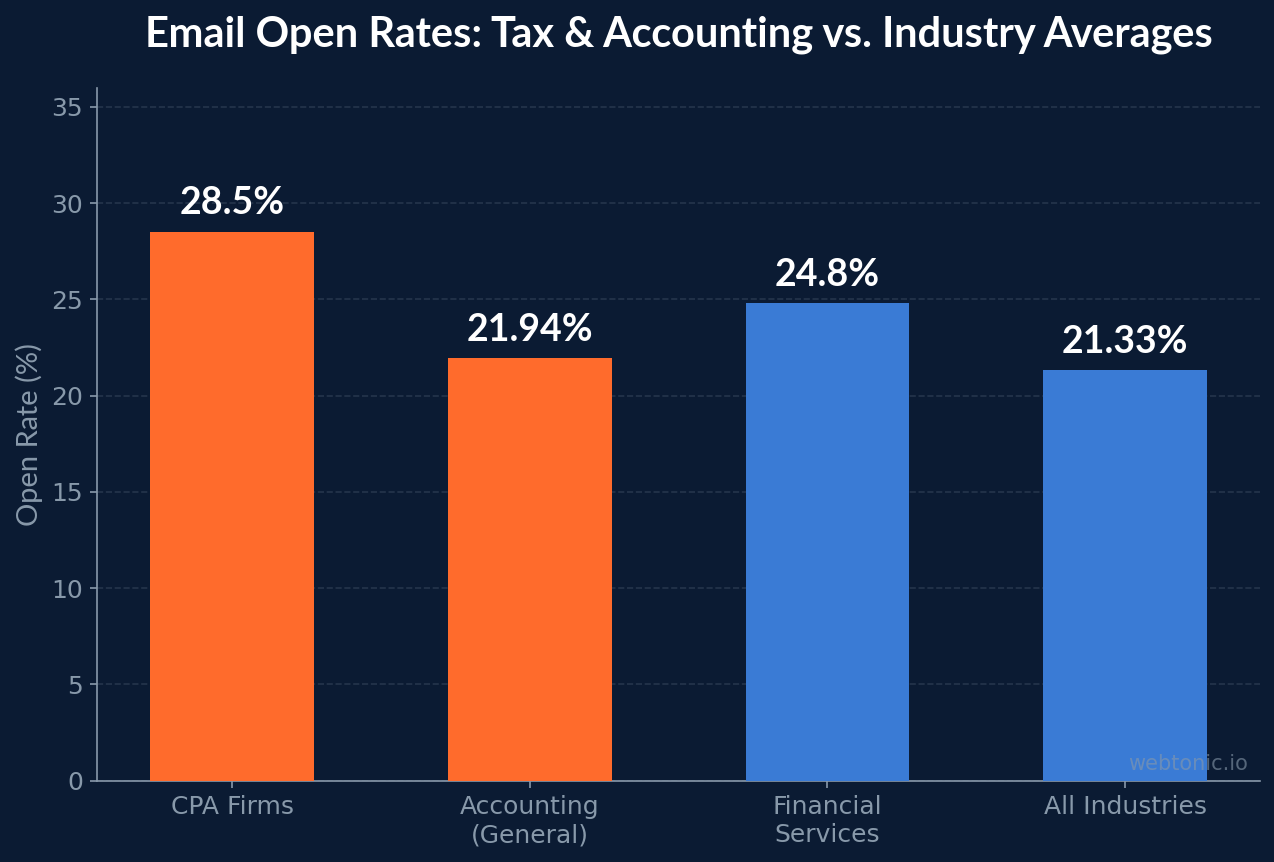
Several factors drive these above-average open rates. First, tax obligations are non-negotiable — clients cannot afford to ignore communication from their accountant the way they might ignore a retail promotion. Second, the regulatory environment changes frequently enough that educational emails carry genuine informational value. Third, the seasonal nature of tax work creates natural urgency windows where email relevance spikes dramatically. Firms that align their sending cadence with these urgency windows see the strongest engagement numbers.
Email Automation Performance for Tax Firms
Automation separates high-growth firms from the rest. According to EmailMarketingForBusiness, automated email campaigns convert leads 47% better than single-send emails. Uncle Kam’s 2026 guide reports that tax firms leveraging email marketing automation see revenue growth averaging 30%, directly measurable through client acquisition pipelines. The most effective automation strategy combines seasonal triggers with evergreen nurture sequences — a mix of 6 to 8 automated touches per year per client that covers tax deadlines, document requests, planning reminders, and advisory upsell opportunities.
| Automation Metric | Benchmark | Source / Context |
|---|---|---|
| Lead Conversion Lift (Automated vs. Single) | +47% | EmailMarketingForBusiness, 2026 |
| Revenue Growth (Automated vs. Manual) | +30% | Uncle Kam, 2026 |
| Optimal Automated Touches Per Year | 6–8 per client | Industry best practice |
| Tax-Deadline Sequence Open Rate | 32–38% | Highest-performing sequence type |
| Educational Drip CTR | 3.4–4.1% | Above industry average |
| Cold-to-Client Pipeline Duration | 45–60 days | Typical B2B accounting cycle |
| Post-Filing Re-engagement Rate | 22–28% | Automation vs. 8% manual |
The data shows that well-structured email automation does not just save time — it fundamentally changes the economics of client acquisition. Firms that automate their seasonal outreach sequences convert at nearly double the rate of those still sending one-off batch emails. The compounding effect is significant: a 47% lift in lead conversion combined with 30% revenue growth means automation pays for itself within the first quarter of deployment for most mid-size practices. The key is building once and iterating annually rather than starting from scratch each tax season.
Email ROI by Campaign Type
Not all emails are created equal. Select Advisors Institute reports that retention and upsell campaigns deliver ROI between 6:1 and 20:1, with the median at roughly 13:1. Tax-season reminder sequences follow at 8.5:1 — driven by the urgency and relevance of deadline-driven messaging. Cold outreach campaigns, while essential for pipeline building, return a more modest 3.8:1 — still well above the break-even threshold. CPA Practice Advisor confirms that email marketing returns $36 for every $1 spent as a broad industry figure, with accounting-specific newsletters tracking even higher when tied to advisory upsells.
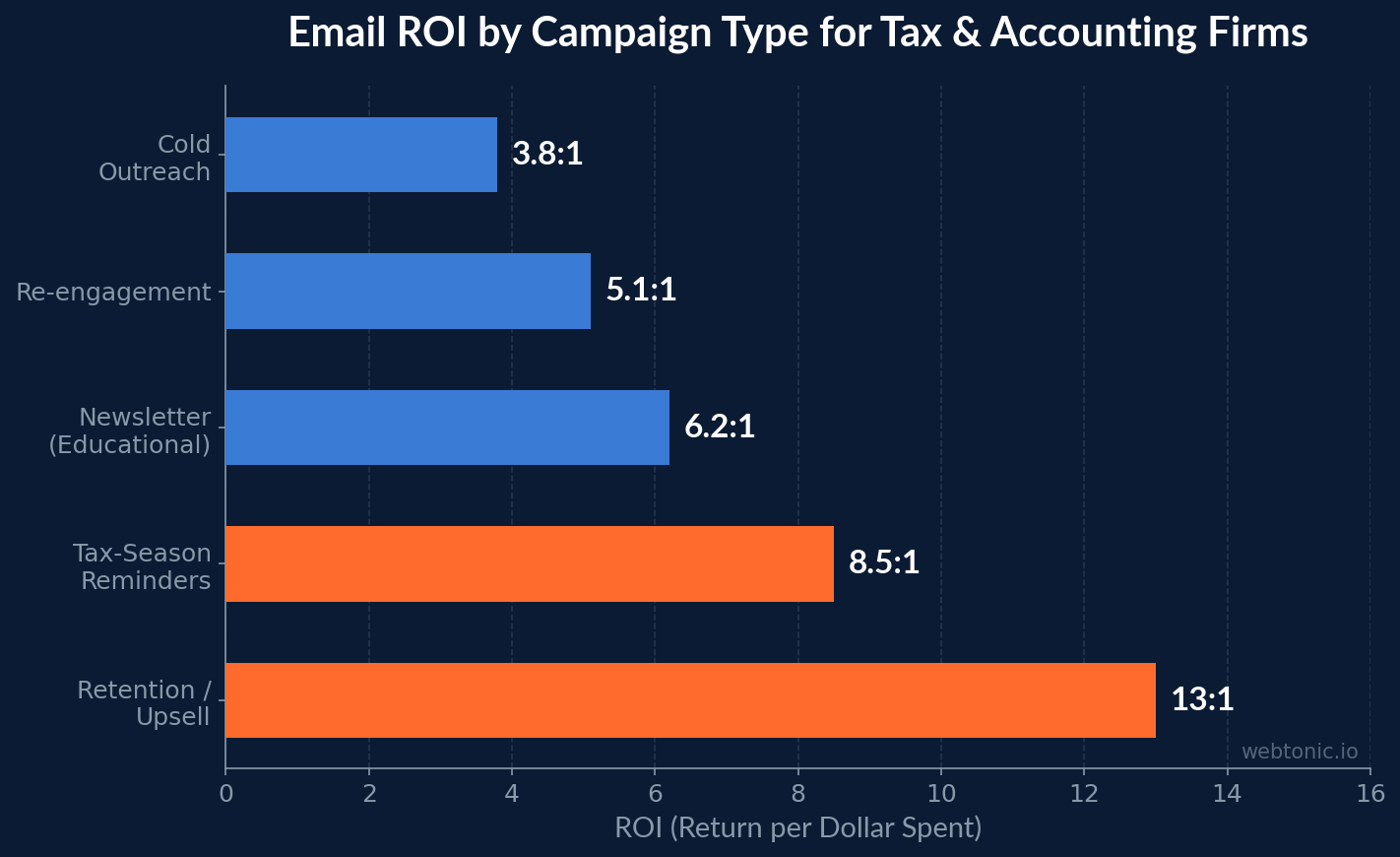
The ROI gap between retention campaigns and cold outreach underscores a core principle of accounting email marketing: existing client relationships are your highest-value asset. A client who already trusts you with their tax filing is far more likely to respond to an advisory upsell email than a cold prospect is to respond to an initial outreach message. Smart firms allocate 60–70% of their email budget to client retention and cross-sell sequences, with the remaining 30–40% directed toward prospect nurturing and list growth activities.
Newsletter Engagement Statistics
The type of newsletter content dramatically impacts engagement metrics. Tax-deadline reminders and document checklists consistently outperform other formats because they combine urgency with practical value — clients open them because missing a deadline has real financial consequences. Educational newsletters covering deduction strategies and tax-law changes sustain solid 24–28% open rates year-round, while purely promotional content (firm news, service announcements) struggles to break the 20% open rate threshold. The key differentiator is relevance: newsletters that answer the question “what should I do about my taxes right now?” consistently outperform generic firm updates.
| Newsletter Type | Avg. Open Rate | Avg. CTR | Best Send Frequency |
|---|---|---|---|
| Tax-Deadline Reminders | 32–38% | 4.5% | Seasonal (Jan, Apr, Oct) |
| Regulatory / Law Updates | 27–31% | 3.8% | As-needed (monthly avg) |
| Educational / Planning Tips | 24–28% | 3.2% | Biweekly |
| Client Onboarding Sequences | 45–52% | 6.8% | Triggered automation |
| Firm News / Promotions | 18–22% | 1.9% | Monthly maximum |
Client onboarding sequences deserve special attention. At 45–52% open rates and 6.8% CTR, they represent the single highest-engagement email type in the entire accounting vertical. These sequences capitalize on the moment when a new client is most engaged and eager to learn about the firm’s services. Firms that invest in a 4–6 email onboarding series — covering what documents to prepare, how to access the client portal, and what advisory services are available — set the foundation for long-term retention and upsell opportunities.
Seasonal Email Performance Patterns
Uncle Kam documents that Q1 accounts for 55–65% of total email-driven revenue at most tax firms. The January–April window is when clients are actively thinking about taxes, making them maximally receptive to outreach. Smart firms pre-load their automation sequences in December to capture early filers — waiting until January means missing the most engaged segment of the audience. The October 15 extension deadline creates a second, often overlooked engagement window that delivers 20% above-baseline open rates with minimal competition from other firms.
| Period | Open Rate Trend | Best Campaign Focus | Revenue Share |
|---|---|---|---|
| Q1 (Jan–Mar) | +35% above baseline | Tax-prep reminders, document checklists | 40–50% |
| April Deadline | +50% above baseline | Last-minute filing, extension offers | 15–20% |
| Q2–Q3 (May–Sep) | Baseline | Advisory upsell, planning content | 15–20% |
| Q4 (Oct–Dec) | +20% above baseline | Year-end planning, extension deadline | 15–25% |
The off-season months from May through September present a strategic opportunity that most firms underutilize. While open rates drop to baseline levels, the clients who do engage during this period are typically the highest-value prospects: business owners evaluating their quarterly estimated payments, high-net-worth individuals considering year-end tax planning moves, and entrepreneurs exploring entity structure changes. These advisory-focused email campaigns generate less volume but significantly higher revenue per conversion, making the off-season a critical period for nurturing premium client relationships.
Deliverability and List Hygiene Benchmarks
High open rates only matter if emails actually reach the inbox. CuFinder reports CPA firm deliverability at 98.4%, significantly above the 96.5% all-industry average. This advantage comes partly from the professional nature of accounting email lists — clients use business or primary personal email addresses rather than throwaway accounts, and they actively whitelist their accountant’s domain. However, maintaining these rates requires consistent list hygiene practices.
| List Hygiene Metric | CPA Firm Average | Industry Average | Red Flag Threshold |
|---|---|---|---|
| Deliverability Rate | 98.4% | 96.5% | Below 95% |
| Hard Bounce Rate | 0.4% | 0.6% | Above 2% |
| Spam Complaint Rate | 0.02% | 0.05% | Above 0.1% |
| List Decay Rate (Annual) | 12–15% | 22–25% | Above 30% |
| Re-engagement Recovery | 18–24% | 10–15% | N/A |
Accounting firms benefit from naturally lower list decay rates because the client-accountant relationship is typically long-term and recurring. A 12–15% annual list decay rate compared to the 22–25% cross-industry average means firms retain more active subscribers over time. Still, firms should run quarterly re-engagement campaigns targeting subscribers who have not opened in 90 days or more. These campaigns typically recover 18–24% of dormant contacts — well above the industry average — because many recipients simply forgot about the firm during the off-season rather than deliberately disengaging.
Best Practices for Tax & Accounting Email Campaigns
- Segment by service type and client lifecycle — a sole proprietor needs different content than a mid-market CFO. Wolf Financial notes that segmented campaigns outperform broadcasts by 14–23% in open rates. Build segments for individual filers, small-business owners, corporate clients, and advisory-only relationships.
- Automate the seasonal calendar — set up deadline reminders, document-request sequences, and post-filing follow-ups as evergreen automations that fire annually. This ensures consistent outreach without manual effort each year.
- Keep unsubscribe rates below 0.2% — the accounting industry benchmark is 0.1–0.2% (CuFinder). Exceeding this threshold signals over-mailing or irrelevant content that damages your sender reputation.
- Test send times systematically — Tuesday and Wednesday mornings between 8 and 10 AM local time consistently outperform other slots for professional services, according to B2B engagement benchmarks.
- Personalize subject lines with client-specific context — including the client’s name or referencing their specific tax situation lifts open rates by 12–18% over generic alternatives.
- Track revenue per email, not just opens — connect your email platform to your CRM to measure actual client acquisitions and advisory upsells driven by each campaign, closing the attribution loop.
- Build a preference center — let clients choose which types of emails they receive. Firms with preference centers report 35% lower unsubscribe rates and higher lifetime engagement scores because clients receive only the content they value.
Tax & Accounting vs. Other Industries
How does accounting stack up against comparable professional services verticals? The sector benefits from inherently high trust and recurring engagement — clients need to open emails from their accountant because the content directly affects their financial obligations. This structural advantage shows clearly in the benchmarks below, where CPA firms lead every major engagement metric except deliverability rate, where healthcare edges ahead due to patient communication regulations.
| Industry | Open Rate | CTR | Unsub Rate | Avg. ROI |
|---|---|---|---|---|
| CPA / Tax Firms | 28.5% | 3.1% | 0.1% | $42 per $1 |
| Financial Services | 24.8% | 2.8% | 0.2% | $38 per $1 |
| Legal Services | 22.1% | 2.3% | 0.3% | $32 per $1 |
| Healthcare | 21.5% | 2.2% | 0.3% | $28 per $1 |
| All Industries | 21.3% | 2.6% | 0.3% | $36 per $1 |
The comparison reveals that accounting firms have a genuine competitive advantage in email marketing that extends beyond just open rates. The combination of high open rates (28.5%), strong CTR (3.1%), and exceptionally low unsubscribe rates (0.1%) creates a compounding engagement effect that drives the sector’s industry-leading ROI of $42 per $1 spent. This advantage is structural — it stems from the nature of the client relationship rather than superior marketing execution, meaning even firms with basic email programs tend to outperform other industries.
Related reading
- Tax and Accounting Cold Email Outbound Data, 2026
- Tax & Accounting Analytics Stats
- Marketing Attribution in Tax and Accounting: 65+ Stats for 2026
- Email Marketing services at Web Tonic
Frequently Asked Questions
What is the average email open rate for accounting firms?
CPA firms average 28.5% open rates, while accounting firms broadly land around 21.9%. Both outperform the cross-industry average of 21.3%, reflecting high client engagement with financial content.
How much ROI can tax firms expect from email marketing?
Tax firms typically see between 3.8 and 13 dollars return per dollar spent on email, depending on campaign type. Retention and upsell sequences deliver the highest ROI at roughly 13 to 1, while cold outreach averages 3.8 to 1.
What email frequency works best for CPA firms?
Most successful CPA firms send 6 to 8 automated touches per year per client, supplemented by monthly or biweekly newsletters. Over-mailing drives unsubscribes above the 0.2 percent industry norm.
Does email automation improve results for accounting firms?
Yes. Automated email sequences convert leads 47 percent better than single-send campaigns. Firms using automation also report up to 30 percent higher revenue growth, according to 2026 industry benchmarks.
What types of emails work best for tax preparers?
Tax-deadline reminders and document checklists see the highest open rates at 32 to 38 percent. Educational content about deductions and planning strategies sustains engagement year-round, while promotional offers see the lowest engagement.
Sources
CuFinder — CPA Firm Industry Marketing Benchmarks 2026
CuFinder — Accounting Industry Marketing Benchmarks 2026
Benchmarketing — Accounting Marketing Benchmarks 2026
Uncle Kam — Tax Firm Email Marketing Guide 2026
Email Marketing for Business — Email Marketing for CPAs
CPA Practice Advisor — Building Newsletters People Actually Read
Wolf Financial — Financial Services Email Marketing KPIs 2025
Select Advisors Institute — Marketing ROI Benchmarks for Accounting Firms
Mailchimp — Email Marketing Benchmarks