Table of contents
Only 3% of businesses picked their accountant from an advertisement, and 57% arrived through a referral - then went online to judge the brand before making contact. That second look is where most tax and accounting firms lose the introduction.
Key Takeaways
- 57% of businesses found their accountant through a peer referral; only 3% through advertising.
- 92% of business clients call referrals critical when choosing an accountant; no other method broke 20%.
- The median accounting firm homepage scores 71 out of 100 (mean 68.9) on a six-category audit rubric.
- 84.6% of graded homepages scored a C or lower; only 10.3% earned an A and 7.7% failed outright.
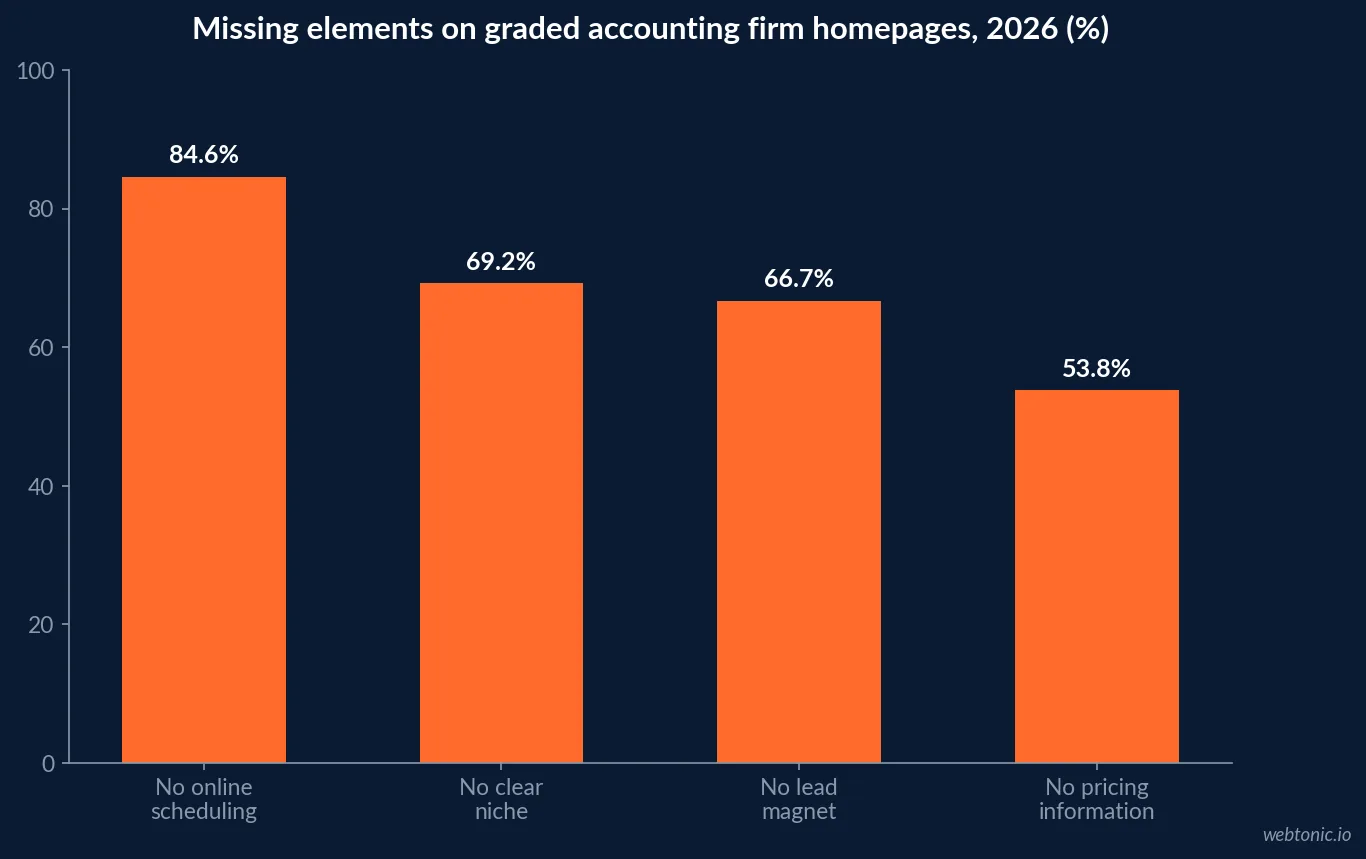
- 69.2% had no clear specialization or niche on the homepage.
- 53.8% published nothing about pricing; 66.7% had no lead magnet.
- Consultation conversion was the weakest brand category at 52.6/100; trust and credibility the strongest at 91.5.
- 84.6% offered no online scheduling - the most common single gap.
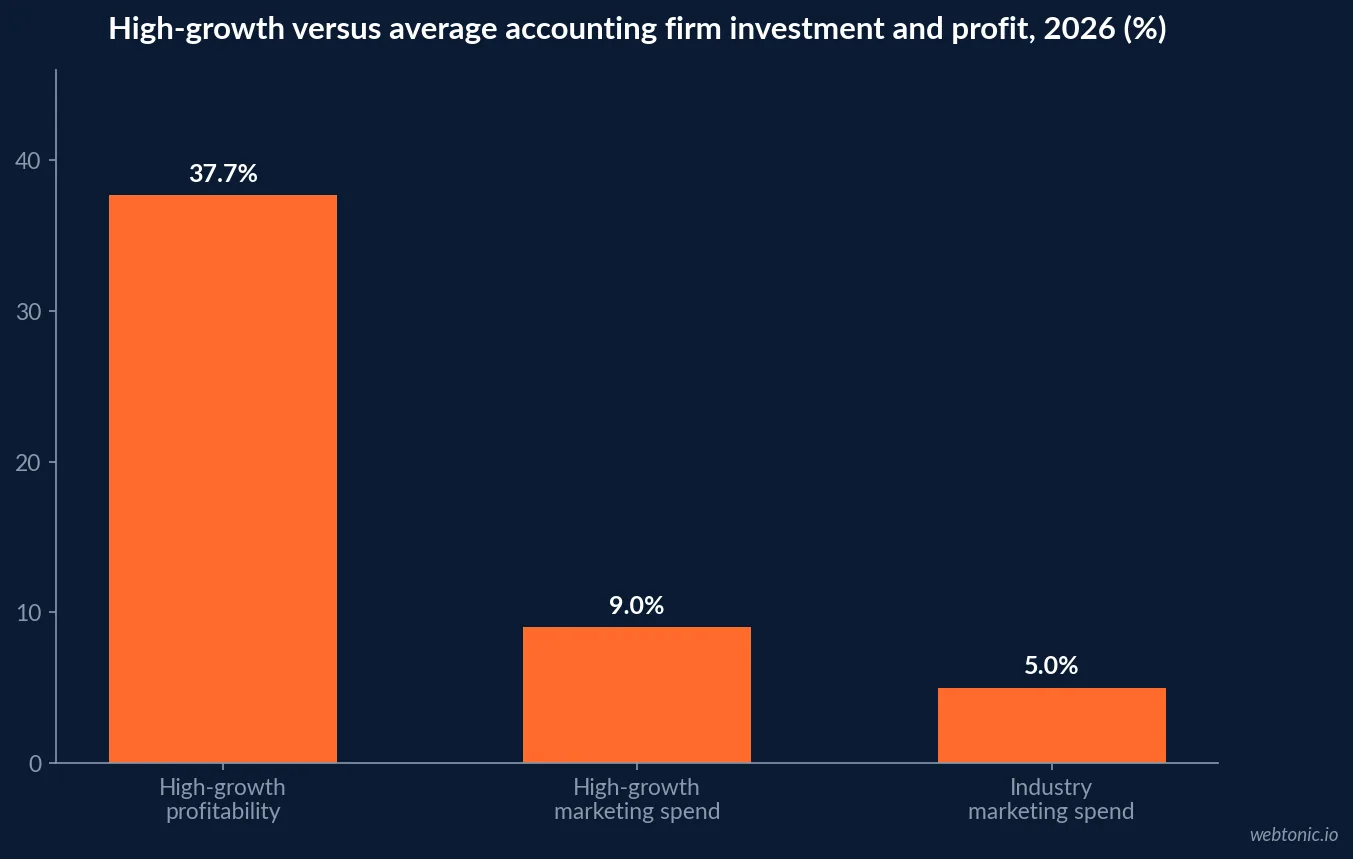
- The industry invests about 5% of revenue in marketing; high-growth firms invest 9.0%.
- High-growth firms grow 3.5x faster and run 37.7% profitability, about 22% more profitable than average.
- The median accounting and financial services growth rate has fallen to 10%, a five-year low.
- Social media leads 2026 brand priorities at 37.5%; developing thought leaders is tied second at 28.1%.
- The 2026 Remarkabrand Index scored 1,400+ accounting firms across 50+ brand indicators.
- Brand strength scores by segment: enterprise firms 58, large 43, mid-sized 29.
- 90% of B2B clients choose providers they already know - recognition precedes shortlisting.
- 98% of businesses that leave a specialist hire another specialist, never a generalist.
- Buyers pay up to 25% more for specific offerings; $1M+ companies are 2x more likely to hire a niche firm.
- Among clients paying $10K+ a year, 83% weigh the firm’s use of technology.
- Median firm revenue growth was 6.7% in the latest AICPA MAP survey, down from 9.1%.
- NPS falls from 84 at 15+ years to 37 at 6-9 years of tenure - the brand-neglect window.
The referral is the introduction, not the decision
Word of mouth remains the engine. In the 2025 Niche Business Accounting Report, a survey of 350 US businesses with $1M-$100M in revenue, 57% of businesses found their current accountant through a peer referral against 3% from advertising. A companion study put the figure at 92% of business clients calling referrals critical, with no other discovery method breaking the 20% barrier.
That statistic is routinely misread as permission to ignore brand. What actually happens, as the New Jersey Society of CPAs describes it, is a sequence: the referral is given, the prospect searches the firm, reads the service pages, checks partner LinkedIn profiles, looks for evidence of industry insight, and compares. If the digital presence is unclear, outdated or generic, the referral quietly disappears and nobody in the firm ever hears about it.
| Discovery or decision factor | Share of business buyers | What it tests | Brand implication |
|---|---|---|---|
| Peer referral as source | 57% | Network reach | Brand must confirm the recommendation |
| Referrals called critical | 92% | Trust threshold | Social proof needs to be visible |
| Advertising as source | 3% | Paid discovery | Ads support recall, rarely close |
| Any other single method | Under 20% | Channel spread | No shortcut around reputation |
| Technology use ($10K+ clients) | 83% | Modernity signal | Portal and UX are brand assets |
| Willing to pay more for specifics | Up to 25% | Perceived expertise | Specificity is priced |
What the second look actually finds
Codivox graded 39 real US accounting firm homepages in July 2026 across nine metros using a six-category rubric. The median homepage scored 71 out of 100 with a mean of 68.9, scores ranged from 34 to 95, and 84.6% graded C or lower. Only four sites in the sample earned an A.
The category pattern is the useful part. Trust and credibility averaged 91.5 - credentials, team bios and testimonials are nearly universal. Consultation conversion averaged 52.6 and services and specialization 58.9. Firms have solved "we are real CPAs" and not "we are the firm for you".
| Audit category | Weight | Mean score | Reading |
|---|---|---|---|
| Mobile and performance | 5% | 94.9 | Solved almost everywhere |
| Trust and credibility | 20% | 91.5 | Credentials and bios are table stakes |
| Client portal and security | 15% | 77.0 | Portal present in 76.9% of sites |
| Local SEO and discovery | 15% | 62.5 | 66.7% show no map or reviews |
| Services and specialization | 20% | 58.9 | 69.2% show no niche at all |
| Consultation conversion | 25% | 52.6 | Highest weight, lowest score |
Sameness is the measurable problem
The 2026 Remarkabrand Index analysed 1,400+ accounting firms across 50+ brand indicators, including a homepage buzzword ranking of the most overused words in the profession. Its segment scores are blunt: enterprise firms average 58, large firms 43 and mid-sized firms 29 on brand strength. Brand equity in accounting still scales with size, which means a mid-sized firm competing on identity is competing in the weakest field in the industry.
The Index also ranks the industries firms target - construction 432, real estate 428, manufacturing 350 - and the services they lead with: tax 940, audit and assurance 665, payroll 258. When 940 of 1,400 firms lead with tax, "we do tax" carries no differentiating information. That is the arithmetic behind the 69.2% of homepages with no visible niche.
| Brand signal | 2026 figure | Source basis | Why it moves revenue |
|---|---|---|---|
| Firms analysed | 1,400+ | Remarkabrand Index | Largest accounting brand benchmark |
| Brand indicators scored | 50+ | Remarkabrand Index | Identity, web, social, messaging |
| Enterprise brand strength | 58 | Segment average | Scale still buys recognition |
| Mid-sized brand strength | 29 | Segment average | Weakest field, cheapest to win |
| Firms leading with tax | 940 | Service ranking | Commodity claim, no signal |
| Top target industry | Construction (432) | Industry ranking | Crowded niche, proven demand |
High-growth firms spend nearly double on brand and marketing
Hinge Research Institute’s 2026 High Growth Study for accounting and financial services found the broader industry investing about 5% of revenue in marketing excluding compensation, while high-growth firms invest 9.0% - an 80% increase on their own prior-year figure. High-growth is defined as 20%+ compound annual growth over three years; those firms grow 3.5x faster than average and post 37.7% profitability, about 22% above average-growth peers.
Context matters: the median growth rate across the sector has fallen to 10%, its lowest in five years, and the AICPA’s 2025 MAP Survey reported median fee growth of 6.7%, down from 9.1% two years earlier. Brand investment is rising while organic lift is falling, which is exactly when creative and identity work stops being cosmetic.
| Metric | Average-growth firms | High-growth firms | Gap |
|---|---|---|---|
| Marketing as % of revenue | About 5% | 9.0% | 1.8x |
| Compound annual growth | Median 10% | 20%+ minimum | 3.5x growth rate |
| Profitability | About 31% | 37.7% | 22% more profitable |
| Top 2026 priority | Mixed tactics | Social media 37.5% | Focused investment |
| Thought-leader development | Occasional | 28.1% name it top-three | Expertise as brand |
| Audience research | Rare | 2x more likely | Positioning from evidence |
Specialization is the brand decision with a price attached
The niche data is unusually clean. Businesses above $1M in revenue are 2x more likely to hire a specialist firm, buyers will pay up to 25% more for specific offerings, and 98% of businesses that leave a specialist move to another specialist rather than back to a generalist. Specialization is therefore both an acquisition and a retention mechanism: it raises price tolerance on the way in and removes the generalist escape route on the way out.
The Association for Accounting Marketing frames rebranding as a signal problem - firms start with conservative, trust-oriented identities and outgrow them as they move toward advisory and client-centric models, leaving an antiquated logo and tagline arguing against the positioning the partners are selling in the room.
Reputation is revenue, and it compounds before contact
UK trade coverage puts the mechanism plainly: 90% of B2B clients choose service providers they already know. Recognition is a precondition for being shortlisted, and recognition is built by publishing, not by being available. The NJCPA sequence and the Hinge finding that high-growth firms rank thought-leader development at 28.1% describe the same behaviour from two sides: buyers form a view before the first call, so the brand has to be doing work while nobody is watching.
Practically, this is why visibility programmes and identity projects should be scoped together. A rebrand with no publishing plan resets the wrapper and changes nothing about the evidence a prospect finds; a publishing plan on a 71/100 homepage sends warm traffic to a page that cannot convert it.
Brand fails inside the client base first
ClearlyRated surveyed 180 accounting firm clients in March 2026 - the people who sign engagement letters - and found NPS falling from 84 among 15+ year clients to 54 at 3-5 years and 37 at 6-9 years. The mid-tenure trough is the group nobody runs a retention play on. In the same survey, 91% of buyers want proactive advisory but only 27% of firms initiate it; firm-initiated advisory scores NPS 62 against 48 when the client raises it, and 90% would pay more for proactive risk identification.
Two more brand-adjacent findings: firms that talk openly about staffing shortages score NPS 79 versus a 55 average, a 24-point swing from one honest conversation, and only 28% of clients are on fixed retainers while 46% prefer them - retainer clients score NPS 70 against 44 for project billing. Positioning, pricing model and communication cadence are the same brand asset viewed from inside the relationship.
| Client segment or practice | NPS | Comparison | Brand action |
|---|---|---|---|
| Clients of 15+ years | 84 | Ceiling | Protect and mine for referrals |
| Clients of 3-5 years | 54 | -30 vs ceiling | Reinforce value story |
| Clients of 6-9 years | 37 | -47 vs ceiling | Highest churn risk, re-onboard |
| Firm-initiated advisory | 62 | vs 48 client-initiated | Proactivity is brand behaviour |
| Open staffing communication | 79 | vs 55 average | Transparency beats perfection |
| Fixed-retainer clients | 70 | vs 44 project billing | Predictability reads as quality |
What a 2026 accounting brand programme should contain
- Name the niche above the fold. 69.2% of homepages do not, and $1M+ buyers are 2x more likely to hire firms that do.
- Publish a pricing philosophy. 53.8% say nothing about price; 46% of clients prefer fixed retainers against 28% who have one.
- Add online scheduling. Missing on 84.6% of sites, inside the highest-weighted and lowest-scoring audit category.
- Fund brand at high-growth levels. 9.0% of revenue versus the 5% median, with audience research in scope - high-growth firms are 2x more likely to run it.
- Build two or three visible experts, not a firm-wide blog; 28.1% of high-growth firms rank thought-leader development top-three.
- Run a mid-tenure re-engagement play aimed at the 6-9 year NPS 37 cohort before it churns.
- Instrument the brand. Branded search, referral-to-consultation rate and homepage conversion against the 1.0-3.0% typical band - see our measurement work for the reporting layer.
- Retire buzzwords flagged by the 1,400-firm homepage word analysis; sameness is measurable and so is its removal.
Brand versus paid: the honest comparison
Accounting paid media is neither cheap nor useless. Benchmark medians put Google Ads CPC at $4.44 with a $101 CPA and a 4.40% conversion rate, Meta CPC at $2.84 and LinkedIn CPL at $84.40, with landing pages converting at 3.20% and tax season driving 60%+ of annual acquisition. Our Google Ads pricing breakdown covers how those medians move by market. Those numbers are perfectly workable - if the brand the click lands on is worth the money. Compare the two lines honestly before reallocating, and if the site scores near the 71/100 median, the brand fix comes first.
| Investment | 2026 benchmark | Time to effect | Failure mode |
|---|---|---|---|
| Brand and positioning | One-off, 9% of revenue cohort | 6-18 months | No publishing plan |
| Homepage rebuild | Median site scores 71/100 | 1-3 months | Trust page, no conversion path |
| Google Ads | $4.44 CPC, $101 CPA | Immediate | Sending paid clicks to a weak brand |
| Meta Ads | $2.84 CPC, 2.4x ROAS | Immediate | Low intent for compliance work |
| LinkedIn Ads | $84.40 CPL | Weeks | Works only with credible expert profiles |
| Thought leadership | 28.1% of high-growth priorities | 9-24 months | Firm-voice content nobody signs |
Frequently Asked Questions
Does branding actually matter for an accounting firm that grows on referrals?
It matters more, not less. Referrals are the discovery step, not the decision: 57% of businesses found their current accountant through a peer referral and only 3% through advertising, but every referred prospect then searches the firm, reads the website and checks LinkedIn before making contact. The brand is the second gate. When the median accounting homepage scores 71 out of 100 and 84.6% grade a C or lower, a warm introduction can quietly die on a page the partner has not looked at in three years.
How much should a tax or accounting firm spend on brand and marketing?
The industry median is about 5% of revenue excluding compensation, while firms achieving 20%+ compound annual growth invest 9.0% - almost double. Those high-growth firms grow 3.5 times faster than average and run 37.7% profitability, roughly 22% more profitable than average-growth peers. Brand work is usually the largest single line in the gap between 5% and 9%, because positioning, naming, identity and a rebuilt site are one-off capital projects rather than monthly media.
What is the single biggest brand weakness on accounting firm websites?
Undifferentiated positioning. In a 2026 audit of 39 US accounting firm homepages, 69.2% had no clear specialization or niche, 53.8% published nothing about pricing, and the weakest scoring category was consultation conversion at 52.6 out of 100 with 84.6% missing online scheduling. Trust and credibility scored 91.5 - firms are good at proving they are real CPAs and bad at explaining who they are for.
Is a niche brand really worth the narrower market?
The switching data says yes. 98% of businesses that left a specialist firm moved to another specialist rather than back to a generalist, companies above $1M in revenue are 2x more likely to hire a niche firm, and buyers will pay up to 25% more for specific offerings. Among clients paying $10,000 or more a year, 83% say the firm's use of technology is a key decision factor - which is a brand signal long before it is a software question.
How do you measure whether a rebrand worked?
Track a small set of leading indicators before and after, not brand sentiment. Useful ones: share of new clients that name the niche in their first enquiry, branded search volume, referral-to-consultation conversion, homepage-to-consultation rate against the 1.0-3.0% typical range (3.0-5.0% for optimised niche sites), and NPS by client tenure - the 2026 ClearlyRated survey found mid-tenure clients at 6-9 years score NPS 37 against 84 for 15-year clients, so brand-led re-engagement has a measurable target.
Sources
CPA Practice Advisor - how SMBs choose an accounting firm (2025 Niche Business Accounting Report)
CPA Practice Advisor - what businesses value when choosing or staying
Codivox - Accounting Firm Website Statistics 2026 (39 graded homepages)
Remarkabrand Index 2026 for accounting firms
Hinge Marketing - 2026 High Growth Study, accounting and financial services
NJCPA - From referrals to reputation, CPA firm growth in 2026
Association for Accounting Marketing - rebranding your accounting firm
Accountancy Today - reputation is revenue
ClearlyRated - what accounting clients actually want in 2026
AICPA - 2025 National MAP Survey results
Benchmarketing - accounting marketing benchmarks 2026