Table of contents

Key Takeaways
- Target marketing focuses resources on specific consumer segments most likely to purchase, instead of broadcasting a generic message to the entire population.
- Companies using segmented campaigns see revenue increases of up to 760%, according to Campaign Monitor's email benchmark study.
- Market segmentation divides a broad audience into four layers — demographic, psychographic, geographic, and behavioral — then selects the segment with the strongest product–market fit.
- Nike, Starbucks, and Dollar Shave Club each demonstrate distinct approaches (aspirational lifestyle, hyper-local personalization, and niche disruption) with measurable ROI gains.
- 75% of consumers expect personalized offers based on their browsing and purchase history, making untargeted campaigns a competitive liability.
- A well-defined buyer persona reduces customer acquisition cost by 30–50% by eliminating wasted ad spend on low-intent audiences.

What Is Target Marketing?
Target marketing is the practice of identifying a specific target market — your ideal buyers — and directing all marketing strategies, offers, and campaigns toward that group. Instead of competing for everyone's attention, you concentrate on the people whose needs align with your product or service. The approach follows a three-phase process known as STP: Segmentation, Targeting, and Positioning — the foundation of every targeted marketing campaign.
Every successful brand operates with a clearly defined audience. A company selling premium organic skincare does not advertise the same way as a discount electronics retailer. Understanding your target audience — their age, gender, income, values, geographic location, and online behavior — lets you craft targeted marketing campaigns that resonate — a foundation of any strong growth marketing program.
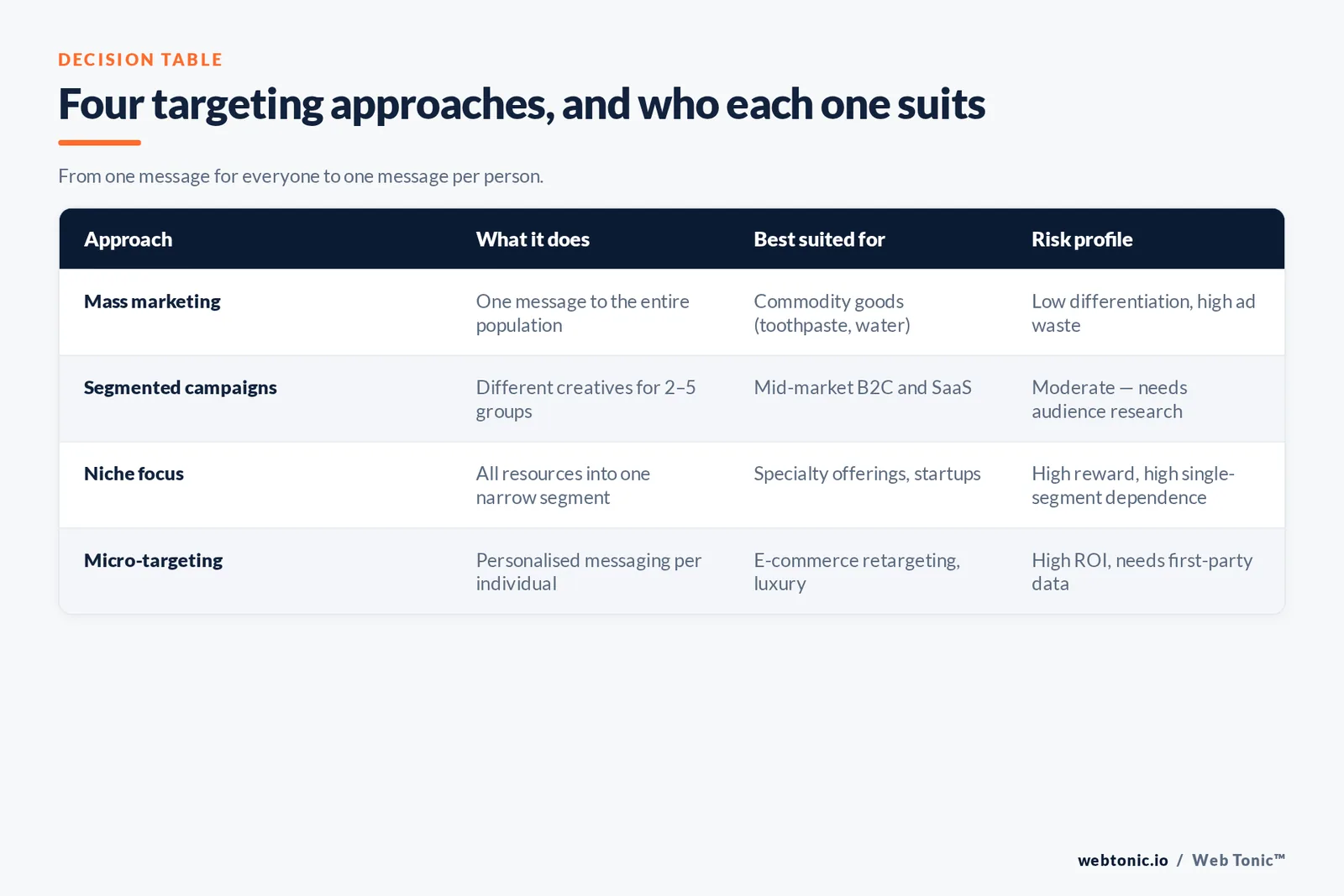
| Approach | What It Does | Best Suited For | Risk Level |
|---|---|---|---|
| Mass Marketing | One marketing message to the entire population | Commodity goods (toothpaste, bottled water) | Low differentiation, high ad waste |
| Segmented Campaigns | Different creatives for 2–5 groups | Mid-market B2C and SaaS | Moderate — requires audience research |
| Niche Focus | All resources into one narrow segment | Specialty offerings, startups | High reward, high dependence on one group |
| Micro-Targeting | Personalized messaging per individual | E-commerce retargeting, luxury labels | High ROI, requires robust first-party data |
How to Define Your Target Market
Before you can run targeted marketing strategies, you need to define your target market. A target market is a specific group of consumers most likely to buy your products or services, defined by shared demographic, psychographic, geographic, and behavioral traits. Defining your target market starts with research: analyze existing customers, study competitor audiences, and identify where your product or service solves a real problem.
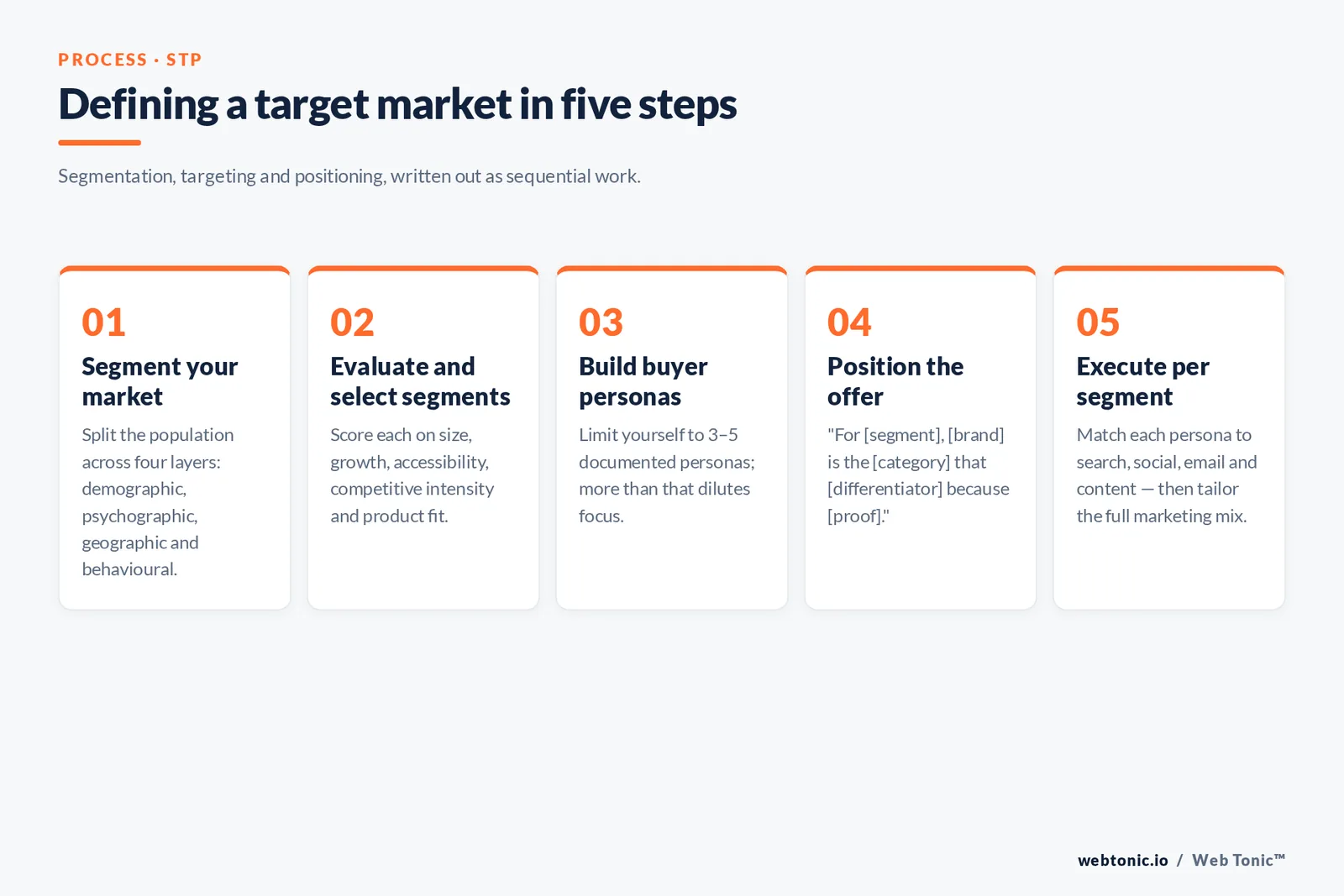
Step 1 — Segment Your Market
Market segmentation splits a broad population into market segments that share meaningful characteristics. The goal is to find clusters of people who respond similarly to a product or service, message, or price point. Four primary dimensions drive effective target market segmentation:
Demographic Segmentation
Groups defined by age, gender, income, education, occupation, or family status. A financial advisory firm might focus on professionals aged 35–55 earning above $120,000 per year because that segment has both disposable income and a pressing need for wealth planning. The U.S. Census Bureau provides free demographic datasets that help validate segment sizing.
Psychographic Segmentation
Defined by values, interests, lifestyles, and personality traits. Two consumers with identical demographics can behave very differently — one prioritizes sustainability, the other prioritizes convenience. Psychographic data comes from surveys, Google Analytics interest reports, and social listening tools.
Geographic Segmentation
Location-based grouping lets companies tailor offers to regional preferences, climate, culture, and regulations. A roofing company advertising snow-load inspections in Minnesota runs fundamentally different marketing campaigns than the same company promoting hurricane preparation in Florida. Geographic data helps businesses focus their marketing efforts on the specific markets where they operate.
Behavioral Segmentation
Groups buyers by purchase patterns, brand loyalty, product usage frequency, and buying stage. Behavioral data — tracked through CRM systems, website analytics, and advertising pixels — is the most actionable layer for any target marketing strategy because it reflects what people actually do, not just who they are. Companies that combine behavioral data with other segmentation data can define their target markets with far greater precision.
| Segmentation Type | Data Sources | Example Segment | Campaign Action |
|---|---|---|---|
| Demographic | Census, CRM, signup forms | Women 25–34, household income $75K+ | Premium skincare launch campaign |
| Psychographic | Surveys, social listening, analytics | Eco-conscious urbanites who value sustainability | Green packaging messaging |
| Geographic | IP data, GPS, billing address | Homeowners in Phoenix, AZ metro area | Local HVAC seasonal discount ads |
| Behavioral | Pixel tracking, purchase history, CRM | Repeat buyers inactive for 90+ days | Win-back email with limited-time offer |
Step 2 — Evaluate and Select Your Target Segments
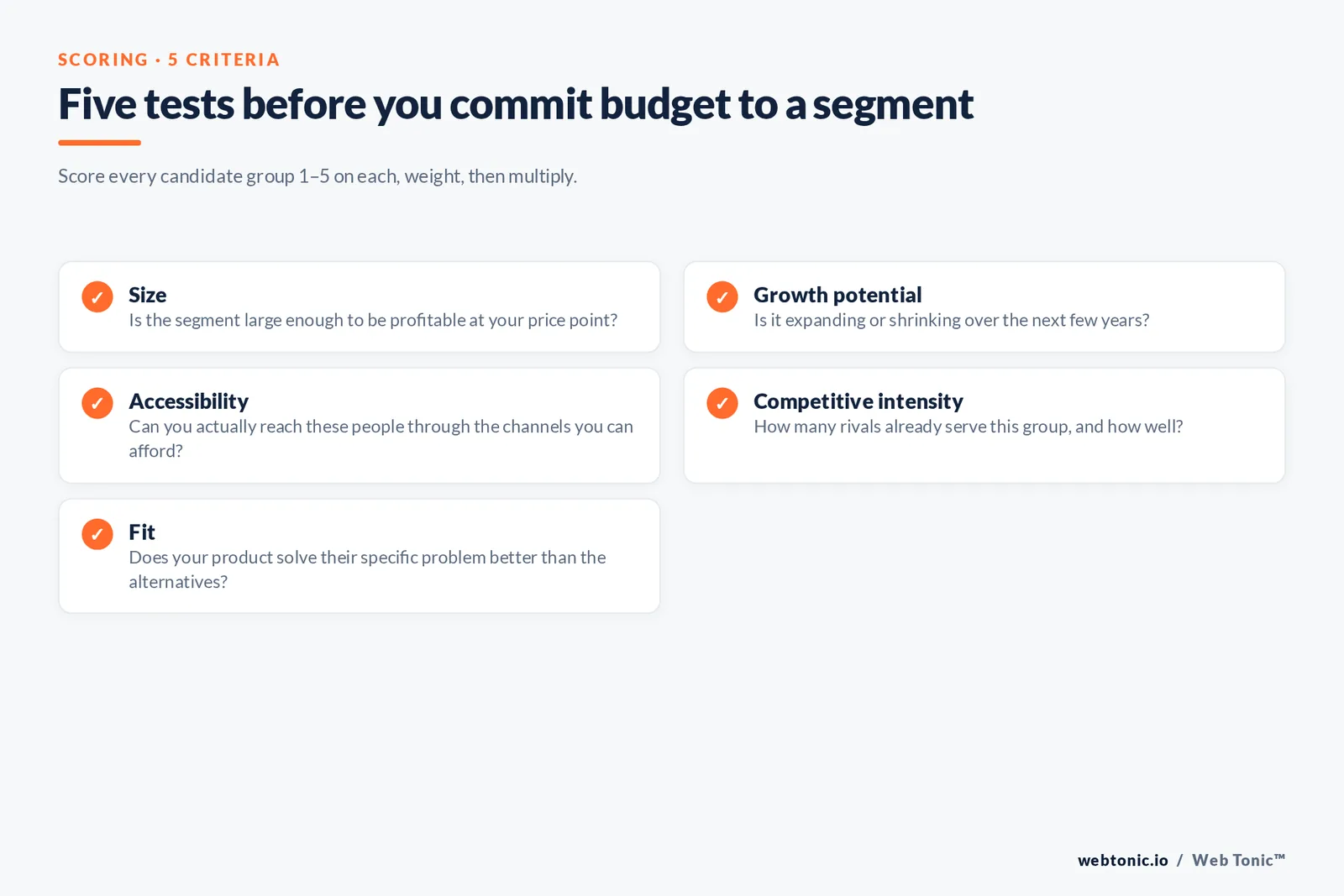
Not every identifiable market segment is worth pursuing. Companies often discover multiple target markets during research but lack the resources to serve them all. Evaluate each against five criteria: size (is it large enough to be profitable?), growth potential (is it expanding or shrinking?), accessibility (can you reach them through available channels?), competitive intensity (how many rivals already serve them?), and fit (does your product or service solve their specific problem better than alternatives?).
A scoring matrix helps compare segments objectively. Assign a weight to each criterion, score every group on a 1–5 scale, and multiply. Tools like Semrush's audience research suite streamline the scoring process with built-in competitive data. The segment with the highest weighted score becomes your primary focus. Strong data intelligence capabilities make this evaluation far more reliable than intuition alone.
Step 3 — Build Buyer Personas
A buyer persona is a semi-fictional profile of your ideal purchaser built from real research, interviews, and analytics. Each persona includes a name, job title, goals, frustrations, preferred channels, and buying triggers. Limit yourself to 3–5 personas — more than that dilutes focus.
When personas are documented and shared across departments, every campaign, landing page, and sales call speaks the same language. Companies with documented personas report a 171% increase in revenue generated by their marketing efforts, according to a HubSpot marketing benchmark analysis.
Step 4 — Position Your Offer for Your Target Market
Positioning is the bridge between knowing your audience and communicating with them. It answers one question: why should this specific group choose you over every alternative?
A strong positioning statement follows this template: "For [segment], [brand] is the [category] that [key differentiator] because [proof point]." Nike positions itself as the performance gear brand for aspirational athletes. Starbucks positions itself as the "third place" between home and work for urban professionals. Neither brand tries to appeal to everyone — and that precision is exactly what makes their campaigns so effective.
Crafting a positioning statement requires honest answers to three questions: Who is the buyer? What is their primary pain point? Why is your solution the best fit? According to Harvard Business Review's marketing research, brands with a clearly articulated positioning outperform category peers by 20% on customer retention. Aligning your positioning with your core services ensures consistency across every touchpoint.
Step 5 — Execute Marketing Campaigns for Each Segment
With segments selected and positioning locked, channel selection and creative development follow naturally. Your marketing efforts should match each persona to the social media platforms and channels where they spend attention:
- Search ads — capture high-intent queries from buyers actively researching solutions.
- Social media ads — reach interest-based and psychographic groups on platforms like Instagram, TikTok, and LinkedIn.
- Email campaigns — re-engage behavioral segments (cart abandoners, lapsed buyers) with personalized offers.
- Content creation — build trust with top-of-funnel segments through educational articles and guides on your company blog.
Tailor your marketing mix — product positioning, pricing framing, creative imagery, and call-to-action copy — to each target market segment. The marketing mix (product, price, place, promotion) must align with the specific needs and behaviors of each target audience. A campaign for budget-conscious small-business owners emphasizes ROI and cost savings; a campaign for enterprise buyers emphasizes compliance, integrations, and scalability.
| Channel | Best Segment Match | Key Metric | Avg. Conversion Lift (Targeted vs. Broad) |
|---|---|---|---|
| Google Search Ads | High-intent transactional buyers | Cost per acquisition (CPA) | +50–80% |
| Meta / Instagram Ads | Interest and lookalike audiences | Return on ad spend (ROAS) | +35–60% |
| Email Sequences | Behavioral re-engagement groups | Revenue per email (RPE) | +760% (segmented vs. batch) |
| LinkedIn Ads | B2B decision-makers by job title | Cost per lead (CPL) | +40–65% |
| Content / SEO | Top-of-funnel researchers | Organic sessions and engagement | +25–40% |
Real-World Target Marketing Examples
Niche marketing — the most focused form of targeted marketing — proves that concentrating on a specific target market beats generic campaigns every time. Here are three brands that demonstrate distinct approaches to focused audience campaigns:
Nike — Aspirational Lifestyle Targeting
Nike segments its market by activity (running, basketball, training, lifestyle) and psychographic identity (competitive athletes vs. casual fitness enthusiasts). Each sub-brand — Nike Running, Jordan, Nike Training Club — speaks directly to its audience with dedicated product lines, endorsement deals, and content. According to Statista's brand analysis, the company's digital direct-to-consumer revenue exceeded $21 billion in fiscal 2025, driven by personalized app experiences tailored to behavioral segments.
Starbucks — Hyper-Local Personalization
Starbucks combines geographic and behavioral segmentation through its mobile app and rewards program. The app tracks purchase frequency, preferred drinks, and visit times, then pushes personalized promotions that drive a 26% higher spend per visit compared to non-app patrons. Menu offerings vary by region — matcha-heavy selections in Japan, seasonal specialty drinks in the United States.
Dollar Shave Club — Niche Disruption
Dollar Shave Club identified a single underserved segment: men who found razor shopping overpriced and inconvenient. By speaking directly to that frustration with irreverent creative and a subscription model priced at $1–$9 per month, the company grew from zero to $240 million in annual revenue within five years, as documented in a Forbes digital business profile. The brand's focused approach demonstrates how niche campaigns backed by strong performance creative can unseat established incumbents.
Common Target Marketing Mistakes to Avoid
- Defining segments too broadly — "millennials" is not a segment. Age alone tells you nothing about values, buying behavior, or channel preferences. Layer at least two segmentation dimensions.
- Relying on outdated persona data — buyer behavior shifts every 12–18 months. Refresh personas annually with new survey data, Google Analytics insights, and CRM analysis.
- Ignoring the competitive landscape — entering a saturated segment without a clear differentiator guarantees low margins. Always audit competitor density before committing resources.
- Spreading budget across too many groups — start with one or two high-value segments, prove ROI, then expand. Splitting a modest budget five ways across multiple target markets produces five mediocre marketing campaigns instead of one strong targeted marketing campaign.
- Skipping post-campaign analysis — every campaign generates behavioral data that refines your next round of segmentation. Feed conversion data back into your CRM to improve future web development and campaign decisions.
Frequently Asked Questions
What is the difference between a target market and a target audience?
A target market is the broad group of consumers a company intends to serve — defined by shared needs, demographics, and characteristics. A target audience is the specific subset within that target market that a single marketing campaign or piece of content is designed to reach. Your target market informs your overall marketing strategy, while your target audience shapes individual marketing efforts. For example, a fitness apparel brand's market is active adults aged 18–45, but a particular Instagram ad might focus on women aged 25–34 who follow yoga influencers.
How do you identify a profitable segment to pursue?
To identify a profitable target market, score each potential market segment on size, growth rate, accessibility, competitive intensity, and product–market fit. The segment with the highest combined score — large enough to generate revenue, growing, reachable through your channels, and underserved by competitors — is the strongest candidate. Use expert consultation to validate assumptions before committing significant budget.
What tools help with market segmentation?
Google Analytics provides demographic and interest data to help you define your target market and identify your target audience. CRM platforms like HubSpot and Salesforce segment by purchase behavior and engagement score. Social media ad platforms (Meta Ads Manager, LinkedIn Campaign Manager) offer built-in audience builders with layered filters. Survey tools like Typeform and SurveyMonkey capture psychographic data directly from buyers. Social media platforms also provide powerful audience insights that help brands identify and define their target markets.
How often should you revisit your buyer personas?
Review personas at least annually, or whenever a major shift occurs (new competitor entry, economic downturn, product pivot). Outdated personas lead to misaligned marketing messages and wasted ad spend across your marketing campaigns.
Can small businesses benefit from focused audience campaigns?
Absolutely. Small companies with limited budgets benefit the most because every dollar must reach a high-intent buyer. Concentrating marketing efforts on one well-defined target market consistently outperforms scattering spend across a broad, unfocused audience. A specific target market lets small businesses tailor their marketing strategies with precision.
Sources: Campaign Monitor – Email Marketing Benchmarks (campaignmonitor.com, 2025); Cintell – Persona Benchmark Study (cintell.com, 2025); Nike Inc. – FY2025 Annual Report (nike.com, 2025); Starbucks – Q4 2025 Earnings Report (starbucks.com, 2025); Dollar Shave Club Case Study (hbs.edu, 2024); Google Analytics – Audience Reports Documentation (analytics.google.com, 2025).