



Table of contents

Quick answer: Use Target CPA when every conversion is worth roughly the same and Target ROAS when values vary and you pass accurate values. Either way, open the target at your measured trailing performance, then tighten by 10–15% every two to three weeks.
Last verified: 2026-08-21
The difference that matters
Target CPA tells Google to get as many conversions as it can at an average cost you name. Target ROAS tells it to generate as much conversion value as it can at an average return you name. Both are Smart Bidding strategies using the same auction-time signals; they differ only in what they are told to maximise.
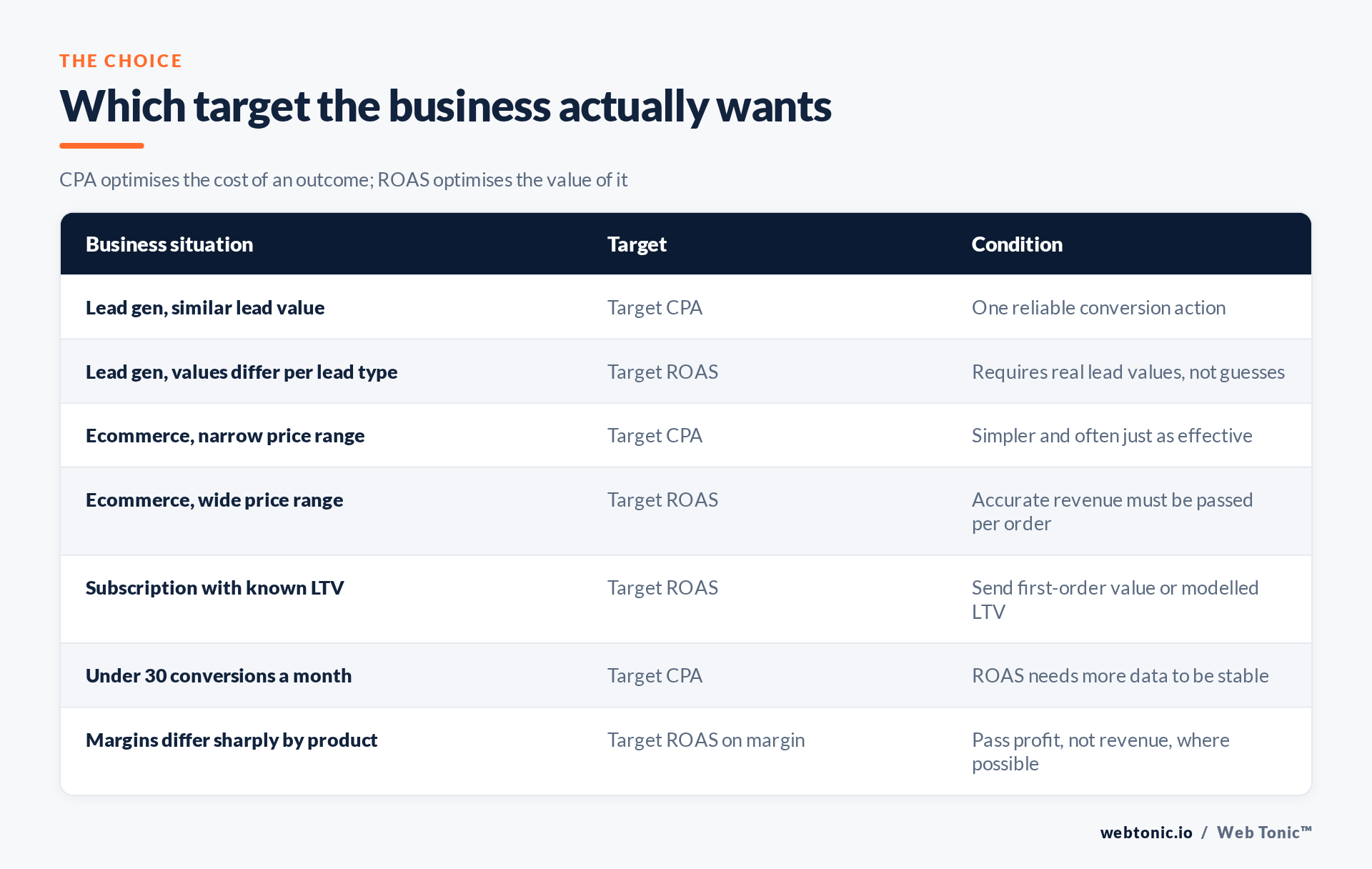
That makes the decision a business question before it is a platform question. If a $40 lead and a $400 lead sit inside the same conversion action, Target CPA will treat them as identical and buy whichever is cheaper — which is usually the worse one. Conversely, if your orders all cost about the same, Target ROAS adds complexity and value-tracking risk for very little upside.
There is a hard prerequisite for ROAS: you must pass conversion values, and they must be right. A ROAS target on top of missing, static or duplicated values is not a strategy, it is a random number generator with good branding. Google's conversion measurement documentation is where to confirm your setup, and value accuracy deserves the same scrutiny as conversion counts.
Picking one
- Measure the spread of your conversion values. Pull the last 90 days of orders or leads. If most values fall in a narrow band, CPA is fine. If the top decile is worth several times the median, ROAS earns its complexity.
- Check whether values reach Google Ads at all. Not GA4, not the CRM — the bidding system. If they do not, that is your project before any target change.
- Count conversions. Below roughly 30 a month, ROAS behaves erratically because it is learning both propensity and value from thin data. Start on CPA and graduate.
- Decide what value means. Revenue is easy and often wrong; margin or gross profit steers the system toward the products you actually want to sell.
- For lead gen, decide whether you can send offline values. Uploading closed-deal values converts lead gen into a genuine ROAS problem — that is the upgrade path worth planning for.
| Question | If yes | If no |
|---|---|---|
| Do conversion values vary widely? | Consider Target ROAS | Target CPA |
| Are accurate values sent to Google Ads? | ROAS is possible | Fix values first, stay on CPA |
| Over ~30 conversions a month? | Either strategy is viable | Target CPA, cautiously |
| Do margins vary by product? | Pass profit as the value | Revenue is acceptable |
| Can offline conversions be uploaded? | Lead gen can use ROAS | CPA on qualified leads |
| Is a fixed monthly budget mandatory? | CPA is easier to pace | ROAS can flex spend to opportunity |
Setting a number you can hit
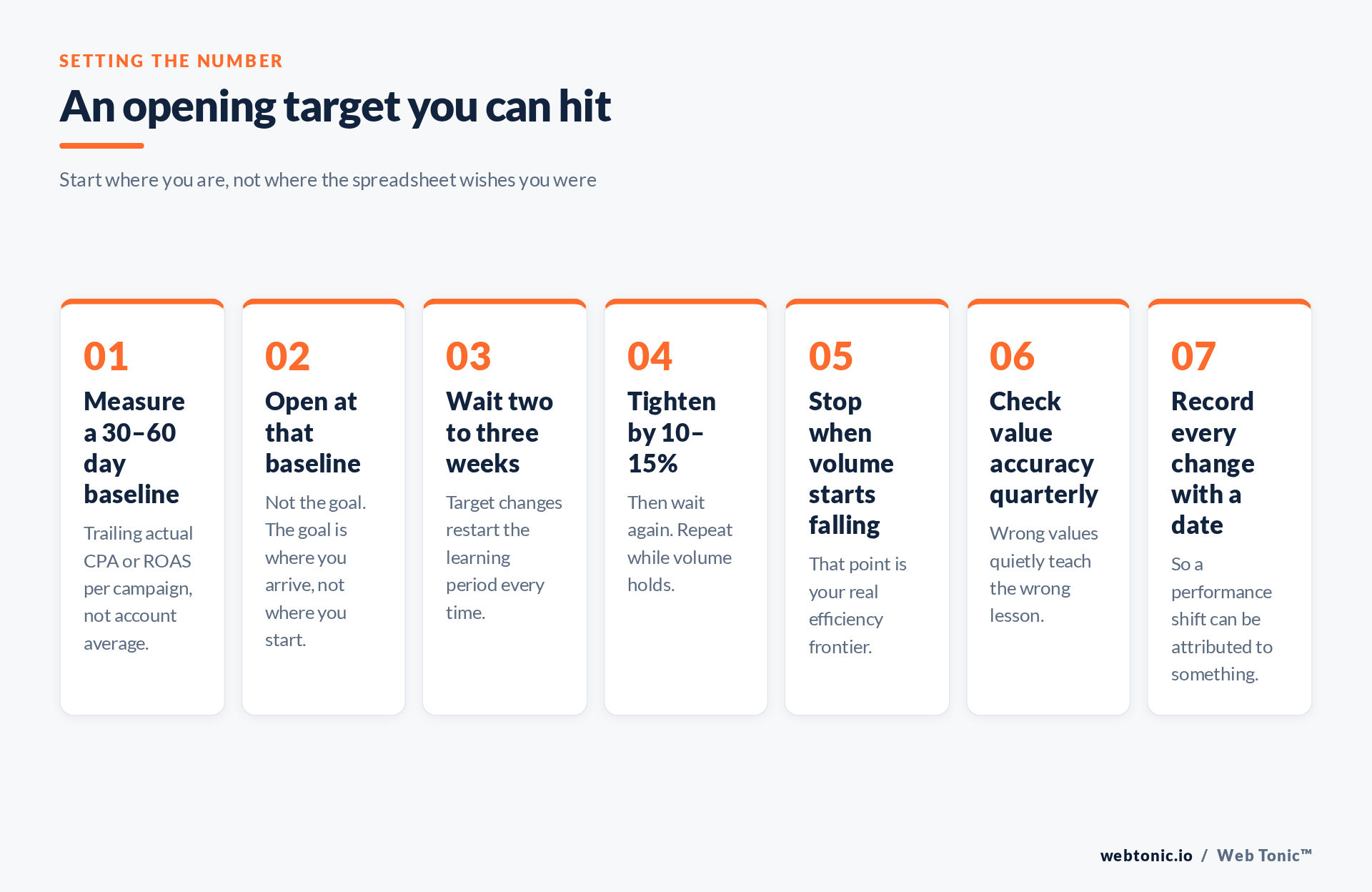
The most common failure in both strategies is an aspirational opening target. Set a CPA well below current performance, or a ROAS well above it, and the system restricts delivery to the small pool of auctions where that number is plausible. Impressions fall, volume collapses, and the strategy gets blamed for doing exactly what it was told.
Open at your trailing 30–60 day actual. Then tighten by 10–15% and wait. Each meaningful target change re-enters a learning period, so the pace of tightening is itself a setting — and impatience is expensive here. Keep going until volume starts to fall, and note that point: it is your genuine efficiency frontier rather than a theoretical one.
Watch search terms and Quality Score alongside the target, because a tightening target changes which queries you win, not just what you pay. And remember that reported returns are attributed returns; the caveats in marketing attribution and the cross-channel view from marketing mix modelling both apply to any ROAS figure you report upward.
Mistakes worth naming
Chasing an efficiency target while volume shrinks. A 6x ROAS on a third of the revenue is rarely the business goal. Track total conversions and total value next to the ratio, always, and decide explicitly which one you are optimising this quarter.
Averaging incompatible things. One campaign covering brand and generic terms will hit a blended target while hiding that generic performance is poor. Separate them before setting targets, or you are targeting an artefact of your own structure.
Treating a seasonal peak as the new baseline. A target set in a strong month becomes unreachable the following month and triggers a panic loop of edits, each one restarting learning. Set targets against comparable periods and use seasonality adjustments for known events.
Never revisiting value accuracy. Sites break value passing during redesigns, tax or shipping changes creep into revenue, and refunds are rarely deducted. Re-check quarterly — it is the cheapest audit in the account. This kind of hygiene is core to how we run conversion tracking, and it underpins the reporting we build in analytics for growth marketing clients. More on our blog.
Frequently Asked Questions
Can I run Target ROAS for lead generation?
Yes, if you assign real values to lead types or upload closed-deal values offline. Without genuine values, Target CPA on a qualified lead action is more honest.
What target should I start with?
Your trailing 30–60 day actual performance for that campaign. Aspirational opening targets suppress delivery and produce a false verdict.
How often can I change the target?
Every two to three weeks at most, in 10–15% steps. Each change restarts a learning period, so frequent edits mean a campaign that never stabilises.
Which one is better overall?
Neither. The one that matches your value spread and the accuracy of your value tracking is the better one for your account.
Should I use revenue or profit as the value?
Profit or margin where you can calculate it, because that is what the business optimises for. Revenue is the acceptable fallback when margins are broadly similar.
Sources: Google Ads — Target CPA bidding; Target ROAS bidding; About Smart Bidding; conversion measurement; marketing attribution; marketing mix modelling; return on marketing investment; Google Ads API reporting. Last verified 2026-08-21.


