Table of contents
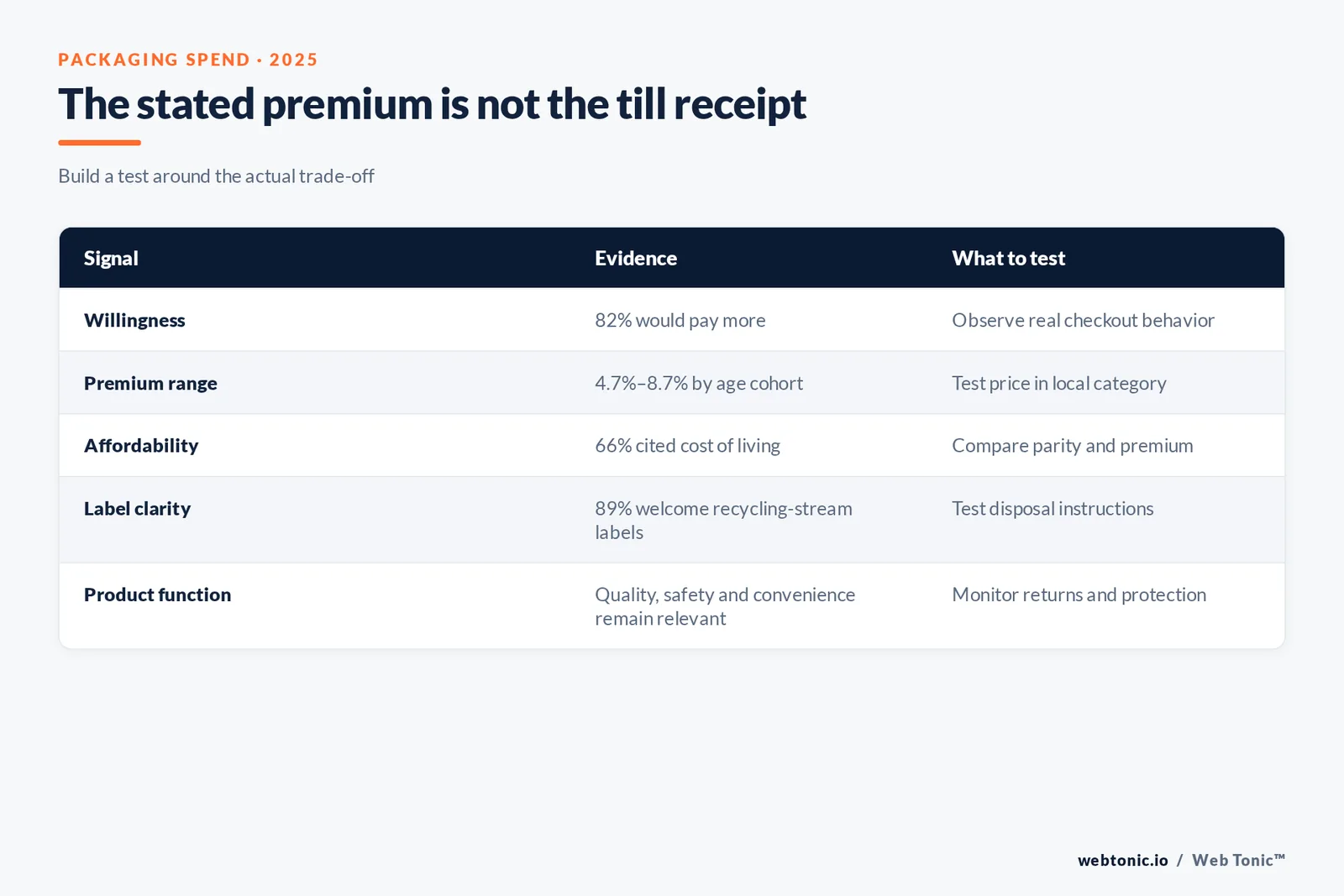
Sustainable-packaging surveys show willingness to pay, not proof that most shoppers complete a more expensive purchase. The useful commercial reading is conditional: packaging can signal value and reinforce choice, but price, quality, convenience and confidence in disposal still shape the checkout.
Key Takeaways
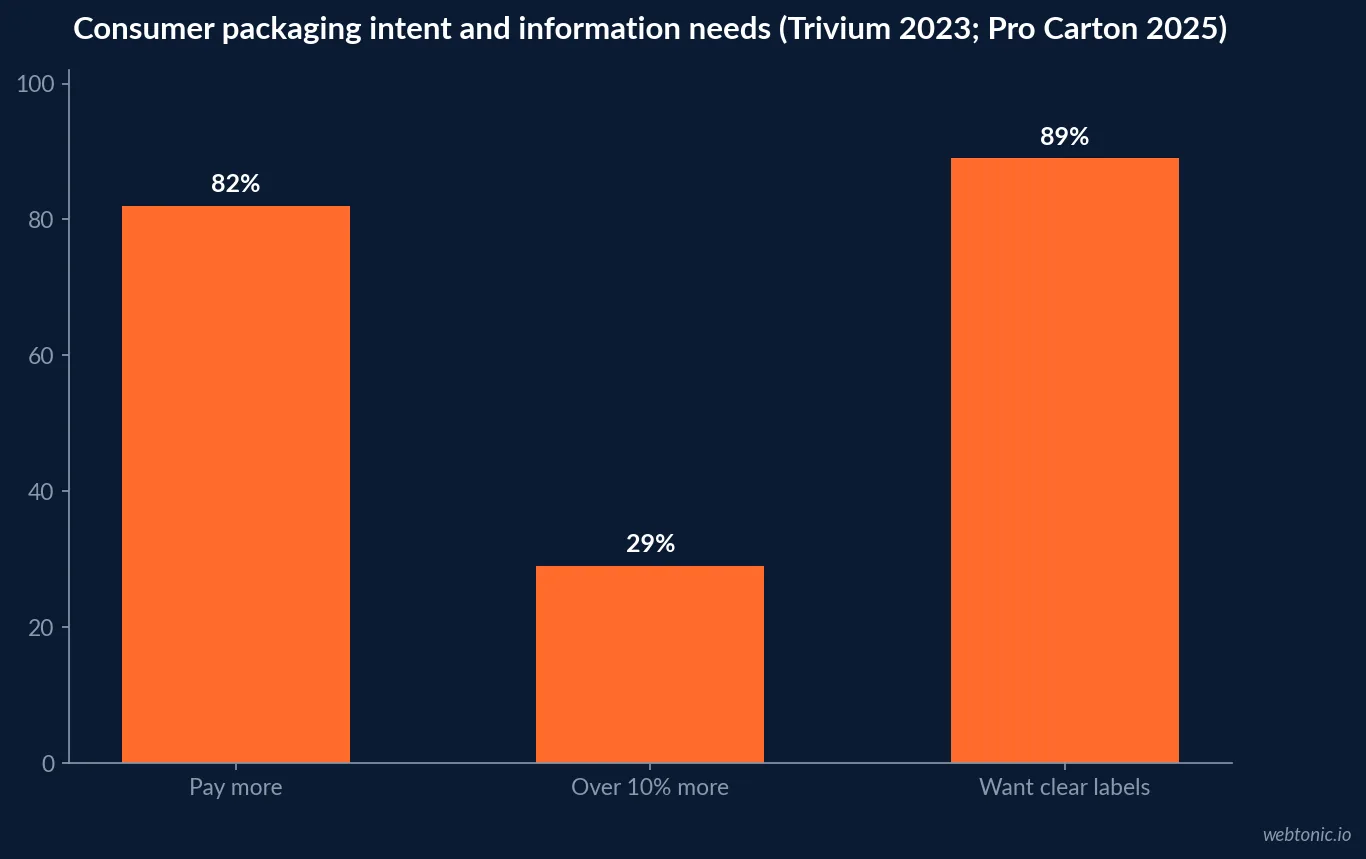
- 82% of respondents said they would pay more for sustainable packaging in Trivium Packaging’s 2023 survey.
- 29% said they would pay over 10% more in that same survey.
- 5,072 adults across five countries took part in Pro Carton’s 2025 European study.
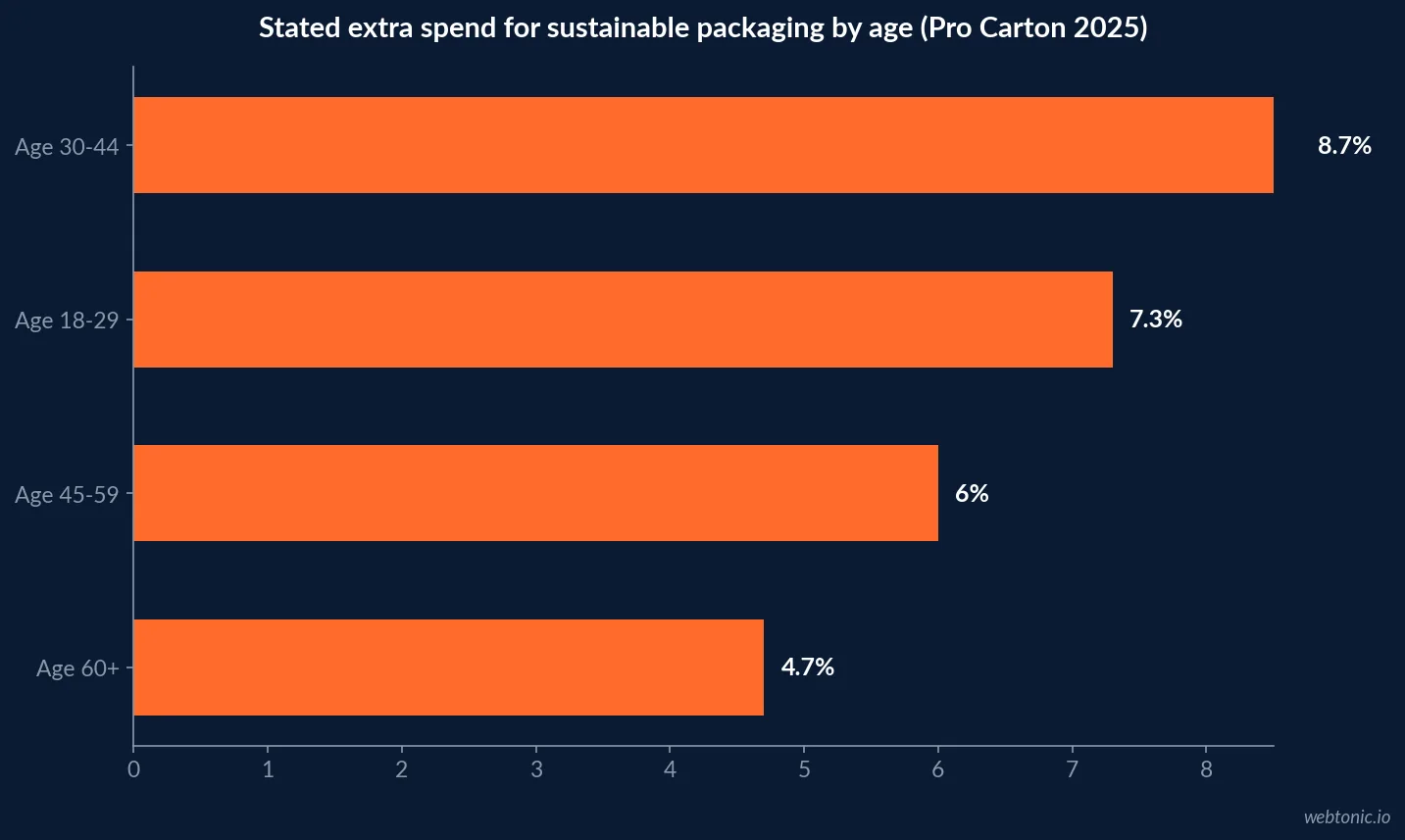
- Pro Carton’s 2025 age-group premium responses ranged from 4.7% to 8.7%.
- 89% welcomed clearer recycling-stream labels in the 2025 Pro Carton study.
- 66% of European respondents cited cost of living as a key influence in 2025, ahead of climate change at 62%.
- Ipsos’ 2024 research put packaging and plastic waste at 41% of global consumer concerns, behind climate change at 46%.
- 84% trusted paper and cartonboard recycling systems in Europe in Pro Carton’s 2025 study.
- EU packaging waste reached 79.7 million tonnes in 2023, or 177.8 kg per inhabitant (Eurostat, 2025 release).
- Measure actual conversion and margin; do not treat claimed willingness as realized willingness-to-pay.
What the numbers measure—and what they do not
Most packaging evidence here is consumer research: respondents report preferences, perceptions or stated price tolerance. It does not directly observe a till receipt. The distinction matters for marketers building price architecture. A person can favor recyclability in principle and still choose a less expensive product when the difference is visible.
Trivium Packaging’s 2023 Buying Green Report, produced with Euromonitor International, surveyed more than 9,000 people in Europe, North America and South America. It reported 82% willing to pay more for sustainable packaging and 29% willing to pay more than 10%. Pro Carton’s 2025 study is narrower geographically and asks a different question: how much extra respondents say they would pay. Neither figure is a measured sales lift.
Use survey numbers to select claims and segments for experiments. Use a matched product test, price test or randomized landing-page test to establish incremental demand in your own market. If the sample, wording or market differs, do not splice results into a synthetic global average.
Stated premiums vary by survey and by question
Two studies illustrate why the figure depends on how a researcher frames the question. Trivium asked whether consumers would pay more; Pro Carton reported average additional price amounts by cohort. Ipsos’ 2024 sustainability research also cautions that consumers do not identify one universally sustainable material; preference varies by country and product category.
For packaging decisions, Pro Carton’s 2025 cohort data is closer to the product question, but it reflects five European countries, not all customers. Its reported age-cohort willingness values were 8.7% for ages 18–29, 7.3% for 30–44, 6.0% for 45–59, and 4.7% for 60+; the country values ranged from 5.6% in France to 7.3% in Italy. Its study was conducted by Perspectus Global and surveyed Germany, France, Italy, Spain and the UK. The survey explicitly notes that results may not add exactly to 100% because of rounding. It should inform a test, not set a universal shelf-price uplift.
| Study / measure | Population and year | Reported result | Interpretation |
|---|---|---|---|
| Trivium Buying Green | 9,000+ consumers, 2023 | 82% would pay more; 29% over 10% more | Broad stated intent; not observed transactions |
| Pro Carton European packaging study | 5,072 adults, five countries, 2025 | Age-cohort stated premium: 4.7%–8.7% | Packaging-specific survey answer |
| Ipsos sustainable-packaging research | Consumers in five markets, 2024 | 41% named packaging/plastic waste as a top concern | Concern measure, not price tolerance |
| Ipsos sustainable-packaging research | Consumers across 28 countries, 2024 | Packaging/plastic waste: 41% concern | Concern measure, not price tolerance |
Affordability is the constraint behind the premium
Pro Carton’s 2025 research places economic context beside environmental concern. Sixty-six percent of surveyed Europeans cited cost of living as an influence on consumer behaviour, compared with 62% citing climate change. This is not evidence that consumers abandon environmental preferences; it is evidence that they weigh them against household budgets.
Ipsos’ 2024 research found packaging and plastic waste was the third-biggest environmental concern across 28 countries at 41%, after climate change (46%) and extreme climate events (43%). Concern is not proof of a willingness to pay. Packaging also protects food safety, shelf life, usability and product integrity. A sustainability redesign that compromises those expectations risks trading a positive signal for a poorer product experience.
Marketing leaders should therefore test the premium in realistic conditions: include the ordinary product price, a clear sustainable-packaging claim, and a credible comparator. Record conversion and contribution margin, not just stated preference. Track whether the premium is accepted by existing buyers, attracts new buyers, or simply moves volume between SKUs.
| Decision signal | Observed survey evidence | Commercial read-through | Test to run |
|---|---|---|---|
| Budget pressure | 66% named cost of living in Pro Carton 2025 | Do not assume values trump price | Compare conversion at price parity and premium |
| Packaging waste concern | 41% in Ipsos 2024, among 28 countries | Concern is not a price premium | Test claim beside quality and convenience |
| Packaging proof | 89% welcomed recycling-stream labels | Specific disposal guidance may reduce uncertainty | A/B test plain-language instruction |
| Pack performance | Food safety and shelf life remain leading expectations | Sustainability cannot impair function | Monitor damage, returns and freshness |
| Age variation | Declared premium ranged 4.7%–6.7% by cohort | Use as a segment hypothesis, not a price rule | Compare willingness with actual cohort sales |
What material preference says about trust
Material preference is not the same as lifecycle evidence. Pro Carton’s 2025 study found 89% of surveyed Europeans favoured cartonboard over plastic, up two percentage points versus its 2024 result, and 84% trusted that paper and cartonboard packaging would be recycled. Those figures describe perception and confidence in collection systems, not a full environmental-impact comparison of each package.
Ipsos’ 2024 research for consumer packaged-goods companies makes the caveat explicit: consumers do not identify one universally sustainable material. Perceptions vary by country and category. A material that respondents see as environmentally preferable in food may not carry the same meaning in personal care. Brands should make substantiated, product-specific claims and avoid treating a material label as a proxy for all lifecycle impacts.
Amcor’s 2025 research, based on 3,351 European consumers across six countries, found 84% check on-pack disposal instructions, and 72% said they understand paper-based packaging claims and use them in purchasing decisions. The relevant question for the buyer is whether packaging information can be understood and acted on. Pro Carton reports 89% welcomed labels explaining recycling streams. That points toward a practical communication opportunity: state what the package is made from and what consumers should do next, using local recycling guidance.
Age and geography: useful test cells, not stereotypes
Pro Carton’s 2025 study reported that respondents aged 18–29 would pay an average 8.7% more, ages 30–44 7.3%, ages 45–59 6.0%, and those 60+ 4.7%. The top age group is not the youngest, and the differences are modest. Do not turn these average stated responses into an age-based surcharge or assume any one generation is automatically a more profitable segment.
Country differences matter too. The report says Italian respondents reported the highest average willingness to pay, 7.3% extra; Germany followed at 6.7%, the UK at 6.2%, Spain at 6.5%, and France at 5.6%. The UK recorded the strongest trust in paper and cartonboard recycling at 88%, while confidence in flexible-plastic recycling was 49%. These variations can guide market-specific creative and packaging education, but remain self-reported data from the five-country sample.
Build a testing plan around a few meaningful cells: market, product category, price tier and claim comprehension. Only split further when the sample can support a reliable comparison. A tiny cohort chart can feel precise while concealing uncertainty.
| 2025 Pro Carton audience cut | Survey result | Useful hypothesis | What not to conclude |
|---|---|---|---|
| Age 18–29 | 8.7% stated extra | Test value-led packaging language | All young buyers pay a premium |
| Age 30–44 | 7.3% stated extra | Include this cohort in price tests | This is a verified checkout uplift |
| Age 45–59 | 6.0% stated extra | Compare claim comprehension | Age alone predicts purchase |
| Age 60+ | 4.7% stated extra | Make affordability and clarity visible | Older customers reject sustainability |
| Italy | 7.3% stated extra | Localize test for market | Result applies to all European buyers |
| UK | 88% trust paper/cartonboard recycling | Explain material and local disposal | Consumer perception proves recyclability |
Packaging facts create a scale and waste context
Consumer interest sits beside a material waste challenge. Eurostat’s October 2025 release reports 79.7 million tonnes of packaging waste generated in the EU in 2023, equivalent to 177.8 kilograms per inhabitant. The 2023 per-capita figure was 8.7 kilograms below 2022, but 21.2 kilograms above 2013. The figures quantify the system-wide scale; they do not attribute waste to any single consumer choice or brand.
The US Environmental Protection Agency’s containers-and-packaging series likewise separates generation from management outcomes. Its data tables are useful for understanding category volumes and recycling, but the most recent figures differ in reference year from newer European figures. Never compare raw rates across jurisdictions without checking definitions, collection boundaries and years.
For marketers, the waste context is a reason to communicate a credible action—not to imply that a package alone solves the issue. The European Commission’s Packaging and Packaging Waste Regulation aims for all packaging on the EU market to be recyclable in an economically viable way by 2030 and calls to reduce unnecessary packaging. These policy milestones make packaging facts commercially relevant, while not serving as consumer-spending data.
There is no universal sustainable-packaging premium
The survey gap is a useful reminder: a percentage reported in a broad consumer poll is not a safe markup for a brand. Pro Carton asked a defined European sample about sustainable packaging; Trivium’s survey covered multiple continents and a different question wording. An individual firm’s product, price tier, retail channel and material claim will differ again.
Build the offer around a real consumer trade-off and avoid a blanket “green premium.” Test at the product and market level, hold product features steady, and report the effect on unit volume and contribution margin. If an estimate depends on a survey answer, label it as stated willingness to pay and include the year and population.
Turn a stated preference into a spending experiment
Start with a clear hypothesis: a specific package feature or verified claim will improve sales, price tolerance, or retention in a defined group. Keep other product attributes constant. If the package itself changes, monitor quality and damage outcomes as well as conversion; customers may reject a redesign that worsens opening or storage.
Use randomized exposure where practical, or compare matched regions and time periods while controlling for promotion, distribution and seasonality. Report the incremental gross margin after packaging cost. A sales lift that requires a premium pack but erodes contribution is not a win. If a premium is rejected, test price parity, smaller pack formats, clearer recycling directions or an alternative value proposition.
Set a decision threshold before the test begins. Use a control group, minimum sample size and practical run duration. Pair observed purchase data with a short comprehension check so that a weak result can be distinguished from a message consumers did not understand.
| Measurement layer | Metric | Decision use | Common trap |
|---|---|---|---|
| Demand | Conversion and units per visitor | Does the pack move purchases? | Counting stated intent as sales |
| Economics | Incremental gross margin after pack cost | Does it create profitable spend? | Ignoring material and logistics cost |
| Retention | Repeat rate and time to next purchase | Does preference persist? | Using a one-week launch spike |
| Operations | Damage, spoilage, returns | Does the pack protect product? | Optimizing sustainability alone |
| Comprehension | Correct disposal response | Did shoppers understand the claim? | Assuming label exposure equals learning |
Use precise language for claims and labels
Where consumers are asked to pay more, the claim must be intelligible and defensible. Avoid unqualified words such as “green” where they imply an environmental benefit without stating what changed. Say what is true: recycled content percentage, locally accepted recycling instructions, reduced material weight, or a verified reuse system. Cite the relevant method and market boundary.
The European Commission’s packaging rules make recyclability, recycled material and avoiding unnecessary packaging central policy themes. Policy text does not automatically validate a marketing claim, and a package that is recyclable in one municipality may not be collected in another. Provide instructions at the point of decision and link to local information where possible.
Web Tonic’s performance creative practice can help structure a claim test; teams should connect it to measurement and data intelligence so reporting separates reach, response and completed orders. For channel-budget context, see our guide to building a measurable paid-search strategy.
Benchmark summary: the signal is real, the premium is conditional
The cross-study message is not “consumers will pay anything for sustainability.” It is that sizable survey groups express willingness to pay, cohorts report differing levels of price tolerance, and packaging information can influence perception. At the same time, affordability competes with environmental concerns, the product still has to perform, and the most relevant evidence is local to the product and market.
Use the numbers as a research brief: choose a credible feature, test a clearly defined premium, observe transaction data and retain a control. A survey can tell you where to look; it cannot replace the checkout test. Build the proposition around the shopper’s actual trade-off between price, function, convenience and evidence.
| Benchmark | Year | Value | How to use it |
|---|---|---|---|
| Willing to pay more for sustainable packaging (Trivium) | 2023 | 82% | Broad directional interest |
| Willing to pay >10% more (Trivium) | 2023 | 29% | Upper premium proposition to test |
| Stated cohort price premium (Pro Carton) | 2025 | 4.7%–6.7% | Packaging-specific segment hypothesis |
| European packaging waste per person (Eurostat) | 2023 | 177.8 kg | System scale, not brand impact |
| Packaging and plastic waste concern (Ipsos) | 2024 | 41%; third-ranked environmental issue | Compare with price and quality |
Frequently Asked Questions
Do consumers actually pay more for sustainable packaging?
Surveys measure stated willingness rather than completed transactions. Trivium Packaging’s 2023 Buying Green survey found 82% of respondents said they would pay more, but it did not establish that 82% later paid a premium at checkout. Pro Carton’s 2025 European study instead measured an average additional amount consumers said they would pay for sustainable packaging, with material differences by age and country. Treat both as declared intent and test actual price elasticity in your own category.
How much more will consumers spend?
There is no universal premium. In Pro Carton’s 2025 survey of 5,072 adults across five European countries, the average stated premium varied across age groups: respondents aged 18–29 said 8.7%, ages 30–44 7.3%, ages 45–59 6.0%, and people aged 60+ 4.7%. The numbers are survey answers, not a price recommendation; product quality, convenience and local context still matter.
Does sustainable packaging beat price in a purchase decision?
Not consistently. Ipsos’ 2024 research found packaging and plastic waste was the third-biggest environmental concern across 28 countries, at 41%, after climate change (46%) and extreme climate events (43%). Cost-of-living pressure also topped climate change in Pro Carton’s 2025 European findings. Sustainability can support preference, but marketers should not assume it overrides affordability or performance.
Which packaging proof should brands communicate?
Lead with specific, locally meaningful evidence: whether the pack is widely recyclable in the customer’s area, what material it contains, and how to dispose of it. Pro Carton’s 2025 study found 89% welcome labels explaining recycling streams; its 2024 edition reported 89% said clear disposal instructions would be helpful. Keep the claim narrow and substantiated, and avoid implying that a material is universally best.
What should marketers measure beyond survey intent?
Track realized price premium, conversion, repeat purchase, product returns, basket mix and customer understanding against a comparable control. Separate the packaging effect from product quality, promotion and distribution. A survey can prioritize a message to test; sales and margin data establish whether the package actually changes spending.
Sources
Trivium Packaging — 2023 Buying Green Report
Pro Carton — European Consumer Packaging Perceptions Study 2025
Ipsos — Mapping the Journey to Sustainable Packaging, 2024
Eurostat — Packaging waste, 2023 data released 2025
European Commission — Facts about EU packaging rules
WRAP — Citizens’ attitudes and behaviours relating to packaging
Amcor — 2025 European consumer claims research