



Table of contents

Surrogacy agencies face a dual-funnel marketing challenge — recruiting qualified surrogate candidates while simultaneously acquiring intended parents willing to invest $140,000–$180,000 in a gestational journey. These statistics reveal how top-performing agencies allocate budgets and measure results across digital channels.
Key Takeaways
- Cost per qualified intended parent inquiry ranges from $80–$300, with Tier-1 metros (NYC, LA, SF) running 30–60% higher than secondary markets.
- Surrogate recruitment CPL sits at $50–$200, but only 10–25% of leads qualify — pushing effective cost per qualified surrogate to $500–$2,000.
- Typical surrogacy agency ROAS reaches 30×–70× against $50K–$150K agency fees per completed journey, making it one of the highest-LTV verticals in healthcare marketing.
- Meta Ads generate 45% of fertility digital conversions by volume, while Google Search captures 20% at higher per-patient revenue.
- Monthly recommended ad spend is $10K–$33K across intended parent acquisition ($5K–$15K), surrogate recruitment ($3K–$10K), and Meta campaigns ($2K–$8K).
- AI search visibility is emerging fast — the Arcalea AEO Index tracked 247 AI responses across 73 buyer-intent prompts for 15 surrogacy agencies in March 2026.
Surrogacy Digital Marketing Budget Benchmarks
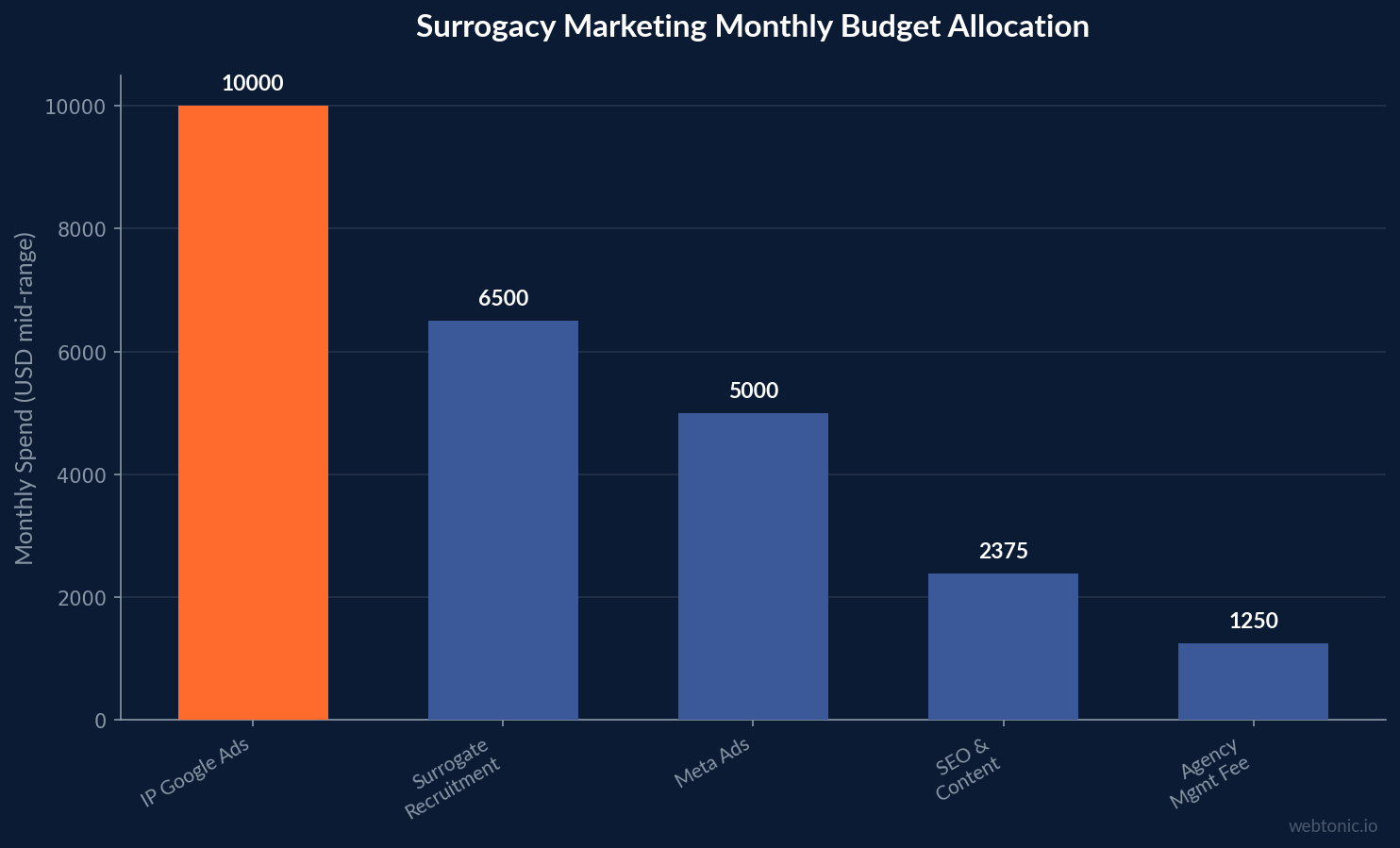
Budget allocation in surrogacy marketing splits across two distinct acquisition funnels, each with different cost structures and timelines. Intended parent campaigns demand higher growth marketing budgets due to longer research cycles, while surrogate recruitment relies more heavily on social platforms.
| Budget Category | Monthly Range | % of Total | Primary Channels |
|---|---|---|---|
| Intended Parent Google Ads | $5,000–$15,000 | 25–35% | Search, Display |
| Surrogate Recruitment Ads | $3,000–$10,000 | 20–30% | Facebook, Instagram |
| Meta Ads (Combined) | $2,000–$8,000 | 15–25% | Facebook Lead Ads, IG |
| SEO & Content | $1,250–$3,500 | 10–15% | Blog, Landing Pages |
| Agency Management Fee | $1,250/mo or 12% of spend | 8–12% | Strategy, Reporting |
Single-location surrogacy agencies typically invest $4,000–$8,000/month on demand-side acquisition (ad spend plus management), separate from surrogate recruitment budgets. Multi-location programs with national ambitions invest $17,500–$285,000/month across all channels, with the highest budgets reserved for agencies processing 100+ journeys annually.
Intended Parent Acquisition Cost Benchmarks
Intended parent acquisition follows a high-consideration purchase funnel where research cycles span 6–18 months before a contract is signed. Cost metrics vary significantly by demographic segment and geography.
| Intended Parent Segment | Google Ads CPL | CPA (Signed Contract) | Typical ROAS |
|---|---|---|---|
| Heterosexual Post-IVF | $200–$450 | $1,500–$4,500 | 30×–70× |
| Gay Male Couples | $180–$400 | $1,200–$3,500 | 35×–65× |
| Solo Parents by Choice | $250–$500 | $1,800–$5,000 | 25×–50× |
| International IPs | $150–$400 | $1,500–$4,000 | 30×–60× |
Against $25K–$45K agency fees per completed journey (and $140K–$180K total journey costs), even the highest acquisition costs produce sustainable returns. Tier-1 metro CPLs run 30–60% higher than tertiary U.S. markets, but these regions also produce higher conversion rates due to greater surrogacy awareness.
Surrogate Recruitment Marketing Statistics
Surrogate recruitment represents a unique marketing challenge — agencies must attract candidates who meet strict medical and psychological screening criteria while navigating advertising compliance restrictions across platforms.
- Cost per initial surrogate inquiry: $50–$200 via Facebook Lead Ads and Instagram campaigns.
- Only 10–25% of surrogate leads qualify after medical and psychological screening, pushing effective cost per qualified surrogate to $500–$2,000.
- Cost per matched surrogate (contract-ready): $3,000–$15,000+ at established agencies, reflecting the full screening pipeline cost.
- Cost per signed surrogate contract: $800–$3,000 for agencies with mature recruitment funnels.
- Facebook dominates surrogate recruitment, with agencies allocating 55–65% of recruitment budgets to Meta platforms. Google captures 25–35% for search-intent queries like "become a surrogate."
- Surrogate recruitment timelines average 6–12 months from initial inquiry to match, requiring sustained performance creative investment.
Channel Performance Comparison
The surrogacy marketing channel mix differs significantly from other healthcare verticals because of the dual-funnel structure — each funnel favors different platforms and targeting approaches.
| Channel | Best For | Avg. CPL | Conv. Rate | Share of Budget |
|---|---|---|---|---|
| Google Search Ads | IP high-intent capture | $200–$450 | 6.8% | 25–35% |
| Facebook/Instagram Ads | Surrogate recruitment | $50–$200 | 1.5–3.0% | 30–40% |
| SEO / Organic | Long-tail education | $15–$40 | 3–7% | 10–15% |
| Email Nurture | IP pipeline warming | $5–$12 | 12–18% | 5–8% |
| Retargeting (Display) | Re-engagement | $30–$80 | 0.8–2.0% | 5–10% |
Meta Ads generate 45% of fertility/surrogacy digital conversions by volume, primarily affordable single-service inquiries, while Google Search captures 20% of conversions at higher average revenue per user — typically 2–3 cycle packages or premium surrogacy programs. Organic channels drive 35% of conversions with the lowest acquisition cost but longest time-to-close.
Case Study Performance Data
Published case studies from surrogacy marketing agencies reveal the scale of results achievable with optimized digital campaigns.
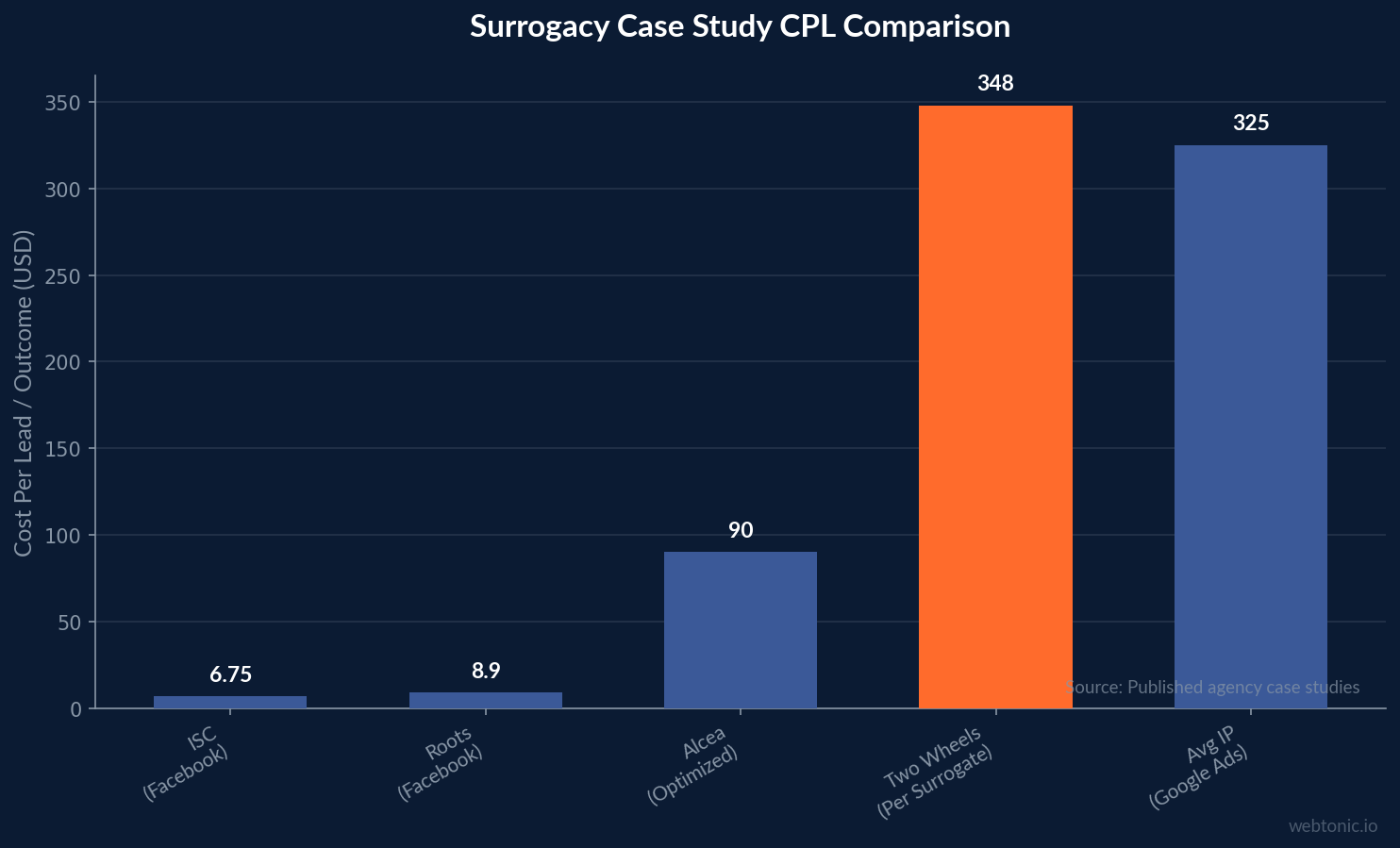
- International Surrogacy Center generated 2,637 leads at $6.75 CPL and received 324 surrogate applications in 8 months, moving forward with 40 qualified candidates via a Facebook-first strategy.
- Canadian Fertility Consulting produced $2.7 million in revenue through Facebook Ads, booking 140 surrogate consultation appointments and signing 43 participants.
- Roots Surrogacy captured 509 opt-ins at $8.90 each and converted 32 to qualified applicants in under two months.
- A Las Vegas agency doubled qualified leads from 50 to 100+ monthly in 5 months, generating 1.8 million impressions and 6,108 link clicks via paid social campaigns.
- Two Wheels Marketing delivered $600,000 in net agency revenue (23 matched surrogates) in under 12 months from Facebook Ads, achieving approximately 600% ROAS on a $96K annual ad investment.
- Alcea Surrogacy reduced CPL from over $200 to approximately $90 through campaign optimization, representing a 55% cost reduction while maintaining lead quality.
Conversion Rate Benchmarks by Funnel Stage
Surrogacy conversion funnels are longer and more complex than typical healthcare marketing, with multiple qualification stages between initial contact and signed agreement.
| Funnel Stage | IP Conversion Rate | Surrogate Conversion Rate |
|---|---|---|
| Ad Click → Landing Page Visit | 85–92% | 80–88% |
| Landing Page → Form Submission | 6.2–8.5% | 4.0–7.0% |
| Form → Qualified Inquiry | 40–55% | 10–25% |
| Qualified → Consultation Booked | 25–40% | 30–50% |
| Consultation → Signed Contract | 15–30% | 20–35% |
The most significant drop-off for intended parents occurs between consultation and signed contract (15–30%), driven by financial considerations and partner alignment. For surrogates, the steepest filter is form submission to qualified inquiry (10–25%) because medical and psychological screening eliminates the majority of applicants.
AI Search Visibility and Emerging Channels
The Arcalea AEO Index (March 2026) analyzed 247 AI-generated responses across 73 buyer-intent prompts for 15 surrogacy agencies across four AI platforms, establishing the first benchmark for AI search visibility in surrogacy marketing.
- Growing Generations holds the second-highest AEO visibility score among tracked surrogacy agencies, indicating strong AI citation presence.
- Mobile search represents 65–80% of total fertility/surrogacy search queries, making mobile-optimized landing pages essential for both IP and surrogate funnels.
- Organic search conversion rates for fertility services range from 3–8% depending on content depth and clinic/agency authority.
- 3–6 month retargeting windows are recommended for intended parents who visited high-intent landing pages but didn't convert, reflecting the extended decision cycle.
Compliance and Platform Restrictions
Surrogacy advertising operates under some of the most restrictive digital marketing compliance frameworks in healthcare, with violations potentially causing 3–6 month recovery periods.
- Meta classifies fertility/surrogacy as a restricted health category — ads cannot target based on personal health conditions and require sensitivity disclaimers.
- Google Ads enforces healthcare advertising verification for surrogacy services, with platform-specific approval processes adding 2–4 weeks to campaign launch timelines.
- LinkedIn is generally not viable for surrogate recruitment due to demographic mismatch, but serves B2B relationship-building with reproductive law attorneys and IVF clinics.
- TikTok has been actively rejecting IVF and surrogacy-adjacent ads, limiting the platform's utility for younger demographic targeting.
- Compliance violations can cost an entire year of preventable acquisition spend — the opportunity cost of a six-month ad flow gap during peak recruitment exceeds lost revenue from the pause period alone.
Surrogacy Market Context
Understanding the broader surrogacy market provides context for digital marketing investment levels and expected returns.
- Average U.S. gestational surrogacy journey costs $140,000–$180,000, with surrogate compensation, surrogacy-specific insurance, and IVF medical fees as the largest cost drivers in 2026.
- PGT-tested embryo success rates reach 70–80%, supporting marketing claims around clinical outcomes.
- Agency fees range from $25,000–$45,000 per completed journey, making even premium acquisition costs ($3,000–$5,000 CPA) highly profitable.
- The surrogacy market is valued at approximately $28.91 billion with a projected 22.19% CAGR, driving increasing competition for digital visibility.
- Agency and legal fees remained stable in absolute terms in 2026 but declined as a share of total journey cost, as surrogate compensation and insurance premiums increased.
SEO and Organic Search Performance
Organic search is the third pillar of surrogacy digital marketing, delivering low-cost leads over longer time horizons. These benchmarks from 34 fertility centers provide context for surrogacy-specific organic performance.
- Organic search conversion rates for fertility services range from 3–8%, depending on content depth, site authority, and the specificity of the search query being answered.
- Mobile search represents 65–80% of fertility and surrogacy queries, making mobile-first landing page design a non-negotiable for organic and paid traffic alike.
- Content-heavy surrogacy sites with 50+ indexed pages generate 3–4× the organic traffic of minimal sites, reflecting Google's preference for topical authority in YMYL (Your Money, Your Life) categories.
- Local SEO matters even for national agencies — state-specific landing pages (e.g., "surrogacy in California," "Texas surrogacy laws") capture high-intent long-tail traffic with lower competition.
- Average time to first-page rankings for competitive surrogacy terms: 8–14 months, making SEO a long-term investment that compounds over time as content authority builds.
Digital Marketing ROI by Channel
Understanding channel-level ROI helps surrogacy agencies allocate budgets more effectively. The following benchmarks reflect documented performance across multiple agency campaigns and industry reports.
- Google Search Ads deliver the highest per-lead revenue because they capture intent-driven queries from parents actively researching surrogacy options, producing conversion rates of 6.8% at fertility clinic benchmarks.
- Facebook Lead Ads produce the highest volume at the lowest CPL for surrogate recruitment, with documented cases achieving $6.75–$8.90 per opt-in, though qualification rates sit at 10–25%.
- SEO delivers the lowest long-term acquisition cost at $15–$40 per organic lead, but requires 6–12 months of sustained content investment to build authority in competitive surrogacy search terms.
- Email nurture sequences produce the highest conversion rate (12–18%) among all channels because they target already-warmed pipeline contacts over extended decision cycles.
- Retargeting display campaigns achieve 0.8–2.0% conversion rates but serve as critical mid-funnel touchpoints that reduce overall CPA when combined with search and social campaigns.
- International IP marketing adds multilingual SEO tiers starting at $750/month for foundational English-language country-specific pages, scaling to $1,750/month for comprehensive Hreflang implementation across priority markets.
Best Practices for Surrogacy Digital Marketing
Top-performing surrogacy agencies follow a set of proven digital marketing practices that maximize ROI across both acquisition funnels while maintaining compliance.
- Separate campaign structures for surrogate recruitment and intended parent acquisition — blending the two audiences dilutes targeting precision and inflates costs for both.
- Invest in testimonial-driven video content — owner-on-camera and surrogate/IP story videos consistently outperform stock imagery by 2–4× in engagement metrics.
- Build landing pages per audience segment rather than driving all traffic to a generic homepage. Segment-specific pages (gay couples, solo parents, international IPs) achieve 40–60% higher conversion rates.
- Implement multi-touch attribution models — last-click attribution drastically undervalues Facebook's contribution because many intended parents see Facebook ads weeks before converting via Google search.
- Maintain compliance buffers — keep backup ad accounts, pre-approved creative libraries, and documented compliance protocols to prevent 3–6 month recovery periods from platform suspensions.
- Track qualification-adjusted metrics — raw CPL is misleading in surrogacy because qualification rates vary 10–60% across channels and segments. Report on cost per qualified lead (CPQL) and cost per signed contract.
Related reading
- 25+ Financial Advisory Digital Marketing Statistics for 2026
- Fitness Digital Marketing Statistics: 80+ Benchmarks on Gym Marketing, SEO & Social (2026)
- Franchise Digital Marketing Strategy Statistics: Key Data Points for 2026
- Marketing Strategy Consulting services at Web Tonic
Frequently Asked Questions
How much should a surrogacy agency spend on digital marketing per month?
Single-location agencies should budget $4,000–$8,000/month for intended parent acquisition (ad spend plus management), with an additional $3,000–$10,000 for surrogate recruitment campaigns. Multi-location programs with national reach may invest $17,500–$33,000+ monthly across all digital channels. Agency management fees typically run $1,250/month or 12% of total ad spend.
What is a good cost per lead for surrogacy marketing?
For intended parent campaigns, $80–$300 per qualified inquiry is the typical range, with Tier-1 metros running 30–60% higher. Surrogate recruitment campaigns achieve $50–$200 CPL, though only 10–25% qualify after screening, making the effective cost per qualified surrogate $500–$2,000.
Which digital channels work best for surrogacy agency marketing?
Google Search Ads capture high-intent intended parent queries (25–35% of budget), while Facebook and Instagram dominate surrogate recruitment (30–40% of budget). SEO provides the lowest long-term acquisition cost but requires 6–12 months to build authority. Email nurture sequences convert at 12–18% for warmed pipeline contacts.
What ROAS can surrogacy agencies expect from digital marketing?
Against $25K–$45K agency fees per completed journey, well-optimized digital campaigns produce ROAS of 30×–70×. One documented case achieved approximately 600% return on $96K annual ad spend, generating $600K in net agency revenue through 23 matched surrogates.
How long does it take for surrogacy digital marketing to produce results?
Paid campaigns (Google Ads, Facebook) typically generate initial leads within 2–4 weeks of launch. However, intended parent research cycles span 6–18 months before a contract is signed, meaning full pipeline ROI takes 9–15 months to materialize. SEO-driven traffic builds over 4–8 months but delivers the lowest acquisition cost at maturity.
Sources
tandemmedicalmarketing.com — Marketing for Surrogacy Agencies
tandemmedicalmarketing.com — Intended Parent Marketing Playbook
tandemmedicalmarketing.com — Surrogacy Advertising Compliance
arcalea.com — Surrogacy Agency AEO Index 2026
acrcglobal.com — Surrogacy Statistics 2026
eggdonorandsurrogacy.com — 2026 U.S. Surrogacy Trends Report
linkedselling.com — International Surrogacy Center Case Study
twowheelsmarketing.com — Surrogacy Agency Lead Gen Case Study
quillinlv.com — US Surrogacy Campaign Results
ichelonconsulting.com — IVF Google Ads vs Meta Ads Data
benchmarketing.org — Fertility Clinics Marketing Benchmarks 2026


