Table of contents

Key Takeaways
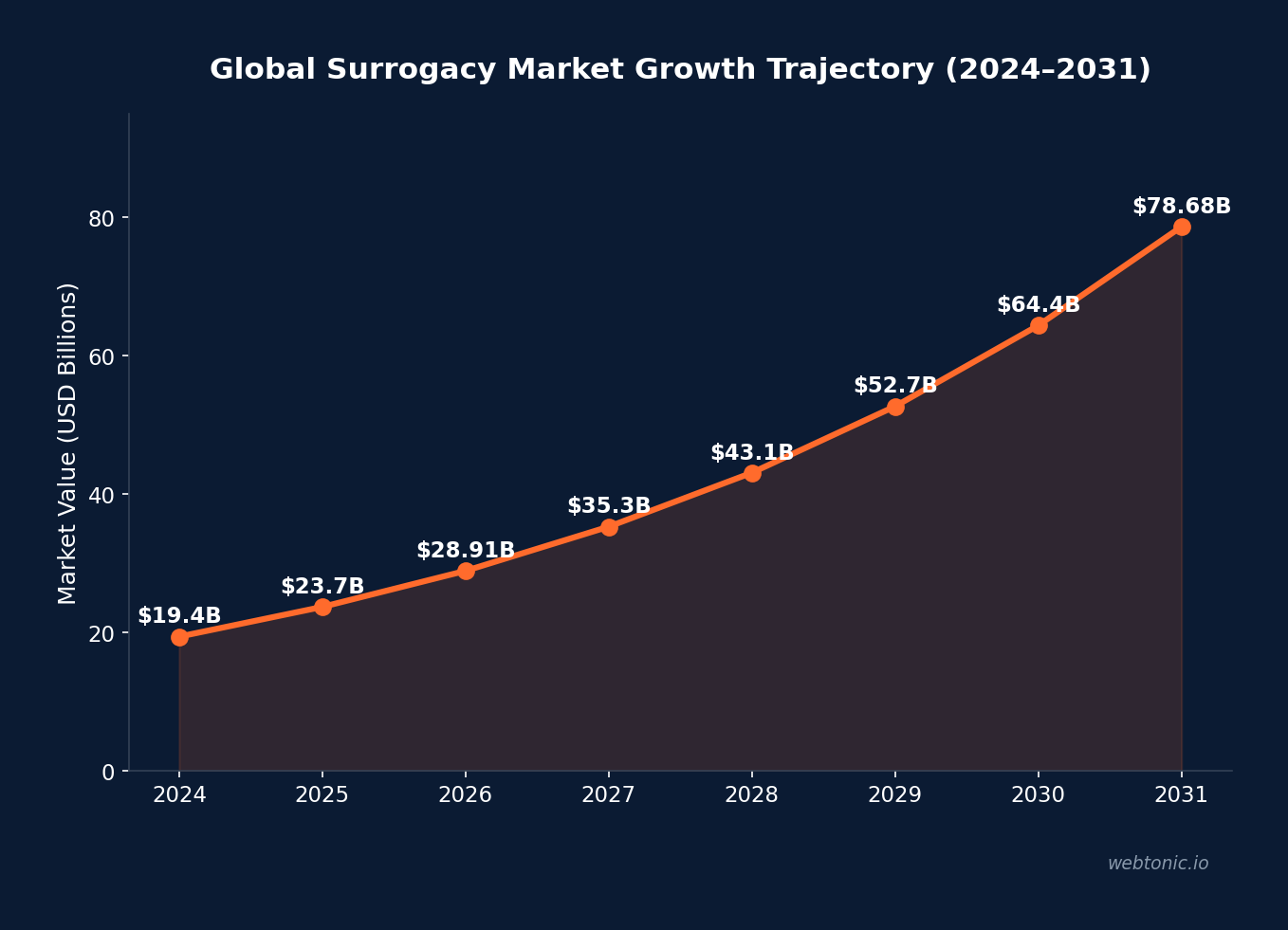
- The global surrogacy market is valued at $28.91 billion in 2026, growing at a 22.19% CAGR toward $78.68 billion by 2031 (Mordor Intelligence).
- Surrogacy agencies face a 30–50× inquiry-to-match pipeline ratio, making funnel tracking essential to identifying where candidates drop off (Tandem Medical Marketing).
- Patient acquisition cost reaches up to $4,000 per intended parent, justified by per-journey agency revenue of $25,000–$80,000+ (Tandem Medical Marketing).
- Google Ads CPC for fertility averages $9.84 with a $112 CPA, while surrogacy-specific keywords command higher premiums due to competitive and compliance factors (Benchmarketing).
- Pixel-free tracking architectures are emerging as surrogacy agencies remove standard Meta/Google pixels from PHI-containing form pages and use server-side event posting (Tandem Medical Marketing).
- Average surrogacy costs span $140,000–$180,000 in the US, with compensation, insurance, and IVF fees as the three largest cost drivers (EDSI 2026 Report).
- Success rates for PGT-tested embryos reach 70–80%, a data point that directly shapes conversion messaging in surrogacy analytics dashboards (ACRC Global).
Surrogacy Analytics Benchmarks at a Glance
| Metric | Value | Source |
|---|---|---|
| Global market value (2026) | $28.91 billion | Mordor Intelligence |
| Projected market (2031) | $78.68 billion | Mordor Intelligence |
| Market CAGR | 22.19% | Mordor Intelligence |
| Inquiry-to-match ratio | 30–50× | Tandem Medical Marketing |
| Intended parent CPA | Up to $4,000 | Tandem Medical Marketing |
| Google Ads CPC (fertility) | $9.84 | Benchmarketing |
| Google Ads CPA (fertility) | $112 | Benchmarketing |
| Surrogate CPL (Facebook) | $6.75 | LinkedSelling / ISC |
| Cost per matched surrogate | $3,000–$15,000+ | Tandem Medical Marketing |
| Avg US surrogacy total cost | $140,000–$180,000 | ACRC Global |
The Dual-Funnel Tracking Challenge in Surrogacy
Surrogacy agencies operate two distinct marketing funnels simultaneously — intended parent acquisition and surrogate recruitment — each with fundamentally different conversion metrics, timelines, and tracking requirements. This dual-funnel reality makes standard marketing analytics frameworks insufficient.
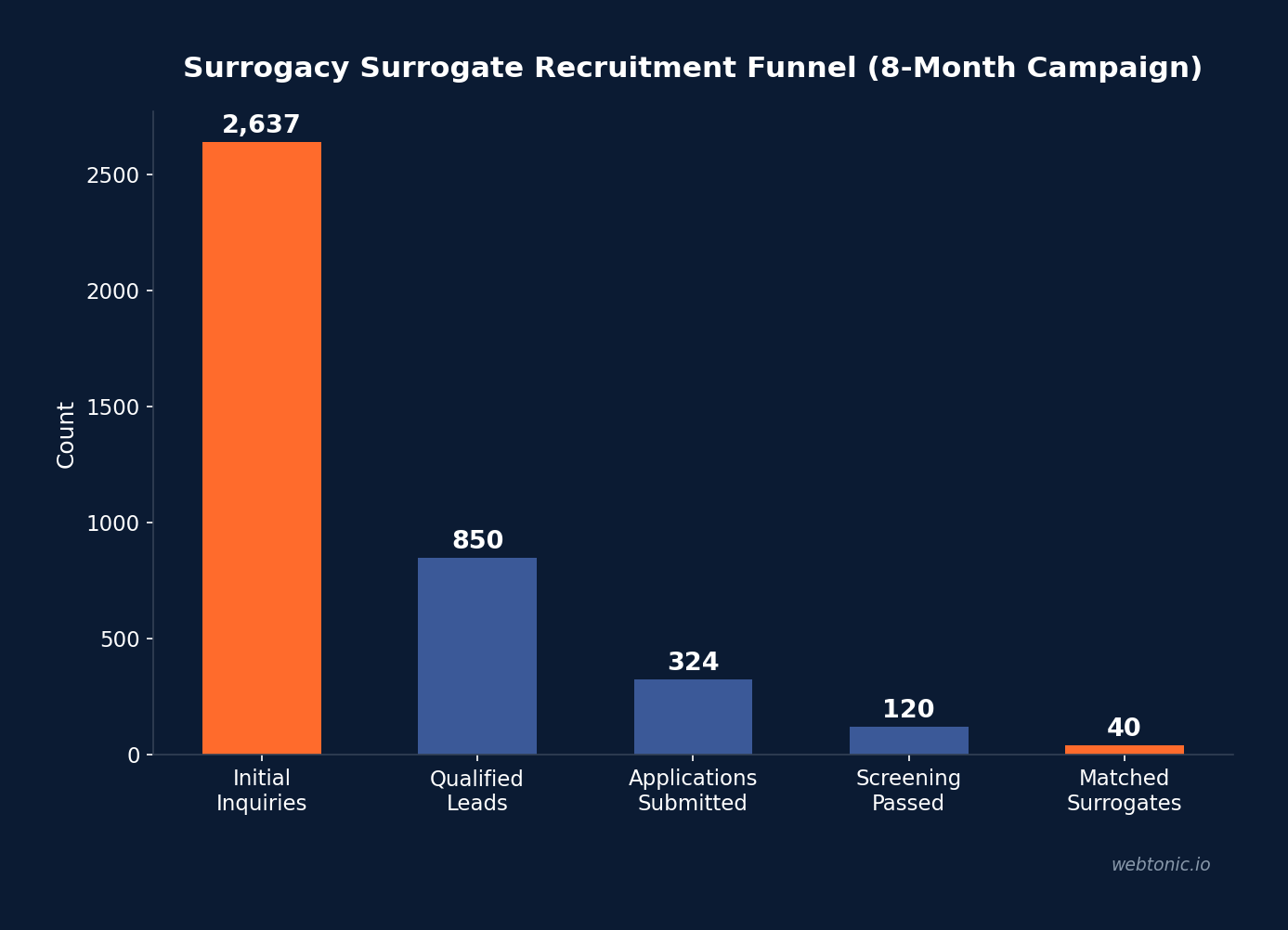
Tandem Medical Marketing's recruitment data reveals the scale of the problem: the 30–50× inquiry-to-match pipeline ratio means that for every contract-ready surrogate, agencies must generate and track 30–50 initial inquiries through screening, background checks, medical evaluation, and psychological assessment. A cost per matched surrogate of $3,000–$15,000+ is the meaningful bottom-of-funnel metric — not the $6.75 top-of-funnel CPL.
On the intended parent side, patient acquisition costs reach up to $4,000, but with per-journey agency revenue of $25,000–$80,000+, the target ROAS of 5–10× remains achievable. The challenge is attributing that revenue across a 12–18 month conversion window that spans multiple touchpoints, channels, and decision milestones.
Privacy-First Tracking for Surrogacy Agencies
Surrogacy agencies handle some of the most sensitive personal health information (PHI) in marketing — fertility status, medical history, financial capacity, and family-building intent. This creates unique tracking constraints that standard marketing analytics tools don't address.
Leading surrogacy marketing agencies are adopting pixel-free architectures: removing Google Ads and Meta pixels from form submission confirmation pages and replacing them with server-side conversion event posting that doesn't carry form field data. This approach maintains conversion tracking for campaign optimization while eliminating the PHI exposure risk of standard pixel implementations.
The approach mirrors broader healthcare marketing trends. Curve Compliance notes that fertility clinics face sensitive category restrictions on Google Ads that affect targeting granularity and require compliance-specific tracking configurations. Agencies that invest in server-side event architecture gain both data intelligence and regulatory protection.
Market Analytics: Growth Drivers and Regional Trends
Understanding the market analytics behind surrogacy growth is critical for agencies positioning their services. other research firms project the market growing from $29.78 billion in 2026 to $140.35 billion by 2034 at a 21.39% CAGR, with some estimates reaching $145.18 billion by 2032 at a 24.14% CAGR.
The EDSI 2026 US Surrogacy Trends Report provides granular analytics on cost composition: surrogate compensation, surrogacy-specific insurance, and IVF medical fees are the three largest cost drivers. Agency and legal fees remained stable in absolute terms but declined as a share of total cost — a trend that affects how agencies position their value proposition in advertising.
North America continues as the largest surrogacy market region, driven by legal infrastructure in states like California, Illinois, and Nevada that support commercial surrogacy. International intended parents — particularly from Europe, Asia, and the Middle East — represent a growing demand segment that requires its own analytics and channel-specific budget allocation.
Key Analytics Metrics Every Surrogacy Agency Should Track
| Metric | Intended Parents | Surrogate Recruitment |
|---|---|---|
| Cost per lead (CPL) | $100–$500 | $6.75–$56 |
| Cost per acquisition (CPA) | $1,000–$4,000 | $3,000–$15,000+ |
| Funnel ratio (inquiry to action) | 5–10× (consultation) | 30–50× (matched) |
| Conversion window | 3–6 months | 2–4 months |
| Revenue per conversion | $25K–$80K+ (agency fees) | Enables $25K–$80K revenue |
| Target ROAS | 5–10× | N/A (capacity metric) |
| Attribution model | Multi-touch, 180-day | First-touch emphasis |
Technology Stack for Surrogacy Analytics
Surrogacy agencies are building increasingly sophisticated analytics stacks to manage their dual-funnel operations. NSI Solution's case study of an international surrogacy agency demonstrates a typical modern setup: Zoho CRM for intake, matching, and case management across surrogates, intended parents, and egg donors, plus Zoho Analytics for key metrics tracking.
Dedicated fertility platforms like STEPS (Surrogacy Tracking & Engagement Platform Software) automate inquiry capture, organize records, and provide automation tools for surrogate and intended parent management. The platform captures every inquiry automatically and tracks the full screening pipeline — addressing the core analytics challenge of long conversion windows and complex multi-party journeys.
For marketing analytics specifically, the Arcalea Surrogacy Agency AEO Index evaluates 15 agencies across SERP visibility, AI Engine Optimization readiness, keyword coverage, and platform-by-platform performance — providing competitive intelligence that shapes advertising strategy.
IVF and Fertility Analytics Benchmarks That Apply to Surrogacy
| Channel | Share of Conversions | Primary Role |
|---|---|---|
| Google Search Ads | 35% (high-intent) | Captures patients actively searching for treatment |
| Meta Ads | 45% (by volume) | Affordable awareness + lower-funnel for single cycles |
| Organic Search | 15% (estimated) | Long-term authority and trust building |
| Referral / Direct | 5% (estimated) | High-trust, highest close rate |
Data from Ichelon Consulting's IVF channel analysis shows that Meta Ads generates 45% of fertility digital conversions by volume, while Google Search captures the highest-intent 35% with a 41.89% conversion advantage on cost-per-patient. These patterns transfer directly to surrogacy analytics, where understanding channel-level patient value — not just lead volume — determines optimal budget allocation.
Attribution Challenges in Long-Cycle Surrogacy Journeys
Standard marketing attribution models break down in surrogacy because the decision journey spans 3–6 months for intended parents and 2–4 months for surrogates — far longer than the typical 7–28 day attribution windows used by most marketing platforms. This creates systematic undervaluation of top-of-funnel channels like Meta awareness campaigns and content marketing.
The analytics challenge is compounded by the multi-party nature of surrogacy transactions. A single completed surrogacy journey involves at minimum an intended parent (or couple), a surrogate, an egg donor (in many cases), legal counsel, a medical team, and the agency itself. Each party enters through different channels, at different times, with different decision timelines.
Leading surrogacy agencies are adopting 180-day multi-touch attribution models that weight both first-touch (awareness) and last-touch (conversion) interactions. This approach reveals that channels like Facebook Ads — which often look expensive on a 28-day last-click basis — are actually the most cost-efficient channel for initiating surrogacy conversations that close 4–6 months later.
The Irresist IVF marketing analytics framework provides a useful model: calculate patients_per_100_leads per channel using booked consultations as a proxy when patient-start data is incomplete. For surrogacy, the equivalent metric is matched surrogates per 100 applications per channel — a number that ranges from 1–3% depending on source quality.
Competitive Intelligence and AEO Readiness
As AI-powered search reshapes how intended parents discover surrogacy agencies, analytics must extend beyond traditional SEO metrics. The Arcalea Surrogacy Agency AEO Index evaluates 15 leading agencies across SERP visibility, AI Engine Optimization readiness, keyword coverage, and platform-by-platform performance — providing the competitive intelligence framework that forward-thinking agencies use to allocate resources.
Key findings from the index suggest that most surrogacy agencies have significant gaps in AI search visibility. Agencies that invest in structured data, comprehensive FAQ content, and authoritative backlink profiles are better positioned for AI-generated answers — which are increasingly becoming the first touchpoint for intended parents researching surrogacy options.
For agencies running Google Ads alongside organic strategy, the AEO index provides actionable data on where competitors are visible and where content gaps create paid media opportunities. This is particularly relevant for surrogacy, where high CPCs ($9.84 average in fertility) make organic visibility a high-ROI alternative for informational queries.
Building a Surrogacy Analytics Dashboard: Essential Components
A well-designed surrogacy analytics dashboard bridges the gap between marketing data and business outcomes. Based on the dual-funnel structure unique to surrogacy, the essential components include:
- Intended parent pipeline view: Track inquiries → consultations → contracts across all channels, with 180-day rolling attribution that captures the full decision timeline. Include cost-per-stage metrics that show where budget is most efficiently spent.
- Surrogate recruitment pipeline: Monitor applications → screenings → medical clearance → matching, with channel-level quality scores. The 30–50× inquiry-to-match ratio means small improvements in screening efficiency compound significantly at the bottom of the funnel.
- Channel efficiency matrix: Compare Google Ads, Meta Ads, organic search, and referral channels side-by-side on both volume and quality metrics. CPL alone is misleading — a $6.75 Facebook lead and a $112 Google Ads lead may produce the same cost per matched surrogate if screening pass rates differ by 10×.
- Compliance and ad health monitoring: Track ad disapprovals, account warnings, and policy violations across platforms. A single compliance failure can shut down an entire account — real-time monitoring prevents revenue loss from surprise suspensions.
- Geographic and seasonal patterns: Identify which regions produce the highest-quality leads for both audiences, and when seasonal trends (New Year resolutions, post-holiday inquiry spikes) create opportunities for budget reallocation.
The investment in a comprehensive analytics setup pays for itself quickly in surrogacy. When a single matched surrogate is worth $25,000–$80,000+ in agency revenue, even a 5% improvement in pipeline efficiency — identified through better analytics — generates returns that dwarf the cost of implementation. Agencies that pair strong analytics with expert campaign management see the compounding benefits of data-driven optimization across both funnels.
Related reading
- 79+ Statistics Shaping Tracking & Analytics in the Health & Wellness Industry (2026)
- HVAC Analytics Stats (2026)
- HVAC Analytics & Tracking Statistics (2026): Benchmarks & Data Gaps
- Marketing Analytics services at Web Tonic
FAQ
What is the most important analytics metric for surrogacy agencies?
Cost per matched surrogate is the most meaningful metric for the recruitment funnel ($3,000–$15,000+), while cost per signed intended parent ($1,000–$4,000) matters most for the demand side. Top-of-funnel metrics like CPL are useful for campaign optimization but misleading for business decisions due to the 30–50× inquiry-to-match ratio.
How do surrogacy agencies track conversions without violating privacy?
Leading agencies use server-side conversion event posting instead of standard Meta and Google pixels on PHI-containing form pages. This approach maintains conversion tracking for ad platform optimization while preventing form field data from being captured by third-party pixels — a critical requirement when handling fertility and financial health data.
What analytics tools do surrogacy agencies use?
The typical stack includes a CRM (Zoho, Salesforce, or dedicated platforms like STEPS) for pipeline tracking, Google Analytics or a privacy-first alternative for website analytics, and platform-specific dashboards for paid media. Advanced agencies add BI tools like Zoho Analytics for cross-channel reporting and multi-touch attribution modeling.
How long is the surrogacy conversion window for analytics?
The intended parent conversion window spans 3–6 months from initial inquiry to signed contract, while the total surrogacy journey runs 12–18 months. Standard 28-day or 90-day attribution windows miss the majority of conversion value — agencies need 180-day multi-touch attribution to accurately measure marketing impact.
What is the ROI of surrogacy marketing?
With per-journey agency revenue of $25,000–$80,000+ and marketing costs of $17,500–$44,500/month at the early stage, the target ROAS of 5–10× is achievable for well-optimized programs. The key is tracking through to matched surrogates and signed intended parents — not stopping at lead counts that don't reflect actual business value.
Sources
Mordor Intelligence — Surrogacy Market Report 2026
Tandem Medical Marketing — Surrogate Recruitment Marketing
Tandem Medical Marketing — Patient Acquisition Cost Benchmarks
Benchmarketing — Fertility Clinics Marketing Benchmarks
EDSI — 2026 US Surrogacy Trends Report
ACRC Global — Surrogacy Statistics 2026
Ichelon Consulting — IVF Google Ads vs Meta Ads
NSI Solution — Surrogacy Agency Digital Transformation
Arcalea — Surrogacy Agency AEO Index