Table of contents
No published study measures whether solar generative engine optimization pays back, so "worth it" cannot be answered with data yet. What can be measured is exposure versus traffic: in Conductor's 2026 benchmarks the utilities sector, the closest mapping to solar, shows AI Overviews on 25.4% of searches, but AI assistants send just 0.35% of its website traffic.
Key Takeaways
- Utilities-sector searches show an AI Overview 25.4% of the time, near the 25.11% average (Conductor).
- AI referrals were 0.35% of utilities website traffic, against 1.08% across 10 sectors.
- Gemini drove 21% of AI traffic to the utilities sector; ChatGPT 87.4% overall.
- energysage.com is a top-five AI-cited domain in Conductor's utilities sector.
- US residential solar installed 1,179 MWdc in Q1 2026, up 6% year over year (SEIA).
- Average quoted solar price was USD 2.49 per watt in H2 2025 (EnergySage).
- The installer price spread widened 24%, to about USD 8,500 on an average system.
- Ahrefs plans list at USD 129 to 1,499 a month; Semrush at USD 139 to 549.
The solar GEO worth check at a glance
The table puts the exposure, the referral reality and the market side by side. Rows labelled utilities come from Conductor's GICS utilities sector, which is dominated by power producers and water utilities, not rooftop installers.
| Worth-check input | Figure | Period | Issuer | Solar-specific? |
|---|---|---|---|---|
| Searches with an AI Overview | 25.4% | 2026 report | Conductor | No, utilities sector |
| AI referral share of traffic | 0.35% | 2026 report | Conductor | No, utilities sector |
| Residential solar installed | 1,179 MWdc (+6% YoY) | Q1 2026 | SEIA / Wood Mackenzie | Yes |
| Average quoted price | USD 2.49/W | H2 2025 | EnergySage (marketplace) | Yes |
| Measured GEO return for solar | Not published | Any | No issuer | - |
Exposure: how often AI sits on energy results
Of 21.9 million Google searches Conductor analysed, 25.11% triggered an AI Overview. Health Care led at 48.75%, followed by Financials at 25.79% and Utilities at 25.4%. For a solar company, that puts energy-adjacent queries ("do solar panels work in winter", "how long do home batteries last") squarely in the zone where an assistant answers first. Across all tracked queries, BrightEdge reports AI Overview presence grew from roughly 30% to 48% in a year, while approximately 52% of queries still show none.
Demand for AI answers is rising on the consumer side too. Pew Research Center found in February 2026 that 49% of US adults use AI chatbots, up from 33% in 2024, and that 60% read AI summaries at the top of search results. Homeowners researching a five-figure purchase with lease, loan and credit trade-offs are a plausible heavy-use group, but Pew does not break its figures out by purchase type, so that remains an assumption.
Referrals: the traffic that actually arrives
Exposure is not traffic. Conductor puts AI referrals at 1.08% of all website traffic across its 10 sectors, "1 out of 100 website visits", growing around 1% month over month. The spread by sector is wide: Information Technology at 2.80% and Consumer Staples at 1.91% lead, while Utilities at 0.35% and Communication Services at 0.25% are lowest. A utilities site with the sector-average mix would see roughly one AI-referred visit in every 286, an illustrative ratio derived from the 0.35% figure, not a solar measurement.
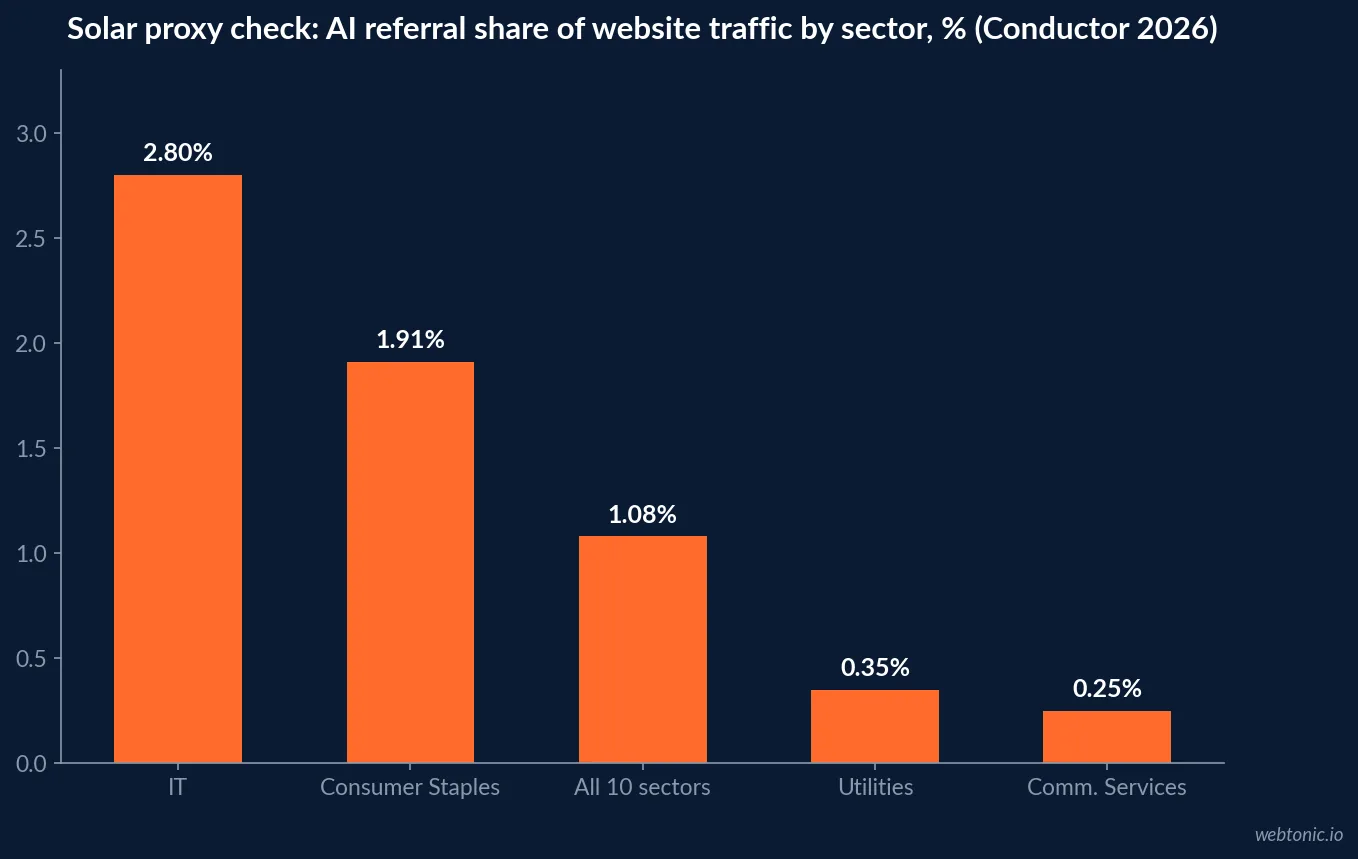
| Conductor sector | AI referral share of traffic | AI Overview presence |
|---|---|---|
| Information Technology | 2.80% | Not used here |
| Consumer Staples | 1.91% | 6.82% |
| All 10 sectors | 1.08% | 25.11% |
| Utilities (solar proxy) | 0.35% | 25.4% |
| Communication Services | 0.25% | Not used here |
Gemini matters more in energy than elsewhere
ChatGPT supplied 87.4% of AI referral traffic on average across the 10 sectors, but Conductor flags that "Gemini drove a significantly high share of AI traffic (21%) to the Utilities industry". That is a reason for a solar firm to check Google's own surfaces, where Gemini and AI Overviews draw on the same index, before paying for multi-engine tracking. Google's AI features documentation says "there are no additional requirements to appear in AI Overviews or AI Mode, nor other special optimizations necessary".
Who gets cited on energy questions
Conductor's utilities top five by AI citation share are newfortressenergy.com, denverwater.org, constellation.com, energysage.com and gevernova.com, and New Fortress Energy holds 35.46% of brand mentions in the sector. The one residential-solar name in that list is EnergySage, a quote marketplace. For an installer, that means the realistic citation path is often indirect: being listed and reviewed on the marketplaces and directories that assistants already cite.
| Utilities brand (Conductor) | AI brand mention share | Relevance to installers |
|---|---|---|
| New Fortress Energy | 35.46% | Energy infrastructure, not residential |
| GE Vernova | 14.61% | Equipment, not residential |
| Constellation | 10.63% | Power supplier |
| Denver Water | 9.92% | Water utility |
| National Grid | 9.07% | Utility, interconnection topics |
The 2026 residential market the answers describe
SEIA and Wood Mackenzie's Q2 2026 Solar Market Insight reports the US installed 7.8 GWdc in Q1 2026, down 27% year over year. Residential installed 1,179 MWdc, up 6% year over year and down 15% quarter over quarter, buoyed by an overflow of installations started in late 2025 to capture the expiring Section 25D credit; commercial installed 523 MWdc and utility-scale 5.9 GWdc. EnergySage adds that after the One Big Beautiful Bill Act eliminated the 30% federal credit for purchased residential systems, leases and power purchase agreements remain eligible for the commercial credit until 2028. Questions about leases, PPAs and lost credits are exactly the explainer queries AI Overviews answer.
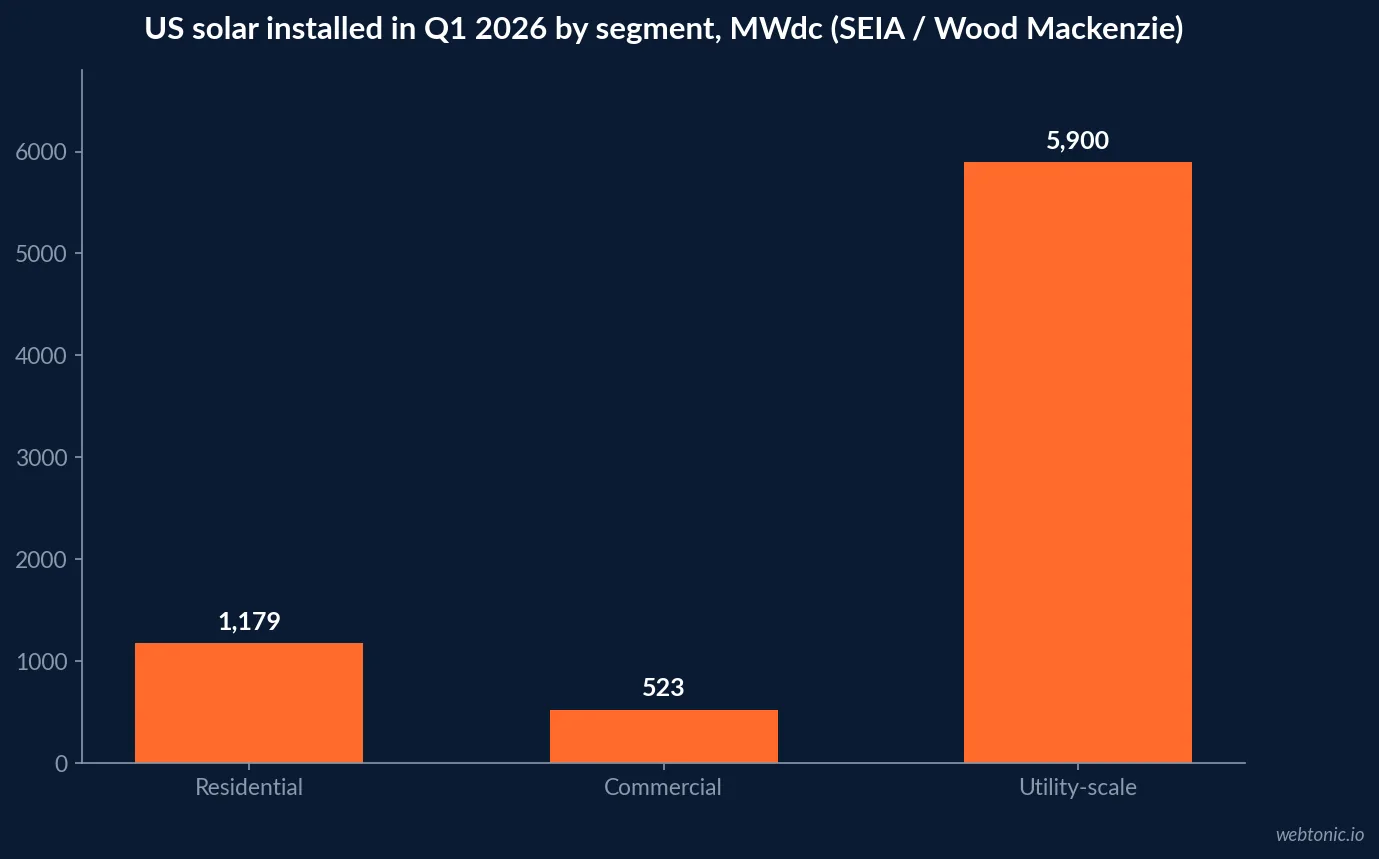
| SEIA Q1 2026 figure | Value | Year over year | Quarter over quarter |
|---|---|---|---|
| Total US solar installed | 7.8 GWdc | -27% | -42% |
| Residential | 1,179 MWdc | +6% | -15% |
| Commercial | 523 MWdc | -4% | -25% |
| Utility-scale | 5.9 GWdc | -34% | -45% |
Price questions are where answers can mislead
EnergySage's H2 2025 report puts the average quoted price at USD 2.49 per watt, up 0.4%, while the spread between the highest and lowest average quoted prices widened 24%, from USD 0.58 to USD 0.72 per watt, about an USD 8,500 difference on an average-sized system. A single national price in an AI answer hides that spread, and an installer's own dated, local price range is the kind of specific fact an answer engine can cite.
EnergySage attributes the wider spread to installers with full pipelines and limited remaining install slots using pricing power at the high end, as buyers rushed to finish purchased systems before the credit expired. That makes 2025 price statements age quickly. A page that says "solar costs about USD 2.49 per watt" without a date and a location will be wrong for many buyers, and if an assistant lifts it, the error spreads under the installer's name.
| EnergySage H2 2025 price metric | Value | What to publish instead |
|---|---|---|
| Average quoted price | USD 2.49/W (+0.4%) | Your dated local range |
| Price spread, H1 2025 | USD 0.58/W | Quote range by system size |
| Price spread, H2 2025 | USD 0.72/W (+24%) | Explain what drives your price |
| Spread on an average system | About USD 8,500 | Itemised quote examples |
| Federal credit for purchased systems | Eliminated (OBBBA, Jul 2025) | Lease and PPA explainer |
Claims rules for citable solar content
The FTC consumer guidance on solar power tells homeowners their options "include buying a system, leasing a system, or signing an agreement to buy solar power", and the Green Guides at 16 CFR 260.15 state it is deceptive "to misrepresent, directly or by implication, that a product or package is made with renewable energy or that a service uses renewable energy". Savings pages written for AI extraction should separate ownership models and date any incentive figure, because an assistant may quote a line without its caveat.
The cost side: dated tool list prices
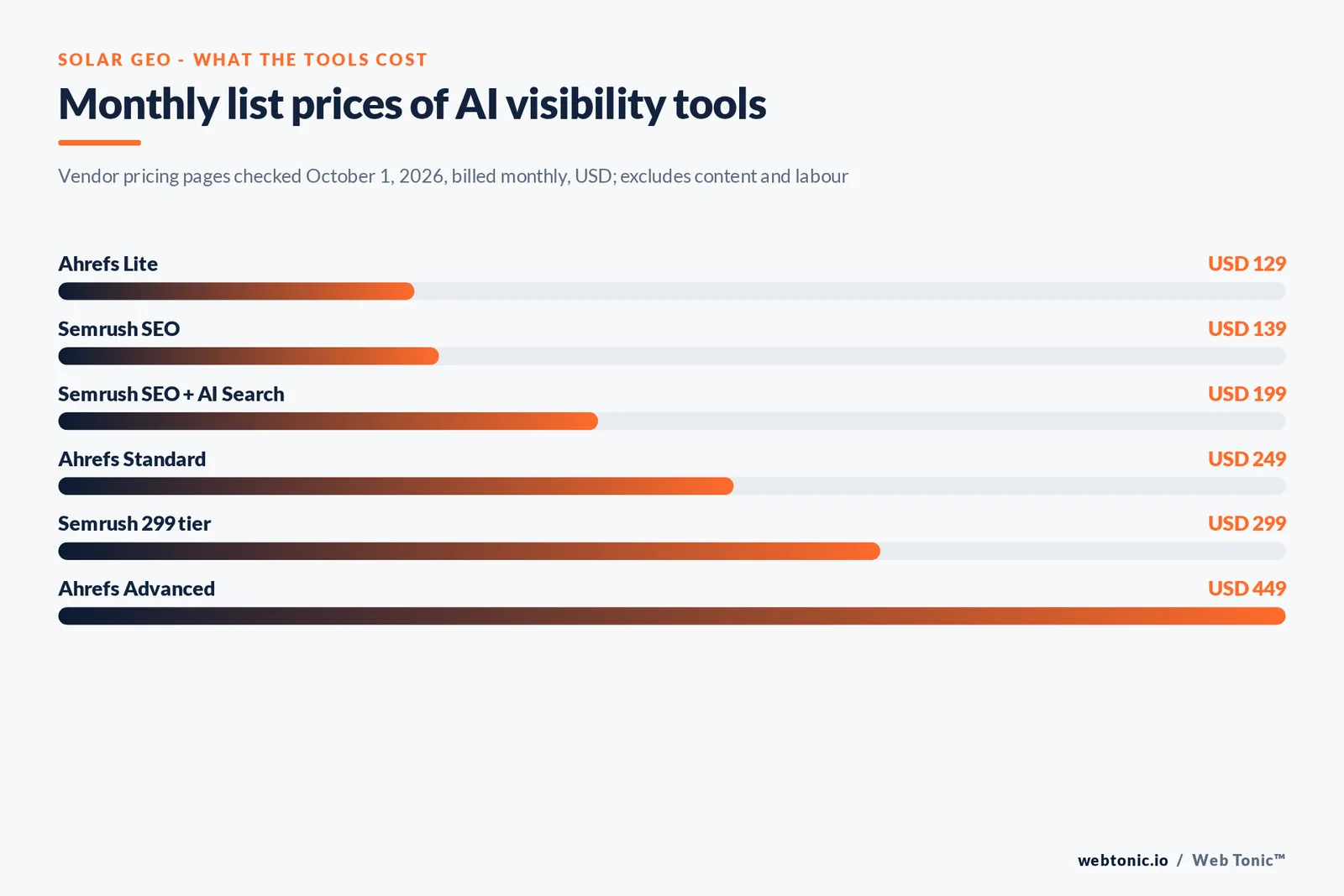
The only hard cost figures we can cite are software list prices from vendors' own pages, checked October 1, 2026. Ahrefs lists Lite at USD 129 a month, Standard at USD 249, Advanced at USD 449 and Enterprise at USD 1,499, with Brand Radar AI tracking in its feature list. Semrush lists its plans at USD 139, 199, 299 and 549 a month billed monthly, with AI search tracking in the higher tiers. These prices exclude content and labour, and no study we found prices GEO services for solar, so we do not estimate one.
| Tool plan (vendor pricing page, Oct 1, 2026) | Monthly list price | AI visibility feature |
|---|---|---|
| Ahrefs Lite | USD 129 | Tracked AI prompts (5) |
| Ahrefs Standard | USD 249 | See vendor feature list |
| Ahrefs Advanced | USD 449 | See vendor feature list |
| Semrush SEO | USD 139 | Track performance in AI search |
| Semrush SEO + AI Search | USD 199 | AI visibility |
| Semrush top self-serve tier | USD 549 | AI visibility with API |
How to run your own worth check
- Measure your AI referral share in analytics; compare it with the 0.35% utilities and 1.08% all-sector figures.
- Count AI Overviews on your 50 core queries; the utilities sector average is 25.4%.
- Check Gemini first, given its 21% share of utilities AI traffic.
- Get listed where assistants already cite, such as quote marketplaces.
- Cap tool spend at an entry plan (USD 129-139 a month list) until referrals justify more.
Clicks from classic results are shrinking either way: Ahrefs measured a 58% lower top-result click-through rate with an AI Overview (December 2025 data), and SparkToro found 68.01% of Google searches ended without a click in January-April 2026. For the organic side see our solar enterprise SEO statistics and solar international SEO statistics; the cross-industry view is in our generative engine optimization statistics, and our data intelligence team can set up AI referral tracking.
What the data does not show
No source we opened publishes a solar AI citation share, a GEO cost per solar lead, an AEO click-through rate for solar queries or a return on GEO spend for installers. The utilities figures are a sector proxy, labelled as such, and the tool prices are list prices, not total programme cost.
Frequently Asked Questions
Is GEO worth it for a solar installer in 2026?
No published study measures the return on GEO for solar companies, so nobody can answer that with data. What the data shows is exposure without much traffic: Conductor's utilities sector, the closest mapping, has AI Overviews on 25.4% of searches but AI referrals at 0.35% of website traffic.
Which AI assistant matters most for solar and energy queries?
ChatGPT supplies 87.4% of AI referral traffic across Conductor's 10 sectors, but Gemini drove 21% of AI traffic to the utilities sector, well above its usual share. Conductor labels this sector Utilities; it is not a solar-installer cut.
Is EnergySage cited by AI assistants?
Yes. Conductor lists energysage.com among the top five domains by AI citation share in its utilities sector, alongside newfortressenergy.com, denverwater.org, constellation.com and gevernova.com.
What do GEO tracking tools cost?
On their own pricing pages as of October 1, 2026, Ahrefs lists Lite, Standard, Advanced and Enterprise at USD 129, 249, 449 and 1,499 a month, and Semrush lists plans at USD 139, 199, 299 and 549 a month when billed monthly. These are tool prices, not service fees.
Do FTC rules affect solar content written for AI answers?
Yes. The FTC Green Guides at 16 CFR 260.15 say it is deceptive to misrepresent that a product or service uses renewable energy, and FTC consumer guidance stresses that buying, leasing and power purchase agreements are different options. Content an assistant may quote should state those differences plainly.
Sources
Conductor, 2026 AEO / GEO Benchmarks Report
BrightEdge, AI Overviews one year: presence, size and citing
SEIA / Wood Mackenzie, Solar Market Insight Q2 2026
EnergySage, Home energy market H2 2025 highlights
FTC Consumer Advice, Solar Power for Your Home
eCFR, 16 CFR 260.15 Renewable energy claims
Ahrefs, pricing (checked Oct 1, 2026)
Semrush, pricing (checked Oct 1, 2026)
Google Search Central, AI features and your website
Ahrefs, AI Overviews reduce clicks by 58% (Feb 2026)
SparkToro, zero-click searches in 2026