



Table of contents
Solar is one of the most international industries by capacity and one of the most local by sale: panels ship worldwide, but installers sell house by house. This page sets 2025-2026 market data from the IEA, IRENA and SEIA beside search-engine share and web-language data for the same countries. No source publishes an international traffic share for solar sites, so none is invented here.
Key Takeaways
- IRENA counts a record 510 GW of solar added in 2025, of 692 GW total renewables.
- China, the US and the EU took 79.5% of new renewable capacity.
- The IEA says solar PV additions passed 600 GW, with cumulative capacity near 2,800 GW.
- 30 countries installed more than 1 GW of solar PV in 2025, per the IEA.
- Germany added 17 GW and Spain a record 14 GW.
- The US installed 11.4 GWdc in Q2 2026, up 45% year over year (SEIA).
- US residential solar installed 995 MWdc in Q2 2026, down 12% year over year.
- Enphase earned 19% of 2025 revenue outside the US, down from 30%.
- Google holds 87.84% of search in Germany but 47.97% in South Korea (Statcounter, Sept 2026).
- German is used on 5.9% of websites and Japanese on 4.9% (W3Techs, Oct 2026).
Two kinds of solar company, two kinds of international SEO
Google's guide to multi-regional and multilingual sites defines a multi-regional site as one that "explicitly targets users in different countries" and gives the example of "a product manufacturer that ships to both Canada and the United States". That describes inverter, panel and battery makers. It does not describe a residential installer, whose market is a set of counties.
So the country data on this page serves two readers. For manufacturers and developers, it shows where installations are and which search engine and language each market uses. For installers, it mainly shows that their international work is domestic: Spanish or other-language pages for homeowners within their service area.
Where solar was installed in 2025
IRENA's Renewable Capacity Statistics 2026 reports that 2025 added 692 GW of renewable capacity, expanding the stock by 15.5%, and that "solar power alone accounted for nearly three-quarters of renewable additions, with a record 510 GW added". China, the United States and the European Union together accounted for 550 GW, or 79.5%, of new renewable capacity.
The IEA's Global Energy Review 2026 counts differently and reports solar PV additions "surpassing 600 GW for the first time", lifting cumulative capacity to around 2,800 GW. The agencies use different methods and data sets, so this page quotes each with its issuer rather than blending them.
| 2025 market fact | Figure | Issuer |
|---|---|---|
| Renewable capacity added worldwide | 692 GW (+15.5%) | IRENA |
| Solar capacity added worldwide | 510 GW (record) | IRENA |
| Share of new renewables in China, US and EU | 79.5% (550 GW) | IRENA |
| Solar PV additions | Above 600 GW | IEA |
| Countries adding more than 1 GW of solar PV | 30 | IEA |
| China renewable additions | Nearly 500 GW | IEA |
Country data from the IEA: Europe and the US
The IEA reports that the European Union added nearly 85 GW of renewable capacity in 2025, with solar PV "almost 70 GW". "Germany added 17 GW, accounting for one-quarter of total EU solar PV additions. Spain hit a record 14 GW of solar PV additions, up 50% from 2024." The United States installed 49 GW of renewable capacity in 2025, "a decline of 10%", led by lower solar additions.
The IEA's Renewables 2025 outlook explains the US slowdown: its US forecast "is revised down by almost 50%" because of policy changes including the earlier phase-out of federal tax credits. It also notes that China "continues to account for nearly 60%" of global renewable capacity growth.
| Market | 2025 figure (IEA) | Main web language | Google share (Sept 2026) |
|---|---|---|---|
| Germany | 17 GW solar PV added | German | 87.84% |
| Spain | 14 GW solar PV added (record) | Spanish | 93.81% |
| European Union | Almost 70 GW solar PV | Many | Varies by country |
| United States | 49 GW renewables (-10%) | English, plus Spanish | 86.1% (Aug 2026) |
| China | Nearly 500 GW renewables | Chinese | Baidu leads at 46.65% |
Where growth is forecast next, region by region
The forward view changes which countries deserve a localised site. The IEA's Renewables 2025 report expects global renewable capacity to rise by 4,600 GW between now and 2030, roughly doubling, with solar PV dominating that growth. The regional revisions are sharp: the Middle East and North Africa forecast was revised up by 25%, "the biggest regional upgrade", the EU forecast slightly upward, and the US forecast down by almost 50%. The IEA also notes that solar PV prices in China are down over 60% since 2023 because of a module glut.
IRENA's 2025 statistics show the same shift already under way: Africa recorded its highest capacity increase, rising 15.9% to 82 GW, and the Middle East grew 28.9%. For a manufacturer, those are the markets where an Arabic, French or Portuguese version may pay off before an extra European one.
| Region or signal | Published figure | Issuer | Site decision it informs |
|---|---|---|---|
| Global renewable additions to 2030 | 4,600 GW | IEA Renewables 2025 | Plan country sites on a 5-year view |
| MENA forecast revision | +25% | IEA Renewables 2025 | Arabic and French versions for the region |
| US forecast revision | Down almost 50% | IEA Renewables 2025 | Do not over-invest in US expansion pages |
| Africa capacity growth, 2025 | +15.9% to 82 GW | IRENA 2026 | French and Portuguese pages for distributors |
| Middle East capacity growth, 2025 | +28.9% | IRENA 2026 | Distributor and project pages in Arabic |
Search engines country by country
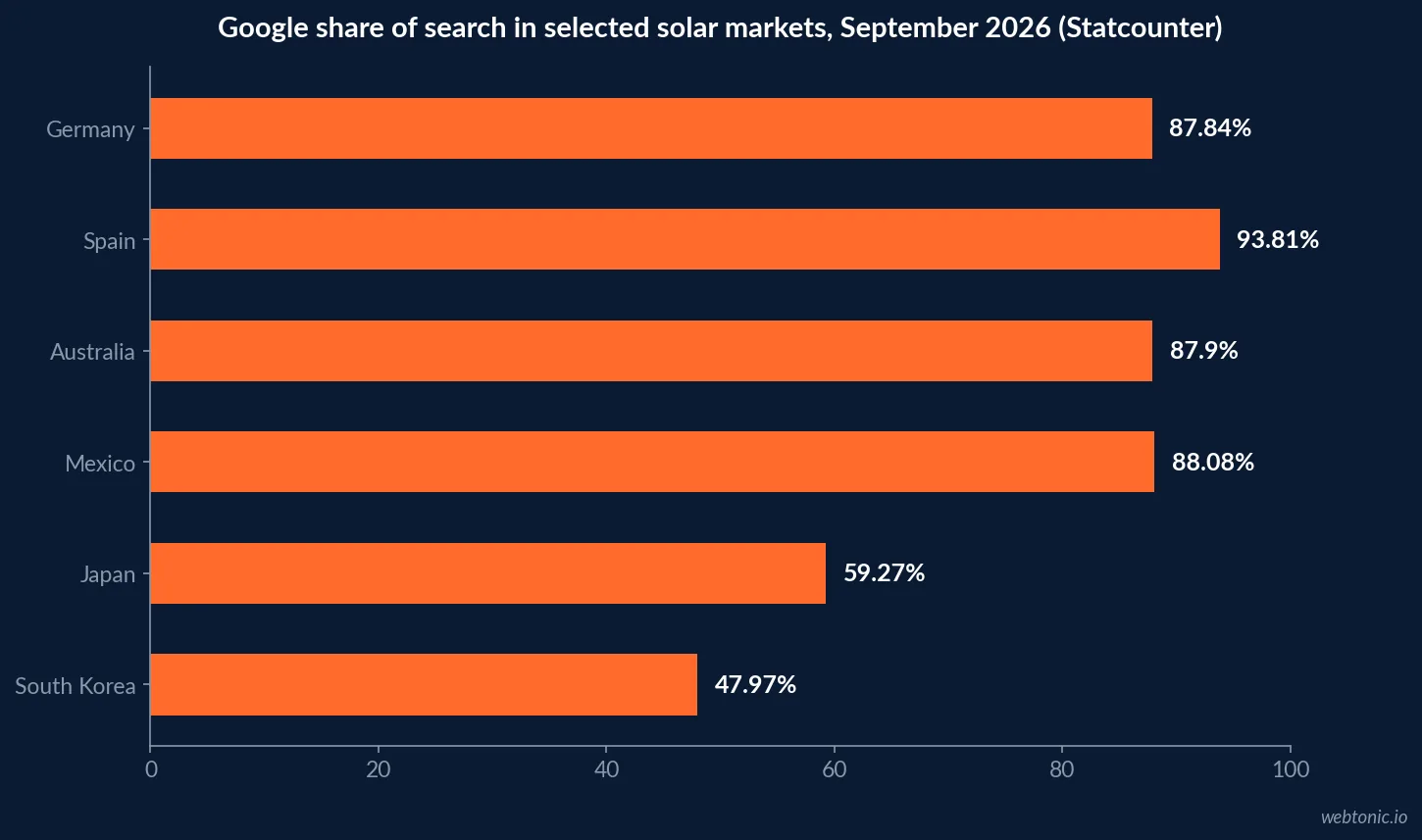
Statcounter's September 2026 data shows Google above 85% in most Western solar markets: 93.81% in Spain, 87.84% in Germany, 87.9% in Australia and 88.08% in Mexico. Two large Asian markets break the pattern: Japan, where Bing takes 31.41% against Google's 59.27%, and South Korea, where Naver holds 43.06%. In China, Baidu leads at 46.65%.
For a manufacturer, that is a concrete to-do list: Bing Webmaster Tools for Japan, Naver registration for Korea and a separate strategy for China. For a US installer, it is background.
| Country | Leading engine | Second engine | Third engine |
|---|---|---|---|
| Spain | Google 93.81% | Bing 3.49% | Yahoo 1.92% |
| Germany | Google 87.84% | Bing 6.49% | Yahoo 1.71% |
| Japan | Google 59.27% | Bing 31.41% | Yahoo 7.61% |
| South Korea | Google 47.97% | Naver 43.06% | Bing 4.83% |
| China | Baidu 46.65% | Bing 21.76% | Yandex 14.98% |
A manufacturer's view: how international revenue shifts
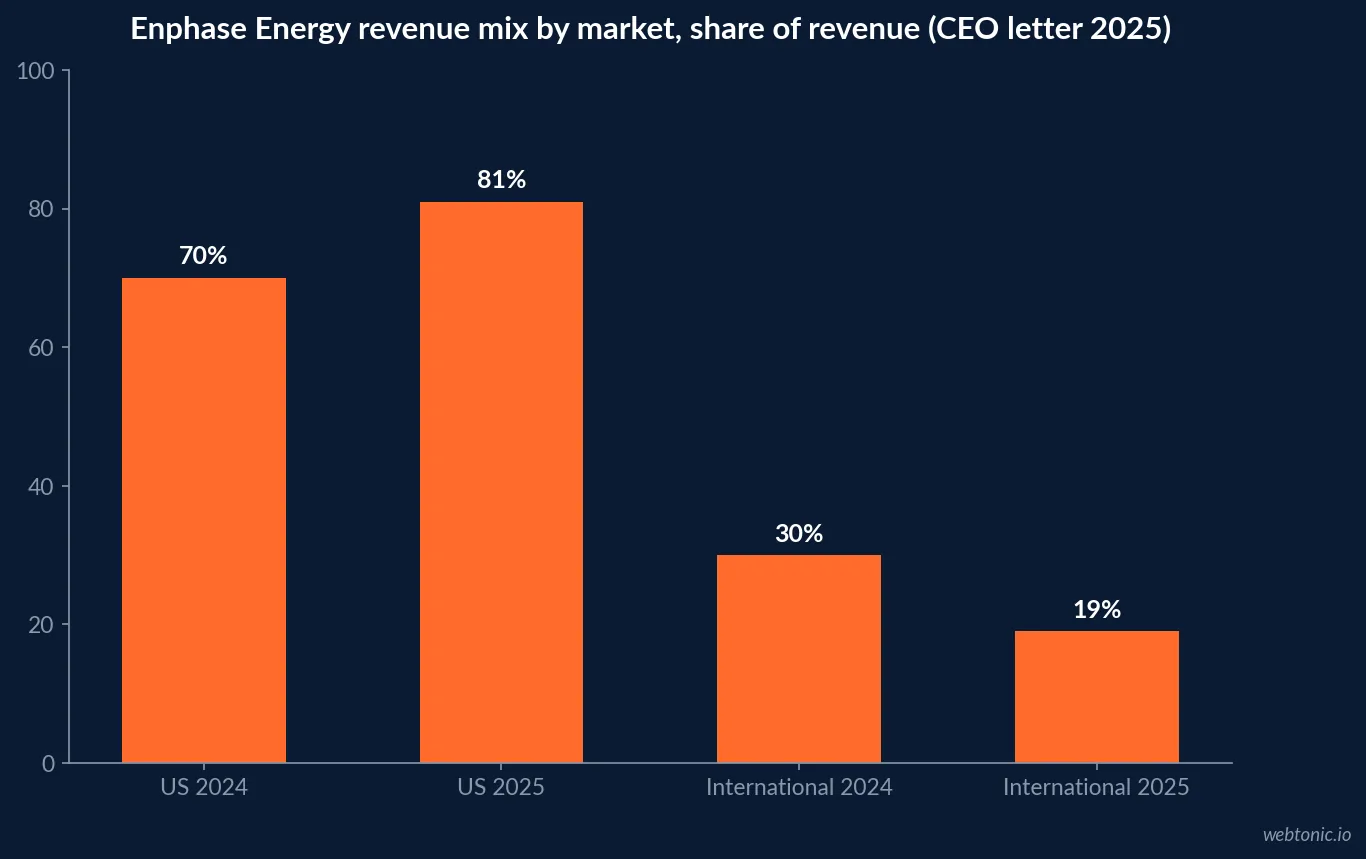
Enphase Energy's 2025 shareholder letter gives a rare company-level split: "In 2025, 81% of revenue came from the United States and 19% from international markets, compared with 70% and 30% in 2024." The company adds that it wants "a more balanced global business over time" but "will not force that balance by chasing weak demand".
That swing matters for search planning. Country sites cannot be switched on and off with demand; their rankings take time to build. A manufacturer whose foreign share falls from 30% to 19% in one year still needs its German, Spanish or Australian pages maintained so they are ready when demand returns.
The US home market an installer actually serves
SEIA's Q3 2026 Solar Market Insight reports that the US installed 11.4 GWdc in Q2 2026, up 45% year over year, "driven almost entirely by utility-scale" volume. Residential installed 995 MWdc, down 12% year over year, as the market adjusts to the end of the Section 25D residential credit after 2025; commercial installed 638 MWdc, up 11%, and community solar 231 MWdc, down 14%.
With residential volume shrinking, installers compete harder for the same homeowners, which is where language pages come in. The US Census Bureau reports that 78.3% of residents aged 5 and older speak only English at home; Spanish is 61.1% of other-language use.
| US segment (SEIA, Q2 2026) | Installed | Year over year | Search implication |
|---|---|---|---|
| All segments | 11.4 GWdc | +45% | Growth is utility-scale, not rooftop |
| Residential | 995 MWdc | -12% | Tighter competition for homeowner queries |
| Commercial | 638 MWdc | +11% | B2B pages by sector and state |
| Community solar | 231 MWdc | -14% | Subscriber pages, often bilingual |
Languages: what the web already covers
W3Techs reported on October 1, 2026 that 49.5% of websites with a known content language use English, against 6.0% Spanish, 5.9% German and 4.9% Japanese. Buyers still want their own language: CSA Research found in 2020 that 76% of 8,709 online shoppers in 29 countries prefer product information in their native language.
Google's localized versions guide is the mechanism for serving those versions: reciprocal hreflang tags, because "if two pages don't both point to each other, the tags will be ignored", and an x-default fallback for unmatched languages.
Country priorities by company type
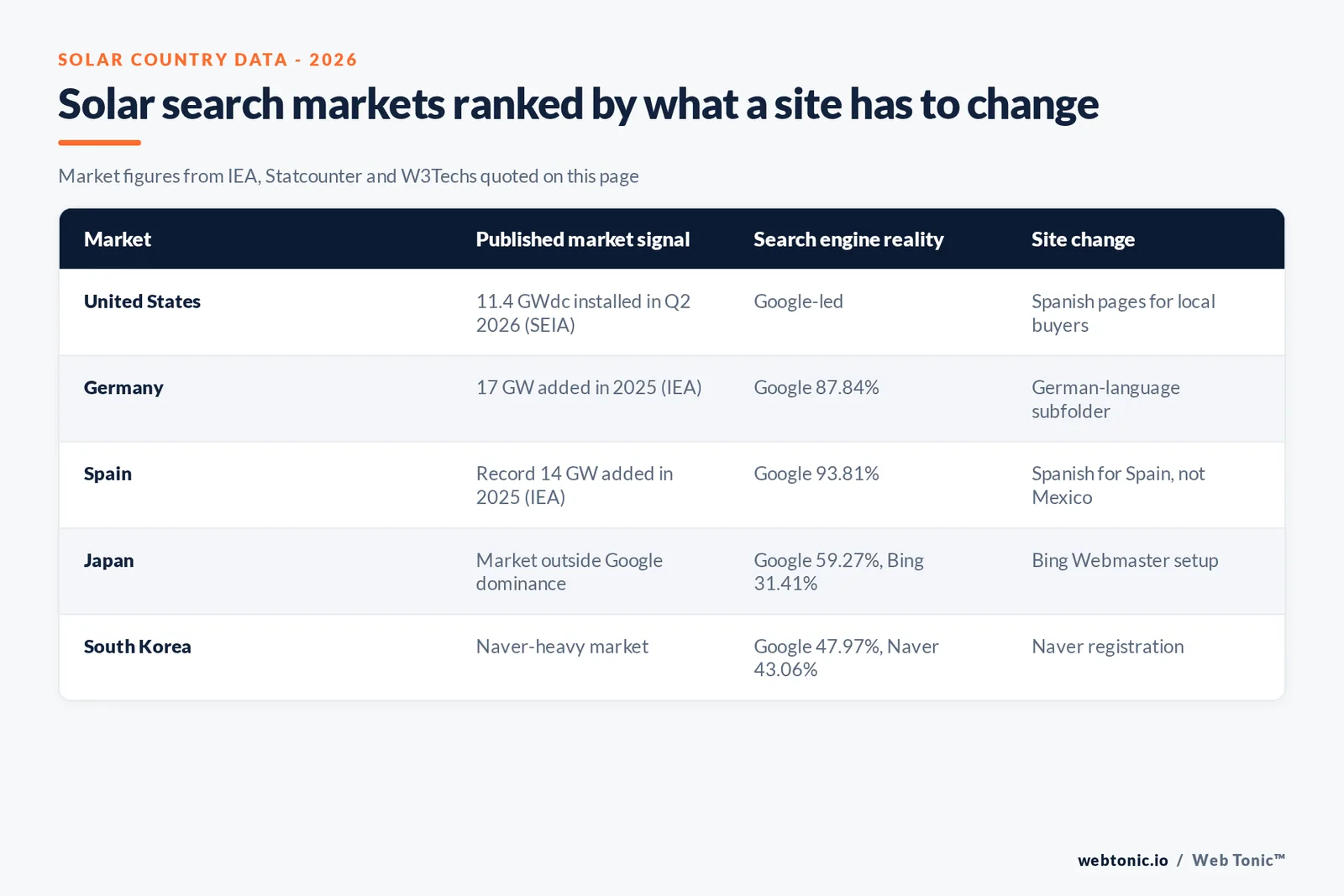
- Residential installer: Spanish service and financing pages for the home territory; no country sites.
- Regional EPC or commercial developer: state and sector pages; Spanish where crews and customers use it.
- Manufacturer selling in Europe: German and Spanish subfolders first, given 17 GW and 14 GW of 2025 additions.
- Manufacturer selling in Asia: Bing for Japan, Naver for Korea, a separate plan for China.
- Everyone: separate URLs per language, reciprocal hreflang and no IP-based redirects.
Larger installers can compare this with our solar enterprise SEO data and solar app store figures, or ask us to scope a bilingual service-area site.
What the country data cannot show
None of these sources measures search behaviour for solar. There is no published share of solar searches by language, no hreflang adoption rate among installers and no figure linking translated pages to sales. Installation data tells you where demand is; search-share and language data tell you how people look for it. The step between the two is yours to test, ideally with separate tracking per language version in Search Console so each country page reports its own impressions, clicks and leads from the first month.
Frequently Asked Questions
Does a residential solar installer need international SEO?
Rarely in the cross-border sense. An installer sells to homes within its service area, so its international work is mostly language work for local buyers. The US Census Bureau reports that 78.3% of people aged 5 and older speak only English at home, and Spanish is 61.1% of other-language use, so Spanish pages are usually the first step.
Who in solar does need multi-country sites?
Manufacturers and large developers. Enphase Energy's 2025 shareholder letter says 81% of its revenue came from the United States and 19% from international markets, against 70% and 30% in 2024. Companies with that kind of footprint need country versions, regional hreflang and local search-engine checks.
How much solar was installed worldwide in 2025?
IRENA's Renewable Capacity Statistics 2026 reports a record 510 GW of solar added in 2025, out of 692 GW of total renewable additions. The IEA's Global Energy Review 2026 puts solar PV additions above 600 GW. The two agencies use different methods and data, so quote each figure with its issuer rather than mixing them.
Which search engines matter in major solar markets?
Google leads most of them: Statcounter's September 2026 data shows 93.81% in Spain, 87.84% in Germany and 87.9% in Australia. Japan and South Korea differ: Bing holds 31.41% in Japan, and Naver 43.06% in South Korea. China, the largest solar market, is led by Baidu at 46.65%.
Should a solar brand use one Spanish page for Spain and Mexico?
Only if the offer is identical, which it rarely is. Google's localized-versions guide supports separate es-ES and es-MX versions linked with reciprocal hreflang tags, and its multi-regional guide recommends separate URLs per version. Incentives, grid rules and currency differ, so separate pages are usually justified.
Sources
IRENA - Renewable Capacity Statistics 2026
IEA - Global Energy Review 2026, solar PV and wind
IEA - Renewables 2025 executive summary
SEIA - Solar Market Insight Q3 2026
Enphase Energy - CEO letter to shareholders 2025
Statcounter - Search engine market share by country
W3Techs - Content languages for websites
US Census Bureau - Language spoken at home
Google Search Central - Multi-regional and multilingual sites
Google Search Central - Localized versions
CSA Research - Can't Read, Won't Buy B2C 2020


