



Table of contents

Key Takeaways
- Solar video content generates 3.2× more engagement than image posts and 4.6× more shares than text posts across social platforms (SurgePV).
- One solar installer's drone time-lapse reached 1.4 million YouTube views and 3.2 million views across TikTok and Instagram, generating 4,800 inquiries at $0.38 per inquiry (SurgePV).
- Video on solar landing pages increases conversion rates by up to 80% (WiFi Talents).
- 63% of renewable energy companies produce video content, but only about 1 in 6 uses video in paid advertising (Zelios Agency).
- A solar company investing $33,800 in video generated $5.1 million in attributed revenue—a 150× ROI on video marketing investment (SurgePV).
- YouTube solar educational ads have a 20% higher retention rate than text-based advertising (WiFi Talents).
Solar Video Marketing Benchmarks at a Glance
| Metric | Value | Source |
|---|---|---|
| Video engagement vs. image posts | 3.2× higher | SurgePV |
| Video shares vs. text posts | 4.6× more | SurgePV |
| Video saves vs. text posts | 5.4× more | SurgePV |
| Landing page CVR lift with video | Up to 80% | WiFi Talents |
| YouTube retention rate advantage (solar edu) | 20% higher than text ads | WiFi Talents |
| Renewable energy companies producing video | 63% | Zelios Agency |
| Companies using video in paid ads | ~17% (1 in 6) | Zelios Agency |
| Documented video marketing ROI | 150× ($33.8K → $5.1M) | SurgePV |
Video Engagement Rates for Solar Companies
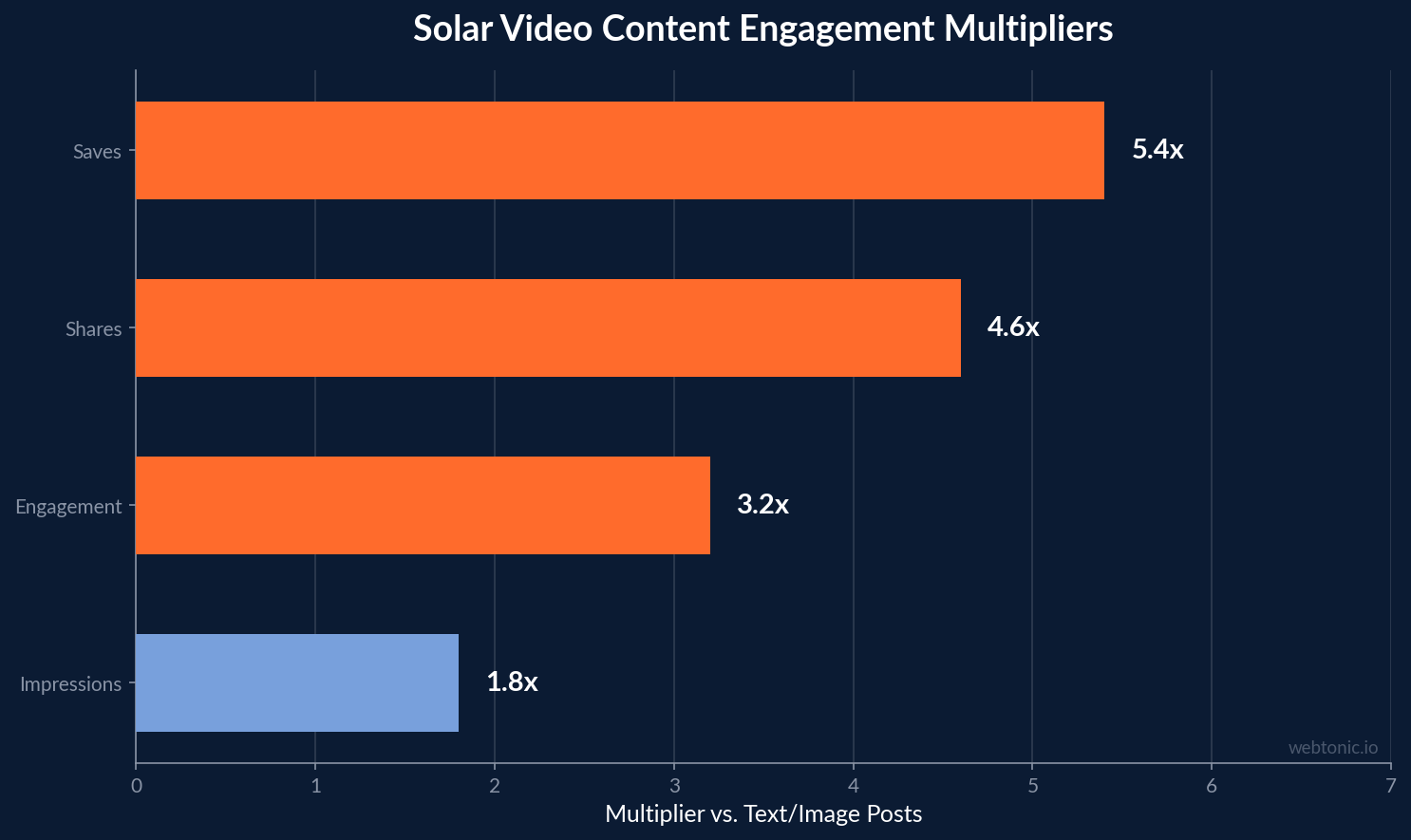
Video content dramatically outperforms every other format for solar energy marketing. Across social media platforms, solar video posts generate 3.2× more engagement than image posts, 4.6× more shares than text posts, and 5.4× more saves. These multipliers reflect the unique advantage of video in communicating solar's value proposition—showing real installations, demonstrating energy savings, and building the visual trust that high-ticket purchases require.
The data extends beyond social metrics. Video content on solar landing pages increases conversion rates by up to 80%, while YouTube solar educational content achieves a 20% higher retention rate than equivalent text-based advertising. For an industry where 85% of consumers say videos influence their purchase decisions, these engagement advantages translate directly into pipeline growth.
Impressions tell a similar story. Solar video posts generate 1.8× more impressions than text posts, extending reach significantly without additional advertising spend. This organic amplification makes video the most capital-efficient content format for solar companies building brand awareness in competitive local markets.
Video Production Costs and ROI in Solar Marketing
The ROI case for solar video marketing is among the strongest in the home services industry. A documented case study tracked a solar company that invested $33,800 in video marketing ($3,800 for equipment and $30,000 for production). Over the campaign period, video content generated $5.1 million in attributed revenue—a 150× return on investment.
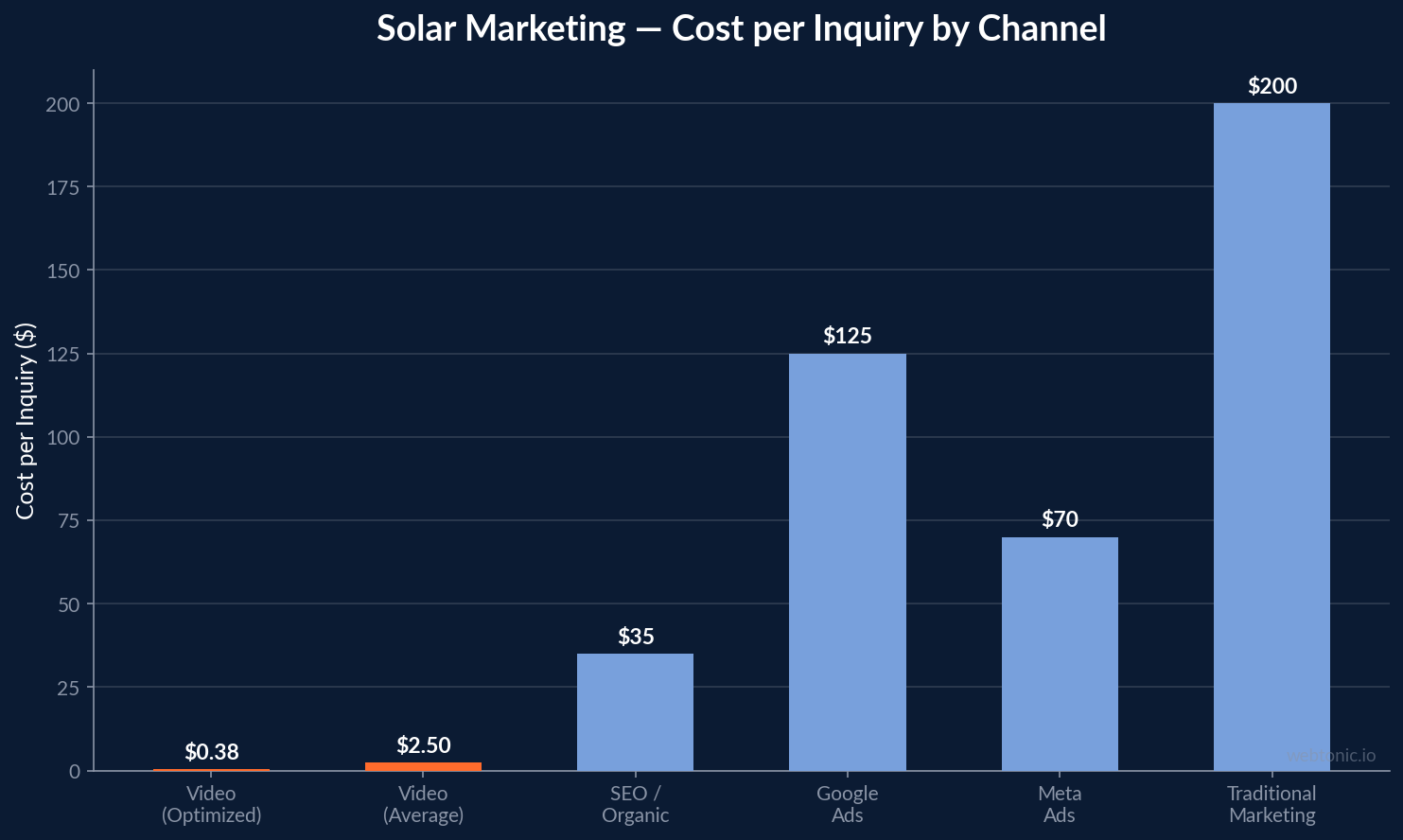
The economics at the individual video level are equally compelling. A San Diego solar installer produced a 2-minute drone time-lapse of a 14-panel installation for $1,800. That single video accumulated 1.4 million YouTube views and 3.2 million views across TikTok, Instagram Reels, and Facebook, generating an estimated 4,800 inbound inquiries over 22 months. The cost per inquiry: $0.38.
Compare this to typical solar marketing channels that deliver $50–$200 per inquiry. Video done right reaches $0.50–$5.00 per inquiry once content is distributed properly across platforms. Production costs for professional solar videos range from $200–$1,500 per video, making it accessible even for small regional installers.
Solar Video Types and Performance Data
| Video Type | Avg. Engagement | Production Cost | Best Platform | Lead Generation Impact |
|---|---|---|---|---|
| Drone installation time-lapse | Very High (1.4M+ views possible) | $800–$1,800 | YouTube | 4,800 inquiries per viral video |
| Customer testimonials | High | $200–$800 | Facebook / Website | Trust-building, 80% LP CVR lift |
| Technical explainers | Medium–High | $500–$1,500 | YouTube | 20% higher retention than text |
| Short-form (TikTok/Reels) | Very High (5.4× saves) | $50–$300 | TikTok / Instagram | Brand awareness, younger audience |
| Before/after comparisons | High | $100–$500 | Instagram / Facebook | Strong visual proof of value |
| Behind-the-scenes installs | Medium | $100–$400 | YouTube / TikTok | Trust + process transparency |
YouTube Performance Data for Solar Companies
YouTube is the second-largest search engine, and solar companies that invest in YouTube SEO generate 200–2,000+ monthly views from search-driven traffic alone. For solar installers, YouTube serves a dual function: it captures buyers in research mode and builds the long-term brand authority that drives referral traffic.
A comprehensive case study of a solar company's YouTube strategy showed 247 videos published across platforms, resulting in 4.2 million total views across YouTube, TikTok, and Instagram. The channel grew to 18,000 YouTube subscribers, generated 1,840 direct inquiries, and produced 243 acquired customers from video traffic.
Pivot Energy's YouTube channel provides another data point: their videos generated over $250,000 of earned media value from 120,000+ organic views, organically attracting hundreds of landowner leads and nurturing leads from Fortune 500 companies. The channel ranked on the first page of both YouTube and Google Search for key solar terms.
For paid YouTube advertising, industry benchmarks show energy sector ads achieving CTR rates of 0.48–0.52% with CPV costs of $0.048–$0.071 and CPM rates of $5.30–$7.10—comparable to the finance and healthcare verticals.
Short-Form Video Strategy for Solar Marketing
Short-form video (TikTok, Instagram Reels, YouTube Shorts) has emerged as a critical channel for solar companies targeting younger homeowner demographics. Solar short-form content achieves the highest save rate of any format—5.4× more saves than text posts—indicating that viewers bookmark solar content for later decision-making.
The format drives meaningful business results. Solar lead generation case studies show that Instagram Reels warm prospects before they enter the sales funnel, improving click quality when combined with paid social campaigns. Companies using reels that feel native to the platform report improved click quality because viewers understand the offer before hitting the form.
Despite its effectiveness, adoption remains low. Only about 1 in 6 renewable energy companies uses video in paid advertising, and 37.3% of renewable energy companies don't produce any video content at all. This gap represents a significant opportunity for early adopters to capture disproportionate market share through video-first social strategies.
Video Platform Performance Comparison for Solar
| Platform | Reach Potential | Lead Quality | Cost Efficiency | Best Video Length |
|---|---|---|---|---|
| YouTube | Very High (4.2M views documented) | High (1,840 direct inquiries) | High ($0.38–$5 CPI) | 2–10 minutes |
| TikTok | Very High (3.2M views on single video) | Medium (brand awareness first) | Very High (low CPM) | 15–60 seconds |
| Instagram Reels | High (warm prospect pipeline) | Medium–High | High | 15–90 seconds |
| Medium–High | Medium | Medium | 30–120 seconds | |
| Medium (B2B solar) | High (commercial leads) | Medium–High | 30–120 seconds |
Video Marketing Adoption in the Renewable Energy Industry
A comprehensive audit of 83 renewable energy companies and startups revealed important adoption patterns. 63% of renewable energy companies produce video content, with the overwhelming majority relying on organic distribution. The main business goals are typically twofold: brand awareness and lead generation.
However, the depth of video investment varies significantly. While most companies produce some video, only approximately 17% use video in paid advertising campaigns. This under-investment in paid video distribution means most solar companies are leaving significant reach and lead generation potential on the table.
The formats most commonly used by renewable energy companies include live action footage (installation processes, facility tours), animated explainers (how solar works, savings calculations), and customer testimonials. Companies that combine multiple formats across platforms see the strongest results, with one documented case producing 247 videos that drove 243 acquired customers.
Solar vs. Other Industries: Video Marketing Comparison
| Metric | Solar Energy | HVAC | Roofing | General Average |
|---|---|---|---|---|
| Video engagement multiplier | 3.2× vs. images | 2.5× vs. images | 2–3× vs. images | 2.5× vs. images |
| Landing page CVR lift with video | Up to 80% | 60–75% | 70–80% | 80% (general) |
| Video production cost range | $200–$1,500 | $200–$1,200 | $200–$1,000 | $200–$1,500 |
| YouTube ad CPV | $0.048–$0.071 | $0.04–$0.06 | $0.03–$0.05 | $0.03–$0.07 |
| Companies producing video | 63% | 45–55% | 40–50% | 91% (all businesses) |
| Companies using video in paid ads | ~17% | 20–30% | 15–25% | ~40% |
Measuring Video Marketing ROI for Solar Companies
Attribution remains the biggest challenge in solar video marketing. The typical solar purchase consideration cycle spans 3–6 months, meaning a prospect might watch a YouTube video in January and not request a consultation until April. Without proper attribution infrastructure, companies undercount video's contribution to their pipeline by 40–60%.
The most effective measurement frameworks for solar video marketing track multiple touchpoints:
- View-through attribution — tracking prospects who watched a video and later converted through a different channel within 30–90 days
- UTM-tagged video descriptions — every YouTube description and social post should include trackable links to landing pages
- "How did you hear about us?" surveys — post-consultation surveys capture video influence that digital tracking misses
- Phone call tracking — connecting video-driven calls to the specific content that prompted them
Companies that implement comprehensive video attribution consistently discover that video influences 2–3× more conversions than last-click attribution suggests. This data is critical for justifying continued video investment to stakeholders who expect measurable ROI from every marketing channel.
Video Marketing Best Practices for Solar Companies
- Start with drone installation time-lapses — they have the highest viral potential and lowest production-to-impact ratio. A single $1,800 video generated 4,800 inquiries at $0.38 each.
- Distribute across all platforms simultaneously — the same installation footage can be edited into a 2-minute YouTube video, a 30-second Reel, and a 15-second TikTok. Cross-platform distribution multiplied one video's reach from 1.4M to 4.6M total views.
- Add video to every landing page — with conversion rate lifts of up to 80%, video on paid traffic landing pages is the single highest-impact CRO change solar companies can make.
- Track hook rate in the first 3 seconds — monitor thumb-stop rate, completion rate, CTR, and landing page conversion rate, then connect those metrics to appointments and signed deals.
- Invest in paid video distribution — with only 17% of renewable energy companies using video in paid ads, early adopters have a significant competitive advantage in ad platforms' auction dynamics.
- Budget $200–$1,500 per video initially — production costs are accessible even for small installers. Focus on authenticity over polish: owner-on-camera and real installation footage outperform studio-produced content.
- Build a YouTube channel as a long-term asset — channels with 200+ videos can generate thousands of monthly leads organically, creating a compounding return that paid channels cannot match.
Related reading
- How Solar Energy Businesses Use Ad Creative in 2026: Stats & Insights
- Solar Energy Branding: 52+ Statistics & Benchmarks (2026)
- The State of Video Marketing in Manufacturing: 2026 Stats & Trends
- Branding services at Web Tonic
FAQ
How effective is video marketing for solar companies?
Extremely effective. Solar video content generates 3.2× more engagement than image posts and can increase landing page conversion rates by up to 80%. One solar company invested $33,800 in video and generated $5.1 million in attributed revenue—a 150× ROI.
What types of videos work best for solar marketing?
The highest-performing formats are drone installation time-lapses (up to 4.6M+ cross-platform views), customer testimonials (trust-building and 80% CVR lift on landing pages), and technical explainers (20% higher retention than text ads). Short-form content on TikTok and Reels drives 5.4× more saves than text content.
How much does solar video marketing cost?
Production costs range from $200–$1,500 per video. A comprehensive video strategy with gear and production budget runs approximately $33,800, but individual high-impact videos can be produced for as little as $1,800. The cost per inquiry from well-distributed solar video content drops to $0.38–$5.00, far below the $50–$200 typical of other marketing channels.
Should solar companies invest in YouTube?
Yes. YouTube is the second-largest search engine, and solar companies ranking there generate 200–2,000+ monthly views from search traffic alone. Documented results include 18,000 subscribers, 4.2 million views, and 243 acquired customers from a single company's YouTube strategy. Pivot Energy generated $250,000+ in earned media value from organic YouTube content.
What percentage of solar companies use video marketing?
63% of renewable energy companies produce video content, but only about 17% use video in paid advertising. Meanwhile, 37.3% produce no video at all. This adoption gap means early movers can capture disproportionate attention and leads through video-first strategies.
Sources
SurgePV — Video Marketing for Solar Installers 2026
Zelios Agency — How 80+ Renewable Energy Companies Use Video Marketing
WiFi Talents — Marketing in the Solar Industry Statistics 2026
Invention Solar — Solar Lead Generation Case Study
Energy Circle — Solar Video Marketing Case Study
GroupHugs — Pivot Energy YouTube Success Story
Dataslayer — YouTube Ads Performance Benchmarks 2026
ResultCalls — Double Solar Leads Using YouTube


