Table of contents
Key Takeaways
- Top-ranking solar pages carry an average domain rating (DR) of 54–71, up from DR 48 just two years ago (Link Building Journal).
- A quality backlink costs $508.95 on average in 2026, a 45% increase since 2022 (AFFiNCO).
- One solar installer grew DR from 18 to 44 (+144%) in 12 months through a focused off-page campaign, increasing organic leads by 211% (Aperture Expert).
- .gov and .edu backlinks are 4–6× more impactful in the energy sector than general domains (Authority Specialist).
- 96.55% of all web pages have zero external backlinks, meaning even a modest link profile gives solar businesses a measurable advantage (AFFiNCO).
- Long-form solar ROI content generates 77% more backlinks than short-form pages (WiFi Talents).
- Top-tier solar companies average 612 referring domains, versus 147 for mid-tier and 28 for lower-ranked competitors (Link Building Journal).
Solar Link Building Benchmarks at a Glance
| Metric | Value | Source |
|---|---|---|
| Avg. cost per quality backlink | $508.95 (up 45% since 2022) | AFFiNCO |
| Avg. DR of top-10 solar pages | DR 54–71 | Link Building Journal |
| Referring domains — top-tier solar sites | 612 avg. | Link Building Journal |
| Referring domains — mid-tier solar sites | 147 avg. | Link Building Journal |
| .gov/.edu link impact multiplier | 4–6× vs. general domains | Authority Specialist |
| Pages with zero backlinks (all web) | 96.55% | AFFiNCO |
| SEO teams spending $3K+/mo on links | 64% | AFFiNCO |
| SEO pros reporting positive link building ROI | 78.1% | AFFiNCO |
Domain Authority Benchmarks for Solar Energy Companies
Domain authority has become the single most reliable predictor of organic visibility for solar energy websites. A 2026 analysis of 240+ renewable energy operators found that the average DR of top-10 ranking pages for high-intent commercial queries rose from DR 54 to DR 71 between 2022 and 2026. That shift reflects aggressive link acquisition by well-funded national installers, raising the bar for smaller competitors.
The gap between tiers is dramatic. Top-tier solar companies average 612 referring domains, with an average DR of 71. Mid-tier operators sit at 147 referring domains and DR 48, while lower-ranked sites average just 28 referring domains and DR 28. The practical takeaway: solar businesses targeting competitive commercial queries need at minimum 150+ referring domains to consistently appear on page one.
One case study tracked a Southwest US solar installer that grew from DR 18 to DR 44 in 12 months, expanding referring domains from 85 to 512 (+502%). The result was a 211% increase in organic lead volume and 225% more appearances in the local map pack for "solar panel installation" queries.
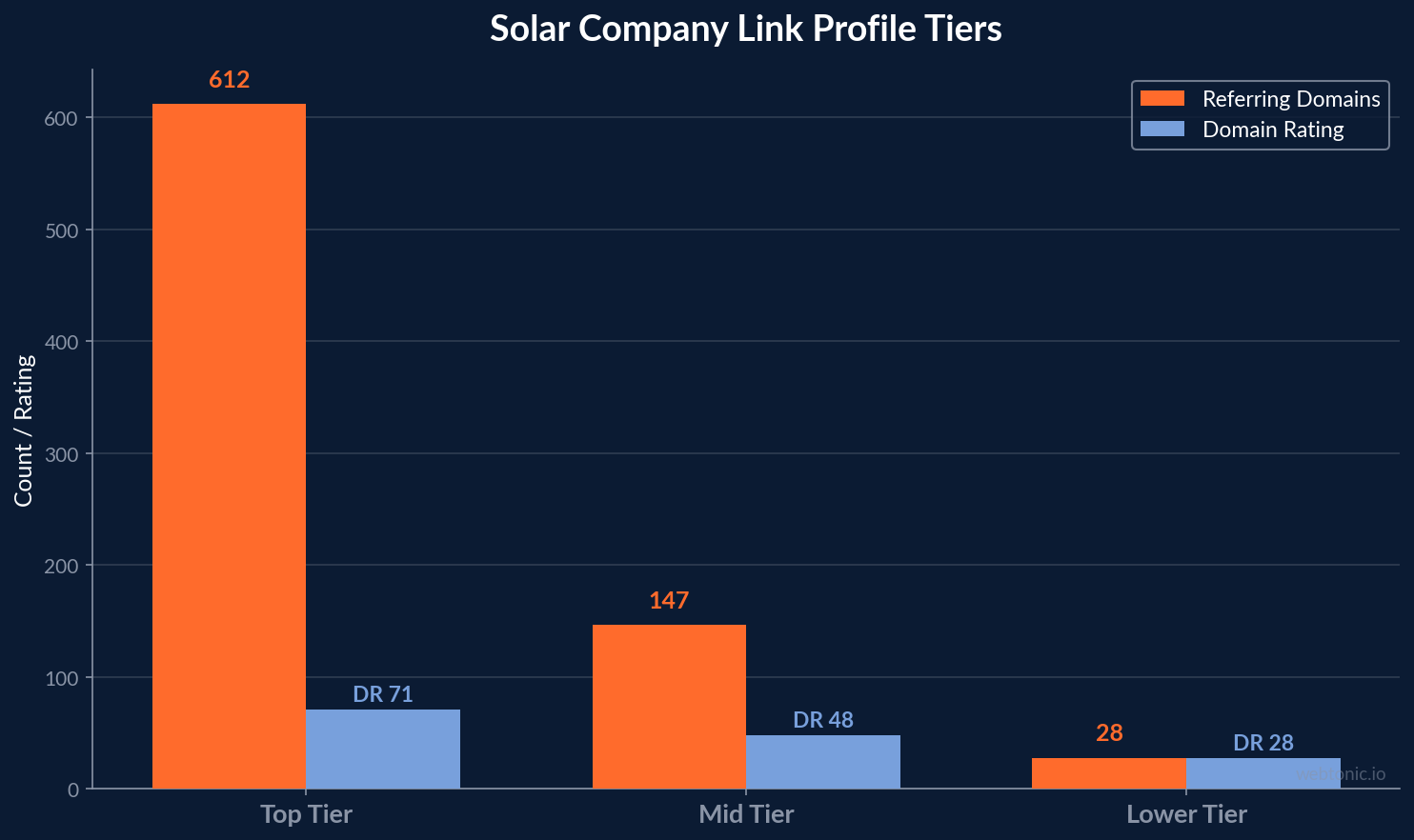
Solar Company Link Profile Tiers
| Tier | Avg. Referring Domains | Avg. DR | Editorial Placements (12 mo) | Research Pieces Published |
|---|---|---|---|---|
| Top Tier | 612 | DR 71 | 28 | 3.4 |
| Mid Tier | 147 | DR 48 | 4 | 0.4 |
| Lower Tier | 28 | DR 28 | 0 | 0 |
Link Building Costs and ROI for Solar Businesses
Link building has never been cheap, and 2026 pricing reflects a maturing market. The average cost per quality backlink reached $508.95 this year, up 45% from 2022 levels. For solar companies competing in high-CPC verticals where Google Ads clicks routinely exceed $10–$25 per click, that investment often delivers superior long-term returns through compounding organic traffic.
64% of SEO teams now spend $3,000 or more per month on backlink acquisition. At the higher end, solar-specific digital PR campaigns—which generate editorial coverage in energy trade publications and mainstream news outlets—can cost $5,000–$15,000 per placement but deliver links with DR 60+ that move rankings measurably.
The ROI data is compelling: 78.1% of SEO professionals report satisfying ROI from link building, with top performers citing returns up to 748%. In the solar industry specifically, companies that invested in sustained link building over 12 months saw organic lead costs 60–80% lower than equivalent paid acquisition channels.
Most Effective Link Types for Solar Energy SEO
Not all backlinks carry equal weight in the renewable energy vertical. Research across 240+ solar operators identified clear patterns in which link types correlate with ranking improvements.
- Editorial trade-press placements — top-tier solar sites average 28 editorial placements per year in publications like Solar Power World, PV Magazine, and Greentech Media. These links carry DR 60–80 and provide both authority and referral traffic.
- .gov and .edu citations — government and academic backlinks are 4–6× more impactful in the energy sector because Google weights YMYL (Your Money, Your Life) trust signals heavily for high-ticket purchase decisions.
- Original data and research — companies publishing original research (solar savings calculators, regional cost data, ROI analyses) earn 77% more backlinks than those relying on standard service pages.
- Trade association directory listings — top-tier solar sites claim an average of 9.1 trade association listings, compared to 3.2 for mid-tier and 1.1 for lower-ranked competitors.
- Local and geographic links — for regional installers, links from local chambers of commerce, community organizations, and hyperlocal news sites provide a dual signal of local relevance and topical authority.
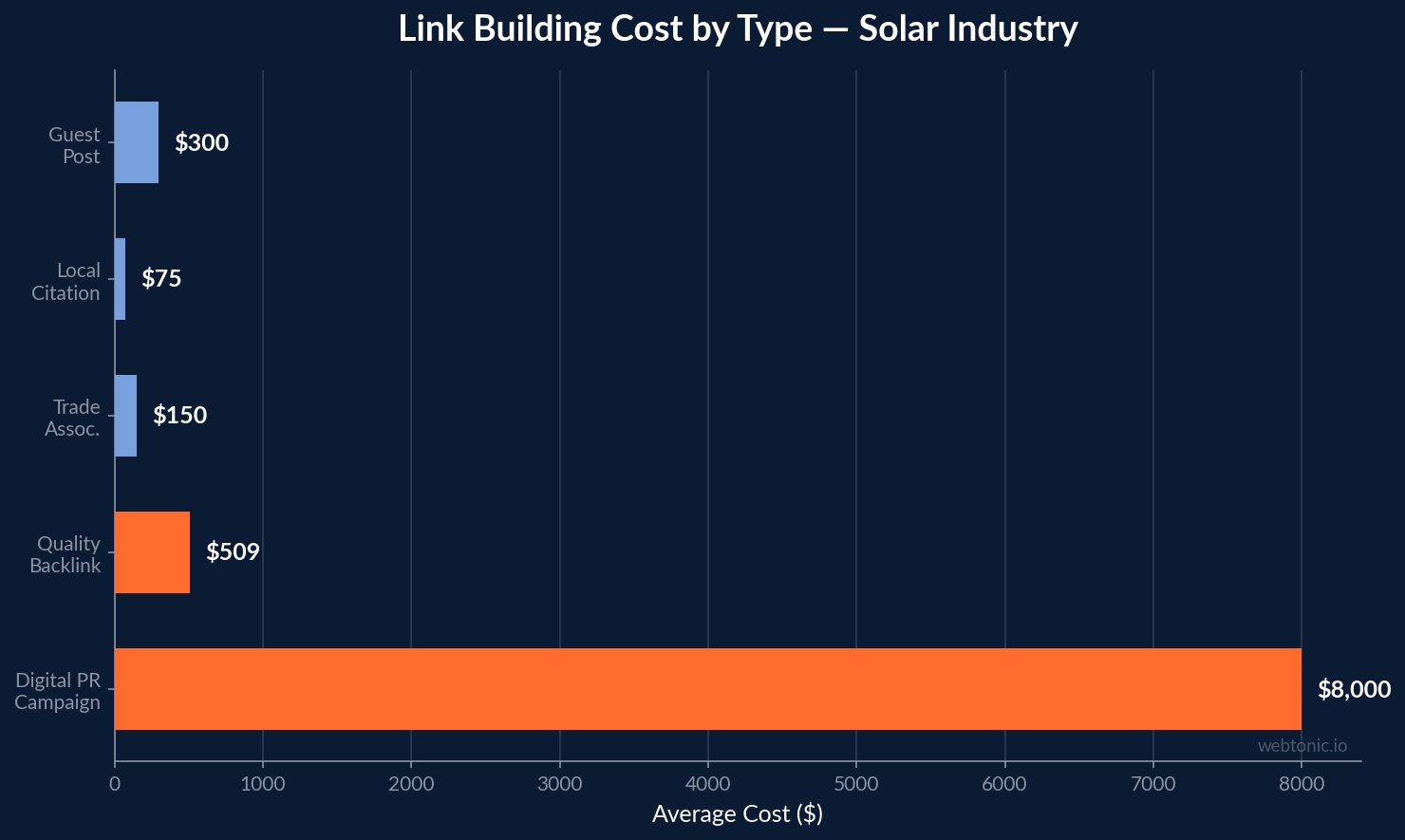
Link Type Effectiveness in Solar Energy SEO
| Link Type | Avg. DR of Source | Ranking Impact | Difficulty to Acquire |
|---|---|---|---|
| Editorial trade-press | DR 60–80 | High | High |
| .gov / .edu citations | DR 70–90 | Very High (4–6× multiplier) | Very High |
| Original data / research | DR 40–70 | High (77% more links) | Medium |
| Trade association directories | DR 30–60 | Medium | Low |
| Local / geographic citations | DR 20–45 | Medium (local pack) | Low–Medium |
| Guest posts on energy blogs | DR 25–50 | Medium | Medium |
| Digital PR campaigns | DR 50–80 | High | High (cost-intensive) |
Content Marketing as a Link Earning Strategy for Solar
The intersection of content marketing and link building is where solar companies find the highest leverage. 80% of solar companies use content marketing to educate prospects, but only a fraction create content specifically designed to attract backlinks. Companies that do—publishing original research, regional cost data, and solar savings calculators—earn 77% more backlinks than those producing generic service pages.
The data is clear about what content attracts links in the solar vertical. Long-form ROI-focused content generates the most natural links, followed by interactive tools (savings calculators, system sizing tools) and original data publications (regional installation costs, performance benchmarks). Trade publications and energy journalists consistently link to companies that publish first-party data and quantitative research.
Content-driven link acquisition also produces secondary benefits: improved topical authority, increased brand mentions (which correlate with AI search visibility at 0.664), and organic referral traffic from the linking publications. For solar companies willing to invest in sustained content production, link earning through content is the most scalable and sustainable approach to building domain authority.
Solar Link Building Case Study Results
Documented case studies from 2024–2026 show consistent patterns in what link building achieves for solar companies.
A residential solar installer in Arizona, Nevada, and New Mexico ran a 12-month off-page SEO campaign focused on high-authority link acquisition and hyper-local citation clusters. The results:
- Domain Rating increased from 18 to 44 (+144%)
- Referring domains grew from 85 to 512 (+502%)
- Total backlinks expanded from 420 to 1,850 (+340%)
- Monthly organic leads increased by 211%
- Google Business Profile interactions grew by 165%
A separate case study documented a 98.5% increase in organic pageviews for a solar energy company after a targeted link building campaign. The target page saw a 4-point improvement in Page Authority, a 64% increase in organic keywords, and a 102% increase in referring domains over one year.
Another commercial solar company achieved a 228% increase in organic conversions and a 123.5% increase in organic sessions through a combined content and link building strategy.
Link Building and AI Search Visibility
The relationship between backlinks and search visibility is evolving with AI-powered search features. While backlinks remain one of Google's top three ranking factors, new data shows that brand mentions correlate with AI Overview visibility at 0.664, compared to just 0.218 for raw backlinks. This means solar companies investing in digital PR and brand-building content see disproportionate benefits in AI search results.
73.2% of SEO professionals believe backlinks influence AI search results, and the evidence supports this: sites with strong link profiles are more likely to be cited in Google's AI Overviews and featured snippets. For solar companies, this makes link building doubly important—it drives both traditional organic rankings and visibility in AI-generated answers to queries like "best solar panels for my home" or "solar installation costs in [city]."
Domain harmonic centrality—a measure of how well-connected a site is within the broader web graph—shows a +0.216 correlation with search rankings for residential solar installers, accounting for roughly 4.7% of the ranking model.
Link Building Best Practices for Solar Companies
- Publish original research and data — solar savings calculators, regional cost breakdowns, and installation data attract natural links from journalists and bloggers. Companies publishing original research earn 77% more backlinks than those without.
- Invest in digital PR over guest posting — 48.6% of SEO professionals now rank digital PR as the most effective link building tactic, surpassing guest posting for the first time.
- Target .gov and .edu links — while harder to acquire, these carry 4–6× the ranking impact in the energy sector and build trust signals critical for high-ticket solar purchases.
- Claim all relevant trade association listings — top-performing solar sites average 9.1 association listings, providing both backlinks and referral leads.
- Build geographic link clusters — for regional installers, links from local chambers of commerce, community solar programs, and hyperlocal news sites strengthen local search presence and support map pack rankings.
- Budget $3,000–$10,000/month for sustained campaigns — one-off link purchases rarely move the needle. The most successful solar companies maintain consistent 12+ month link building programs.
- Monitor link quality, not just quantity — links below $80–$100 carry quality risk, and solar companies should prioritize DR 40+ sources over high-volume low-authority placements.
Solar Energy vs. Other Industries: Link Building Comparison
| Metric | Solar Energy | HVAC | Roofing | All Industries Avg. |
|---|---|---|---|---|
| Avg. DR to rank page 1 | 54–71 | 35–50 | 30–45 | 40–55 |
| Avg. cost per quality link | $500–$700 | $400–$600 | $350–$500 | $508.95 |
| Referring domains (top tier) | 612 | 250–400 | 200–350 | 300–500 |
| .gov/.edu link impact | 4–6× multiplier | 2–3× | 2–3× | 2–4× |
| Content that earns links | ROI calculators, data | Seasonal guides | Storm damage data | Varies |
| Link building ROI timeline | 6–12 months | 4–8 months | 4–8 months | 6–10 months |
The renewable energy link building landscape continues to evolve rapidly. Solar companies pursuing strategic backlink acquisition should focus on energy sector publications, sustainability platforms, and regional business directories. Building topical authority through consistent off-page signals remains the most reliable path to sustained organic visibility for solar installation and consulting businesses.
Competitive analysis of solar company backlink profiles reveals significant variance in link quality across the industry. Companies that prioritize editorial coverage and data-driven content creation over mass outreach consistently achieve higher domain authority growth rates and more stable search engine rankings over time.
Related reading
- Pool Building Link Building Statistics: Costs, Tactics & ROI Data
- Rehab & Addiction Treatment Link Building Statistics (2026)
- Roofing Link Building Statistics (2026): Backlinks, DA & Citation Data
- Link Building Services services at Web Tonic
FAQ
How many backlinks does a solar company need to rank on page one?
The data shows that top-tier solar companies average 612 referring domains, but you do not need that many to start seeing results. A realistic first-year goal is 150+ referring domains from DR 30+ sources. The key is quality over quantity—a solar installer in the Southwest grew from 85 to 512 referring domains in 12 months and saw a 211% increase in organic leads.
What is the average cost of a backlink for a solar energy company?
A quality backlink averages $508.95 in 2026, up 45% since 2022. Solar-specific editorial placements in energy trade publications can cost $5,000–$15,000 per placement but deliver DR 60+ links that significantly move rankings. Budget at least $3,000–$10,000 per month for a meaningful link building program.
Do backlinks still matter for solar SEO in 2026?
Yes. Backlinks remain one of Google's top three ranking factors. Pages with at least one backlink are 77% more likely to rank in the top 10. Additionally, 73.2% of SEO professionals believe backlinks influence AI search results, and brand mentions—often generated through link building campaigns—correlate with AI Overview visibility at 0.664.
What types of backlinks work best for solar companies?
The most impactful links for solar companies are editorial placements in energy trade press (DR 60–80), .gov and .edu citations (4–6× impact multiplier), and original research-driven links (77% more backlinks than standard content). Trade association directory listings and local geographic citations also contribute meaningfully to rankings.
How long does it take for link building to show results in the solar industry?
Most solar companies see measurable ranking improvements within 6–12 months of sustained link building. Case studies show that a focused 12-month campaign can produce a 144% increase in domain rating and a 211% increase in organic leads. The compounding effect means results accelerate after the initial investment period.
Sources
Link Building Journal — Link Building for Solar, EV, and Renewable Energy Sites
Aperture Expert — Off-Page SEO for Solar: Local Authority Strategy
AFFiNCO — Link Building Statistics 2026
Authority Specialist — Energy SEO Benchmarks 2026
Sure Oak — Solar Energy SEO Case Study
WiFi Talents — Marketing in the Solar Industry Statistics 2026
BacklinkGrid — Link Building Statistics & Benchmarks 2026
OppAlerts — Residential Solar Installers AI Search Visibility
RankPill — SEO for Solar: The Complete 2026 Guide