Table of contents

Type "best running shoes" into Google and count how far you scroll before you hit a plain blue link. Chances are you'll pass a row of shopping ads, a knowledge panel, a People Also Ask box, and maybe a video carousel first. That crowded page is the new normal, and it's exactly what this guide means by SERP features.
If your keyword strategy still assumes ten blue links and nothing else, you're optimizing for a search engine results page that stopped existing years ago. This guide breaks down what SERP features are, the most common types you'll run into, why they matter for SEO, and how to actually optimize your content to appear in them.
Key Takeaways
- SERP features are any search result element that isn't a standard organic listing, including featured snippets, the local pack, knowledge panels, People Also Ask, and image or video carousels.
- Nearly all first-page results now include at least one SERP feature, which means treating organic rankings as the only prize is a losing strategy.
- Rich results, sometimes still called rich snippets, consistently out-click plain organic listings, and features like featured snippets and the local pack can meaningfully change how much traffic a given ranking position actually delivers.
- Structured data (schema markup) is the technical lever behind most rich results, and the majority of first-page pages already use it.
- Winning a SERP feature usually means answering one specific search query clearly, not writing a longer article.
- A complete Google Business Profile is required for local pack visibility, regardless of how strong your organic rankings are.
What Are SERP Features?
SERP features are the elements on a Google search engine results page that sit outside the standard list of ten organic links. A modern Google SERP can stack a dozen of these elements around a handful of organic search listings, and other search engines are moving in a similar direction. SERP stands for "search engine results page," and Google itself refers to these elements as "search result features." They include featured snippets, knowledge panels, the local pack, People Also Ask boxes, top stories, image and video carousels, and shopping results, among others.
Google's own Search Central documentation on featured snippets and how they work confirms that these boxes reverse the usual order of a search result, showing the descriptive snippet before the link rather than after it, and that Google's systems, not the site owner, decide when a page qualifies. That single detail explains most of the frustration SEOs feel with SERP features: you can build content that's structurally ready to appear in one, but you can't request or purchase the placement.
Why SERP Features Matter for SEO
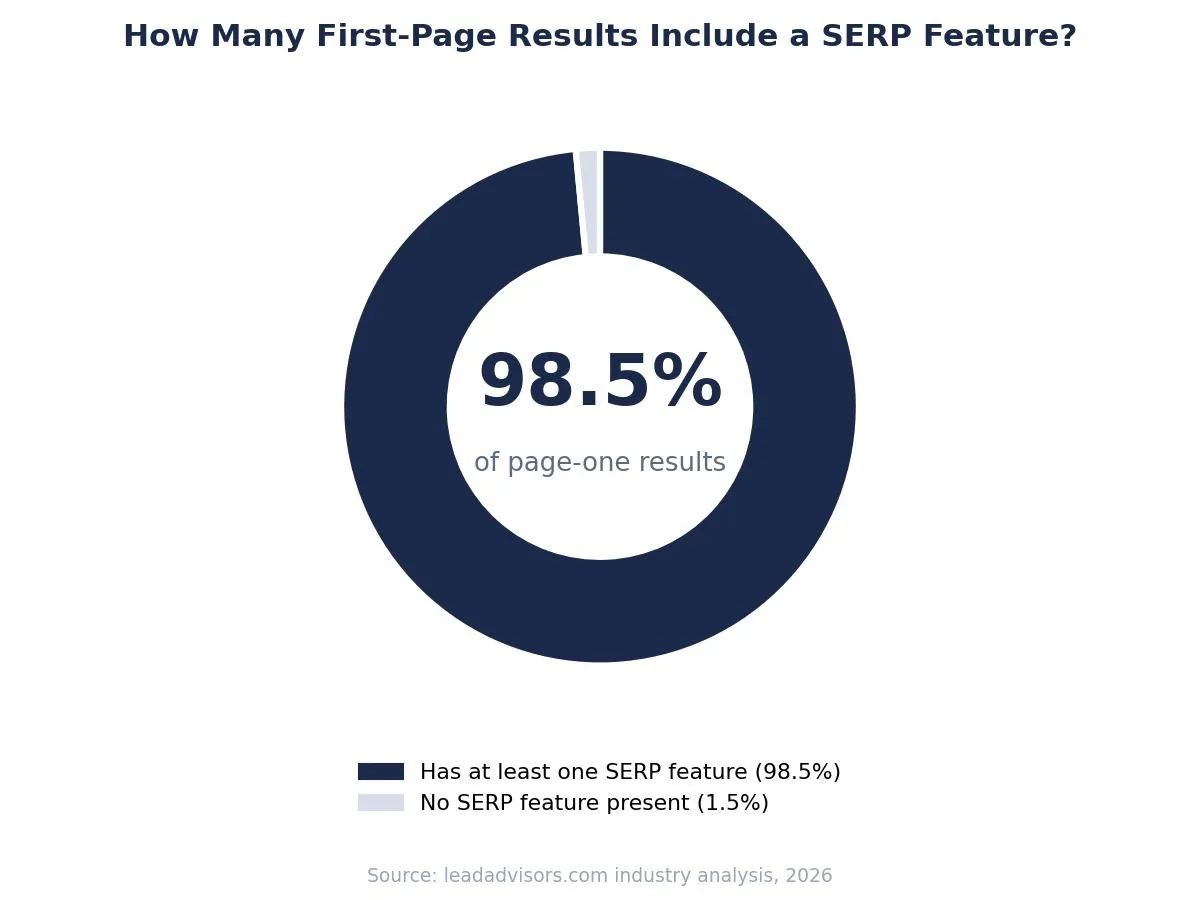
The scale of the shift is the part most site owners underestimate. According to a recent industry analysis, only about 1.5 percent of Google's first-page results now appear with no SERP feature of any kind on the page, meaning roughly 98 percent of first pages include at least one. Optimizing purely for organic position ten while ignoring everything Google now layers around it leaves most of the page's real estate uncontested.
That matters because SERP features change click behavior, not just page layout. The same analysis found that rich results capture roughly 58 percent of clicks compared with 41 percent for standard listings, and that featured snippets can push click-through rate above 40 percent for the query they answer. A separate breakdown of click-through rate data by ranking position found that position one on Google carries a 31.7 percent CTR when no SERP features are present on the page, but drops to 19.4 percent when the full range of possible features is showing. In other words, the exact same ranking position can be worth close to half as much traffic depending on what else appears around it.
A high organic ranking with no SERP feature presence is no longer a guarantee of strong click-through rate. That's the practical reason SERP feature strategy has become part of core SEO work rather than a side project.
The Most Common Types of SERP Features

Not every SERP feature behaves the same way, and each one is triggered by a different kind of search query. Here's a breakdown of the ones you'll encounter most often.
Featured snippets
A featured snippet is a highlighted box, usually near the top of the results, that pulls a paragraph, list, or table directly from a ranking page to answer the query outright. Google can format a featured snippet as a paragraph, numbered list, bulleted list, or table depending on what the query and the source content look like. Featured snippets often appear inside or alongside a People Also Ask ("PAA") group of related questions.
Knowledge panels
A knowledge panel is the information box, typically on the right side of desktop results, that summarizes facts about an entity: a person, place, organization, or brand. Knowledge panels are built from Google's knowledge graph and often pull structured facts from sources like Wikipedia, official websites, and verified profiles, rather than from any single ranking article. Google's own guidance on establishing business details confirms that claiming and verifying a Business Profile is one of the direct ways a business can feed accurate information into its own knowledge panel.
The local pack
The local pack (sometimes called the "map pack" or "3-pack") shows three local business listings alongside a Google Maps snippet whenever Google detects local search intent, such as "plumber near me" or "best pizza in Chicago." A breakdown of how the local pack ranking works notes that Google weighs three factors to fill those three spots: relevance to the query, physical distance from the searcher, and the business's overall prominence, including review volume and rating. Appearing here depends far more on a complete Google Business Profile and reviews than on the website's own organic content.
People Also Ask
A People Also Ask box lists related questions that expand into short answers when clicked, usually pulled from different ranking pages than the main organic result. PAA boxes tend to grow the longer a searcher interacts with them, surfacing new related questions each time one is expanded.
Top stories and Google News
The top stories carousel surfaces recent, timely articles, typically sourced from Google News-eligible publishers, for queries with a clear news angle.
Shopping and merchant listings
Shopping results, often powered by product feeds submitted through Google Merchant Center, show images, prices, and ratings directly on the search results page for commercial queries, and are commonly labeled Google Shopping results. These normally sit alongside or above traditional Google Ads (PPC) listings.
Video and image results
Video and image carousels pull directly from video hosts and image-heavy pages, and they dominate the page for how-to and visual queries, such as "how to tie a tie" or "kitchen remodel ideas."
Discussion and forum results
Community platforms like Reddit increasingly appear as their own SERP feature, especially for queries where searchers are looking for first-hand opinions rather than a polished guide.
SERP Features at a Glance
| SERP Feature | Typical Trigger | What Drives It | Reported CTR/Traffic Impact |
|---|---|---|---|
| Featured snippet | Question or definition-style query | Clear, well-structured on-page answer | Above 40% CTR for the answered query |
| Local pack | "Near me" or city-specific local queries | Google Business Profile, reviews, proximity | Around 42% CTR reported for local pack listings |
| Knowledge panel | Brand, person, or entity queries | Knowledge graph data, structured data, Wikipedia | Reinforces brand search, no direct CTR figure published |
| Rich results (general) | Structured data present on the page | Valid schema markup (Product, FAQ, Review, etc.) | 58% of clicks vs. 41% for standard listings |
| Standard organic listing | Any indexed, relevant page | Traditional ranking factors | 31.7% CTR at position one with zero SERP features present, dropping to 19.4% when features are present |
How to Optimize for SERP Features
1. Structure content to answer one query cleanly. Featured snippets favor a single, tightly scoped answer, ideally a 2-3 sentence paragraph, a numbered list, or a small table, placed directly under the heading that matches the search query's phrasing.
2. Implement structured data (schema markup). Google's structured data documentation confirms that Google uses structured data to understand page content well enough to display it as a richer, more prominent result. FAQPage, HowTo, Product, and Review schema are among the most common types tied to visible rich results, and roughly 72 percent of first-page results now carry some form of schema markup, according to the same industry analysis referenced above.
3. Claim and fully complete your Google Business Profile. For any business with local search intent, this is the single highest-leverage step toward local pack visibility. A comprehensive guide to Google Business Profile optimization notes that the local pack, also called the map pack or 3-pack, is the primary set of local results displayed near the top of the page, and that profile completeness and a strong volume of reviews are among the signals Google uses to decide who appears there.
4. Research SERP features by keyword, not just by ranking. Tools like Semrush's SERP feature research reports let you filter a keyword list by which features are currently showing, so you can prioritize terms where a featured snippet, local pack, or PAA box is realistically winnable. Ahrefs and Advanced Web Ranking offer comparable SERP feature tracking if your team already works in one of those platforms.
5. Use the keyword magic tool (or equivalent) to map intent to feature type. Informational, question-style keywords tend to trigger featured snippets and PAA. Local, service-based keywords trigger the local pack. Commercial keywords trigger shopping results tied to Google Merchant Center. Matching content format to the feature type a keyword already triggers is far more efficient than trying to win a feature type the query never shows.
6. Validate everything before publishing. Run any new schema through Google's Rich Results Test before the page goes live. A structured data error is often the difference between a page that's eligible for a rich result and one that Google silently ignores.
Try It: Which SERP Feature Should You Target?
Use the interactive tool below to match your keyword type to the SERP feature you have the best shot at winning.
SERP feature finder
Which SERP feature should you target?
Answer two quick questions about your keyword to see which SERP feature is the most realistic one to compete for.
1. What kind of search are you targeting?
2. What do you already have in place?
Recommended target
—
—
Frequently Asked Questions
What is the difference between a SERP feature and a regular organic result?
A regular organic result is a standard blue-link listing ranked according to Google's usual ranking factors. A SERP feature is any additional element layered on top of or around those listings, such as a featured snippet, knowledge panel, or local pack, that presents information in a different format.
Can you pay Google to appear in a SERP feature?
No. Google Ads and PPC listings are a separate, clearly labeled paid section of the page. Featured snippets, knowledge panels, People Also Ask, and the local pack are all algorithmically selected and can't be purchased directly.
Do SERP features hurt or help organic traffic?
Both, depending on the feature and the query. Rich results tend to out-click standard listings, but zero-click features like some knowledge panels can answer a search directly on the page, reducing the incentive to click through at all. The net effect depends heavily on search intent.
How long does it take to win a featured snippet or other SERP feature?
There's no fixed timeline. A page generally needs to already rank on page one for the target query, since Google draws most SERP features from pages it already considers relevant. From there, structuring the content clearly and adding appropriate schema markup can shorten the path, but there's no guaranteed schedule.
Do SERP features look the same on mobile and desktop?
No. Several features, including the knowledge panel's layout and the number of local pack listings shown before a "more places" link, render differently on mobile than on desktop, and mobile search behavior around zero-click features also tends to differ from desktop behavior.
The Bottom Line on SERP Features
Google's results page stopped being ten uniform links a long time ago, and treating it that way is the fastest way to leave traffic on the table. Understanding what each SERP feature is, what triggers it, and what it takes to realistically compete for it turns an unpredictable-looking page into a set of specific, winnable targets: a well-structured answer for a featured snippet, a complete profile for the local pack, valid schema for a rich result.
Start by pulling the SERP feature data for your own priority keywords, then match your content format to what's actually showing today rather than what used to show a few years ago.
Ready to Turn SERP Features Into Traffic?
Auditing every keyword for SERP feature opportunities and rebuilding content and schema to match takes real time, and most in-house teams are already stretched thin. Web Tonic's growth marketing team builds SERP feature strategy into every SEO engagement, from schema implementation to local pack optimization, so your rankings translate into clicks instead of getting absorbed by the page around them.
More from Web Tonic: growth marketing services, data & analytics, performance creative.
Sources: developers.google.com · leadadvisors.com · searchlab.nl · embedsocial.com · searchengineland.com · semrush.com