Table of contents
A SERP — a search engine results page — is the page a search engine returns after a query, mixing organic results, paid ads and specialised features like AI Overviews, featured snippets, local packs and knowledge panels.
Understanding how a SERP is assembled is the difference between chasing rankings and winning visibility. Here is the full anatomy.
Key Takeaways
- A SERP has three layers: paid results, organic results and SERP features. Only the middle one is what most people mean by "ranking".
- Google handles about 91.25% of global search, with Bing near 4.68% and every other engine under 4%, so SERP strategy is mostly Google strategy (Statcounter).
- Google's ranking systems weigh meaning, relevance, content quality, usability and context — five signal groups, not one score (Google Search Central).
- You do not control your listing outright. Google rewrites title links and generates snippets per query from the page content (snippet documentation).
- Structured data unlocks rich results — reviews, FAQs, products, recipes, events and more — listed in Google's search gallery.
- AI Overviews and AI Mode now sit above traditional results for many informational queries, changing what a "position 1" click is worth (Google).
- Users scan rather than read: 79% of people always scan a page and only 16% read word by word, which is why your snippet's first eight words do most of the work (Nielsen Norman Group).
- Visibility is not traffic: 96.55% of pages get no organic search traffic from Google at all (Ahrefs).
SERP definition: what the acronym actually covers
SERP stands for search engine results page. It is the single page a search engine renders in response to a search query, populated in real time from an index of crawled documents plus advertising inventory and data panels. Every SERP is query-specific and user-specific: two people searching the same words from different cities, devices or languages can see materially different pages.
The plural, SERPs, is used loosely in digital marketing to mean "search results in general" — as in "we track our SERP positions". Technically a SERP is one page for one query at one moment. That distinction matters because a keyword does not have a single result page; it has as many variations as there are contexts.
Anatomy of a modern Google SERP
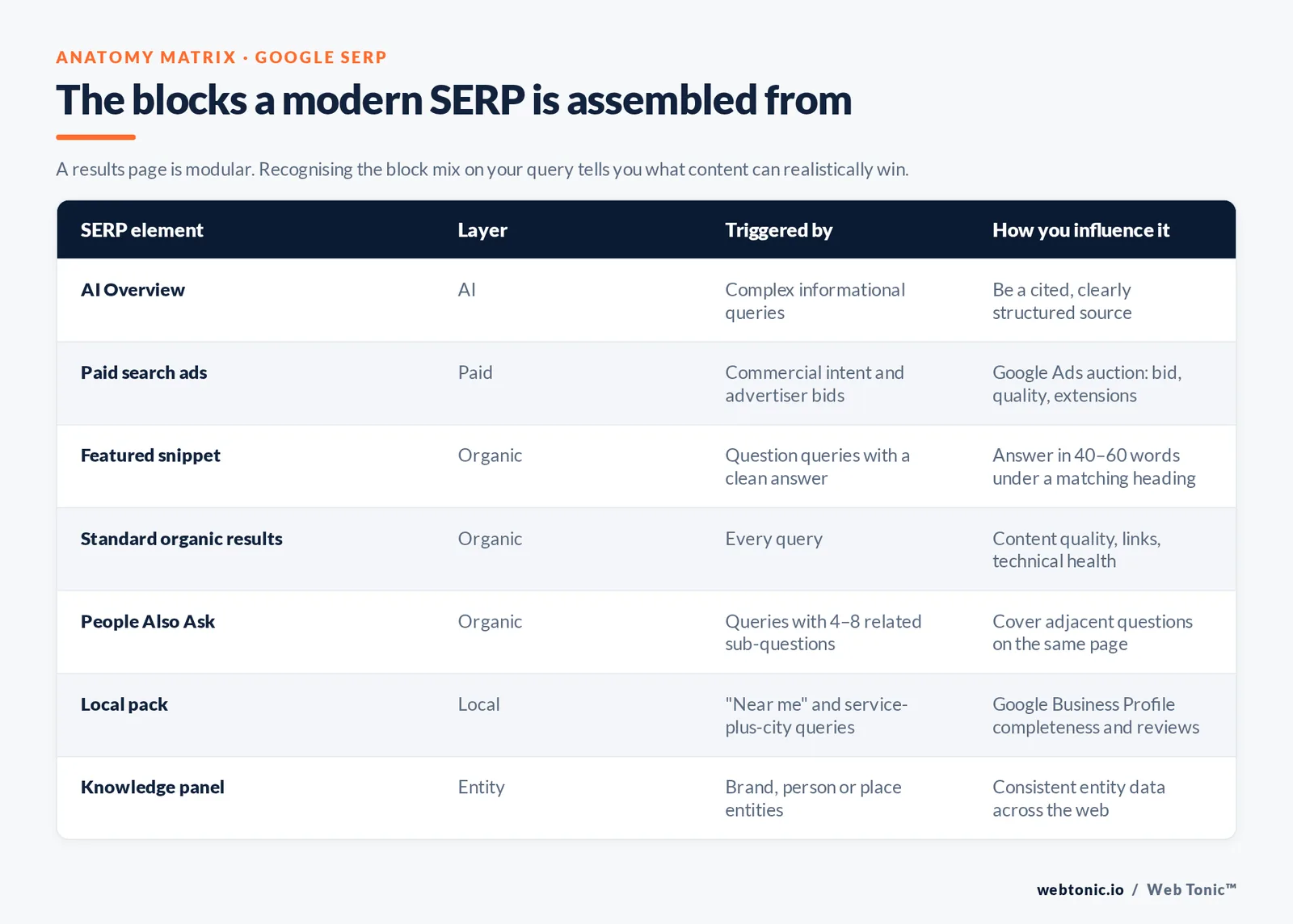
A results page is assembled in blocks. Google decides which blocks appear based on what it infers the searcher wants — informational, navigational, commercial or transactional intent. Recognising the block mix on your target query tells you what kind of content can realistically win.
| SERP element | Layer | Triggered by | How you influence it | Click behaviour |
|---|---|---|---|---|
| AI Overview | AI | Complex informational queries | Be a cited, clearly structured source | Fewer clicks, higher-quality clicks |
| Paid search ads | Paid | Commercial intent and advertiser bids | Google Ads auction: bid, quality, extensions | Top of page, strong on transactional queries |
| Shopping / product listings | Paid | Product queries | Merchant feed quality and product data | High intent, price-led |
| Featured snippet | Organic | Question queries with a clean answer | Answer in 40–60 words directly under a matching heading | Position zero, but often zero-click |
| Standard organic results | Organic | Every query | Content quality, links, technical health | Top 3 results absorb most clicks |
| People Also Ask (PAA) | Organic | Queries with 4–8 related sub-questions | Cover adjacent questions on the same page | Expands in place, second-chance visibility |
| Local pack | Local | "Near me" and service-plus-city queries | Google Business Profile completeness and reviews | Dominant on mobile local intent |
| Knowledge panel | Entity | Brand, person or place entities | Consistent entity data across the web | Brand defence, few outbound clicks |
| Image and video packs | Organic | Visual or how-to queries | Alt text, filenames, video structured data | High on tutorials and products |
| Sitelinks and rich results | Organic | Brand queries, marked-up pages | Clear site architecture plus structured data | Larger listing, higher CTR |
Google publishes the full inventory of these blocks in its visual elements gallery, which is the reference to check before you assume a feature exists on your query.
How a SERP is built: from query to page
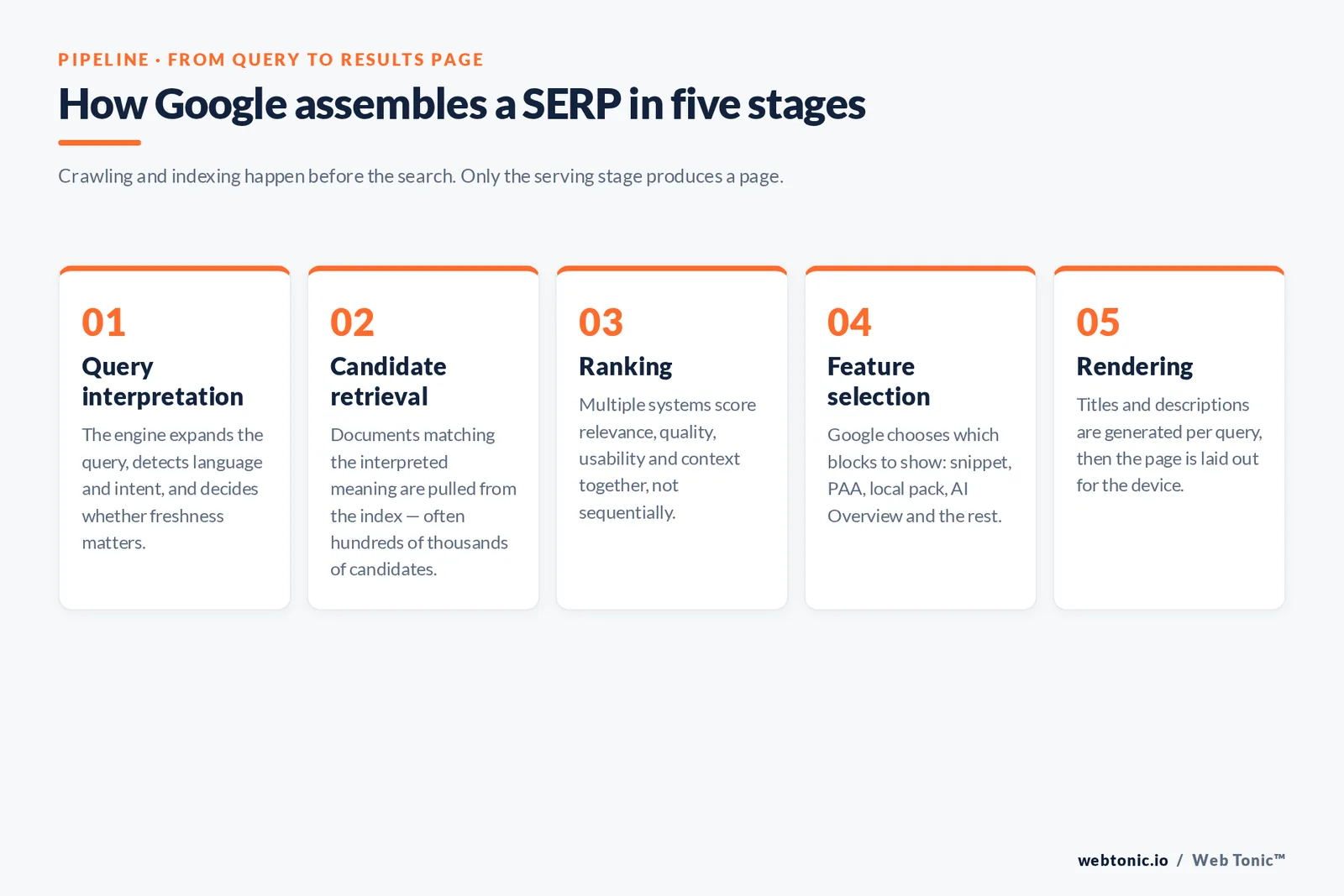
Search works in three stages — crawling, indexing and serving — and only the third produces a SERP. When a query arrives, the engine interprets it (including synonyms and misspellings), retrieves matching documents from the index, ranks them with its ranking systems, then assembles features around them. Google documents this pipeline in How Search works.
- Query interpretation. The engine expands the query, detects language and intent, and decides whether freshness matters.
- Candidate retrieval. Documents matching the interpreted meaning are pulled from the index — often hundreds of thousands of candidates.
- Ranking. Multiple systems score relevance, quality, usability and context together, not sequentially.
- Feature selection. Google chooses which blocks to show: snippet, PAA, local pack, AI Overview and so on.
- Rendering. Titles and descriptions are generated per query, then the page is laid out for the device.
Because steps 4 and 5 happen per query, the same URL can appear as a plain blue link on one search and as a rich, image-led result on another. Tracking a single "average position" hides that entirely.
Organic vs paid results: the two economies on one page
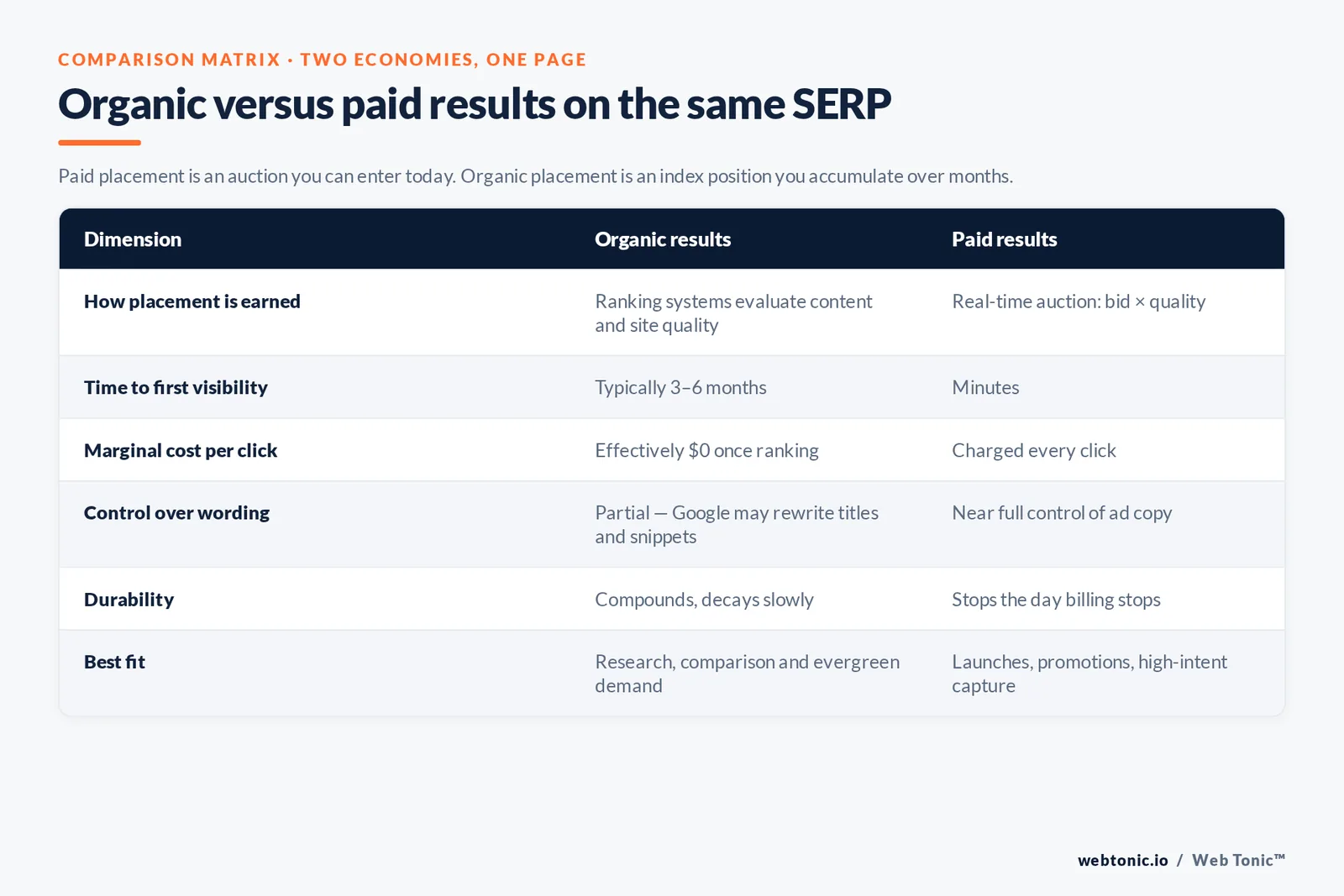
Paid and organic results sit on the same real estate but are earned in completely different ways. Paid placement is an auction you can enter today; organic placement is an index position you accumulate over months. Most strong programmes run both, using paid search to test demand and organic to lower the long-run cost of that demand.
| Dimension | Organic search results | Paid search results |
|---|---|---|
| How placement is earned | Ranking systems evaluate content and site quality | Real-time auction: bid × quality |
| Time to first visibility | Typically 3–6 months | Minutes |
| Marginal cost per click | Effectively $0 once ranking | Charged every click |
| Control over wording | Partial — Google may rewrite titles and snippets | Near full control of ad copy |
| Durability | Compounds, decays slowly | Stops the day billing stops |
| Trust signal | Perceived as editorial | Labelled "Sponsored" |
| Best fit | Research, comparison and evergreen demand | Launches, promotions, high-intent capture |
The strategic point: on a SERP crowded with ads and features, organic position 1 may be the fifth thing a user sees. Judge opportunity by share of the visible page, not by rank number. That is how our search and growth teams size SEO opportunities before committing to a keyword.
Optimising for the SERP, not just for rank
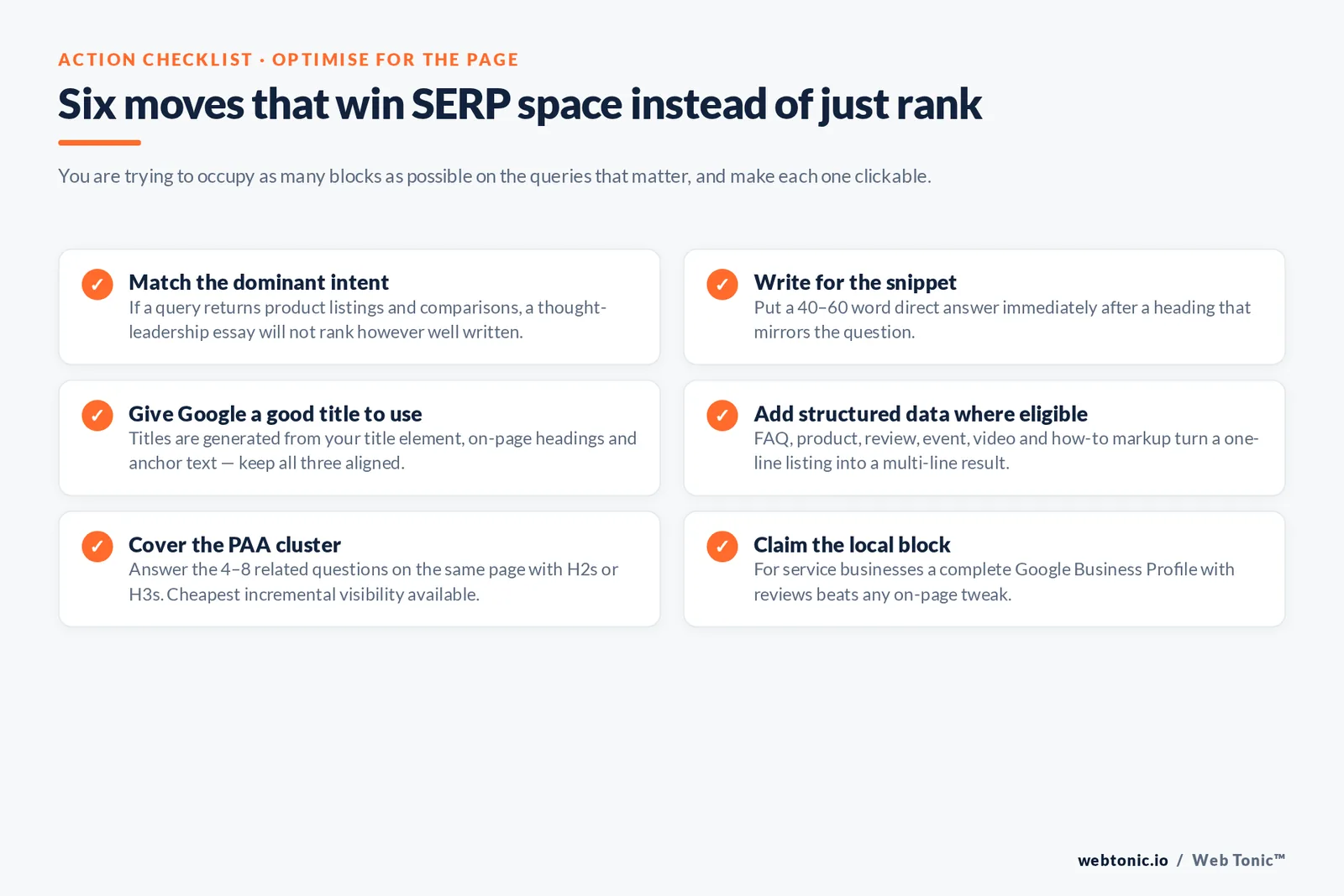
Once you accept the page is modular, optimisation becomes concrete. You are trying to occupy as many blocks as possible for the queries that matter, and to make each occupied block as clickable as possible.
- Match the dominant intent. If a query returns product listings and comparison pages, a thought-leadership essay will not rank no matter how well written it is.
- Write for the snippet. Put a 40–60 word direct answer immediately after a heading that mirrors the question. Google builds featured snippets from exactly this shape.
- Give Google a good title to use. Titles are generated from your
<title>element, on-page headings and anchor text, so keep all three aligned — see Google's title link guidance. - Add structured data where it is eligible. FAQ, product, review, event, video and how-to markup can turn a one-line listing into a multi-line result.
- Cover the PAA cluster. Answer the 4–8 related questions on the same page with H2s or H3s; it is the cheapest incremental visibility available.
- Claim the local block. For service businesses, a complete Google Business Profile with reviews and accurate hours (a 100%-complete profile) matters more than any on-page tweak.
- Be quotable for AI answers. Clear definitions, real data and named sources make a page easy for AI features to cite.
- Measure with Search Console. Search Console reports impressions, clicks, CTR and position per query — the only first-party SERP data you have.
SERP metrics that actually predict revenue
Rank tracking alone is a vanity exercise now. These are the numbers to put on a dashboard instead.
| Metric | What it tells you | Healthy signal | Where to get it |
|---|---|---|---|
| Impressions by query | How often you appear at all | Growing on non-brand queries | Search Console |
| Click-through rate | Whether your listing is compelling | Above 3% on page-one queries | Search Console |
| SERP feature coverage | How much of the page you own | 2+ blocks on priority queries | Rank trackers |
| Share of visible page | Real prominence above the fold | Rising against competitors | Manual SERP audit |
| Zero-click share | How much demand never leaves search | Stable, offset by brand queries | Impressions vs clicks trend |
| Assisted conversions | Revenue organic search contributes | Improving per session | Analytics platform |
A page that loads badly loses the click it earned. Core Web Vitals thresholds — LCP under 2.5s, CLS under 0.1, INP under 200ms — are the usability floor for any page you want visible in search results, and they interact with everything else on this list.
Related terms you will meet alongside SERP
| Term | Short definition | Relationship to the SERP |
|---|---|---|
| Search query | The words a person actually typed or spoke | The input that generates the page |
| Keyword | The term a marketer targets | An approximation of many real queries |
| SEO | Search engine optimisation | Work to improve organic placement |
| PPC / paid search | Pay-per-click advertising | Buys the paid layer |
| SERP feature | Any non-standard result block | Occupies space above organic links |
| Position zero | Informal name for the featured snippet | Sits above result one |
| Zero-click search | A search that ends without a website visit | Answer given on the page itself |
| Knowledge graph | Google's database of entities and relations | Powers knowledge panels |
| Search intent | The goal behind a query | Determines which blocks appear |
| Index | The store of crawled, processed pages | The pool results are drawn from |
How SERPs are changing — and what to do about it
Three shifts are reshaping search results pages. AI-generated answers are absorbing simple informational queries. Feature blocks keep pushing the 10 blue links further down, especially on mobile. And forum, video and social sources appear more often in mainstream results, so the competitive set for a query is no longer just the 10 other websites in your industry.
The practical response is not to abandon SEO but to change what you optimise for: fewer thin informational pages, more pages that provide something an AI summary cannot replace — original data, real pricing, tooling, comparisons and expertise. Coverage of these shifts in outlets like Search Engine Land is worth following monthly, because feature rollouts change click economics faster than rankings change.
If you want your visibility measured across the whole page rather than by rank alone, our data intelligence team builds that reporting, and our blog covers the tactical side. You can also talk to us about a SERP-level audit of your priority queries.
FAQ
What does SERP stand for?
SERP stands for search engine results page — the page returned after a search query, containing organic results, paid ads and features such as AI Overviews, featured snippets, People Also Ask, local packs and knowledge panels. The plural "SERPs" is used informally to mean search results generally.
What is the difference between a SERP and SEO?
A SERP is the output; SEO is the work. Search engine optimisation is the practice of improving a site so it appears higher and in more blocks of that output. You optimise a website, and you measure the result on the SERP.
Are organic and paid results ranked the same way?
No. Organic results come from ranking systems that assess meaning, relevance, quality, usability and context. Paid results come from an advertising auction combining your bid with ad quality. They are separate systems that happen to share one page — buying ads does not improve organic rank.
Why does my SERP look different from a colleague's?
Results are personalised by location, language, device, search history and time. Local intent is the strongest modifier: a service query in one city returns an entirely different local pack than the same query 50 miles away. Use incognito plus a location setting when auditing.
Do featured snippets and AI Overviews reduce traffic?
They reduce clicks on simple informational queries while leaving high-intent traffic largely intact. With 96.55% of pages already receiving no Google traffic, the winning response is to target queries where a user must visit a site to act — buying, booking, configuring or comparing.
Sources: Google Search Central (How Search works, ranking systems guide, snippet and title link documentation, search gallery, visual elements gallery, AI features) · Google Search Console · Google Business Profile Help · The Keyword (Google blog) on generative AI in Search · Statcounter search engine market share · Ahrefs SEO statistics · Nielsen Norman Group reading behaviour research · Search Engine Land. Benchmarks are directional and vary by query, market and device.