Table of contents
Two data points anchor Australian SEO in 2026: 85% of Australian businesses now run on some form of ICT infrastructure, per the Australian Bureau of Statistics, and Google still commands close to nine in ten searches. Between those two facts sits the actual SEO opportunity - a market with near-universal digital infrastructure but a search layer still concentrated almost entirely on one engine.
Key Takeaways
- 85% of Australian businesses used ICT tools in the year to June 2022, per the ABS.
- That is up from 69% just two years earlier.
- 63% of businesses use cyber security software, the most common ICT category.
- 59% use cloud technology.
- 41% run internal digital platforms; 38% run public-facing ones.
- Only 17% use CRM software, and just 5% use dedicated data analytics.
- 30% of Australian businesses received online orders in FY2022.
- 61% of Australian businesses placed online orders as buyers.
- 22% of businesses reported a cyber security incident, up from 8% two years earlier.
- Standalone AI adoption sat at 1% of businesses in the 2021-22 ICT module.
- By 2024-25, the ABS reports 46% of businesses finding efficiencies through innovation, AI included.
- Google holds 88% to 90.7% of the Australian search engine market in 2026.
- Bing has climbed to roughly 6.6% to 9%, its highest share in years.
- Google's share has fallen from about 94% to about 88% over the past year.
- Yahoo sits at 1.3% to 1.6%; DuckDuckGo under 1%.
- Mobile Google share runs slightly lower, at 88.2%, than the blended figure.
- The ABS ICT module moved to a biennial survey cycle starting 2024-25.
The infrastructure baseline: how digital is the Australian business sector
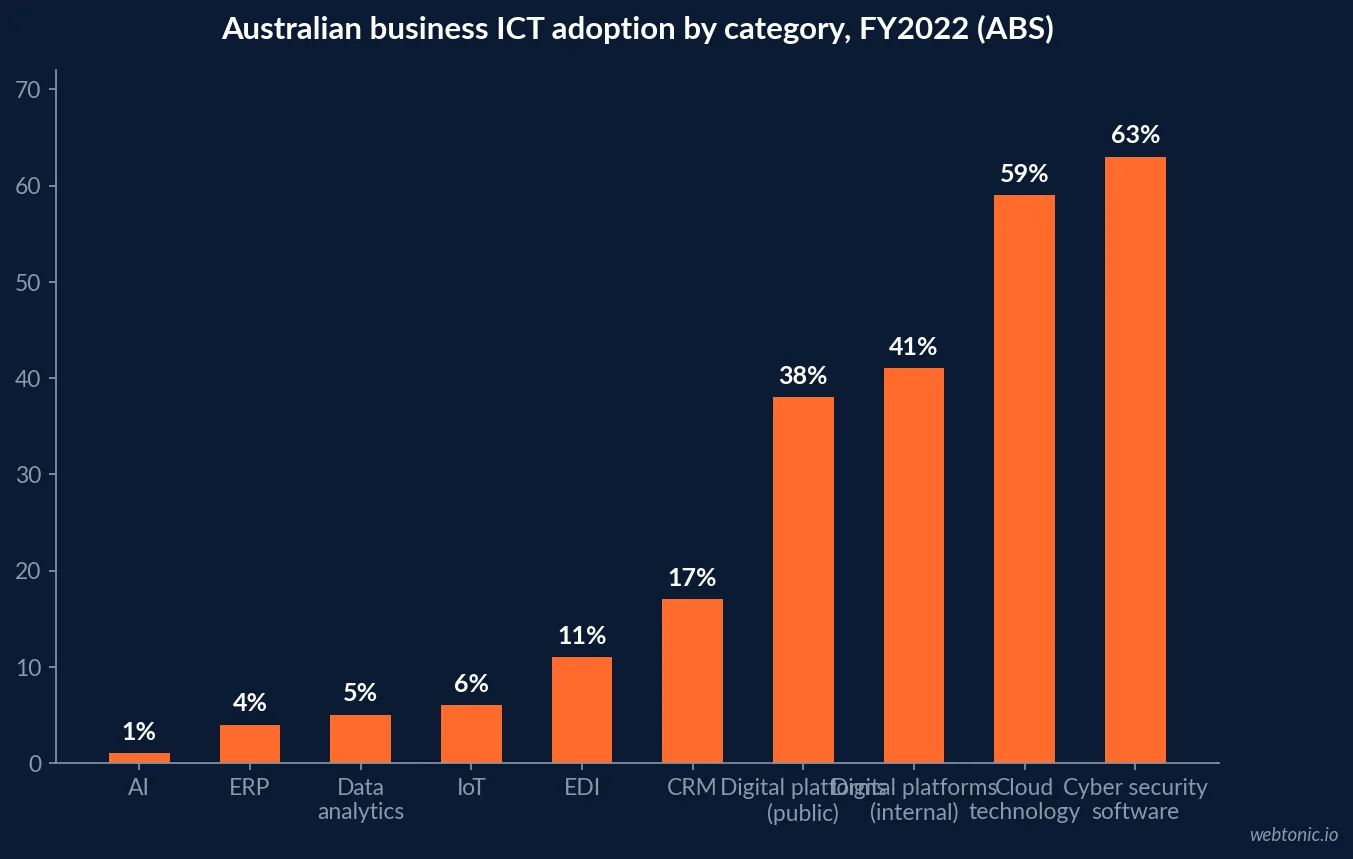
The Australian Bureau of Statistics' Characteristics of Australian Business survey is the country's official benchmark for how businesses use technology. For the year ended 30 June 2022, it found 85% of businesses reported using ICTs of some kind, up from 69% just two years before - one of the larger two-year jumps in the survey's history, likely reflecting pandemic-era digitization that did not reverse.
| ICT category | Share of businesses using it (FY2022) |
|---|---|
| Cyber security software | 63% |
| Cloud technology | 59% |
| Digital platforms - internal | 41% |
| Digital platforms - public | 38% |
| Customer Relationship Management (CRM) software | 17% |
| Electronic Data Interchange (EDI) | 11% |
| Internet of Things (IoT) | 6% |
| Data analytics | 5% |
| Enterprise Resource Planning (ERP) software | 4% |
| Artificial intelligence (AI) | 1% |
Source: Australian Bureau of Statistics, Characteristics of Australian Business. The 38% figure for public digital platforms is the closest official proxy for "has an indexable web presence" - it is the ceiling on how many Australian businesses even have a website that SEO work could apply to, which is a materially different denominator than "all Australian businesses."
AI adoption is moving faster than the last full ICT survey shows
The ABS's most recent full technology-by-category breakdown is now three years old by publication date, but a newer 2026 media release narrows the gap: it reports business AI adoption accelerated through the 2024-25 year, with 46% of businesses saying they were finding savings and efficiencies through innovation - a broader category than AI alone, but one the ABS explicitly ties to AI-driven change. Set against the 1% standalone AI-adoption figure from FY2022, the direction of travel is unambiguous even though the two figures are not directly comparable measurements.
Search concentration: Google's position is high but softening
Statcounter's tracking shows Google holding 88% to 90.7% of the Australian search engine market across 2026 readings, with Bing at roughly 6.6% to 9%. SearchScope's own analysis of the underlying trend flags something worth noting for anyone planning a 12-month SEO strategy: Google's share has fallen from around 94% to roughly 88% over the past year as Bing gains ground - a bigger single-year shift than most comparable markets have shown.
| Search engine | Australia market share (2026) |
|---|---|
| 88.0% - 90.7% | |
| Bing | 6.6% - 9.0% |
| Yahoo! | 1.3% - 1.6% |
| DuckDuckGo | 0.9% - 0.94% |
| Ecosia | 0.18% - 0.22% |
| YANDEX | 0.15% - 0.18% |
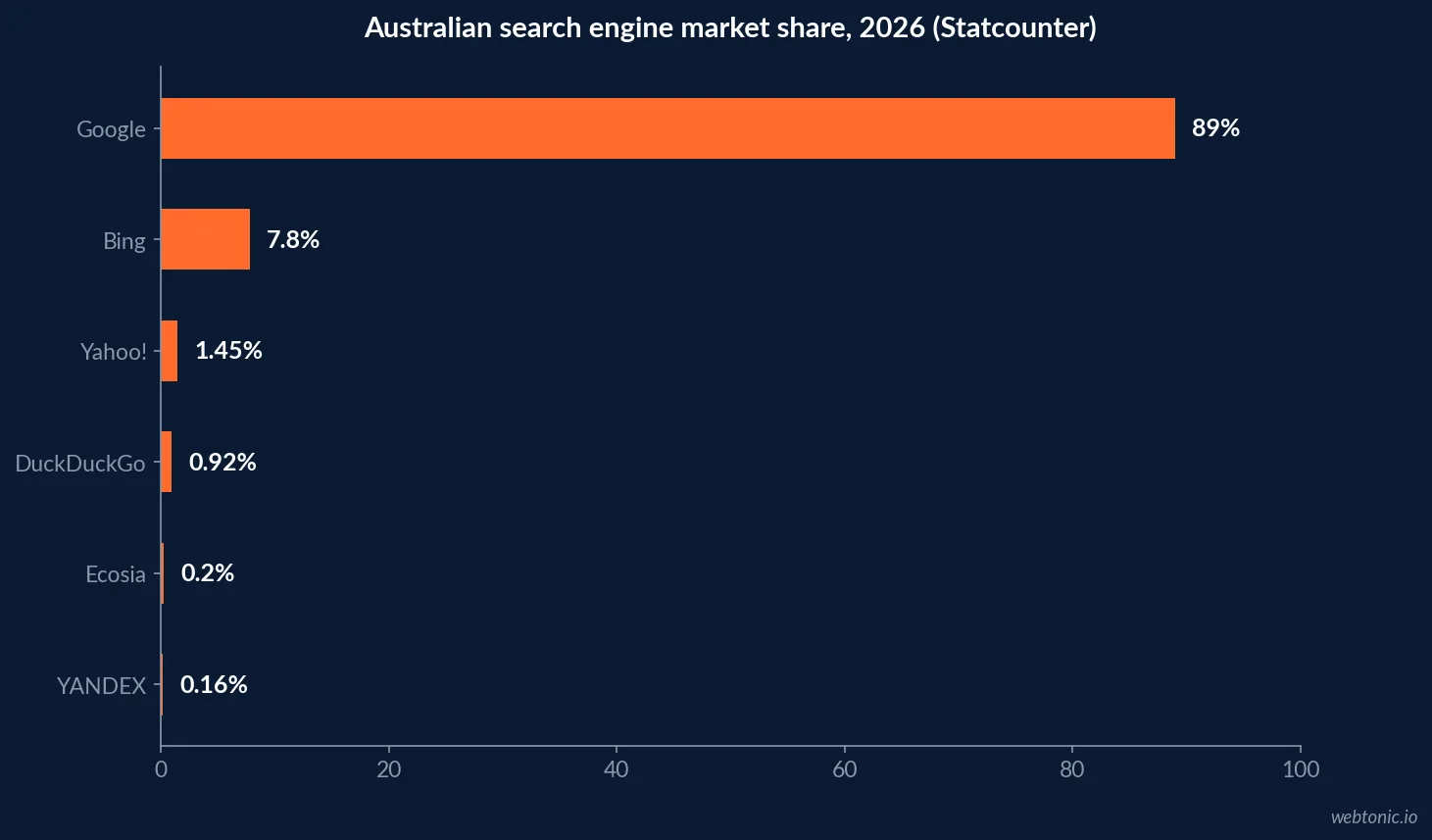
Source: Statcounter Global Stats, Search Engine Market Share Australia, cross-checked against SearchScope's 2026 Australian search engine statistics analysis.
What that concentration is worth in real dollars
Search's near-90% concentration on Google is not an abstract statistic - it sits underneath real ad spend. IAB Australia's FY26 Internet Advertising Revenue Report, prepared by PwC, measured search as the single largest category of Australian internet advertising at AUD 8.6 billion, 43% of the total digital ad market, and still setting a new financial-year record even as newer formats grow faster in percentage terms. Every dollar of that AUD 8.6 billion is being bid for attention inside a search results page that Google alone controls at close to 90% share, which is the practical reason a technical SEO program built for anything other than Google's crawlers and ranking systems is optimizing for the wrong 10-12% of the market.
Desktop versus mobile search behaviour
Statcounter's mobile-only reading puts Google at 88.22% in Australia, marginally below its blended desktop-and-mobile figure, with Bing correspondingly a touch higher on mobile at 8.74%. The gap is small, but it is consistent enough across months that a technical SEO audit defaulting to mobile-first crawling and rendering checks remains the right baseline for the Australian market, not an optional add-on.
| Platform | Google share | Bing share |
|---|---|---|
| Desktop & mobile blended | 88.5% - 90.7% | 6.56% - 8.57% |
| Mobile only | 88.22% | 8.74% |
What the two data sets together imply for a 2026 SEO plan
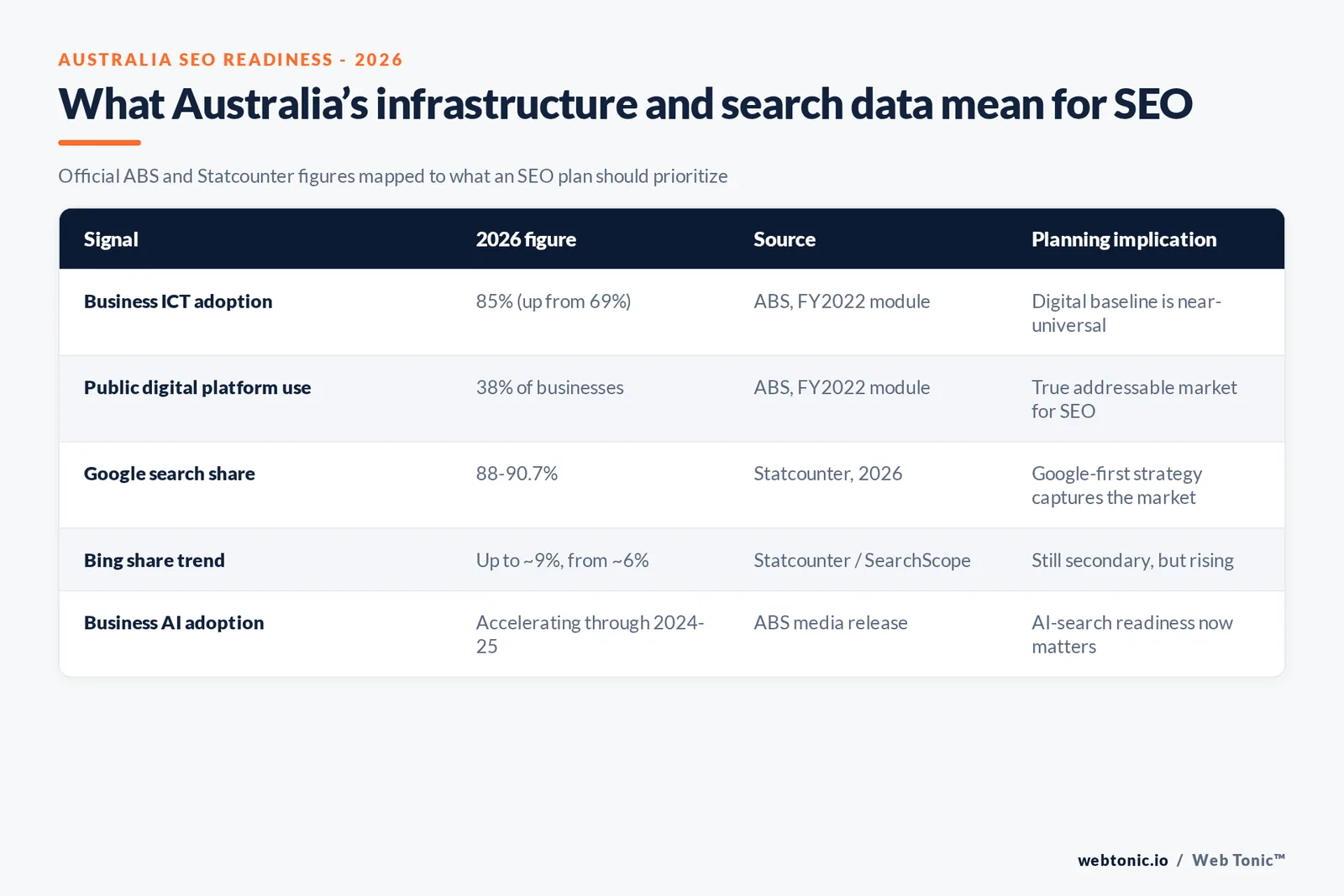
Put the ABS and Statcounter numbers side by side and the picture is a market with the infrastructure to compete in search - 85% ICT adoption, 59% cloud, growing AI use - but with a search layer still concentrated enough on one engine that a Google-first technical and content strategy captures the overwhelming majority of available demand. The 38% of businesses with a public digital platform is the more important denominator than the 85% headline ICT figure: it is the group that actually has a website an SEO program can act on.
| Planning question | What the data says |
|---|---|
| Which search engine to prioritize | Google, at 88-90.7% share - Bing is a distant secondary consideration |
| Is the audience mobile or desktop | Both matter; mobile Google share is only ~2pp below blended |
| How much of the market even has a website to optimize | 38% of businesses run a public digital platform (ABS) |
| Is AI-driven search change already affecting the market | Yes - AI adoption accelerated through 2024-25 per the ABS |
| How current is the infrastructure baseline | ABS ICT-by-category data is from FY2022; the survey is now biennial |
How many Australian businesses actually sell online
The same ABS survey found 30% of Australian businesses received online orders in the year to June 2022 - 20% through their own website or app, 12% through a third-party platform or marketplace, and 6% via Electronic Data Interchange. On the buying side, a much larger 61% of businesses placed online orders themselves. That asymmetry - more businesses buying online than selling online - is a specific, sourced opportunity signal: two-thirds of the market has not yet built the transactional web presence that organic search traffic would actually convert against.
| E-commerce activity | Share of Australian businesses (FY2022) |
|---|---|
| Placed online orders (as a buyer) | 61% |
| Received online orders (as a seller), any channel | 30% |
| ...via own website or app | 20% |
| ...via a third-party platform or marketplace | 12% |
| ...via Electronic Data Interchange (EDI) | 6% |
| Experienced a cyber security incident | 22% |
Source: Australian Bureau of Statistics, Characteristics of Australian Business.
What Australian SEO actually costs in 2026
Local Digital's 2026 audit of 232 Australian SEO agencies' published pricing found a median entry price of AUD 1,200 a month, with the middle of the market running AUD 1,000 to 3,500 and top tiers clustering between AUD 2,312 and 6,000. Only 23% of the agencies audited publish a price at all, which the researchers note skews the visible market toward the cheaper end since better-reviewed agencies are the least likely to disclose rates publicly. Clutch-reported data in the same analysis puts the median Australian SEO hourly rate at AUD 124.
| Pricing tier | Monthly range (AUD) | Notes |
|---|---|---|
| Entry | 750 - 2,000, median 1,200 | 23% of 232 audited agencies publish a price |
| Middle of market | 1,000 - 3,500, median 2,000 | Most commonly quoted range across directories |
| Top tier | 2,312 - 6,000, median 5,000 | Full-service, multi-location or competitive verticals |
| Hourly (Clutch-reported) | AUD 124 median | Cross-checked against Semrush minimum-budget listings |
Source: Local Digital, SEO Pricing Australia 2026.
Turning the data into a 2026 SEO plan
The gap between 61% of Australian businesses buying online and only 30% selling online is the clearest planning signal in this data set - it defines the addressable market for a conversion-focused SEO program far more precisely than the 85% headline ICT-adoption figure does. Teams building that program alongside a broader performance creative function get the content and landing-page side covered in the same motion, and pricing this work against the AUD 1,000-3,500 middle-market range above, rather than the unpublished quotes from the 77% of agencies that do not disclose rates, keeps the budget conversation grounded in actual 2026 market data instead of a guess. For teams also running paid channels alongside organic, Web Tonic's Google Ads pricing guide gives the comparable paid-media cost baseline to weigh against these SEO figures, and a Google Ads agency partner is the natural pairing once the SEO retainer is scoped, since both channels are ultimately bidding for the same Google-controlled attention documented above.
Frequently Asked Questions
What share of Australian businesses actually use digital tools that support SEO?
The Australian Bureau of Statistics' Characteristics of Australian Business survey found 85% of businesses reported using information and communication technologies in the year to 30 June 2022, up sharply from 69% two years earlier. Cloud technology sat at 59% and public-facing digital platforms at 38% - both prerequisites for a functioning SEO program, since a business without a stable public web presence has nothing to optimize.
Is Google as dominant in Australia as it is elsewhere?
Close to it. Statcounter puts Google between 88% and 90.7% of the Australian search engine market through 2026, with Bing capturing roughly 6.6% to 9%. SearchScope's own tracking of the same underlying data notes Google's share has fallen from around 94% to roughly 88% over the past year as Bing gains ground, a bigger shift than in most comparable English-speaking markets.
How many Australian businesses are adopting AI tools that intersect with SEO?
The ABS reported in its 2026 business-technology release that AI adoption accelerated through the 2024-25 year, with 46% of businesses saying they were finding savings and efficiencies through innovation broadly (a figure that includes but is not limited to AI). The 2021-22 ICT module had put standalone AI adoption at just 1% of businesses, so the trajectory - even allowing for different survey questions - is a fast one.
What is the biggest data limitation in Australian SEO benchmarking?
The ABS Business Characteristics Survey moved to a biennial cycle from 2024-25, so the most recent full ICT-adoption breakdown by technology type still dates to the year ended 30 June 2022. Search-share data from Statcounter is far more current (monthly), but it measures browser-reported search requests, not conversions or revenue - it tells you where the audience is, not how well a given site is capturing them.
Does mobile search behave differently from desktop in Australia?
Yes, modestly. Statcounter's mobile-only measurement shows Google slightly lower at 88.2% versus its desktop-and-mobile blended figure near 90%, with Bing correspondingly higher on mobile. The gap is small next to markets with heavier alternative-app search usage, but it is large enough that a mobile-first technical SEO audit should still be treated as the default, not an afterthought.
Sources
Australian Bureau of Statistics, Characteristics of Australian Business
Australian Bureau of Statistics, Business AI adoption accelerates 2024-25
Statcounter Global Stats, Search Engine Market Share Australia
Statcounter Global Stats, Australia mobile search share
SearchScope, Australian Search Engine Market Share Statistics 2026
Local Digital, SEO Pricing Australia 2026
IAB Australia, Internet Advertising Revenue Report FY26