Table of contents
SEO prices in 2026 cluster in a narrow band that most buyers never see quoted openly: surveys of hundreds of providers put the average monthly retainer between roughly $2,900 and $3,200, with hourly rates around $111 to $148 depending on provider type and market.
This guide sets out what SEO actually costs by pricing model, business size and market, which factors move a quote up or down, how to sanity-check a proposal against benchmark data, and how to model the return before you sign anything.
Key Takeaways
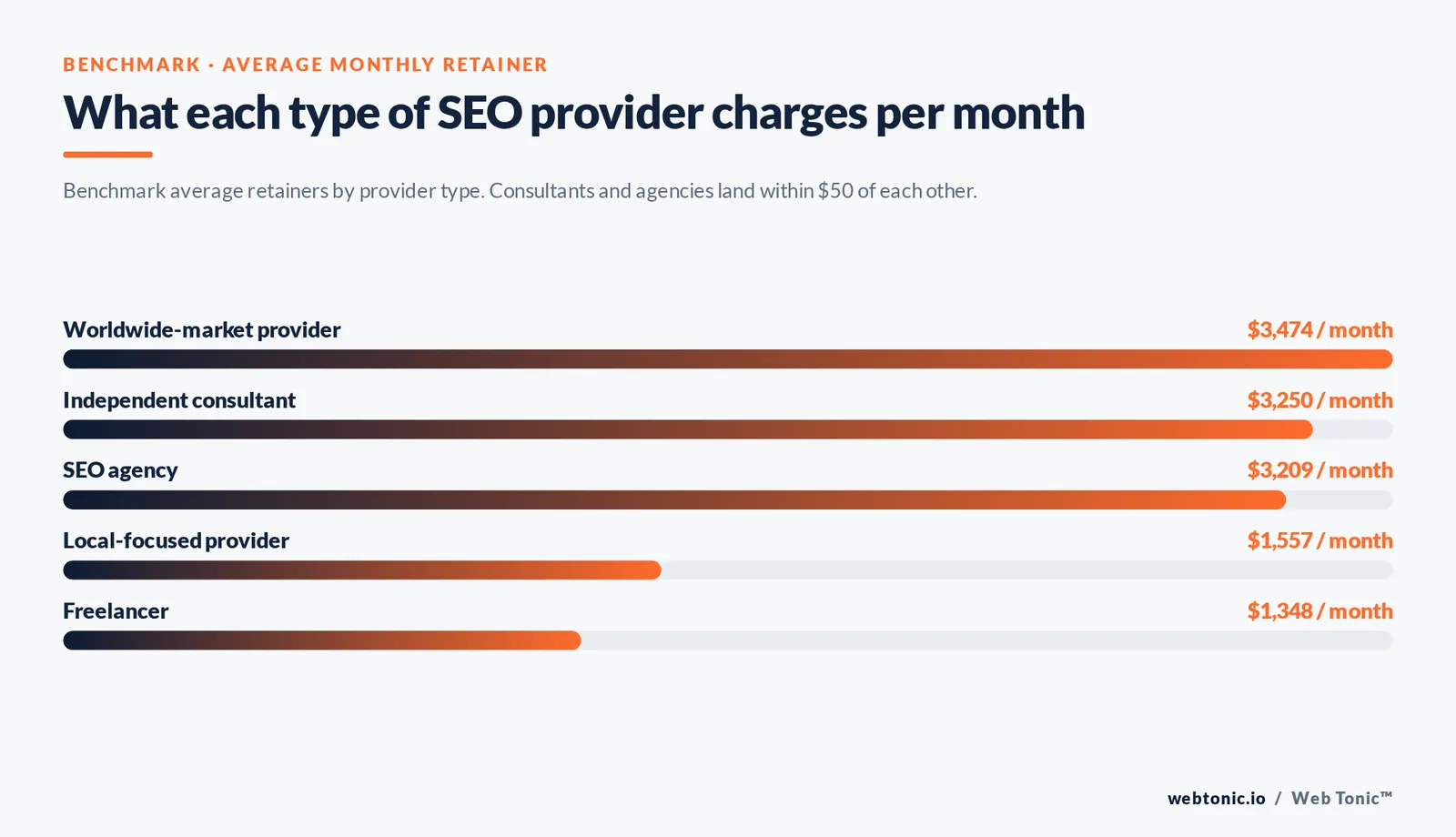
- A poll of 439 SEO providers put the average monthly retainer at $2,917: agencies $3,209, consultants $3,250 and freelancers $1,348.
- Hourly pricing averages $111 across providers overall, while a separate survey of nearly 400 respondents found agencies charging $134.14 per hour worldwide and $147.93 in the United States.
- 78.2% of providers work on a monthly retainer, making it the default commercial model rather than one option among many.
- Budget reality check: 68.8% of providers report typical monthly fees at $2,000 or below, yet 79.1% of US and Canadian providers charge above $1,001 per month.
- Half of SEO providers worldwide require a monthly retainer under $3,000, which is the practical ceiling for most small and mid-market engagements.
- Local SEO is materially cheaper than national work — around $1,557 per month on average, against $3,474 for providers serving worldwide markets.
- SEO typically takes three to six months to show results, and longer in competitive niches, so any budget shorter than two quarters is a test, not a programme.
- The competitive backdrop is unforgiving: 96.55% of pages get zero Google traffic and only 5.7% of new pages reach a top-10 position within a year.
- Google holds roughly 91.25% of global search, so search visibility budgets are effectively Google budgets with a 4.68% Bing rounding error.
- Click distribution justifies the spend: the first organic result takes about 39.8% of clicks and the top three positions together take roughly 68.7%.
SEO pricing models: the five ways SEO is sold
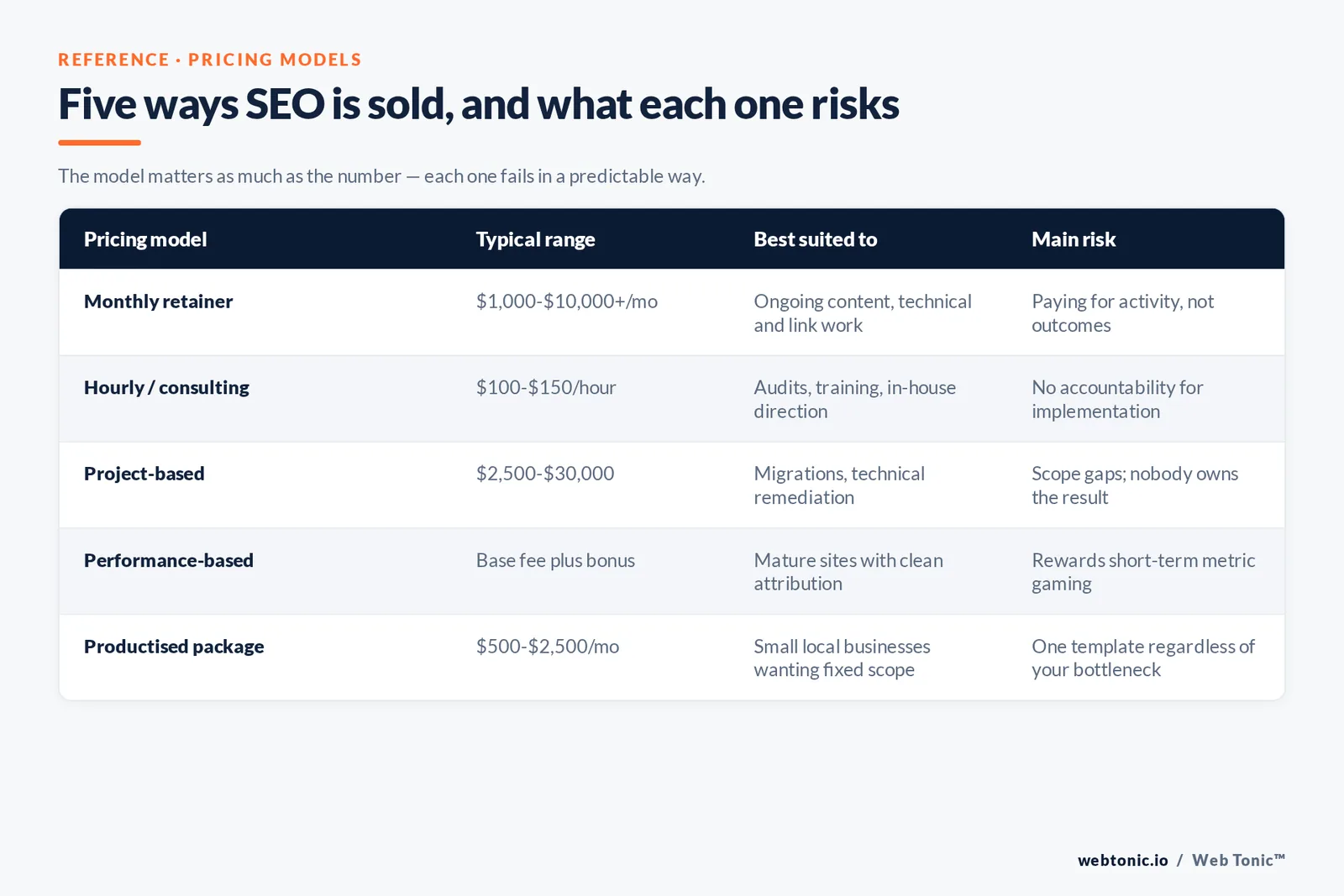
Before comparing numbers, compare structures. The same scope of work can be packaged five different ways, and the model changes who carries the risk far more than it changes the total cost.
| Pricing model | Typical range | Best suited to | Main risk |
|---|---|---|---|
| Monthly retainer | $1,000-$10,000+/month | Ongoing programmes needing content, technical and link work | Paying for activity rather than outcomes if reporting is weak |
| Hourly / consulting | $100-$150/hour | Audits, training, second opinions, in-house teams needing direction | No accountability for implementation |
| Project-based | $2,500-$30,000 per project | Migrations, technical remediation, one-off content builds | Scope gaps; nobody owns the result after handover |
| Performance-based | Base fee plus bonus on ranking or revenue | Mature sites with clean attribution | Incentivises short-term tactics and metric gaming |
| Productised package | $500-$2,500/month, fixed deliverables | Small local businesses wanting predictable scope | One template applied regardless of your actual bottleneck |
Retainers dominate for a reason. Ahrefs' pricing poll of 439 providers found 78.2% billing a monthly retainer, because search results move on a schedule that no project window respects: technical fixes, publication, crawling, re-evaluation and link acquisition each take weeks and interact with one another.
Performance-based pricing sounds like buyer-friendly risk transfer and rarely is. Ranking bonuses reward whichever keyword is easiest to move, not the one that produces revenue, and revenue-share models require attribution that most mid-market sites do not have. Where it works, the base fee still covers the real cost of work and the bonus is genuinely incremental.
What SEO costs per month: benchmarks by provider type
Two independent surveys give the most reliable public picture of SEO cost, and they broadly agree. The Ahrefs poll averaged $2,917 per month across all providers. Semrush's survey of nearly 400 respondents reports agencies at $134.14 per hour worldwide, $147.93 in the US, consultants at $139.29 worldwide and $144.68 in the US, and notes that half of providers worldwide require a retainer below $3,000 per month.
| Provider type | Average monthly retainer | Typical hourly rate | What you're actually buying |
|---|---|---|---|
| Freelancer | $1,348 | $75-$125 | One specialist's time, usually strong in one discipline |
| Independent consultant | $3,250 | $139 worldwide / $145 US | Senior strategy and direction; you implement |
| SEO agency | $3,209 | $134 worldwide / $148 US | A team covering technical, content and links, plus project management |
| Local-focused provider | $1,557 | $75-$120 | Google Business Profile, citations, local landing pages, reviews |
| Worldwide-market provider | $3,474 | $130-$200 | Multi-market, multi-language, higher-competition scope |
| In-house hire | Salary plus $300-$800 tooling | n/a | Dedicated ownership, narrower skill coverage |
The distribution matters more than the average. Ahrefs found 68.8% of providers charging $2,000 per month or less, while 79.1% of North American providers charge above $1,001. In other words the global market has a long cheap tail, and the US and Canadian market does not. A $400-per-month quote from a North American agency is an outlier that deserves scrutiny, not celebration.
SEO cost by business size and market
The single biggest driver of an SEO quote is not the agency's brand — it is how many pages need to change and how many competitors are already doing the work well. That scales with business size and geography in a fairly predictable way.
| Business profile | Realistic monthly budget | Core scope | Time to meaningful results |
|---|---|---|---|
| Single-location local service | $800-$2,000 | Google Business Profile optimisation, citations, 5-15 service and area pages, reviews | 3-4 months |
| Multi-location local (5-25 sites) | $2,500-$6,000 | Location page system, profile management at scale, local link building | 4-6 months |
| Small national B2B | $3,000-$7,000 | Technical baseline, 4-8 content pieces monthly, digital PR, conversion tracking | 6-9 months |
| Mid-market ecommerce | $5,000-$15,000 | Category and facet architecture, feed and product data, content, link acquisition | 6-12 months |
| Enterprise / multi-market | $15,000-$50,000+ | Platform-level technical SEO, internationalisation, editorial operations, governance | 9-18 months |
Note the pattern in the last column. Ahrefs' analysis of SEO timelines puts the general expectation at three to six months, with hyper-competitive keywords taking months or years. Any quote that implies results inside eight weeks is either targeting keywords nobody searches or planning to buy links. Budget across at least two quarters or treat the spend as a diagnostic exercise.
The nine factors that move an SEO quote
Two businesses in the same industry can receive quotes that differ by a factor of five. These are the variables doing the work:
- Industry competition level. Legal, insurance, finance and SaaS have well-funded incumbents publishing continuously. Beating them costs more because the quality bar is higher, not because the tactics differ.
- Current site health. A site failing Core Web Vitals thresholds — LCP under 2.5s, CLS under 0.1, INP under 200ms — needs engineering hours before any content work pays off. Check your own baseline free with PageSpeed Insights.
- Content volume required. Content is usually the largest single line item. Four properly researched pieces a month at genuine subject-matter depth costs more than twelve thin posts and works better.
- Link building scope. Real editorial links require outreach, assets and time. Industry research puts one earned link at one to two hours of work, before any content cost.
- Geographic footprint. One city, one country or twelve markets is the difference between $1,557 and $3,474 in the survey averages, and the gap widens with language count.
- Technical complexity. A headless build, a faceted catalogue with a million URL permutations, or a legacy CMS with no template control all add engineering hours.
- Existing authority. An established domain converts effort into rankings faster. A brand-new site is paying to build the asset first.
- Reporting and governance needs. Enterprise stakeholder reporting, attribution modelling and approval workflows are real hours. They belong in the quote openly.
- Who implements. Strategy-only engagements are cheaper and frequently deliver nothing, because the recommendations sit in a document. Implementation is where the cost and the outcome both live.
What should be in an SEO package at each price point
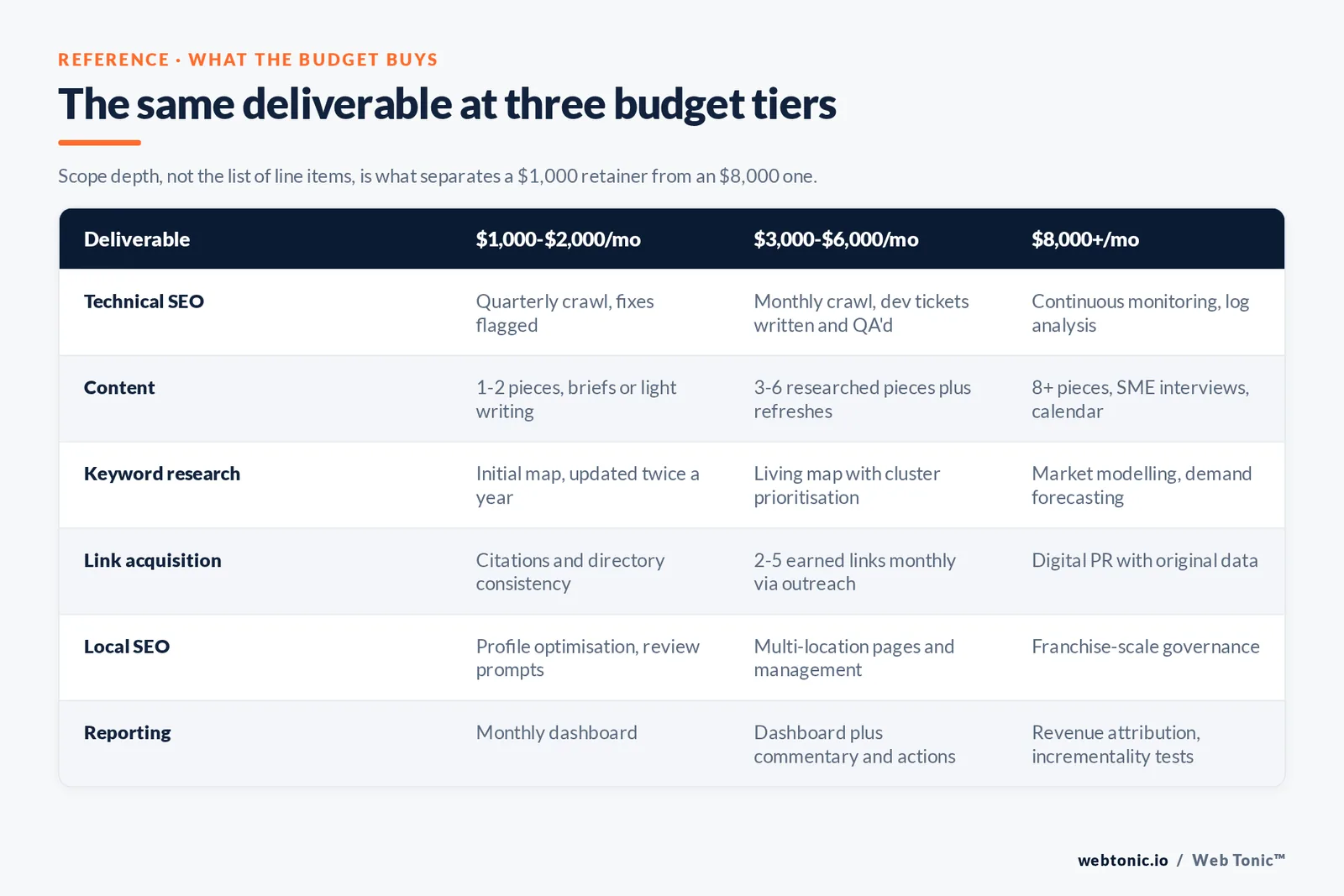
The fastest way to compare two proposals at different prices is to normalise them against deliverables rather than headline scope language. Ask for hours or units, not adjectives.
| Deliverable | $1,000-$2,000/mo | $3,000-$6,000/mo | $8,000+/mo |
|---|---|---|---|
| Technical SEO | Quarterly crawl, priority fixes flagged | Monthly crawl, dev tickets written and QA'd | Continuous monitoring, log analysis, platform-level work |
| Content | 1-2 pieces, briefs only or light writing | 3-6 researched pieces, plus refresh programme | 8+ pieces, subject-matter interviews, editorial calendar |
| Keyword and intent research | Initial map, updated twice a year | Living map with cluster prioritisation | Market-level modelling, demand forecasting |
| Link acquisition | Citations and directory consistency | 2-5 earned links monthly via outreach | Digital PR campaigns with original data |
| Local SEO | Profile optimisation, review prompts | Multi-location management, local landing pages | Franchise-scale governance and templating |
| Reporting | Monthly dashboard | Dashboard plus commentary and next actions | Revenue attribution, incrementality testing |
Two deliverables are non-negotiable at every tier. First, conversion tracking that ties organic sessions to revenue or qualified leads — without it you cannot evaluate the spend. Second, documented alignment with Google Search Essentials and its helpful-content guidance, which is the published standard any provider should be able to point to.
Local SEO pricing: why it costs less and what it includes
Local SEO averages roughly $1,557 per month against $3,474 for worldwide-facing work, and the discount is structural rather than a quality trade-off. A single-city service business competes against a handful of local rivals for a few dozen commercially meaningful queries, and a disproportionate share of the outcome comes from one asset: the Google Business Profile.
Research into local pack influence attributes roughly 32% of local ranking weight to Business Profile signals, per Whitespark's local search ranking factors study. Google's own data indicates a complete profile makes a business 2.7x more likely to be considered reputable and drives 70% more location visits and 50% more purchase consideration. That is a cheap lever, and Google's own profile documentation covers most of it.
A credible local package at $800-$2,000 per month should include profile optimisation and posting, citation consistency across the major aggregators — the discipline explained in Moz's local citations primer — service and area landing pages, review generation and response, and local link acquisition through sponsorships, chambers and press. If a quote at that level includes "national keyword rankings", the scope is wrong for the budget.
SEO cost calculators, and what they can and cannot tell you
SEO cost calculators are useful for one narrow job: producing a defensible budget range before you speak to a provider. They typically ask for your market, number of target keywords, site size and competitiveness, then map that against benchmark rates.
What they cannot do is price your actual bottleneck, and the bottleneck determines cost. A site with 400 orphaned product URLs, a site with excellent architecture and no content, and a site with strong content and no authority need three different budgets that a calculator will happily average into one number. Build your own range instead, in four steps:
- Count the pages that must change. Templates plus priority URLs, not total URL count.
- Count the content pieces needed per quarter to cover your top clusters, then price them at market rates for your subject depth.
- Estimate engineering hours for the technical fixes already visible in your crawl and Vitals data.
- Add the benchmark retainer for your provider type from the tables above, then compare the total against the value of the traffic you are targeting.
That last comparison is the one that matters. With the top three organic positions taking about 68.7% of clicks according to First Page Sage's click-through research, the value of moving from position eight to position two is calculable — and if it does not cover the retainer within your payback window, the budget is wrong regardless of how reasonable the hourly rate looks.
How to evaluate an SEO quote without being an SEO
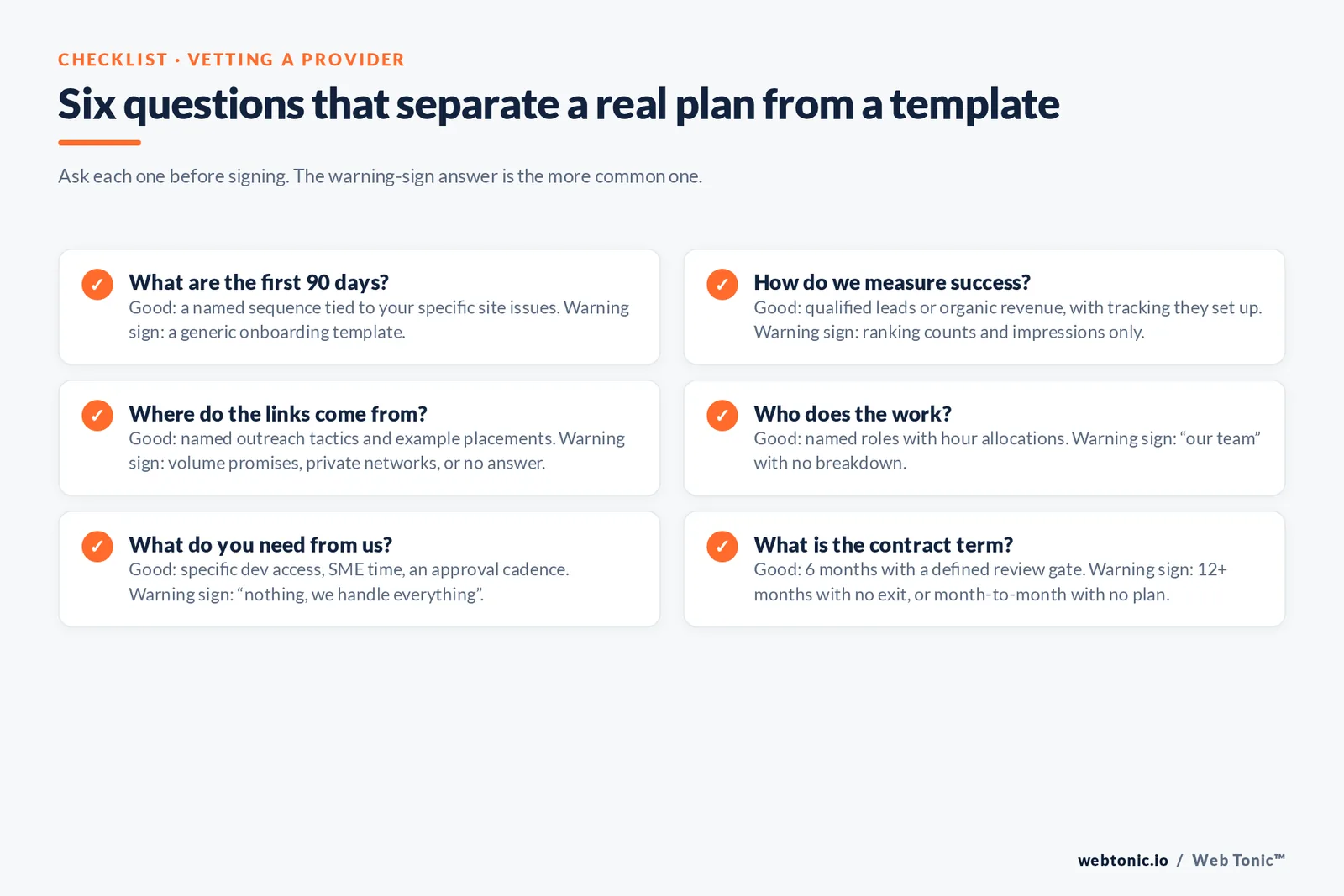
You do not need technical fluency to separate a serious proposal from a weak one. You need six questions and the benchmark data above.
| Ask this | Good answer | Warning sign |
|---|---|---|
| What are the first 90 days? | A named sequence tied to your specific site issues | A generic onboarding template |
| How do we measure success? | Qualified leads or revenue from organic, with tracking they will set up | Keyword ranking counts and impressions only |
| Where do links come from? | Named outreach tactics and example placements | Volume promises, private networks, or no answer |
| Who does the work? | Named roles with hour allocations | "Our team" with no breakdown |
| What do you need from us? | Specific dev access, SME time, approval cadence | "Nothing, we handle everything" |
| What's the contract term? | 6 months with a defined review gate | 12+ months with no exit, or month-to-month with no plan |
Two hard filters are worth applying immediately. Any provider guaranteeing a position-one ranking is either misrepresenting how search works or planning black hat tactics that carry manual-action risk — and cleanup costs more than the original engagement. And any quote materially below the market floor for its geography, such as a North American retainer under $500 when 79.1% of regional providers charge above $1,001, is buying you volume-produced deliverables rather than outcomes.
Modelling SEO return before you commit
SEO is a compounding asset with a slow ignition curve, which makes payback modelling essential rather than optional. The arithmetic is simple: target keyword volume, times realistic click share for your achievable position, times your organic conversion rate, times average order or deal value, minus the retainer over the same period.
Three inputs are usually optimistic and should be stress-tested. First, achievable position — only 5.7% of new pages reach a top-10 spot within a year, and 72.9% of current top-10 pages are more than three years old. Second, click share, which shrinks when AI answer layers occupy the top of the result page. Third, timeline: the three-to-six-month floor means the first two quarters are cost, not return.
What makes the model work in your favour is durability. Paid search stops the day the budget stops; a ranking page keeps compounding. With Google at roughly 91.25% of global search share, an asset that ranks well is an annuity on the only search market that matters at scale. Getting that model right is a strategy question first, which is why it sits inside growth marketing planning rather than being bolted on afterwards, and why the measurement side belongs with your analytics and attribution setup.
If you want a range built against your own site rather than an industry average, our services start from an audit of what actually needs fixing, and you can get in touch for a scoped estimate. More pricing and search breakdowns are on the Web Tonic blog.
In-house, freelancer or agency: what each option really costs
Every buyer eventually reaches the same fork: hire, contract a specialist, or retain an agency. The published rates only tell part of the story, because each route carries a different mix of fixed cost, skill coverage and time-to-productivity.
SEO is not one job. A serious programme needs technical optimization, content production, digital PR and link building, plus analytics and reporting. Very few individuals cover all four at a senior level, which is the structural reason agencies charge $3,209 per month on average against $1,348 for freelancers — you are paying for coverage and for management time, not just for hours.
| Route | Annual cost order of magnitude | Strengths | Where it breaks down |
|---|---|---|---|
| In-house SEO manager | $70,000-$120,000 salary plus $4,000-$10,000 tooling | Full-time ownership, deep product knowledge, fast internal access | One person cannot cover technical, content and links at once |
| Freelance specialist | $16,000-$30,000 at benchmark retainers | Senior skill in one discipline at low overhead | Capacity ceiling; holidays and illness stop the programme |
| SEO agency retainer | $36,000-$80,000 at typical mid-market rates | Team coverage across every discipline, process, benchmarking across clients | Weak fit if the account is junior-staffed or under-scoped |
| Hybrid: in-house lead plus agency delivery | Salary plus $30,000-$60,000 | Internal accountability with external scale and specialist depth | Needs a genuinely capable internal owner to work |
Hourly rates are the cleanest way to compare like with like. Providers report an average of $111 per hour overall, while agencies bill $134.14 worldwide and $147.93 in the United States, and consultants sit at $139.29 and $144.68 respectively. Convert any monthly proposal into implied hours at those rates and you will immediately see whether the scope is deliverable. A $1,500 retainer promising technical work, four content pieces and link building is claiming roughly 13 hours of senior time for all of it.
Whichever route you choose, the measurement standard should not change. Tie organic traffic to leads and revenue, then judge the spend on cost per lead and blended return rather than on rankings. The standard approach to calculating SEO ROI divides the profit attributable to organic by the total invested, including internal time — and internal time is the line most companies forget, which flatters agency comparisons and penalises in-house builds unfairly.
Three cost factors decide which route wins for a specific business. First, competition level: highly contested keywords need continuous link building and editorial firepower that a single hire cannot generate. Second, publishing volume: if the plan needs eight pieces a month, content capacity is the binding constraint and an agency or a managed freelance bench scales better. Third, timeline: with the first meaningful movement arriving in three to six months, a slow hiring process can cost a quarter of compounding before any work starts. Businesses that already have website and brand experience in place — an established domain, a functioning content operation, clear conversion tracking — get results from a smaller budget, because they are buying prioritisation rather than building the asset from zero.
FAQ
How much does SEO cost per month in 2026?
Survey data puts the average monthly retainer at about $2,917 across 439 providers, with agencies at $3,209, consultants at $3,250 and freelancers at $1,348. Local-focused work averages roughly $1,557 per month and worldwide-market work $3,474. Most small businesses land between $800 and $2,500, mid-market between $3,000 and $8,000, and enterprise programmes above $15,000.
Is a $500-per-month SEO package worth it?
Rarely in North America. Around 79.1% of US and Canadian providers charge above $1,001 per month, so a $500 quote usually means templated deliverables, low-value directory links or a handful of hours split across many clients. It can make sense as a maintenance retainer for a site that already ranks, or from a genuinely low-cost market, but it will not move a competitive keyword set.
How long before SEO pays for itself?
Plan on three to six months for measurable movement and longer in competitive niches. Payback depends on deal value: a B2B business with a $20,000 average contract can recover a $5,000 monthly retainer on one additional deal per quarter, while a low-margin ecommerce site needs sustained traffic growth. Model the first two quarters as investment.
Should I pay hourly or on retainer for SEO?
Retainers suit ongoing programmes and are what 78.2% of providers use, because search work compounds across months. Hourly engagements at $111 to $148 per hour suit audits, training, migrations and second opinions, or an in-house team that needs senior direction rather than execution. Project pricing fits defined one-off jobs such as a replatform.
What factors make SEO more expensive?
Industry competition, the volume of content required, link acquisition scope, geographic and language footprint, technical complexity of the platform, the current health of the site, existing domain authority and reporting requirements. Of these, competition level and content volume typically account for the largest share of the difference between two quotes.
Is SEO cheaper than paid search?
Per acquisition it usually becomes cheaper over time, but not immediately. Paid search delivers traffic the day it launches and stops the day the budget stops; SEO costs money for months before returning anything, then keeps returning after spend pauses. Most businesses run both, using paid to validate which queries convert before investing in ranking for them organically.
Do SEO cost calculators give accurate estimates?
They give a defensible starting range, not a quote. Calculators price scope inputs such as keyword count and site size, but they cannot see whether your bottleneck is technical debt, thin content or missing authority — and that is what determines the real budget. Use one to set expectations, then get a scoped estimate from an audit.
Sources: Ahrefs — SEO pricing poll (439 providers), how long SEO takes, SEO statistics; Semrush — SEO pricing survey; Google Search Central — Search Essentials and helpful-content guidance; web.dev — Core Web Vitals; PageSpeed Insights; Google Business Profile Help; Whitespark — local search ranking factors; Moz — local citations; First Page Sage — organic click-through rates by position.