Table of contents

A couple gets engaged, opens Google, and types "wedding photographer" plus their city. That single search, repeated by nearly every engaged couple in the country, is the entire opportunity behind SEO for wedding photographers, and also the reason a beautiful portfolio with no search visibility books far fewer weddings than it should.
SEO for wedding photographers, or search engine optimization applied specifically to a photography business, means optimizing a photography website, its images, local listings, and content so it ranks for the terms couples actually search, rather than relying entirely on Instagram, referrals, or paid directory listings. Search engine optimization for this niche looks different from most local SEO because a photographer's biggest advantage, original high quality images, is also the thing search engines struggle hardest to understand without help. Done well, it attracts potential clients who are already searching for exactly the style a photographer shoots, in cities from New York to Los Angeles.
Key Takeaways
- 99% of couples hire a photographer within their own region, and 95% of engaged couples use Pinterest for wedding inspiration, so local SEO and visual search both matter more than a national brand ever could. (Squareko, GetAFollower)
- Many wedding photographers report that 30% to 40% of inquiries originate from Google Images impressions, which means a photography website's alt text and file names are doing real business work, not just accessibility work. (ImageSEO.io)
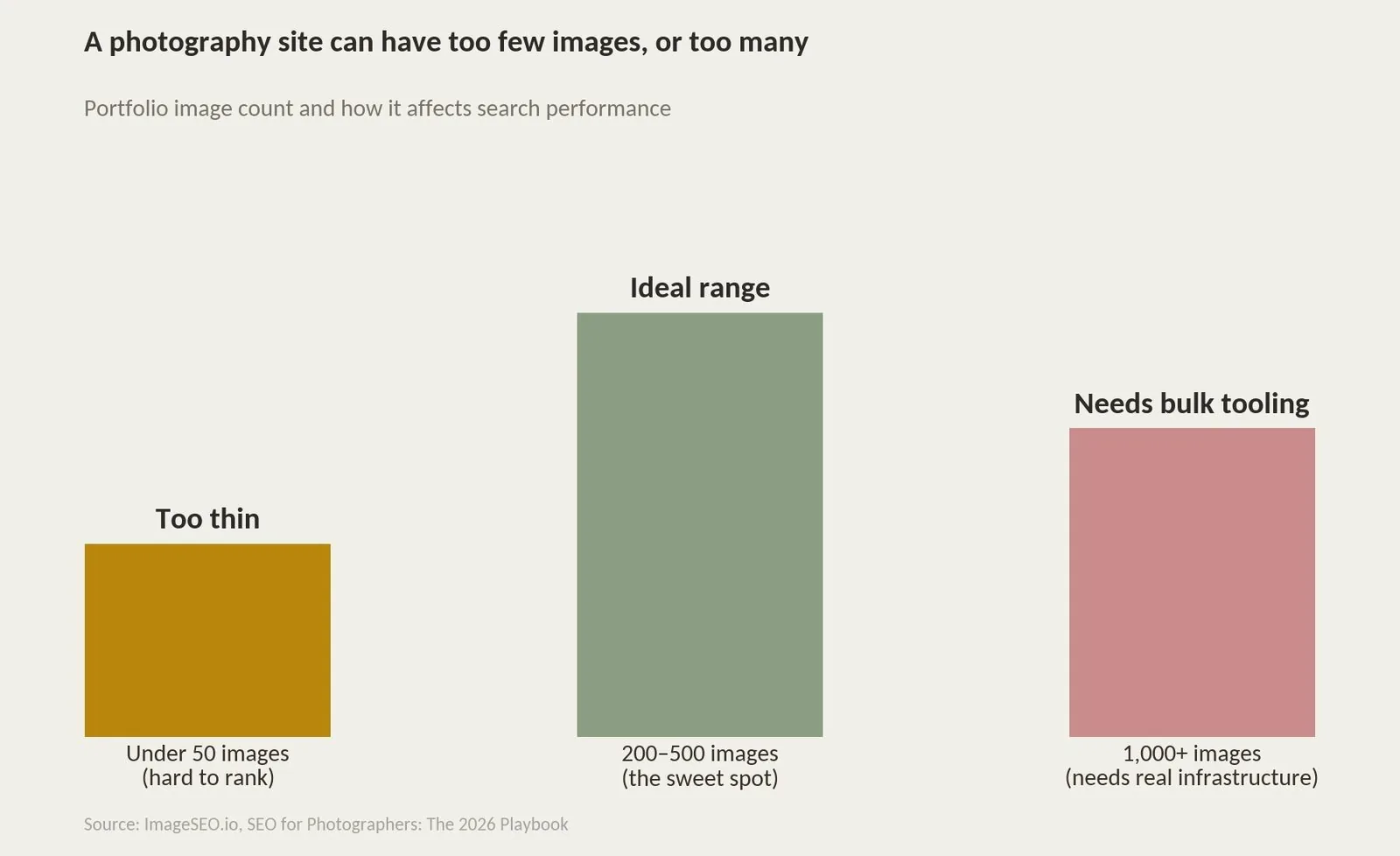
- A photography site with under 50 images struggles to rank, while 200 to 500 well-optimized images tends to be the sweet spot, and sites approaching 1,000+ images need real image-compression infrastructure to avoid hurting page speed. (ImageSEO.io)
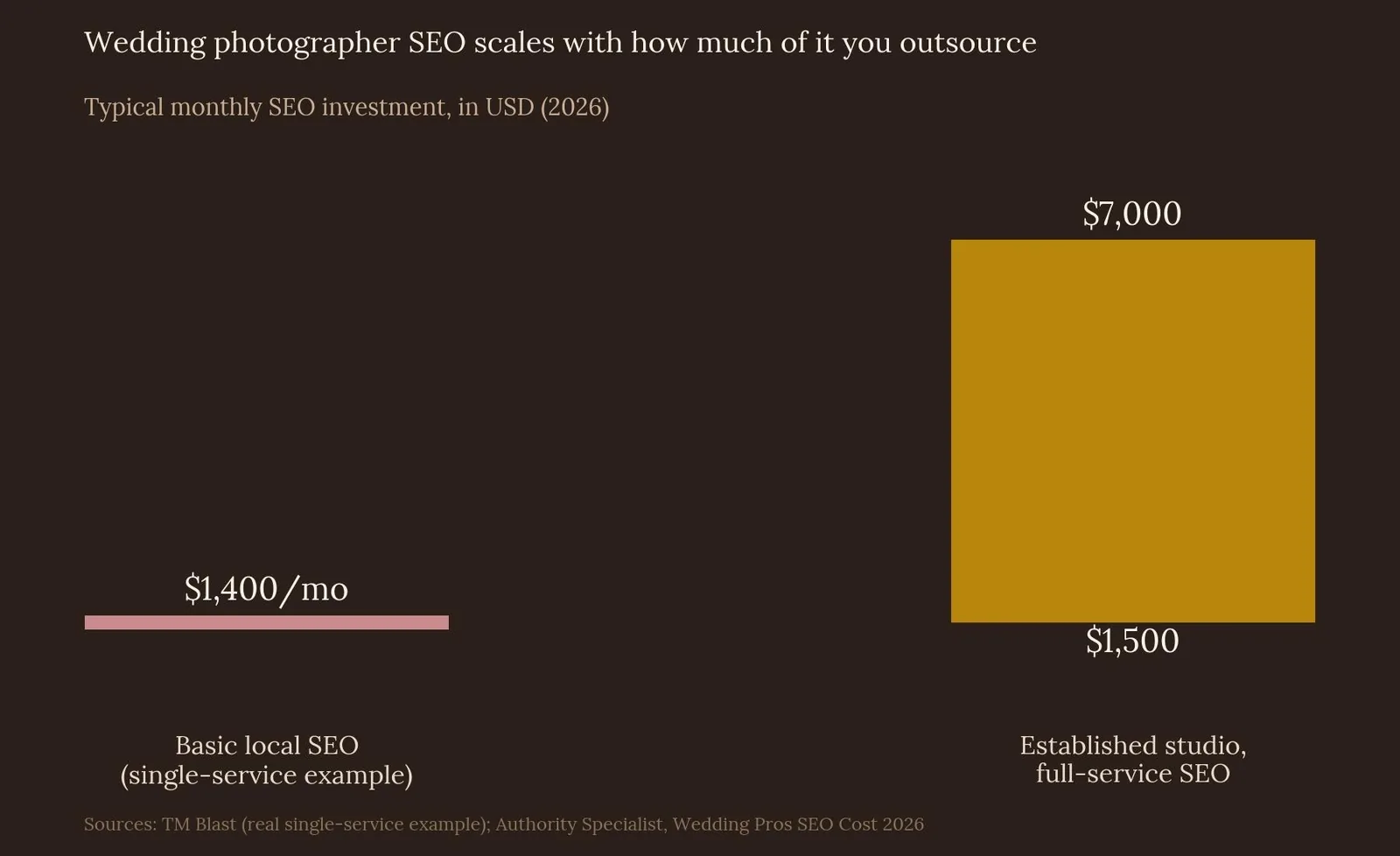
- Wedding photographer SEO ranges from around $1,400 a month for a basic single-service local SEO package up to $1,500 to $7,000 a month for established studios running full-service SEO, with most full-service engagements needing a 6-month minimum given how long couples take to book. (TM Blast, Authority Specialist)
- Blog content built around real weddings and specific venues captures long tail searches that a homepage alone never will, and photographers who publish consistently over 12 to 18 months tend to see Google Search grow into 40%+ of total bookings. (ImageSEO.io)
- 64% of wedding professionals say Google Search is their top lead source, and among photographers specifically, a properly optimized Google Business Profile — not Instagram — is usually the single highest-leverage local SEO asset a photography business has. (WeddingProSEO)
What Makes SEO for Wedding Photographers Different
A wedding photography business lives or dies on trust built through images, which flips the usual SEO priority order. Where a typical local business might split its effort 70% content, 20% technical work, 10% images, photographers should run closer to the opposite: image optimization first, local SEO second, supporting content third. Google can't actually see a photo. It reads file names, alt text, and surrounding page content to understand what an image shows, and most photographers either skip this step entirely or paste their business name into every alt field.
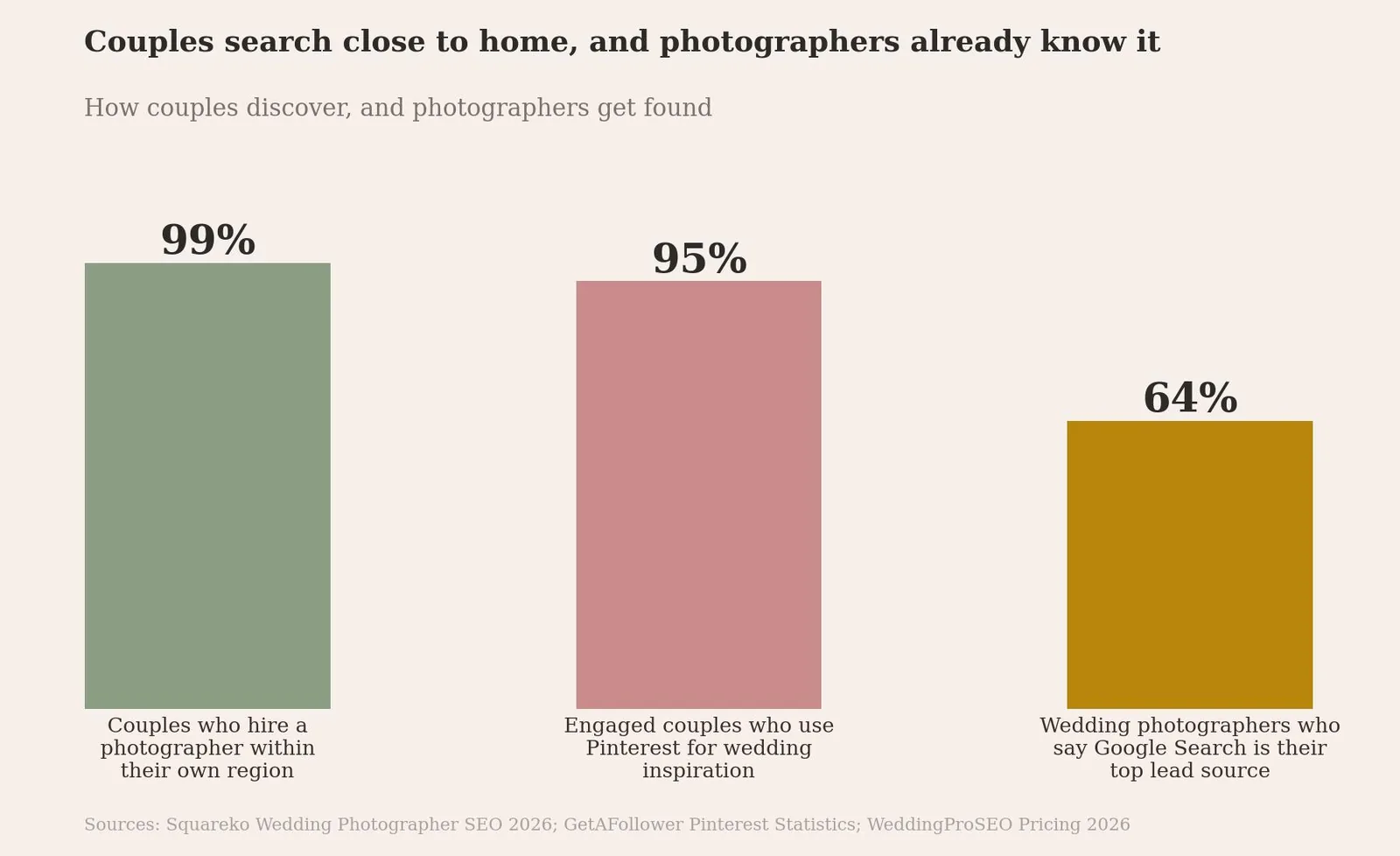
Couples confirm this pattern in how they actually search. 99% of couples hire a photographer within their own region, and 95% of engaged couples use Pinterest for wedding inspiration during the planning process, whether they're in Chicago, Los Angeles, Austin, or Miami. 64% of wedding professionals say Google Search is their top lead source. That's a strong signal that the photographers winning local search aren't necessarily the most talented — they're the ones whose sites actually help search engines and couples find them.
Image SEO: Why Your Portfolio Does More Work Than Your Blog
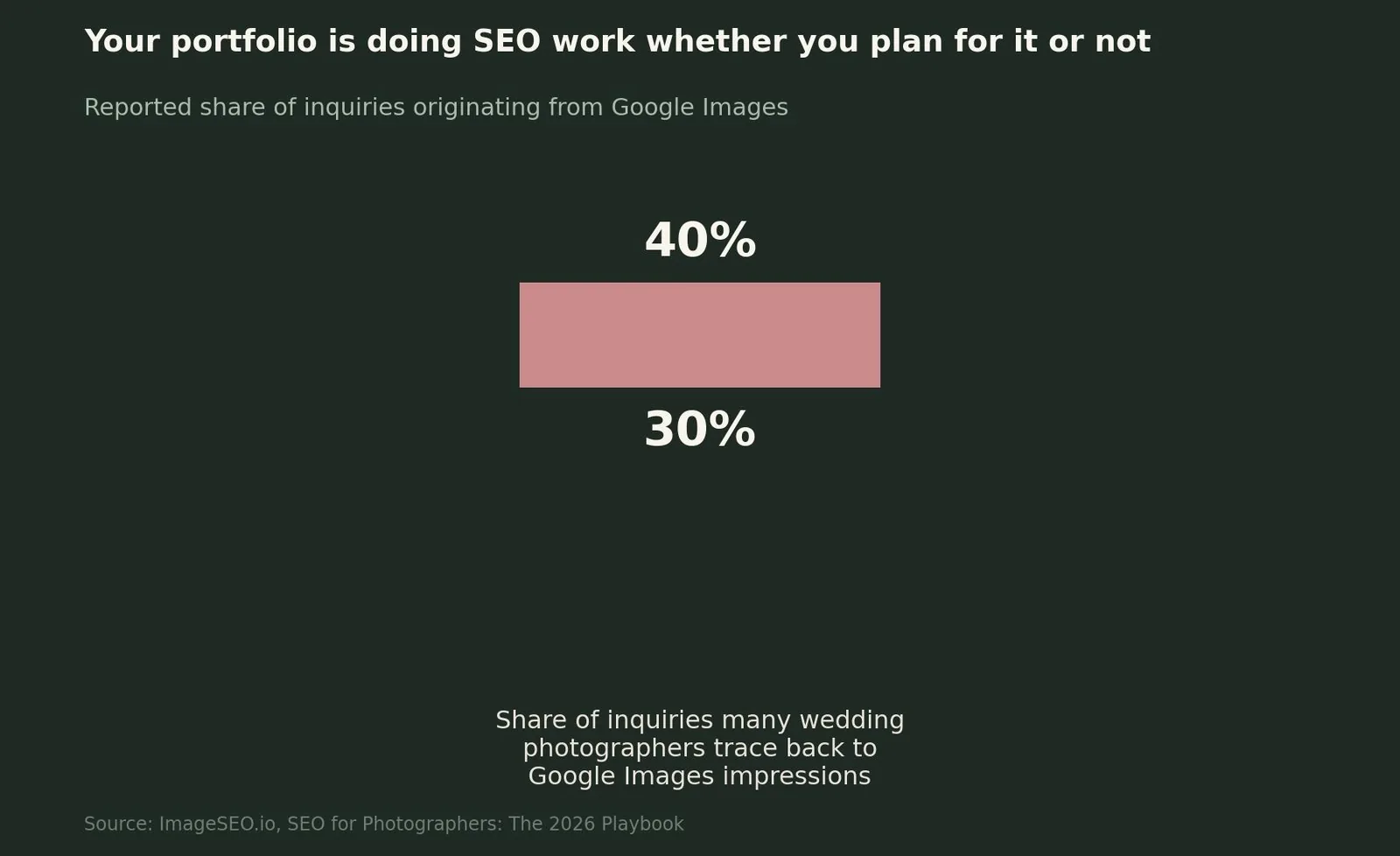
Many wedding photographers report that 30% to 40% of inquiries originate from Google Images impressions, since couples search Google Images directly during venue research and style discovery. That makes alt text one of the single most important ranking signals on a photographer's website, because couples search Google Images directly during venue research and style discovery.
Good alt text describes what's actually happening in the image naturally, for example "bride and groom sharing a first dance at a historic venue in Austin," rather than a string of keywords. (Format) File names matter just as much: a file exported as a descriptive name before upload, rather than a generic camera-generated name, gives search engines genuine content to work with. Export finished images as JPEG or PNG depending on the platform's requirements, and compress aggressively. Large uncompressed image files are the leading cause of slow photography websites.
Own Your Venue and Location Keywords
Couples rarely search "best wedding photographer". They search a venue name, a city, or a style: "Fairmont wedding photographer", "documentary wedding photographer Montreal", "winter elopement photographer". That is good news, because those queries have far less competition than the head term and far higher intent — the couple has usually already put a deposit on the venue.
The structure that captures this is a small, honest set of pages rather than a programmatic sprawl. One page per market you actually shoot, one page per venue you have genuinely worked, each carrying real images from that place. A venue page with a full gallery, notes on where the light falls at 5 p.m., and the practical constraints of the space is nearly impossible for an out-of-town competitor to fake.
| Page type | Keyword focus | What has to be on the page |
|---|---|---|
| Home | Brand + primary city | Signature portfolio, service area, one clear inquiry CTA |
| City / location page | "wedding photographer + city" | Local real weddings, named venues, pricing range, travel policy |
| Venue page | "venue name + wedding photographer" | Full gallery shot at that venue, light and timing notes, logistics |
| Real wedding post | Venue + season + style long-tail | 30 to 60 captioned images, vendor credits, couple's story |
| Pricing / investment | "wedding photography prices + city" | Starting price, package inclusions, what drives cost up |
Google Business Profile Is the Highest-ROI Hour in Your Week
For a service business tied to a geography, the local pack often sits above every organic result. Claiming and completing a Google Business Profile — correct category, service area, hours, and a steady flow of photos — is the cheapest ranking work available, and Google's own guidelines for representing your business spell out what is allowed. Add recent work monthly, because a profile with fifteen images from three years ago reads as inactive to both the algorithm and the couple comparing you to two other photographers.
Reviews are the other half. Ask every couple at delivery, while the gallery is still exciting, and reply to each review with a sentence that names the venue — a natural way to reinforce the geography you want to rank for. Google's review policies prohibit incentivized reviews, so keep the ask simple and unpaid.
Blog Real Weddings as Search Assets, Not Diary Entries
A real-wedding post is the most underused SEO asset in this industry. Treated properly it targets a specific long-tail query, proves venue experience, feeds your location pages with internal links, and gives vendors a reason to link back to you. Treated as a diary entry — twelve untitled images and two sentences — it ranks for nothing.
The version that works: a title built around venue plus season or style, a short story of the day, 30 to 60 images with descriptive filenames and alt text, full vendor credits with links, and one clear link to the relevant venue or city page. Compress before upload and serve modern formats, following Google's image best practices, so a 50-image gallery does not sink your page speed.
One thorough post a month beats four thin ones. Within a year that library is what makes a small studio findable for the exact searches its ideal couples are typing.
Frequently Asked Questions
How many location pages should a wedding photographer have? One per market you genuinely serve and can show work from, not one per town within driving distance. A page with three real weddings shot in that city, named venues, and specific local detail will outrank ten thin pages that swap the city name. Most photographers are well served by one primary city page plus pages for the two or three venues or regions they shoot most.
Do venue-specific pages really bring in inquiries? They are usually the highest-intent traffic a photographer gets, because someone searching a venue name plus "photographer" has already booked or shortlisted the venue. The page needs to prove you have shot there: a full real-wedding gallery, timing notes for the light at that property, and practical logistics only someone who has worked the space would know.
Is blogging still worth it when most of my inquiries come from Instagram? Instagram creates demand but leaves no searchable record. A blogged real wedding keeps working for years, ranks for venue and city queries, and gives you something to link from your location pages. The pragmatic split most photographers land on is one thorough real-wedding post per month rather than weekly thin posts.
More from Web Tonic: growth marketing services, data & analytics, performance creative.
Sources: squareko.com · getafollower.com · imageseo.io · tmblast.com · authorityspecialist.com · weddingproseo.com · format.com · support.google.com · developers.google.com