Table of contents

SEO for lawyers is the practice of making a law firm the obvious answer when someone in your area searches for legal help — through local search, practice-area pages, reviews and citable content. It differs from generic SEO because bar advertising rules and Google's trust thresholds both apply.
Key Takeaways
- Google still handles 91.25% of worldwide search, so the local pack and the top three organic results decide most legal enquiries.
- The first organic result earns roughly 39.8% of clicks and the top three together take 68.7% — position four onwards is a rounding error for case volume.
- Google Business Profile signals account for an estimated 32% of local pack influence, yet only 35% of small businesses have claimed a profile at all.
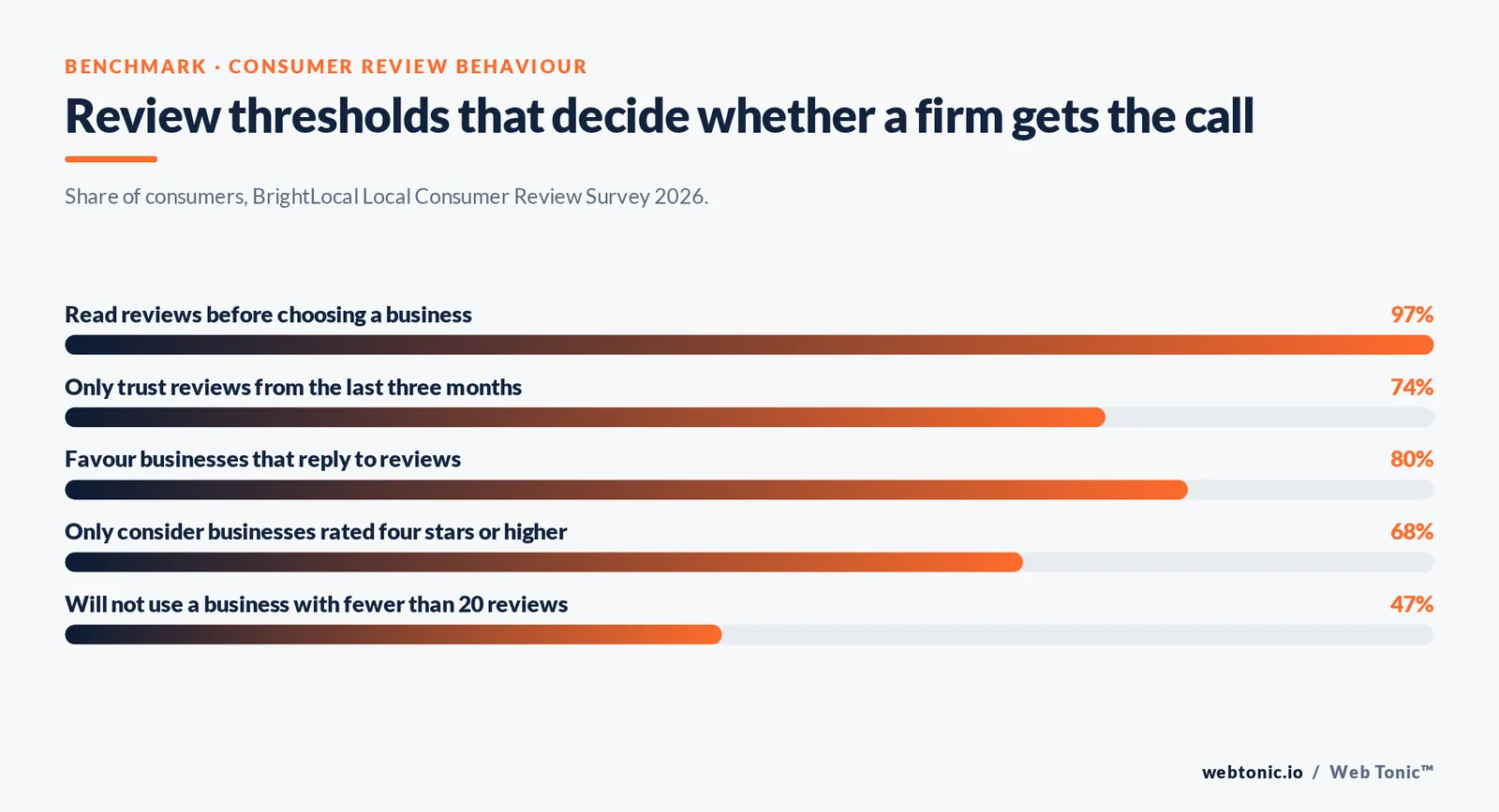
- 47% of consumers will not use a business with fewer than 20 reviews, and 68% only consider businesses rated four stars or higher.
- Legal is the most expensive paid search category at a $9.87 average CPC, which is exactly why organic visibility compounds so well for firms.
- Retainers for professional SEO average $2,917 per month across providers, $3,209 at agencies and $1,348 with freelancers.
- Only 5.7% of new pages reach the top ten within a year, and 72.9% of pages that do rank are more than three years old — legal SEO is a 9-to-18-month programme, not a campaign.
Why SEO for lawyers is a different game
Three constraints make legal SEO unlike SEO for a shop or a SaaS product. First, the queries are high-stakes and Google applies its strictest quality expectations to money-and-life topics, which its own guidance on creating helpful, people-first content ties to demonstrable experience and expertise. A page about a wrongful death claim written by an anonymous freelancer will not compete with one signed by the attorney who tries those cases.
Second, every claim you publish is regulated. State conduct rules on communications about a lawyer's services — see, for example, the California Rules of Professional Conduct — restrict comparative superlatives, testimonials without disclaimers, and anything implying a guaranteed outcome. Marketing copy that would be unremarkable for a plumber can create a disciplinary problem for a firm.
Third, demand is intensely local and intensely competitive. Legal services is a market measured in the hundreds of billions of dollars in the United States alone, and in paid search it is the priciest vertical in the benchmark set at $9.87 per click. Organic and local visibility are the only channels where a well-executed programme keeps paying after the budget stops.
The searches that actually generate cases
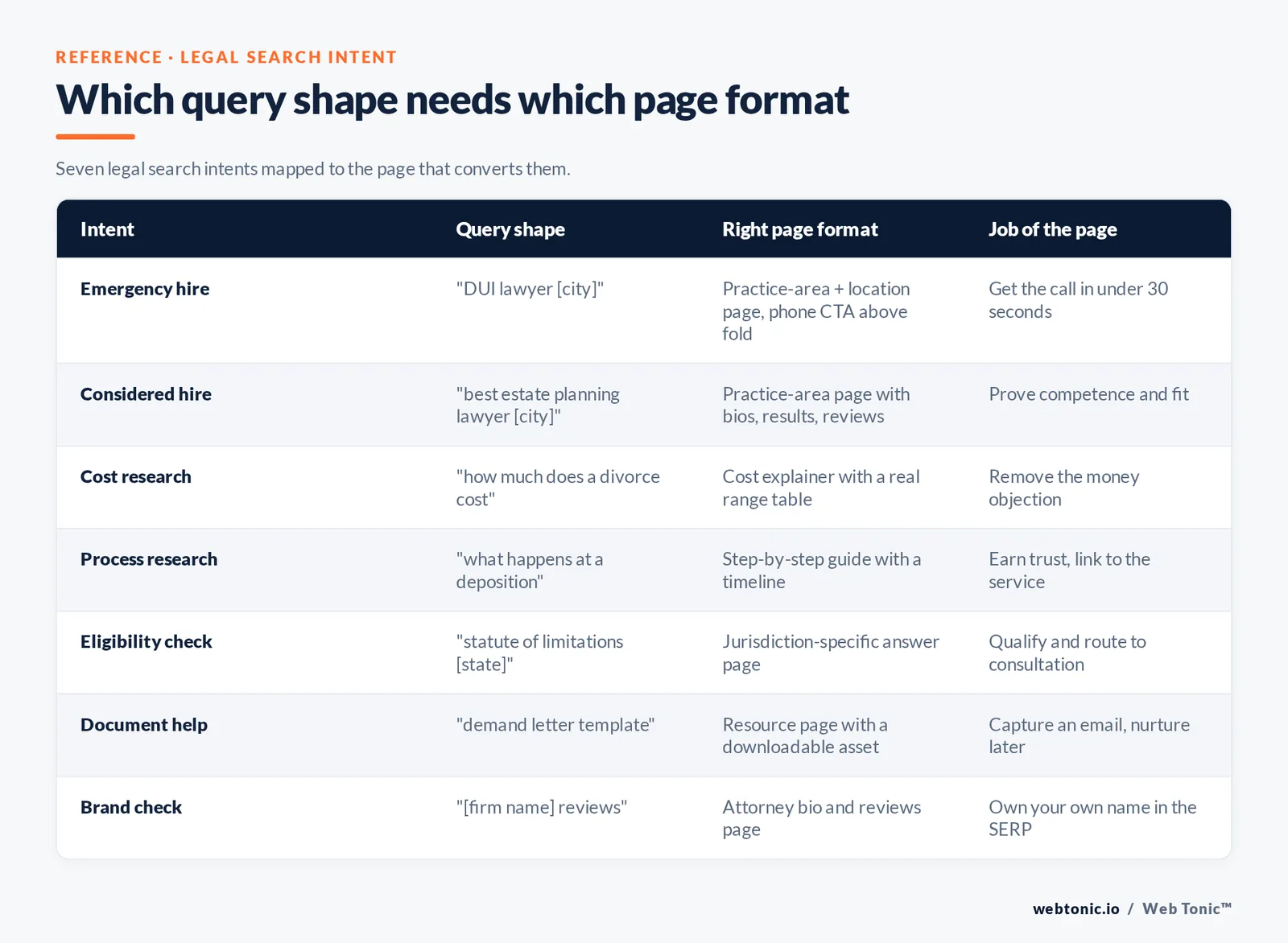
Most firms lose the SEO argument before it starts by chasing volume instead of intent. A term like "personal injury" is a research query; "car accident lawyer near me" and "how long do I have to sue after a car accident in Texas" belong to two completely different funnel stages and need two completely different page formats.
| Intent | Query shape | Right page format | Primary job of the page |
|---|---|---|---|
| Emergency hire | "criminal defense attorney near me", "DUI lawyer [city]" | Practice-area + location page with a phone CTA above the fold | Get the call in under 30 seconds |
| Considered hire | "best estate planning lawyer [city]", "family law firm [neighbourhood]" | Practice-area page with attorney bios, results and reviews | Prove competence and fit |
| Cost research | "how much does a divorce cost", "contingency fee percentage" | Cost explainer with a real range table | Remove the money objection |
| Process research | "what happens at a deposition", "how long does probate take" | Step-by-step guide with a timeline | Earn trust and internal-link to the service |
| Eligibility check | "statute of limitations [state] [claim]", "do I have a case if…" | Jurisdiction-specific answer page | Qualify and route to a consultation |
| Document help | "power of attorney form [state]", "demand letter template" | Resource page with a downloadable asset | Capture an email, nurture later |
| Brand check | "[firm name] reviews", "[attorney name]" | Attorney bio and reviews page | Own your own name in the SERP |
Rule 1 — one primary query per URL. Firms routinely publish four near-identical "car accident lawyer" pages and then wonder why none ranks. Map every target term to exactly one page and record the mapping in a spreadsheet before writing a word.
Rule 2 — build the bottom of the funnel first. Eligibility and cost pages convert at a multiple of blog traffic, and there are far fewer of them to build.
Local SEO: the work that actually moves the map pack
For most firms, the local pack is the single most valuable piece of screen real estate on the internet. Analysis of local ranking signals puts Google Business Profile factors at roughly 32% of local pack influence, ahead of on-page and link signals, and Google reports that a complete profile makes a business 2.7x more likely to be considered reputable, with about 70% more visits and 50% higher purchase consideration. Start with Google's own instructions for editing your business profile and its rules on eligible business categories and service areas.
| Signal | Relative weight | What to do this month | Common firm mistake |
|---|---|---|---|
| Primary category | Very high | Set the most specific category per office ("Personal injury attorney", not "Lawyer") | Generic "Law firm" category |
| Proximity to searcher | Very high | Nothing to hack — instead build content for the suburbs you serve | Fake addresses, which get profiles suspended |
| Review volume and velocity | High | Ask every closed matter; target a steady 4–8 reviews per month | 50 reviews in one week, then silence for a year |
| Review recency | High | Keep a rolling supply — 74% of consumers only value reviews from the last three months | Treating reviews as a one-off project |
| Owner responses | Medium-high | Reply to all of them; 80% of consumers favour businesses that do | Arguing with a one-star reviewer in public |
| NAP consistency | Medium | Match name, address and phone across bar directories and legal listings | Tracking numbers that differ from the profile |
| On-page location signals | Medium | Embed the address, an office photo and LocalBusiness structured data | Address hidden in a footer image |
| Profile completeness | Medium | Hours, services, attorney photos, Q&A, monthly posts | Claimed in 2019, untouched since |
Two structural facts make this the cheapest win available to a firm: 58% of companies still do not optimise for local search at all, and among nearby smartphone searches, 76% result in a visit within a day and 28% in a purchase. Ahrefs' practical walkthrough of local SEO fundamentals is the best free checklist for the mechanics.
Practice-area and location pages without the duplication trap
The standard firm growth model is practice area × location, and it collapses when 40 pages share the same three paragraphs with the city name swapped. A page earns its place when it contains something only that page can contain.
| Page type | Unique content it must carry | Minimum depth | Internal links to add |
|---|---|---|---|
| Practice-area hub | Process, fee structure, who it is for, results, named attorneys | 1,200+ words | Down to sub-services and cost pages |
| Sub-service page | One claim type, its deadlines and its evidence requirements | 800+ words | Up to the hub, across to the FAQ |
| City or borough page | Local courts, filing venue, local statistics, directions, local matters handled | 700+ words | To the relevant practice-area hub |
| Attorney bio | Admissions, notable matters, speaking, publications, jurisdictions | 500+ words | To every practice area they cover |
| Cost page | Real ranges, what drives the number, fee agreement types | 900+ words | To the consultation form |
| Guide or explainer | Statutes, timelines, forms, worked examples | 1,500+ words | To the matching service page |
Limit 3: no more than one page per intent per city. If two of your URLs can answer the same query, Google will pick one and discount the other. Our growth marketing team treats de-duplication as the first task on any legal site with more than 30 service pages.
Content and authority: what earns citations in legal
Links remain the hardest input to fake, and the numbers explain why so many firms fail: 96.55% of all pages receive no organic traffic from Google whatsoever, largely because nothing links to them. Legal has an advantage here — attorneys generate genuinely citable material as a by-product of practising.
| Asset | Why journalists and sites cite it | Effort | Realistic link potential |
|---|---|---|---|
| Case-outcome data study | Original numbers nobody else has | High | 10–40 links per study |
| New-law explainer, published within 48 hours | Speed and authority on a live news hook | Medium | 5–15 links |
| State-specific deadline calculator | Practical tool, endlessly referenced | Medium | 5–20 links |
| Expert commentary for reporters | Named source with credentials | Low, ongoing | 1–3 links per placement |
| Local sponsorship or scholarship | Community relevance | Low | 1–5 links |
| Bar association and CLE contributions | Peer recognition | Medium | 2–8 links |
| Free legal clinic or webinar | Event listings and local press | Medium | 3–10 links |
Keep a standing watch on legal news sources such as the ABA Journal and practice-management research like Clio's Legal Trends work. Both routinely surface the statutory changes and industry shifts that make a fast explainer worth publishing.
Reviews and trust signals are now half the ranking battle
Review behaviour changed sharply in the last two years, and firms operating on 2022 assumptions are losing enquiries they never see. According to BrightLocal's 2026 consumer review survey, 97% of consumers read reviews, 41% now do so every single time (up from 29%), and 54% visit the business's website afterwards. Google's share of where those reviews are read fell from 83% to 71% while generative AI tools jumped from 6% to 45% as a source of local recommendations.
Step 4 — set thresholds, not vanity goals. The practical bar is 20+ reviews minimum, a rating of 4.5 or better (the threshold 31% of consumers now require), fresh reviews inside 90 days, and an owner response on every one. Everything else in review management is optional.
Technical foundations and the metrics that matter
Technical SEO for a law firm is unglamorous and finite: crawlable pages, fast pages, structured data, and a measurement setup that reports signed matters rather than sessions. Meet the Core Web Vitals thresholds — LCP under 2.5 seconds, CLS under 0.1, INP under 200 milliseconds — and you are ahead of the roughly two-thirds of sites that fail at least one.
| Metric | Why it matters for a firm | Healthy direction (90 days) | Where to read it |
|---|---|---|---|
| Signed matters from organic | The only number that pays salaries | Up quarter on quarter | CRM, matched to source |
| Qualified consultations | Leading indicator of signings | Up, with stable qualification rate | CRM plus call tracking |
| Calls from Google Business Profile | Pure local-pack performance | Up 10–30% | Profile performance report |
| Top-3 rankings for money terms | Below three, clicks collapse | More terms in the top 3 | Rank tracker plus Search Console |
| Impressions on cost and eligibility pages | Shows new intent coverage | Up | Search Console |
| Referring domains gained | Authority trajectory | 2–8 per month | Any backlink tool |
| Review count and rating | Ranking and conversion at once | +12–24 reviews, rating held | Profile dashboard |
Instrument this properly once and the arguments stop. Our data intelligence practice exists mostly because firms cannot otherwise tell which of their channels produced last month's cases.
What legal SEO costs and how to evaluate a provider
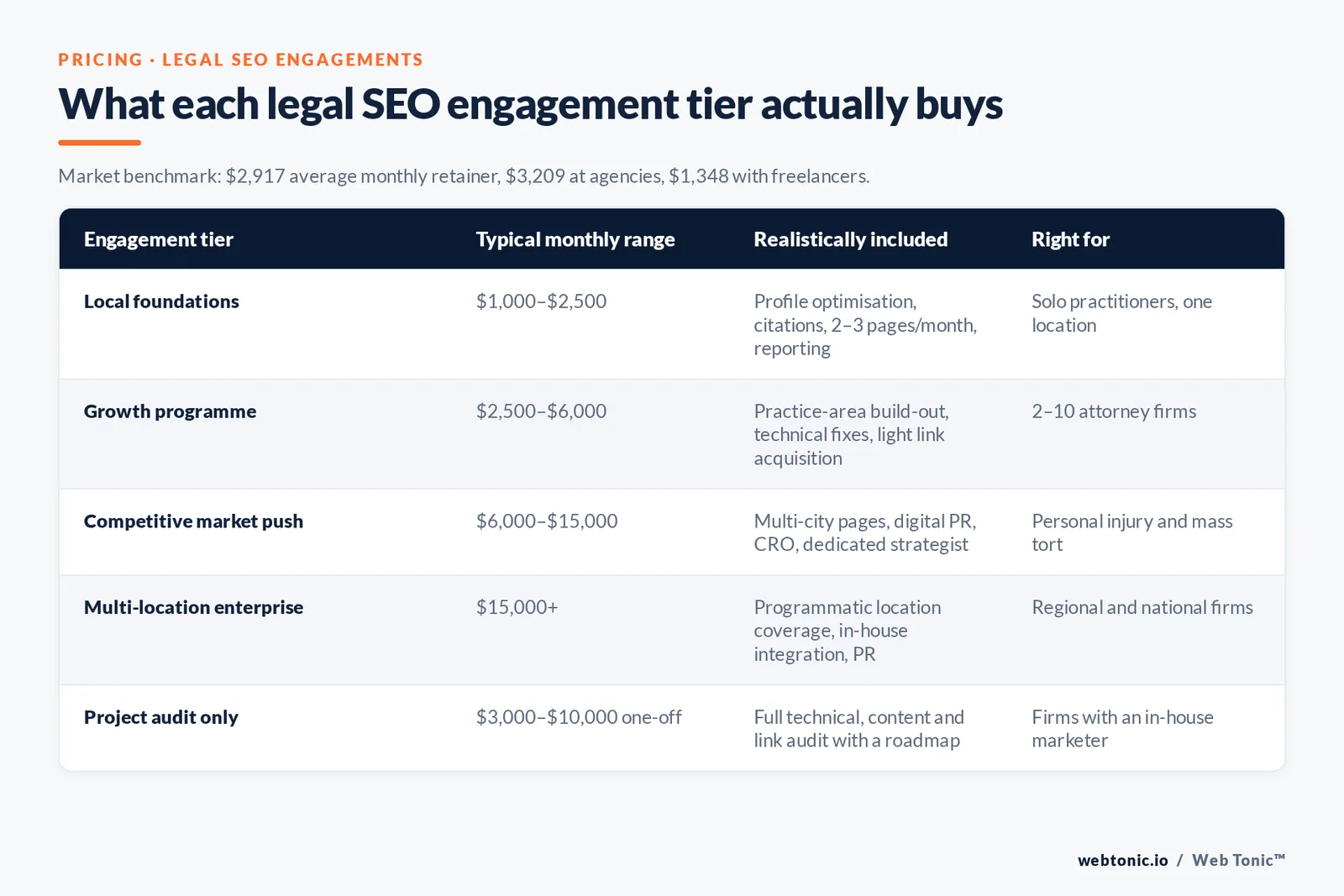
There is no single market rate, but there are defensible benchmarks. Across nearly 440 providers surveyed, monthly retainers averaged $2,917, agencies charged $3,209 and freelancers $1,348, with an average hourly rate of $111 and 78.2% of providers working on retainer. Competitive legal markets sit at the upper end of that range because the content and link requirements are heavier.
| Engagement tier | Typical monthly range | What is realistically included | Right for |
|---|---|---|---|
| Local foundations | $1,000–$2,500 | Profile optimisation, citations, 2–3 pages/month, reporting | Solo practitioners, one location |
| Growth programme | $2,500–$6,000 | Practice-area build-out, technical fixes, light link acquisition | 2–10 attorney firms |
| Competitive market push | $6,000–$15,000 | Multi-city pages, digital PR, CRO, dedicated strategist | Personal injury and mass tort |
| Multi-location enterprise | $15,000+ | Programmatic location coverage, in-house integration, PR team | Regional and national firms |
| Project audit only | $3,000–$10,000 one-off | Full technical, content and link audit with a roadmap | Firms with an in-house marketer |
Rather than ranking agencies, evaluate them. Ask for the last three legal clients' rank-and-revenue trajectories, who writes the content and whether an attorney reviews it, how they handle bar advertising compliance, whether links are earned or bought, and what happens to the assets if you leave. Any provider promising page one in 90 days is contradicting the data: only 5.7% of new pages break into the top ten within a year. If you want that assessment done independently, talk to our team or review how we scope service engagements.
How the plan changes by firm type
| Firm type | First priority | Content engine | Realistic first result |
|---|---|---|---|
| Solo practitioner | Google Business Profile plus one strong practice-area page | Two client-question posts per month | Local pack movement in 60–90 days |
| Boutique (2–10) | Practice-area architecture and attorney bios | Four pages per month, attorney-reviewed | Organic consultations up in 4–6 months |
| Personal injury | City-level pages plus aggressive link acquisition | Data studies and news explainers | Competitive terms in 9–18 months |
| Family law | Cost and process pages | Emotionally clear guides and checklists | Lead volume up in 3–6 months |
| Business and corporate | Thought leadership and named-attorney authority | Regulatory updates, industry briefings | Referral-quality traffic in 6–12 months |
| Immigration | Multilingual eligibility pages | Visa-type explainers and timelines | High volume in 4–8 months |
| Multi-location regional | One profile and one page per office, no duplication | Central hub with local variants | Compounding gains from month 6 |
Whatever the firm type, the website has to be able to carry the programme. Sites that cannot publish a new page without a developer stall within two quarters — one reason our web development team is usually involved before the content plan starts.
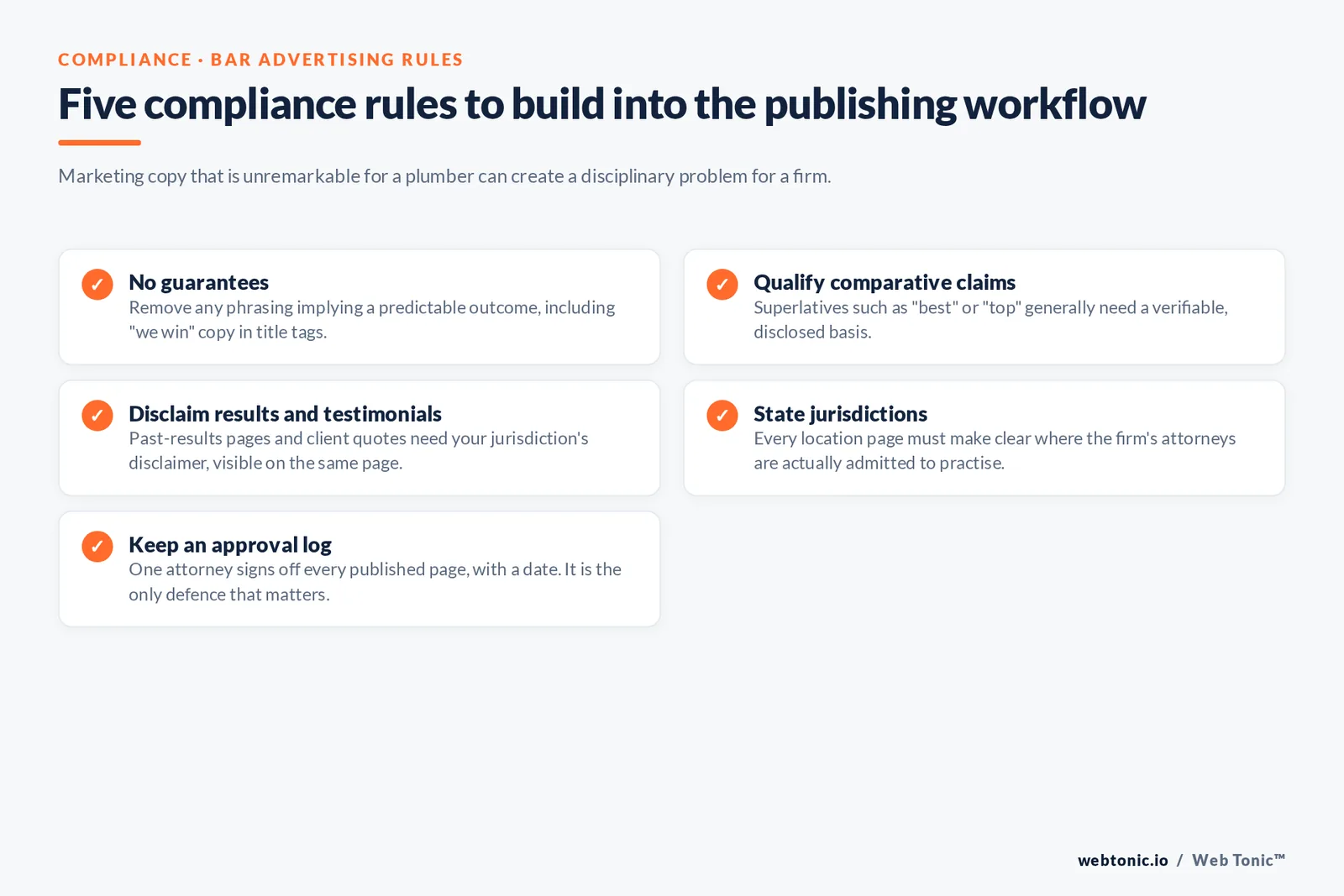
Five compliance rules to build into the workflow
Rule 1 — no guarantees. Remove any phrasing that implies a predictable outcome, including "we win" copy in title tags.
Rule 2 — qualify comparative claims. Superlatives such as "best" or "top" generally need a verifiable, disclosed basis.
Rule 3 — disclaim results and testimonials. Past results pages and client quotes need the disclaimer your jurisdiction requires, visible on the same page.
Rule 4 — state jurisdictions. Every location page should make clear where the firm's attorneys are actually admitted to practise.
Rule 5 — keep an approval log. One attorney signs off every published page, with a date. It takes minutes and it is the only defence that matters.
Editorial standards apply too: advertising claims are also subject to general truth-in-advertising law, summarised in the FTC's advertising and marketing guidance.
A legal digital marketing strategy checklist for building online visibility
Search engine optimization for law firms works best as a written strategy rather than a list of tasks. The checklist below is the one our team uses when a legal marketing agency engagement starts: each row names the strategy, the online visibility it builds, and the expertise required to execute it. Firms focused on personal injury or other competitive practice areas should expect to run all nine rows in parallel; a boutique firm can sequence them one per month.
| Strategy | Visibility it builds | Expertise required | Cadence |
|---|---|---|---|
| Local search optimization | Map pack presence for every location the firm serves | Local SEO specialist | Weekly, 2 hours |
| Practice-area content marketing | Organic visibility for services the firm actually sells | Legal content writer plus attorney review | 2–4 pages/month |
| Authority building through digital PR | Referring domains and brand searches | PR and outreach | 1 campaign/quarter |
| Technical search optimization | Crawlability, speed and structured data eligibility | Developer plus technical SEO | Quarterly audit |
| Review and reputation growth | Local ranking plus conversion of searching clients | Intake team | Daily ask, 5 min |
| Attorney expertise signals | Trust for high-stakes legal queries | Marketing plus each attorney | Bios refreshed 2x/year |
| Conversion optimization on service pages | More clients from the same search traffic | CRO and design | Monthly test |
| Digital advertising alignment | Coverage of terms organic cannot reach yet | Paid search manager | Weekly optimisation |
| Measurement and attribution | Proof of which strategies produce signed matters | Analytics | Monthly report |
Step 1 — write the strategy down. One page: the practice areas ranked by profitability, the locations targeted, the keywords mapped to each page, and the monthly output the firm can genuinely sustain.
Step 2 — assign an owner per row. Legal digital marketing fails most often because reviews belong to nobody and content depends on an attorney with a trial next month.
Step 3 — review the strategy quarterly, not monthly. Search engines need time; changing direction every four weeks guarantees you never learn which strategy worked.
The questions clients are searching for, by practice area
Users rarely search the way lawyers write. They ask questions in plain language, and the firm whose content answers those exact questions is the one that earns the click, the trust and the call. The table maps the most common client questions per practice area to the page that should answer them — the fastest content plan a law firm can build, because the demand is already proven.
| Practice area | Questions clients are searching for | Page that should answer it | Business value |
|---|---|---|---|
| Personal injury | "how much is my injury claim worth", "do I need a lawyer for a car accident" | Claim-value explainer plus a personal injury cost page | Very high |
| Family law | "how long does a divorce take", "who gets custody" | Process timeline and custody guide | High |
| Criminal defence | "what happens after an arrest", "can charges be dropped" | Step-by-step process page per charge type | Very high |
| Estate planning | "do I need a will or a trust", "how much does probate cost" | Comparison page plus a fee explainer | Medium-high |
| Employment | "was I wrongfully terminated", "how long do I have to file" | Eligibility checker and deadline page | High |
| Immigration | "which visa do I qualify for", "how long is the wait" | Visa-type explainers with current timelines | High |
| Business and corporate | "LLC or S corp", "what should a contract include" | Decision guides for founders | Medium |
| Real estate | "do I need a lawyer to buy a house in [state]" | Jurisdiction page per market | Medium |
Rule 6 — one question, one page, one answer. Publish the answer in the first 60 words, then expand. That structure is also what makes a page quotable by AI answer systems, which now supply 45% of local recommendations for some searchers.
FAQ
How long does SEO for lawyers take to work?
Local pack improvements can appear within 60 to 90 days because profile and review signals update quickly. Competitive organic terms take 9 to 18 months, which matches the wider data showing only 5.7% of new pages reach the top ten inside a year and that 72.9% of top-ten pages are older than three years.
Is SEO better than Google Ads for a law firm?
They solve different problems. Paid search buys immediate presence at an average legal cost per click of $9.87, while SEO builds an asset that keeps producing after spend stops. Most firms run paid search for the emergency-hire queries and SEO for the full intent range.
How many reviews does a law firm need?
At least 20, because 47% of consumers will not use a business with fewer, and ideally a rating of 4.5 or above with new reviews inside the last three months. Volume matters less than a steady flow plus a reply on every review.
Should a firm build separate pages for every city it serves?
Only where you can write something genuinely specific to that city — the courts, the venue, the local matters, real directions. Thin location pages that swap a city name into shared paragraphs compete with each other and usually suppress the whole set.
Can a small firm rank against national legal marketing agencies' clients?
Yes, at the local and long-tail level. Proximity and profile quality dominate the local pack, and 58% of companies still do not optimise for local search, so a well-run single-office firm can consistently outrank larger firms for its own city and suburbs.
Sources: Google Search Central documentation on helpful content and LocalBusiness structured data; Google Business Profile Help; StatCounter Global Stats; BrightLocal Local Consumer Review Survey 2026; Ahrefs SEO statistics and local SEO research; Clio Legal Trends resources; Statista legal services topic data; California Rules of Professional Conduct; FTC advertising and marketing guidance; web.dev Core Web Vitals; ABA Journal.