Table of contents

Amazon shoppers aren't browsing. They're buying, and the product that shows up first in that search box is almost always the one that gets the sale. SEO for Amazon sellers is the practice of optimizing titles, images, backend keywords, and the customer signals that follow so your listing is the one Amazon's search engine surfaces first, not your competitor's.
This playbook breaks down what actually moves rankings on Amazon in 2026, the technical limits that quietly sabotage listings when sellers get them wrong, and a practical framework for prioritizing your optimization effort.
Key takeaways
- Conversion rate is the single strongest predictor of Amazon search rank in 2026, ahead of raw keyword density or sales volume alone.
- Backend search terms are capped at 249 bytes, not characters — exceeding the limit by even one byte can silently de-index the entire field with no warning from Amazon.
- Products with 100+ reviews convert 2-3x better than listings with under 20 reviews, and review quality now factors into ranking alongside review count.
- External traffic driven to a listing can influence organic rank, and Amazon's Brand Referral Bonus program offers up to a 10% rebate on sales attributed to tracked external sources.
- "A10" is seller shorthand, not an officially confirmed Amazon algorithm name. Amazon's documented system is still A9, now layered with AI components like COSMO, and understanding that distinction matters more than chasing a named algorithm.
A necessary clarification: what "A10" actually is
Before going further, a clarification worth making up front, since a lot of Amazon SEO content gets this wrong. "A10" is seller shorthand, not an Amazon-confirmed name. The documented system is still A9, now substantially rebuilt around AI and contextual search, per Canopy Management's 2026 breakdown of the Amazon algorithm. Feedvisor's A9 search engine guide makes the same point: the label matters less than understanding where the underlying weighting has actually shifted.
That shift is real, even if the name isn't official. Amazon's ranking system today weighs conversion rate, external traffic, seller authority, and customer satisfaction signals far more heavily than the keyword-matching tactics that worked in 2018.
What actually drives Amazon rank in 2026
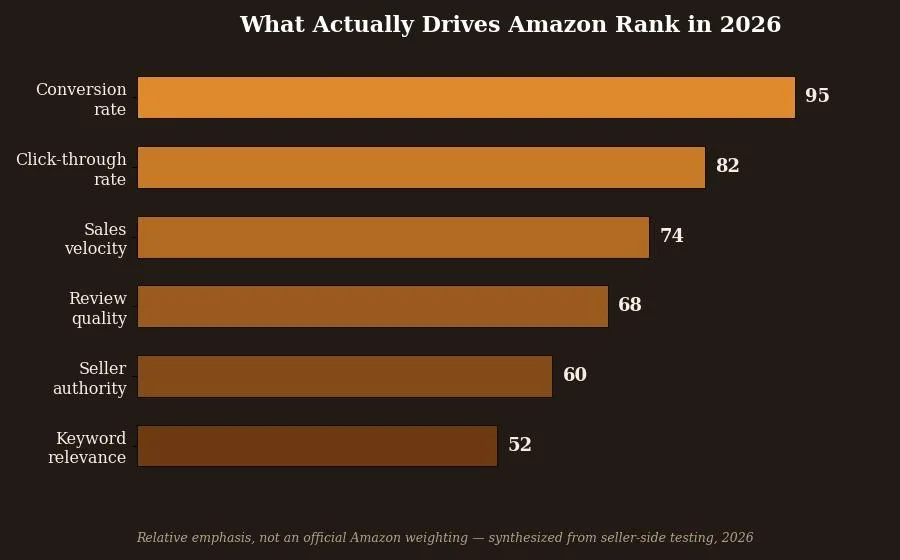
Conversion rate outweighs everything else. A listing that turns clicks into orders at a high rate tells Amazon's systems the product satisfies buyer intent, and Amazon rewards that with more impressions. Lyxel & Flamingo's 2026 guide to Amazon ranking and conversion walks through why. Click-through rate, sales velocity, review quality, and seller authority all matter too, but they largely feed into whether a shopper converts once they land on the page.
This is also why keyword stuffing backfires, and why the shift extends to voice and conversational shopping too. Amazon's semantic layer, commonly called COSMO, is designed to understand what a listing actually communicates about the product, not just which keywords appear in it. A listing built to answer "what is this for" in plain language performs better when a shopper asks Rufus a question than one built purely around keyword density.
The technical limits that quietly sabotage listings
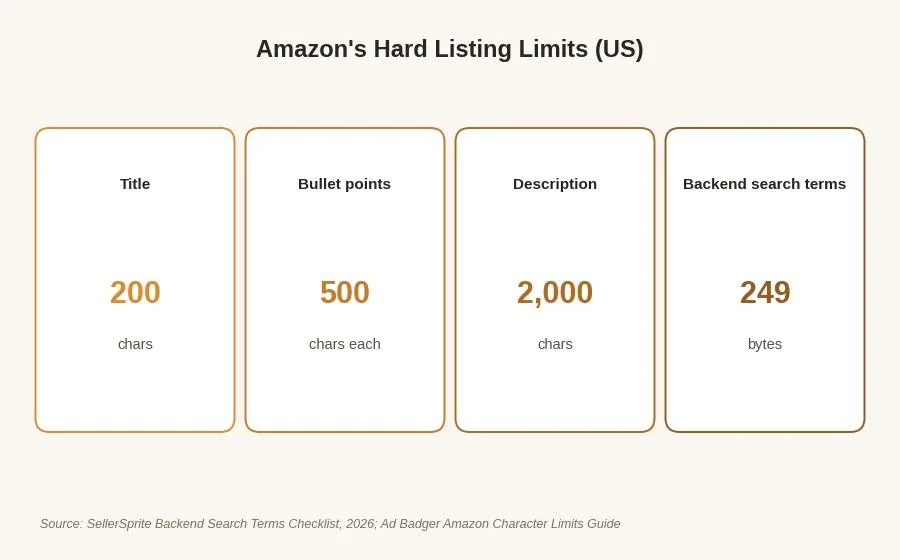
Every field on an Amazon listing has a hard limit, and getting one wrong costs more than a few missed characters:
- Title: 200 characters in most categories, though mobile search results truncate around 70-80 characters.
- Bullet points: 500 characters each, though only the first portion is typically indexed for search.
- Product description: 2,000 characters, including any HTML formatting tags.
- Backend search terms: 249 bytes, not characters. Standard English letters count as one byte each, but accented characters and non-Latin scripts can use two to four bytes. SellerSprite's 2026 backend search terms checklist covers the full field-by-field breakdown.
The backend field is the one that trips up the most sellers. Go one byte over 249, and Amazon may silently ignore the entire field with no error message, no warning, and no indication anything is wrong, per Ad Badger's guide to Amazon keyword limits. A seller who writes 300 characters thinking they're getting credit for all of them may only be indexed for the first 249 bytes, with everything after silently discarded.
Amazon SEO tool
Listing limit checker
Paste your title and backend search terms to check against Amazon's real limits before you save and risk silent de-indexing.
Comparing keyword placement strategies
| p style="padding:0;margin:0;color:#000000;font-size:11pt;font-family:"Arial";line-height:1.15;orphans:2;widows:2;text-align:center">Field/p> | p style="padding:0;margin:0;color:#000000;font-size:11pt;font-family:"Arial";line-height:1.15;orphans:2;widows:2;text-align:center">Visible to customers/p> | p style="padding:0;margin:0;color:#000000;font-size:11pt;font-family:"Arial";line-height:1.15;orphans:2;widows:2;text-align:center">Best use/p> | p style="padding:0;margin:0;color:#000000;font-size:11pt;font-family:"Arial";line-height:1.15;orphans:2;widows:2;text-align:center">Common mistake/p> |
|---|---|---|---|
| p style="padding:0;margin:0;color:#000000;font-size:11pt;font-family:"Arial";line-height:1.15;orphans:2;widows:2;text-align:left">Title/p> | p style="padding:0;margin:0;color:#000000;font-size:11pt;font-family:"Arial";line-height:1.15;orphans:2;widows:2;text-align:left">Yes/p> | p style="padding:0;margin:0;color:#000000;font-size:11pt;font-family:"Arial";line-height:1.15;orphans:2;widows:2;text-align:left">Primary keyword, key attribute, brand/p> | p style="padding:0;margin:0;color:#000000;font-size:11pt;font-family:"Arial";line-height:1.15;orphans:2;widows:2;text-align:left">Keyword stuffing past the point of readability/p> |
| p style="padding:0;margin:0;color:#000000;font-size:11pt;font-family:"Arial";line-height:1.15;orphans:2;widows:2;text-align:left">Bullet points/p> | p style="padding:0;margin:0;color:#000000;font-size:11pt;font-family:"Arial";line-height:1.15;orphans:2;widows:2;text-align:left">Yes/p> | p style="padding:0;margin:0;color:#000000;font-size:11pt;font-family:"Arial";line-height:1.15;orphans:2;widows:2;text-align:left">Benefits, use cases, objection handling/p> | p style="padding:0;margin:0;color:#000000;font-size:11pt;font-family:"Arial";line-height:1.15;orphans:2;widows:2;text-align:left">Repeating title keywords instead of adding new terms/p> |
| p style="padding:0;margin:0;color:#000000;font-size:11pt;font-family:"Arial";line-height:1.15;orphans:2;widows:2;text-align:left">Description/p> | p style="padding:0;margin:0;color:#000000;font-size:11pt;font-family:"Arial";line-height:1.15;orphans:2;widows:2;text-align:left">Yes/p> | p style="padding:0;margin:0;color:#000000;font-size:11pt;font-family:"Arial";line-height:1.15;orphans:2;widows:2;text-align:left">Deeper story, additional use cases/p> | p style="padding:0;margin:0;color:#000000;font-size:11pt;font-family:"Arial";line-height:1.15;orphans:2;widows:2;text-align:left">Leaving it thin or duplicating bullet content/p> |
| p style="padding:0;margin:0;color:#000000;font-size:11pt;font-family:"Arial";line-height:1.15;orphans:2;widows:2;text-align:left">Backend search terms/p> | p style="padding:0;margin:0;color:#000000;font-size:11pt;font-family:"Arial";line-height:1.15;orphans:2;widows:2;text-align:left">No/p> | p style="padding:0;margin:0;color:#000000;font-size:11pt;font-family:"Arial";line-height:1.15;orphans:2;widows:2;text-align:left">Synonyms, misspellings, regional variations/p> | p style="padding:0;margin:0;color:#000000;font-size:11pt;font-family:"Arial";line-height:1.15;orphans:2;widows:2;text-align:left">Repeating keywords already indexed elsewhere, wasting bytes/p> |
Never repeat a keyword already present in your title or bullets within backend search terms. Amazon has already indexed those; repeating them wastes limited byte space that could capture an entirely new search term.
Reviews: a conversion lever and a ranking signal
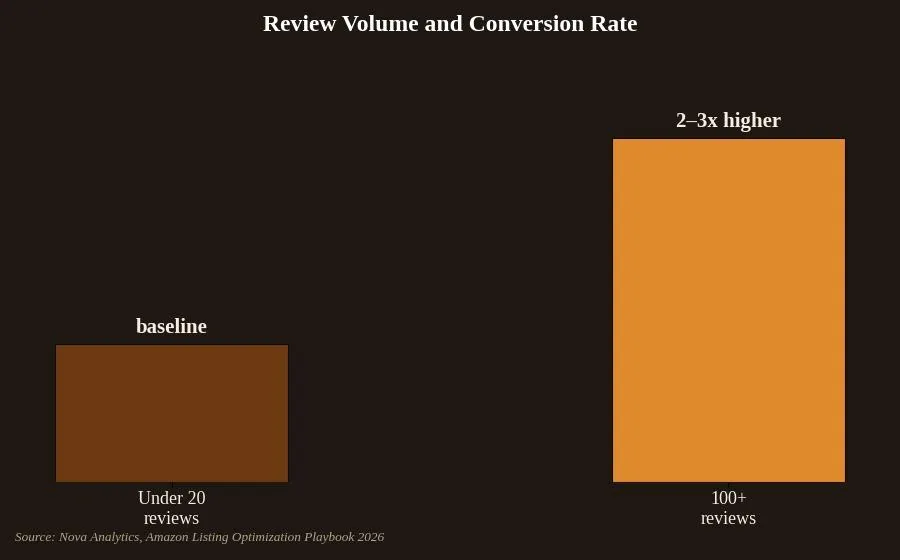
Reviews do two jobs on Amazon simultaneously: they're social proof that helps a shopper decide to buy, and they're a signal Amazon's system reads directly. Products with 100+ reviews convert 2-3x better than listings with fewer than 20 reviews, according to Nova Analytics' Amazon listing optimization playbook.
Volume alone isn't the whole picture anymore. Review quality and helpful-vote rate increasingly factor into how Amazon weighs a listing's trustworthiness, meaning a product with 200 reviews where most are marked helpful can outperform one with twice as many low-detail reviews.
Track what's actually working
Sellers enrolled in Amazon Brand Registry get access to Brand Analytics, including Search Query Performance, which shows exactly how shoppers find and click your listings for a given search term, broken out by impressions, CTR, and conversion rate. This is the most direct way to see whether a specific keyword is pulling its weight or just taking up space in your backend terms. Third-party tools like Jungle Scout and SellerSprite extend this further with keyword tracking and competitor research that Amazon's native dashboards don't surface.
Should you drive traffic from outside Amazon?
Yes, and increasingly it's rewarded rather than ignored. When a shopper finds a product through Google, social media, or an influencer recommendation and then buys it on Amazon, the system reads that as market validation, according to GoAura's 2026 Amazon SEO guide, which also notes Amazon has expanded its Brand Referral Bonus program to offer up to a 10% rebate on sales driven by tracked external traffic.
The caveat: the traffic has to convert. Sending low-quality clicks to inflate visit counts reads as the opposite signal, and can actively hurt rank rather than help it.
This is also part of why Rufus, Amazon's AI shopping assistant, mattered so much in 2025: more than 300 million shoppers used it across the year, with interactions up 210% year over year, according to theStacc's 2026 Amazon SEO guide and Amazon's own Q4 2025 earnings disclosure. Rufus reads the same conversion and review signals before recommending a product, which means the fundamentals that win classic Amazon search also win inside conversational shopping.
FBA sellers carry a built-in edge here too: Amazon's own fulfillment guarantees fast, consistent shipping, which directly strengthens the seller authority signals discussed above.
Common Amazon SEO mistakes
- Keyword stuffing in the title or bullets. Amazon's semantic systems read for meaning, not density, and stuffed listings read as lower quality to both the algorithm and the shopper.
- Repeating keywords across every field. Title, bullets, and backend terms should each capture distinct search terms, not restate the same phrase.
- Ignoring the byte-vs-character distinction in backend search terms. This single mistake silently costs sellers indexing on their most valuable hidden keyword field.
- Chasing review volume without review quality. A large batch of low-detail reviews carries less weight than a smaller set of detailed, helpful ones.
- Sending low-quality external traffic. Clicks that don't convert can hurt organic rank rather than help it.
Frequently asked questions
What is "A10" and is it different from A9?
"A10" is community shorthand sellers use, not an officially confirmed Amazon algorithm name. Amazon's documented system is still called A9, now substantially enhanced with AI layers like COSMO for semantic understanding.
What matters more for Amazon SEO: keywords or conversion rate?
Conversion rate. Keyword relevance is a gate to being considered for a search, but conversion rate, click-through rate, and customer satisfaction signals now drive most of the ranking weight once a listing is in the running.
How many bytes can I use in backend search terms?
249 bytes, not characters. Standard English letters count as one byte each, but accented characters and non-Latin scripts can use two to four bytes, so multilingual keyword sets hit the limit faster than expected.
Does running Amazon PPC ads help organic ranking?
Not directly, but indirectly. Ads don't buy organic rank on their own, but the sales and conversion data a well-targeted campaign generates feeds the same signals Amazon uses to rank listings organically.
How many reviews does a listing need to rank well?
There's no fixed number, but 100+ reviews convert meaningfully better than under 20. Review quality and helpful-vote rate matter alongside volume, so a smaller set of detailed reviews can outperform a larger set of thin ones.
Turning listings into your highest-converting asset
SEO for Amazon sellers in 2026 comes down to one shift: optimizing for the shopper who converts, not the algorithm you think you're gaming. Conversion rate, review quality, and accurate, byte-conscious keyword placement now do more for rank than any amount of keyword stuffing ever did. The sellers still treating Amazon SEO like a 2018 keyword game are watching their best products slide down page one, while the ones optimizing for genuine buyer satisfaction are the ones compounding organic sales velocity month over month.
If you're ready to build an Amazon strategy where listing quality and advertising work together instead of masking each other's weaknesses, Web Tonic's marketplace team rebuilds listings and runs Amazon Ads as a connected system, not a spend dump. See Web Tonic's Growth Marketing services
More from Web Tonic: growth marketing services, data & analytics, performance creative.
Sources: canopymanagement.com · feedvisor.com · lyxelandflamingo.com · sellersprite.com · adbadger.com · novadata.io · goaura.com · thestacc.com