Table of contents

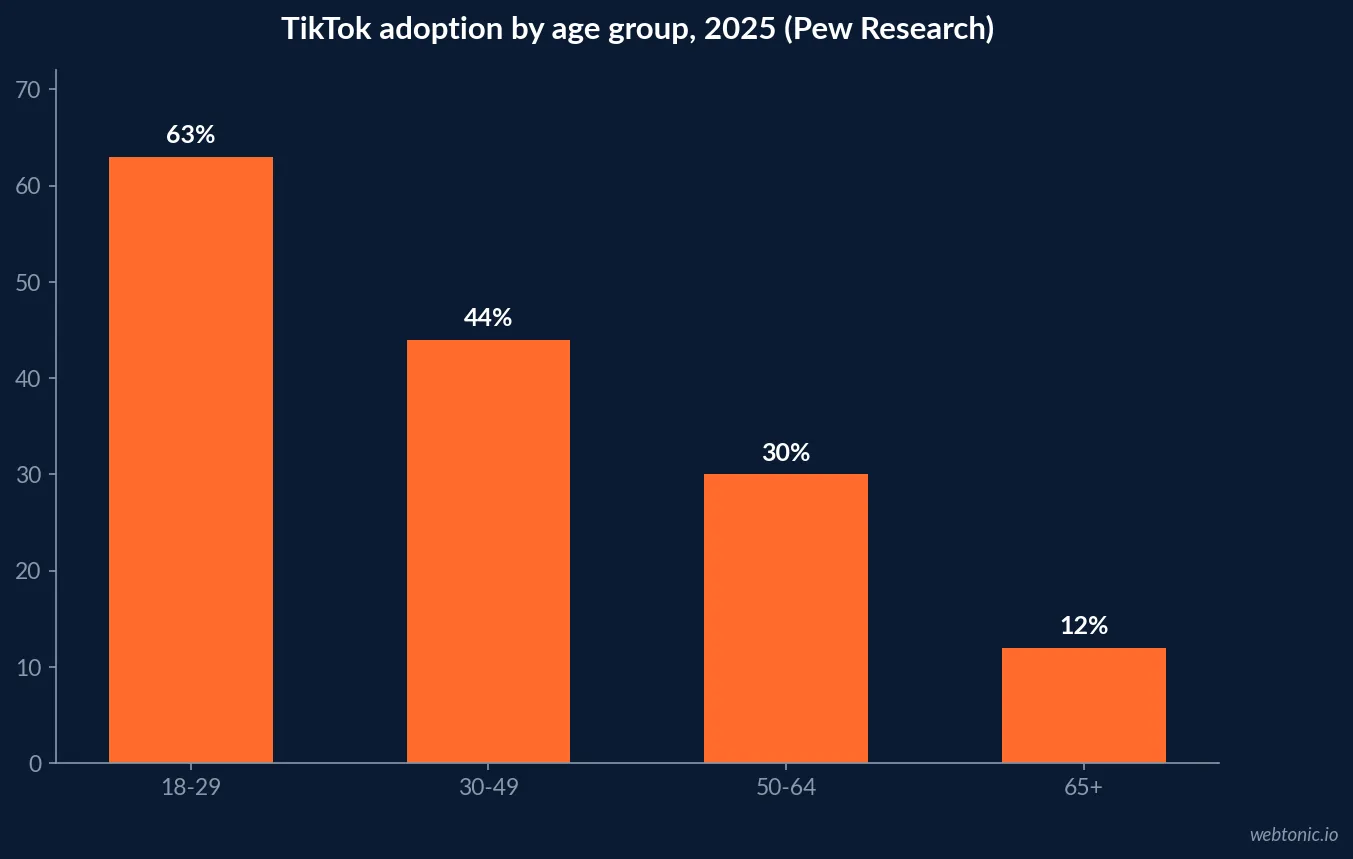
Only 12% of adults 65 and older use TikTok, against 44% of adults 30-49 and 30% of adults 50-64 (Pew Research, 2025). The senior living TikTok buyer is the adult-child caregiver in that middle range, not the future resident - and no TikTok-specific senior living or healthcare ad benchmark exists to size a budget against, a gap this page states plainly rather than papering over with an invented number.
Key Takeaways
- Only 12% of adults 65+ use TikTok, versus 44% of 30-49 year-olds (Pew Research).
- 30% of adults 50-64 use TikTok - the caregiver-heavy middle cohort.
- 63 million family caregivers exist nationwide, most in that 35-64 age band (AARP).
- 55% of caregivers already use technology to manage caregiving tasks (AARP).
- No published TikTok-specific healthcare or senior living ad benchmark exists as of 2026 - stated explicitly, not filled with a guess.
- TikTok adoption among 50-64 year-olds runs 2.5x the 65-plus rate (30% vs 12%, Pew Research).
- One healthcare campaign reported a 44% CPM reduction after shifting spend to the 55-plus segment (Strike Social case study).
- Cross-industry, Health and Fitness Meta CTR runs 1.72%, the closest labeled proxy absent a TikTok figure (WordStream/LocaliQ).
- Health and Fitness Meta CPC runs USD 2.64, cross-industry (WordStream/LocaliQ).
- Assisted living occupancy reached 88.4% in Q2 2026, meaning every extra inquiry matters more (NIC MAP).
- 71% of adults 50-plus bought new technology in 2025, up from 67% in 2024 (AARP).
- 53% of assisted living residents are 85 or older - functionally absent from TikTok's audience (AHCA/NCAL).
Why the audience question comes before the budget question
Before pricing a TikTok campaign, the honest first step is confirming anyone in the target demographic is actually on the platform. Pew Research's 2025 social media use data puts TikTok adoption at 63% of adults 18-29, 44% of 30-49, 30% of 50-64 and just 12% of 65 and older. For a category where the paying decision-maker is usually the resident's adult child, that 30-44% band - not the sub-15% band containing most residents - is the honest target.
| Age group | TikTok adoption (2025) | Relevance to senior living | Source |
|---|---|---|---|
| 18-29 | 63% | Rarely the decision-maker | Pew Research |
| 30-49 | 44% | Primary adult-child caregiver band | Pew Research |
| 50-64 | 30% | Secondary caregiver / early-decision band | Pew Research |
| 65+ | 12% | The resident population, mostly absent | Pew Research |
Stating the gap plainly: there is no TikTok healthcare benchmark
TikTok's own advertiser research tools do not publish per-industry cost or conversion benchmarks the way Meta and Google do, and no association covering senior living - Argentum, AHCA/NCAL, NIC - has published TikTok-specific ad data as of this writing. This page will not invent a CPM or CTR figure to fill that gap. Instead, the closest labeled proxies are used and marked as cross-industry: WordStream/LocaliQ's Meta Ads benchmarks for the Health and Fitness category, which is the nearest published health-adjacent social ad data available.
| Metric (cross-industry proxy) | Health & Fitness figure | Platform | Source |
|---|---|---|---|
| Click-through rate | 1.72% | Meta (not TikTok) | WordStream/LocaliQ |
| Cost per click | USD 2.64 | Meta (not TikTok) | WordStream/LocaliQ |
| Conversion rate | 5.63% | Meta (not TikTok) | WordStream/LocaliQ |
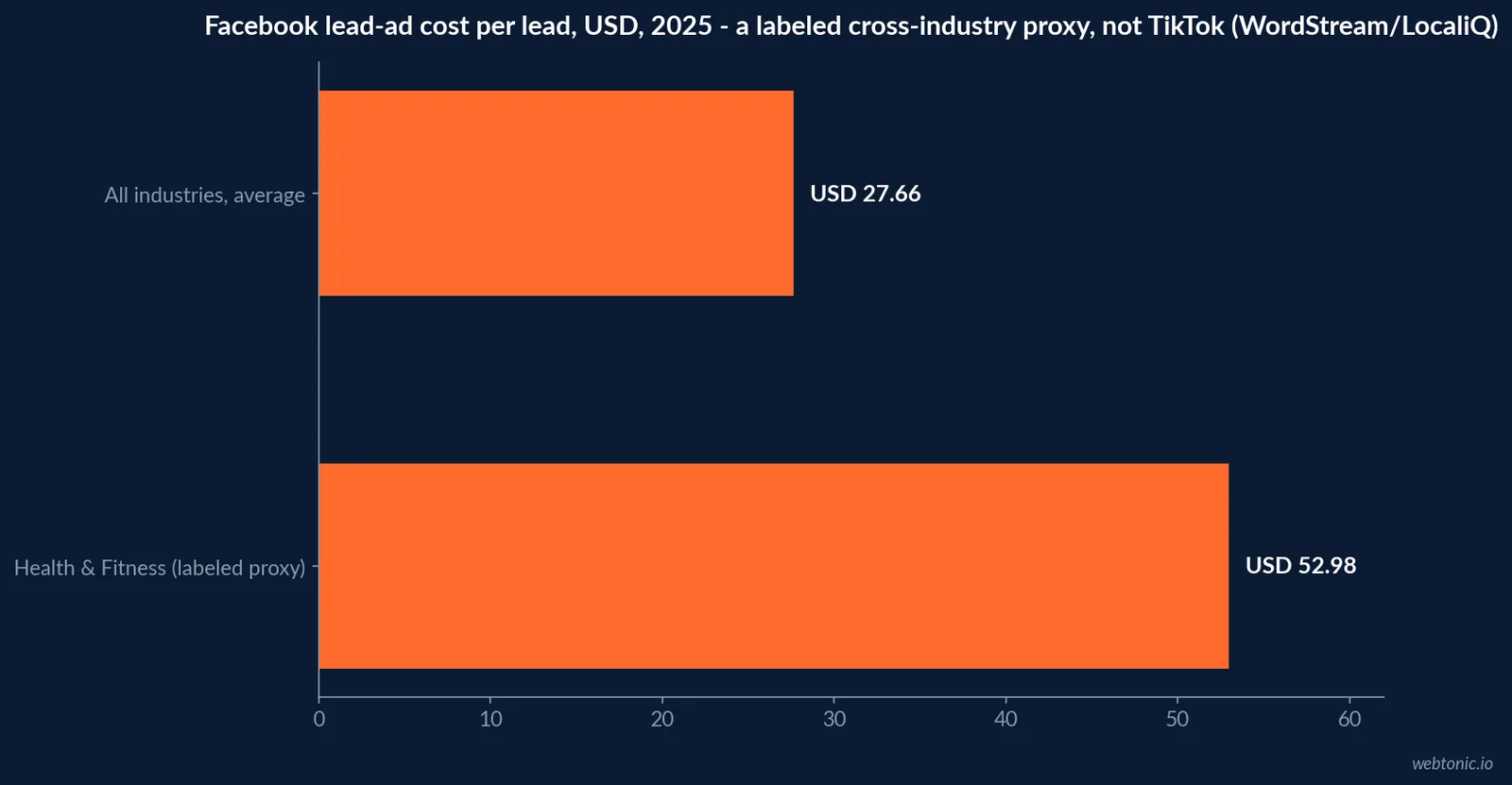
| Cost per lead | USD 52.98 | Meta (not TikTok) | WordStream/LocaliQ |
Every row above is a Meta figure, not a TikTok figure - it is included only because it is the closest labeled health-adjacent paid-social benchmark that exists in public data, and it should be treated as a rough sanity check on CPC and CPL magnitude, not as a TikTok quote. For scale, the all-industries average Facebook lead-ad cost per lead is USD 27.66, against USD 52.98 for Health & Fitness - a health-adjacent category runs roughly double the blended average, cross-industry.
What one disclosed healthcare TikTok case actually showed
The single named senior-adjacent healthcare TikTok case available is Strike Social's 55-plus healthcare campaign case study, which restructured targeting to prioritize the 55-plus demographic over TikTok's default younger skew and reported a 44% CPM reduction along with stronger video completion rates in that older segment - evidence that the 55-plus cohort is an underpriced, "untapped audience" on the platform rather than a dead end. This is one campaign for one healthcare brand, not a senior living benchmark, and the figure should be read as "worth testing," not "expect this."
On the video-completion side, the same Strike Social case reported stronger completion rates in the 55-plus segment than in the campaign's younger default audience - a second signal, alongside the CPM drop, that the platform under-prices this cohort once a campaign is deliberately targeted at it rather than left on TikTok's default younger skew. Pew Research's 2025 adoption data (30% of 50-64 year-olds, 12% of 65-plus) explains why: the buying decision-maker for senior living sits in the age band TikTok already reaches best, even without a category-specific ad benchmark.
| Evidence | Type | Headline figure | Source |
|---|---|---|---|
| 55-plus healthcare campaign | Single paid case study | -44% CPM after re-targeting to 55+ | Strike Social |
| TikTok adoption, ages 50-64 | Platform-wide survey | 30% of adults | Pew Research 2025 |
| TikTok adoption, ages 65+ | Platform-wide survey | 12% of adults | Pew Research 2025 |
Why the caregiver, not the resident, is the media plan
AHCA/NCAL's 2026 fast facts put 53% of assisted living residents at 85 or older, an age band with essentially no TikTok presence per Pew's data. AARP separately counts 63 million family caregivers nationwide and finds 55% already use technology to manage caregiving tasks, with 71% having bought new technology in 2025, up from 67% the year before. Building a senior living TikTok ad around lifestyle footage aimed at the resident misreads both the platform's demographics and the actual research behavior of the person deciding.
How to sequence the spend given the missing benchmark
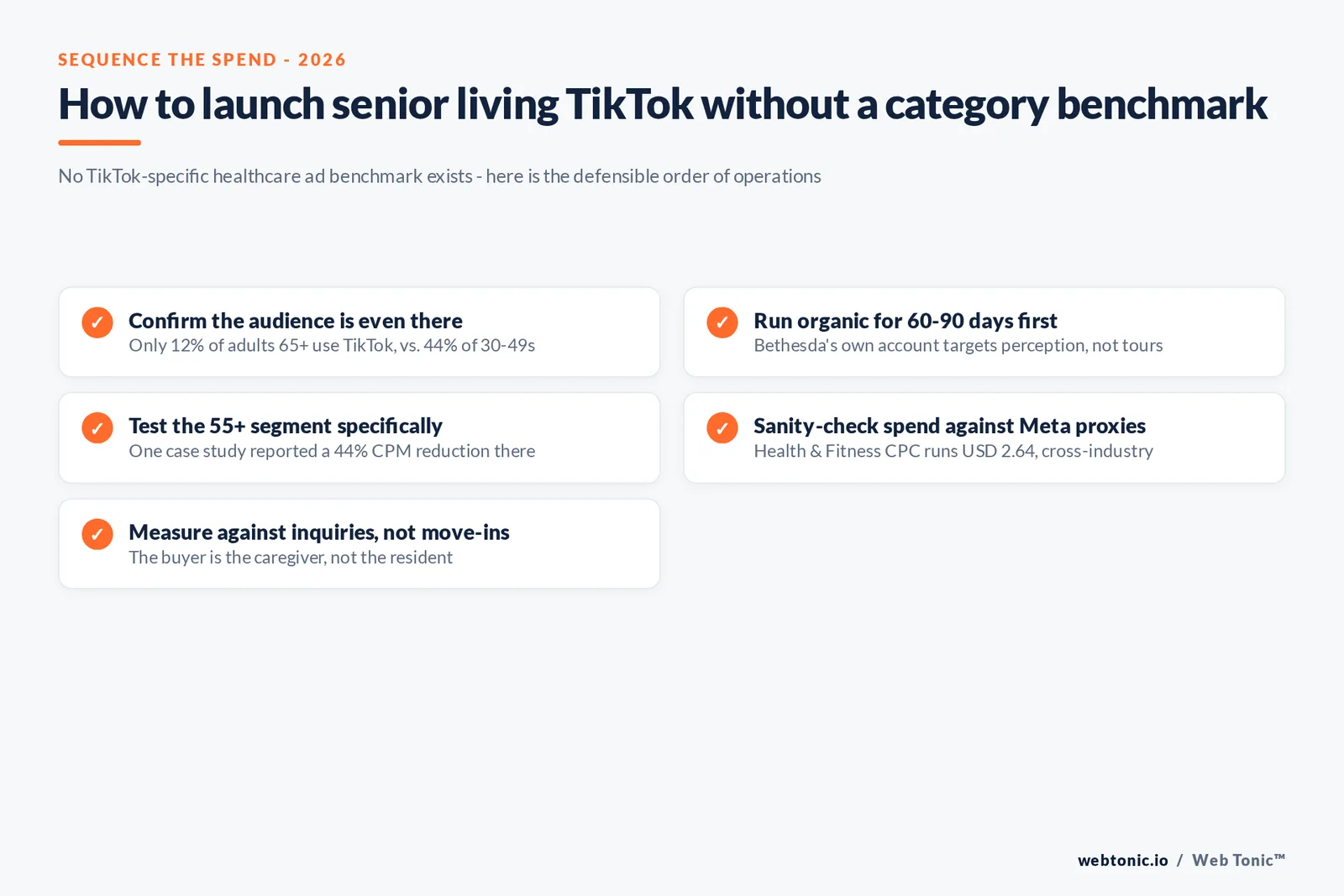
Absent a category-specific rate card, the defensible sequence is organic first, then a small paid test measured against inquiries rather than move-ins: publish resident-life and staff-culture content for 60-90 days to establish an account and gauge organic engagement, then run a limited paid test targeting the 35-64 caregiver band with the cross-industry Health and Fitness CPC (USD 2.64) as a rough sanity check on spend efficiency, adjusting once real platform data comes back. With senior housing occupancy at 88.4% for assisted living (NIC MAP, Q2 2026), even a modest inquiry lift from an inexpensive test is worth the CPM risk. Our performance creative practice builds that organic-first content plan, and our breakdown of what paid social actually costs is a useful comparison point before committing new budget to an unproven channel.
What "underpriced audience" means in practice
Strike Social's framing of the 55-plus cohort as an "untapped audience" is worth unpacking rather than repeating as a slogan. TikTok's default advertiser behavior skews campaigns toward its largest, youngest audience segments, which means older cohorts see less advertiser competition for the same impression - the mechanism behind the reported CPM reduction is auction dynamics, not a change in senior living relevance. That mechanism should hold for other advertisers targeting the 35-64 caregiver band specifically, though it has not been tested for senior living directly in any published case this page could verify.
| Signal | What it suggests | Confidence |
|---|---|---|
| Pew: 30% of 50-64s use TikTok | A real, sizeable caregiver-age audience exists | High - primary survey data |
| Strike Social: -44% CPM for 55+ | Older segments may be underpriced in the auction | Medium - one case study |
| Ogilvy: 2.5B+ views on #medicaltiktok | Health content has real organic demand | Medium - platform content volume, not ad data |
| No published TikTok senior living benchmark | Budget sizing needs its own small test | Stated gap, not filled with a guess |
What organic content operators are already running
Beyond Bethesda's account, senior living operators experimenting with TikTok consistently describe the same use case in public commentary: resident life, staff personality and community culture, never tour scheduling or pricing. That consistency across independent operators is itself a signal - absent a paid benchmark, the organic pattern that has emerged without any central playbook is the closest thing to a validated content strategy this category has. A media buyer should treat the first 60-90 days as content-strategy discovery, not a paid media test. Our team can scope that discovery phase against a specific community's occupancy targets.
Frequently Asked Questions
Do people actually move into senior living because of a TikTok ad?
There is no published study that credits a move-in decision to a TikTok ad specifically, and this page does not claim one. What the data supports is reach into the researching audience: Pew Research finds 44% of adults 30-49 and 30% of adults 50-64 use TikTok, against only 12% of adults 65 and older - so a TikTok budget is buying attention from the adult child doing the research, not the future resident, and should be measured on inquiries and tour requests, not on move-ins directly.
Is there a TikTok ad benchmark specific to senior living or healthcare?
No. TikTok does not publish per-industry ad benchmarks the way Meta and Google do, so this page uses the closest labeled proxies: Pew Research's platform-adoption data by age (audience sizing, not ad cost) and a single disclosed case study - Strike Social's healthcare campaign targeting the 55-plus cohort, which reported lower CPM and stronger video completion than the campaign's younger segments. Treat that case as directional, not as a rate card.
What content actually works for a senior living TikTok account?
The strongest evidence is still Strike Social's disclosed case: stronger video completion rates in the 55-plus segment than in the campaign's younger default audience, alongside the 44% CPM reduction - both point to an under-served older audience once content is targeted correctly rather than left on TikTok's default skew. Pew Research's 2025 data backs that read: 50-64 adoption (30%) runs well ahead of 65-plus adoption (12%), which argues for content built for the adult-child decision-maker rather than the future resident.
Who is the real audience for a senior living TikTok ad?
Adult children and other family caregivers aged roughly 35 to 64, not prospective residents. AARP counts 63 million family caregivers nationwide, and Pew's age breakdown of TikTok use (44% of 30-49s, 30% of 50-64s) sits squarely inside that caregiving-age range. Casting a senior living TikTok ad around a 68-year-old aging-in-place message misses the platform's actual audience for this category by about two generations.
Should a small senior living operator run TikTok ads at all in 2026?
Only after organic testing, given the absence of a category-specific benchmark. AARP's 2026 research found 71% of adults 50-plus bought new technology in 2025, up from 67% in 2024, which signals a digitally engaged caregiver audience worth reaching somewhere - but without a senior living ad benchmark to size a budget against, cross-industry health and fitness Meta figures (the closest labeled proxy, not a TikTok number) are a safer starting reference than guessing at a TikTok-specific CPM.
Sources
Pew Research Center - Demographics of Social Media Users and Adoption
AARP - 2026 Tech Trends and Adults 50-Plus
WordStream/LocaliQ - 2025 Facebook Ads Benchmarks (PDF)
Strike Social - TikTok Case Study: 44% CPM Savings Reaching 55+ Audiences
AHCA/NCAL - Assisted Living Fast Facts and Figures, June 2026
NIC - Senior Housing Occupancy Climbs in Second Quarter 2026