Table of contents
Aline's Q2 2026 CRM data, drawn from senior living communities nationwide, puts web-sourced inquiry-to-tour conversion at 51% to 57% depending on care type - roughly double the 27% to 32% rate for inquiries pooled across every channel. That gap is the argument for treating a senior living landing page as an instrumented funnel, not a brochure.
Key Takeaways
- Web inquiries convert to a tour at 51% to 57%, by care type (Aline, Q2 2026).
- All-source inquiry-to-tour runs only 27% to 32% once every channel is pooled.
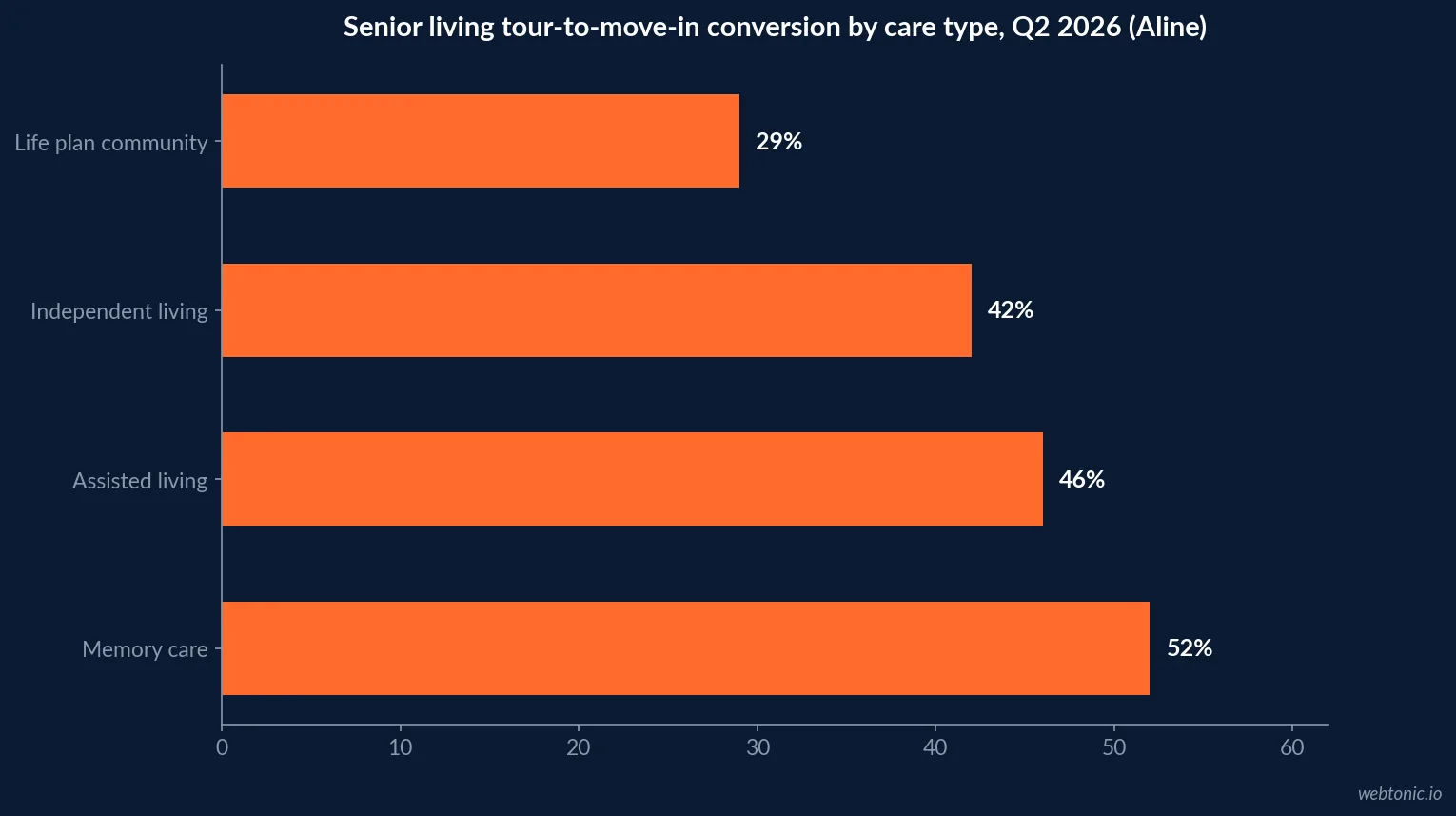
- Tour-to-move-in spans 29% to 52% - narrowest for life plan, widest for memory care.
- Web is now the largest inquiry method for three of four care types, at 38% to 54%.
- Paid/directory inquiries convert to a tour at just 24% to 40%, half the web rate.
- Senior housing occupancy hit 89.9% in Q2 2026, the highest level since 2015 (NIC MAP).
- Assisted living occupancy reached 88.4%; independent living reached 91.3%.
- The AL-IL occupancy gap narrowed to 2.9 points, the smallest since 2014.
- Healthcare search ads convert at 8.09% on average, a cross-industry ceiling for paid traffic (LocaliQ/WordStream).
- The cross-industry landing page median sits at 6.6% across all verticals (Unbounce).
- Healthcare-specific landing pages average roughly 4.2%, cross-industry (CorePPC).
- 1,016,424 residents live in assisted living nationwide (AHCA/NCAL, June 2026).
- 53% of assisted living residents are 85 or older, the cohort whose adult children fill out the form.
- 63 million family caregivers nationwide now use technology to manage care (AARP).
- 55% of caregivers use tech tools to coordinate caregiving responsibilities.
- Assisted living costs USD 74,400 a year on average, the number the form has to justify collecting (AHCA/NCAL).
Benchmarks at a glance
The two data sets below are not interchangeable. Aline's numbers describe the senior living inquiry funnel specifically; the landing page conversion figures are the closest published cross-industry proxies and are labeled as such throughout this page.
| Metric | Figure | Scope | Source |
|---|---|---|---|
| Web inquiry-to-tour (assisted living) | 57% | Senior living, Q2 2026 | Aline |
| All-source inquiry-to-tour (assisted living) | 30% | Senior living, Q2 2026 | Aline |
| Tour-to-move-in (memory care) | 52% | Senior living, Q2 2026 | Aline |
| Healthcare search ad conversion rate | 8.09% | Cross-industry healthcare | LocaliQ/WordStream |
| All-industry landing page median | 6.6% | Cross-industry, all verticals | Unbounce |
| Healthcare landing page average | ~4.2% | Cross-industry healthcare | CorePPC |
Why the funnel, not the page template, is the real metric
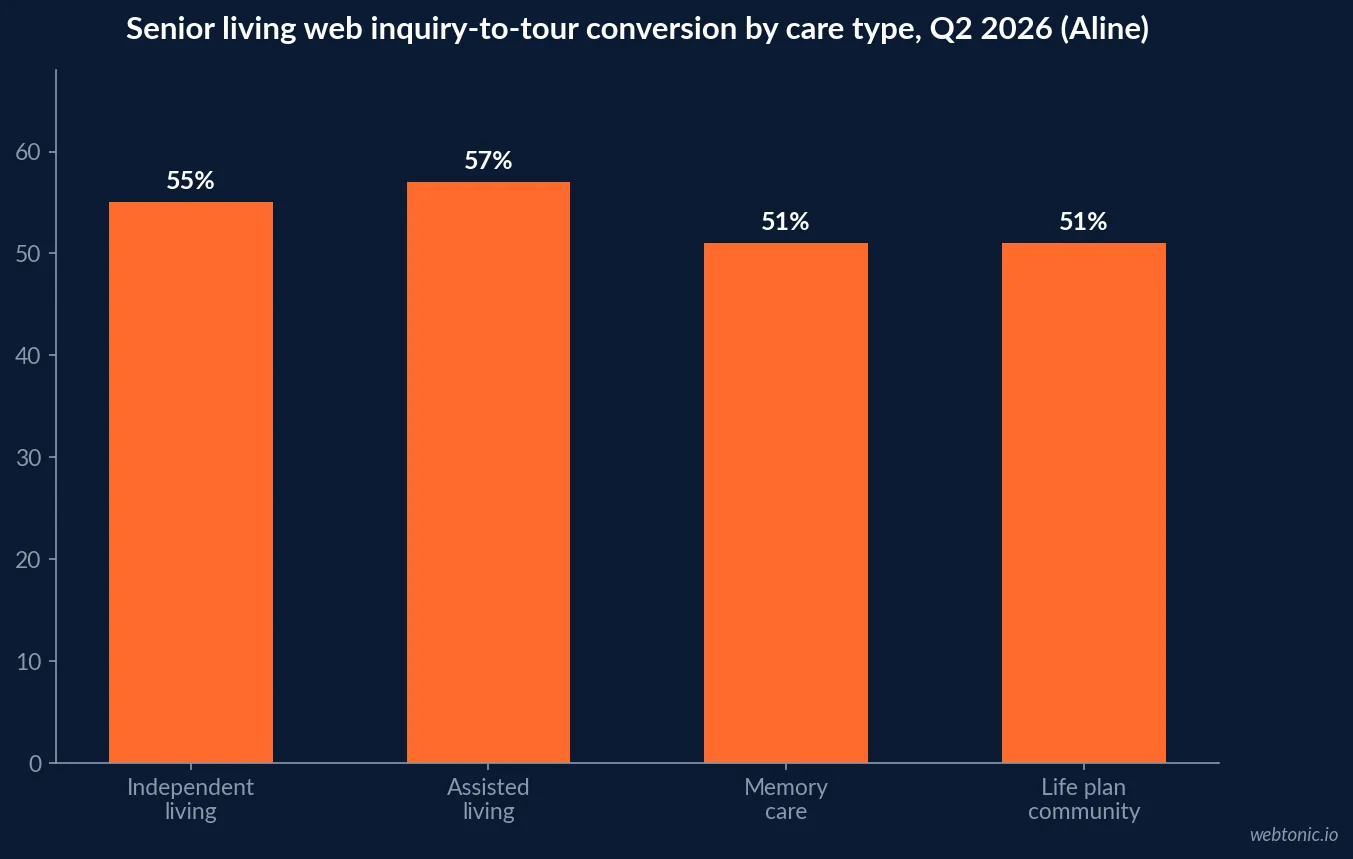
Aline's 2026 Sales & Marketing Benchmark Report tracks inquiries, tours and move-ins across independent living, assisted living, memory care and life plan communities each quarter. In Q2 2026, web-sourced inquiries converted to a scheduled tour at 55% for independent living, 57% for assisted living, 51% for memory care and 51% for life plan communities - against an all-source blended rate of just 27% to 30% across those same four care types. The page is not the whole funnel, but it is the part an operator controls most directly, and it is currently outperforming every other channel by roughly two to one.
| Care type | Inquiry-to-tour (web) | Inquiry-to-tour (all sources) | Tour-to-move-in |
|---|---|---|---|
| Independent living | 55% | 32% | 42% |
| Assisted living | 57% | 30% | 46% |
| Memory care | 51% | 36% | 52% |
| Life plan community | 51% | 27% | 29% |
Where inquiries are actually coming from
Web has become the largest single inquiry method for three of four care types, and paid/directory inquiries still lag web conversion by roughly half. Aline's Q2 2026 method-of-inquiry split:
| Care type | Web share of inquiries | Paid/directory share | Call-in share |
|---|---|---|---|
| Independent living | 54% | 24% | 15% |
| Assisted living | 51% | 26% | 13% |
| Memory care | 38% | 21% | 18% |
| Life plan community | 52% | 4% | 29% |
Paid and directory-sourced leads still convert to a tour at only 24% to 40% depending on care type - a wide range, but every figure in it sits below the web channel's floor of 51%. That gap is the practical argument for spending CRO effort on the operator's own page rather than assuming a third-party directory listing will do the qualifying work.
What the cross-industry landing page numbers actually cover
No published study prices a senior living landing page specifically, so operators researching "good conversion rate" numbers land on cross-industry benchmarks built from unrelated categories. Unbounce's Conversion Benchmark Report, built from more than 57 million conversions across 41,000 landing pages, puts the median at 6.6% with a range of 3.8% to 12.3% across nine verticals; its dedicated healthcare and wellness category sits toward the lower end of that range. These figures describe form-fills on generic landing pages across all of healthcare and wellness, not tour-request pages specifically - use them as a floor to beat, not a target to hit.
| Vertical (cross-industry) | Median landing page conversion | Source |
|---|---|---|
| All industries | 6.6% | Unbounce |
| Legal | 8.5% (avg) | CorePPC |
| Healthcare | 4.2% (avg) | CorePPC |
| Financial services | 4.8% (avg) | CorePPC |
| Real estate | 3.6% (avg) | CorePPC |
The compliance layer a tour-request form has to clear
A senior living inquiry form routinely asks about mobility, memory status or the level of care a prospect needs - health information collected outside a clinical setting but still sensitive. HHS's Office for Civil Rights bulletin on online tracking technologies warns HIPAA-covered entities and their business associates that pixels and analytics scripts placed on pages that transmit this kind of data can trigger compliance exposure. Many senior living operators are not themselves HIPAA-covered entities, but the same pixel-audit discipline - know what every script on the tour-request page actually sends, and to whom - is cheap insurance either way, and increasingly what state attorneys general expect to see.
The FTC's Health Products Compliance Guidance is the second layer: testimonials and before/after framing on a landing page ("she moved in and thrived") need the endorser's honest experience and cannot imply a typical result the operator cannot substantiate.
| Compliance check | Why it applies to a senior living landing page | Source |
|---|---|---|
| Audit every pixel/script on the form page | Care-level fields can carry sensitive health data | HHS OCR |
| Get consent language before third-party trackers fire | Same bulletin, applies pre-consent load | HHS OCR |
| Substantiate resident/family testimonials | Implied results claims need evidence | FTC |
| Avoid disease-treatment claims in ad copy | Assisted living is not a medical treatment | FTC |
Why occupancy at 89.9% raises the stakes on every leak
NIC MAP's Q2 2026 data put senior housing occupancy at 89.9% across the 31 NIC MAP Primary Markets - the highest level since 2015 - with independent living at 91.3% and assisted living at 88.4%, a gap that has narrowed to just 2.9 percentage points, the smallest since 2014. Fifteen of the 31 markets are already above 90% occupied. In a market this tight, a leaking tour-request form is not a minor UX issue; it is turning away demand the community cannot easily replace with a new marketing channel, because new supply growth remains near record lows.
Who is actually filling out the form
AHCA/NCAL's 2026 fast facts put the assisted living population at 1,016,424 residents nationwide, 53% of whom are 85 or older - an age group unlikely to be the one filling out an inquiry form. That job routinely falls to an adult child, and AARP's 2026 research counts 63 million family caregivers nationwide, 55% of whom use one or more tech tools to coordinate care. The page is being read and judged by someone comparing communities on a phone at 11pm, not by the eventual resident - which argues for mobile-first forms and a cost figure early, since AHCA/NCAL puts the average annual cost at USD 74,400.
Fixing the funnel without touching what already works
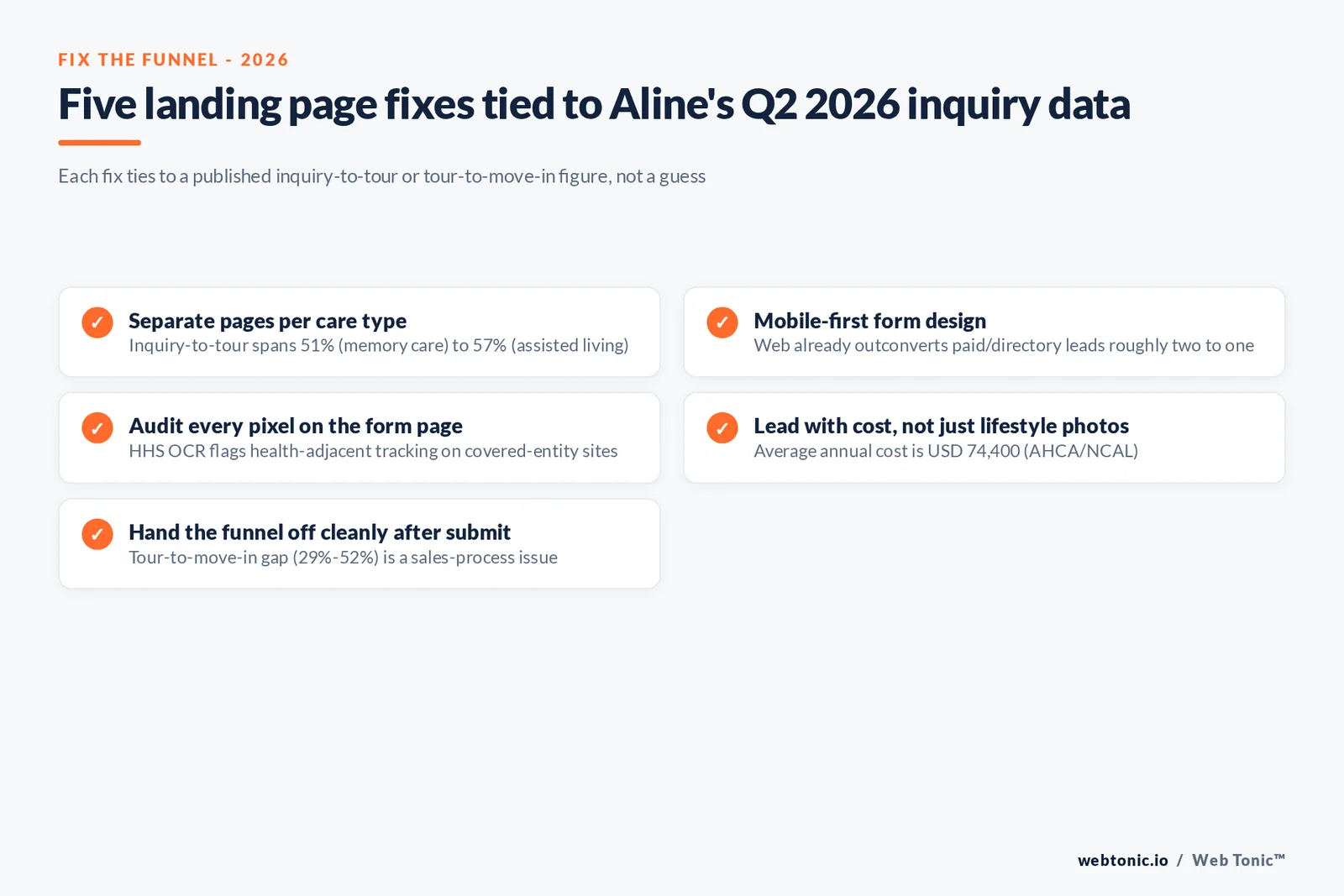
Because web already converts to a tour at roughly double the blended rate, the highest-leverage fix is rarely the page's copy - it is removing friction between "read the page" and "the form is submitted." Aline's own data on tour-to-move-in shows the widest gap sits after the tour (29% to 52% by care type), which is a sales-process question, not a page question; a landing page audit should stop at the form submission and hand off cleanly from there. See our growth marketing practice for how we instrument that handoff, and read our breakdown of what paid search actually costs before assuming a bigger media budget fixes a leaking form.
If a rebuild is on the table, our data and analytics practice instruments the tour-request funnel by care type before touching the design, which is the only way to know whether a redesign moved the number or just made the page look different.
Frequently Asked Questions
What is a good landing page conversion rate for senior living?
There is no senior-living-specific landing page benchmark, so the honest anchor is the funnel stage behind the page. Aline's Q2 2026 CRM data across roughly 40,000 units puts web-sourced inquiry-to-tour conversion at 51% to 57% depending on care type, well above the 27% to 32% rate for inquiries pooled across every source. Cross-industry, Unbounce's Conversion Benchmark Report puts the median landing page conversion rate at 6.6% across all verticals and CorePPC's healthcare-specific figure at roughly 4.2% - both are the closest published proxies, not a senior living number, and should be labeled as such when quoted.
Why do web inquiries convert to tours so much better than other sources?
Aline's data shows web-sourced inquiries convert to a scheduled tour at 51-57%, compared with 24-40% for paid directories and lead aggregators and 27-32% for unpaid referrals. A visitor who fills out a form on the community's own site has already self-selected on price, location and care level using the page's own content, so the sales team is scheduling a tour rather than re-qualifying a cold lead.
Does a tight occupancy market change how a landing page should be built?
Yes. NIC MAP's Q2 2026 data put senior housing occupancy at 89.9%, the highest level since 2015, with assisted living at 88.4% and independent living at 91.3%. When inventory is this constrained, a form that leaks even a small share of its already-scarce inquiries is a larger revenue loss than it would be in a soft market, which is the practical case for treating the page as a funnel to instrument rather than a brochure to publish.
Does a senior living inquiry form need HIPAA-level privacy handling?
Most inquiry forms collect care-level and health-condition detail (mobility, memory care needs) that makes the page's own tracking setup relevant even outside a clinical setting. HHS's Office for Civil Rights bulletin on online tracking technologies for HIPAA-covered entities and business associates flags pixels and analytics scripts placed on pages that transmit this kind of information as a compliance exposure - worth a legal review before adding a new pixel to a tour-request page, whether or not the operator is formally a covered entity.
Should the landing page be built around care type or around location?
Aline's data argues for care type first. Inquiry-to-tour conversion spreads from 51% (independent living, web) to 57% (assisted living, web), and tour-to-move-in spreads far wider - 29% for life plan communities up to 52% for memory care. A single generic landing page averages those gaps away; separate pages per care type let each one be written and measured against its own funnel.
Sources
Aline - 2026 Senior Living Sales & Marketing Benchmark Report
Aline - Q2 2026 Sales & Marketing Benchmark Snapshot (PDF)
NIC - Senior Housing Occupancy Climbs in Second Quarter 2026
AHCA/NCAL - Assisted Living Fast Facts and Figures, June 2026
AARP - 2026 Tech Trends and Adults 50-Plus
LocaliQ - Healthcare Search Ads Benchmarks for 16 Specialties
Unbounce - Conversion Benchmark Report
HHS OCR - Use of Online Tracking Technologies by HIPAA Covered Entities
FTC - Health Products Compliance Guidance