Table of contents
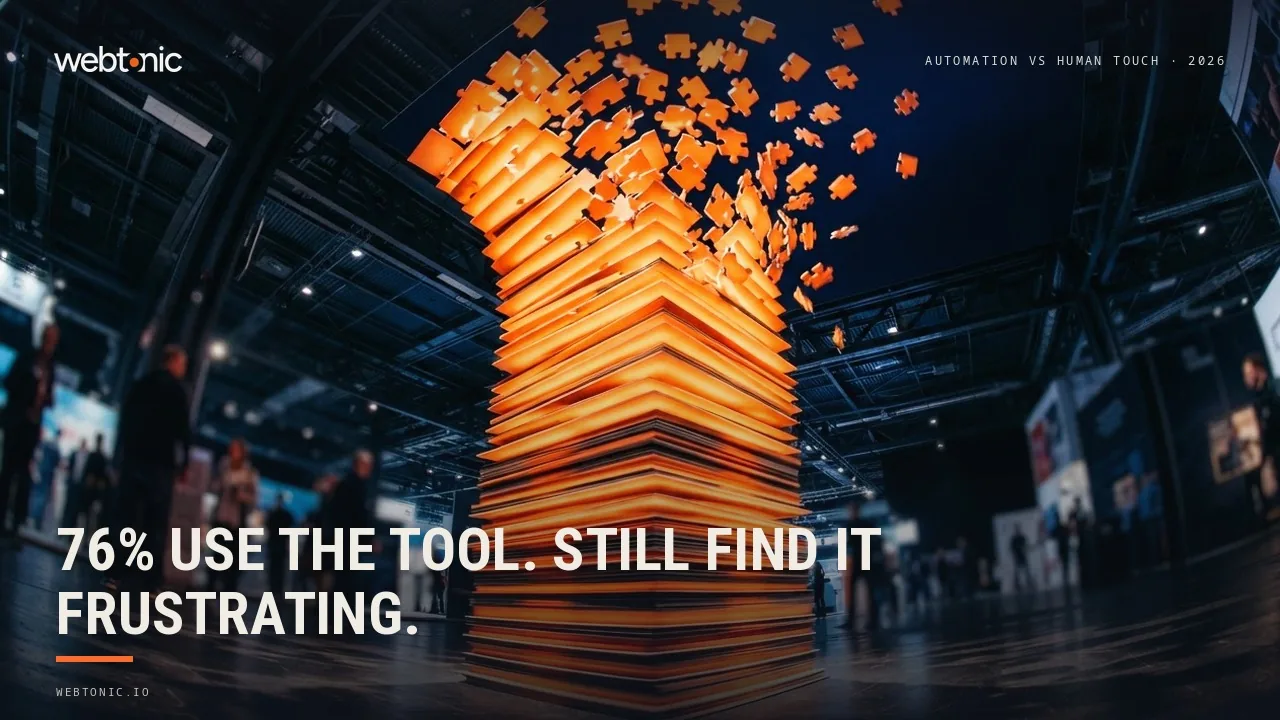
No published study benchmarks senior living email marketing on its own, so this page builds from Mailchimp's cross-industry averages and layers in OATS/AARP's own 350-caregiver technology survey, which found that 76% of family caregivers use patient portals yet still call them frustrating - the exact tension a senior living email sequence has to manage between automation and a human contact.
Key Takeaways
- 35.63% average open rate across all industries on Mailchimp, the nearest available cross-industry floor.
- 40.04% average open rate for non-profits specifically, a category many CCRCs fall into (Mailchimp).
- 76% of caregivers use patient portals or similar digital health tools (OATS/AARP, 2026).
- 65% call those same tools the most useful caregiving technology they have (OATS/AARP).
- Yet those same tools rank among the most frustrating to navigate, per the same survey.
- 59 million family caregivers of adults are the real audience behind most inquiry emails (AARP).
- 49.5 billion hours of unpaid care those caregivers provided in 2024, at $20.41 an hour (AARP).
- 51% to 54% of inquiries for three of four care types arrive through the web channel email nurture feeds (Aline, Q2 2026).
- Caregivers prefer self-paced formats - video, hotlines, newsletters - over fixed in-person training (OATS/AARP).
- 2.62% average click rate across all industries on Mailchimp, the honest ceiling for a nurture sequence's action step.
- 0.22% average unsubscribe rate across all industries, a useful list-health check (Mailchimp).
Why there is no senior-living-specific email benchmark
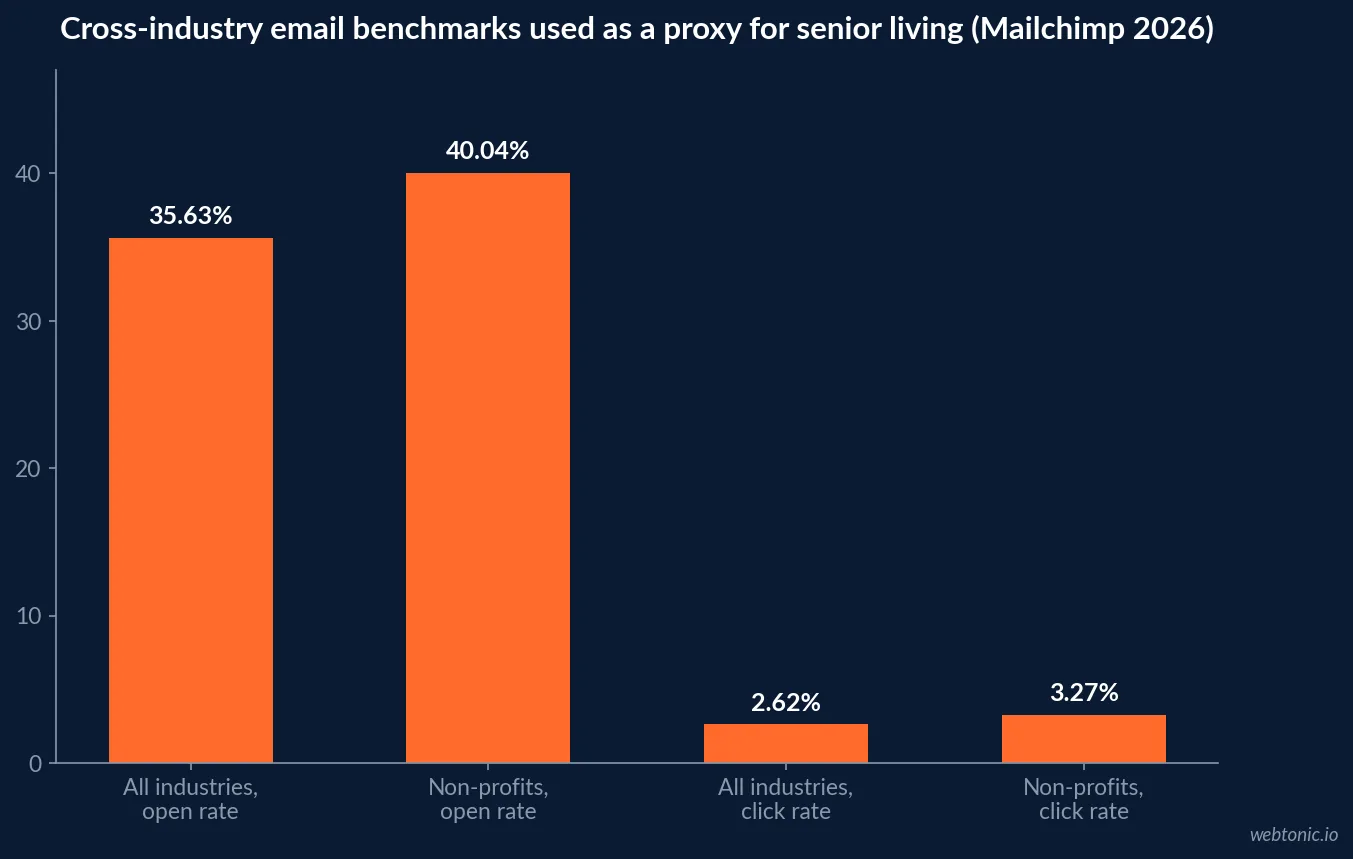
Email marketing platforms publish benchmarks by broad industry vertical, and senior living is not one of the categories Mailchimp's own benchmark page breaks out separately. The nearest honest proxies are its "All Users" average and its "Non-Profits" category, since a meaningful share of senior living operators - continuing care retirement communities, faith-based communities, life plan communities - are themselves structured as non-profits. Both figures below are cross-industry, not senior-living-specific, and should be read as a floor to benchmark against rather than a target.
| Metric (Mailchimp 2026) | All Users | Non-Profits |
|---|---|---|
| Average open rate | 35.63% | 40.04% |
| Average click rate | 2.62% | 3.27% |
| Average unsubscribe rate | 0.22% | 0.18% |
The caregiver-technology tension email has to solve
OATS from AARP's 2026 Caring for Caregivers report, based on a survey of more than 350 caregivers, found that 76% of caregivers use patient portals or similar digital health tools, and 65% named those same tools the most useful caregiving technology available to them. The same survey found those tools were also among the most frustrating to navigate - a direct data point on why "automate everything" is the wrong default for a senior living email sequence. Caregivers already manage several frustrating digital systems; an email nurture that adds another one without a human escape hatch compounds the problem it is trying to solve.
| Caregiver technology finding (OATS/AARP 2026) | Figure |
|---|---|
| Caregivers using patient portals / EHR tools | 76% |
| Caregivers naming those tools most useful | 65% |
| Caregivers caring for a spouse or partner | Nearly half of respondents |
| Preferred training format | Self-paced: video, hotlines, newsletters, classes |
Who is on the list
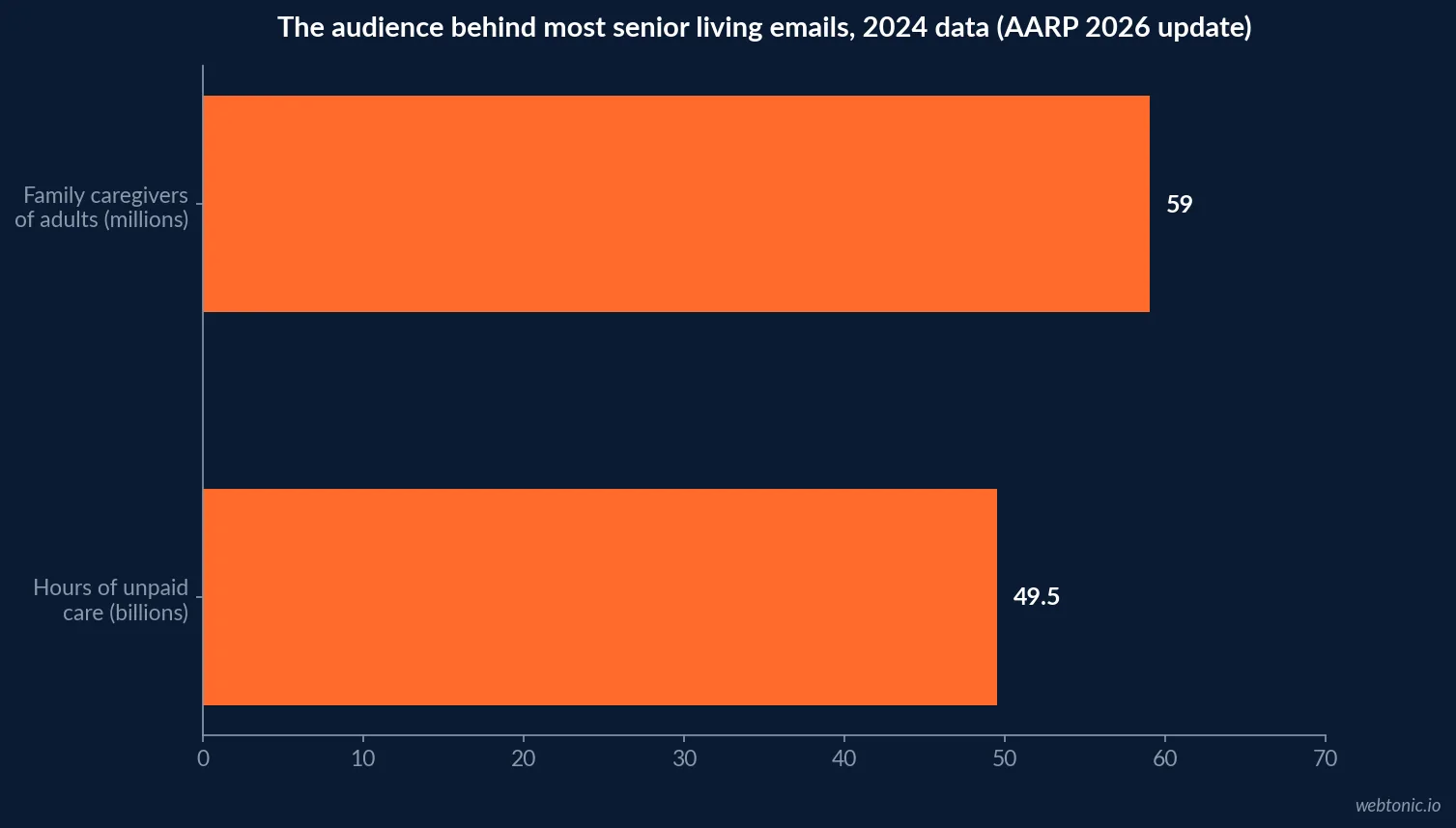
The realistic subscriber on a senior living email list is rarely the future resident. AARP's Valuing the Invaluable 2026 update counts 59 million family caregivers of adults in the U.S., who together provided an estimated 49.5 billion hours of unpaid care in 2024 at an average value of $20.41 an hour - a total economic value of roughly $1.01 trillion. That is the demographic an email nurture sequence is actually writing to: someone managing a parent's care search alongside their own job and household, which argues for concise, action-oriented emails over long-form persuasive copy.
Where email fits in the inquiry funnel
Aline's Q2 2026 Sales & Marketing Benchmark Snapshot, drawn from CRM data across more than 5,000 senior housing communities, shows the web channel - the source most email nurture programs are built to capture and re-engage - supplying 54% of independent living inquiries, 51% of assisted living inquiries and 52% of life plan community inquiries. Email is rarely the first touch in this funnel; it is the sequence that keeps a web-sourced inquiry warm across the multi-week research window a family typically takes before a first tour.
| Method of inquiry, Q2 2026 (Aline) | Independent Living | Assisted Living | Life Plan |
|---|---|---|---|
| Web (organic + direct) | 54% | 51% | 52% |
| Paid | 24% | 26% | 4% |
| Call-ins | 15% | 13% | 29% |
| Unpaid referrals | 8% | 11% | 15% |
What to automate and what to keep human
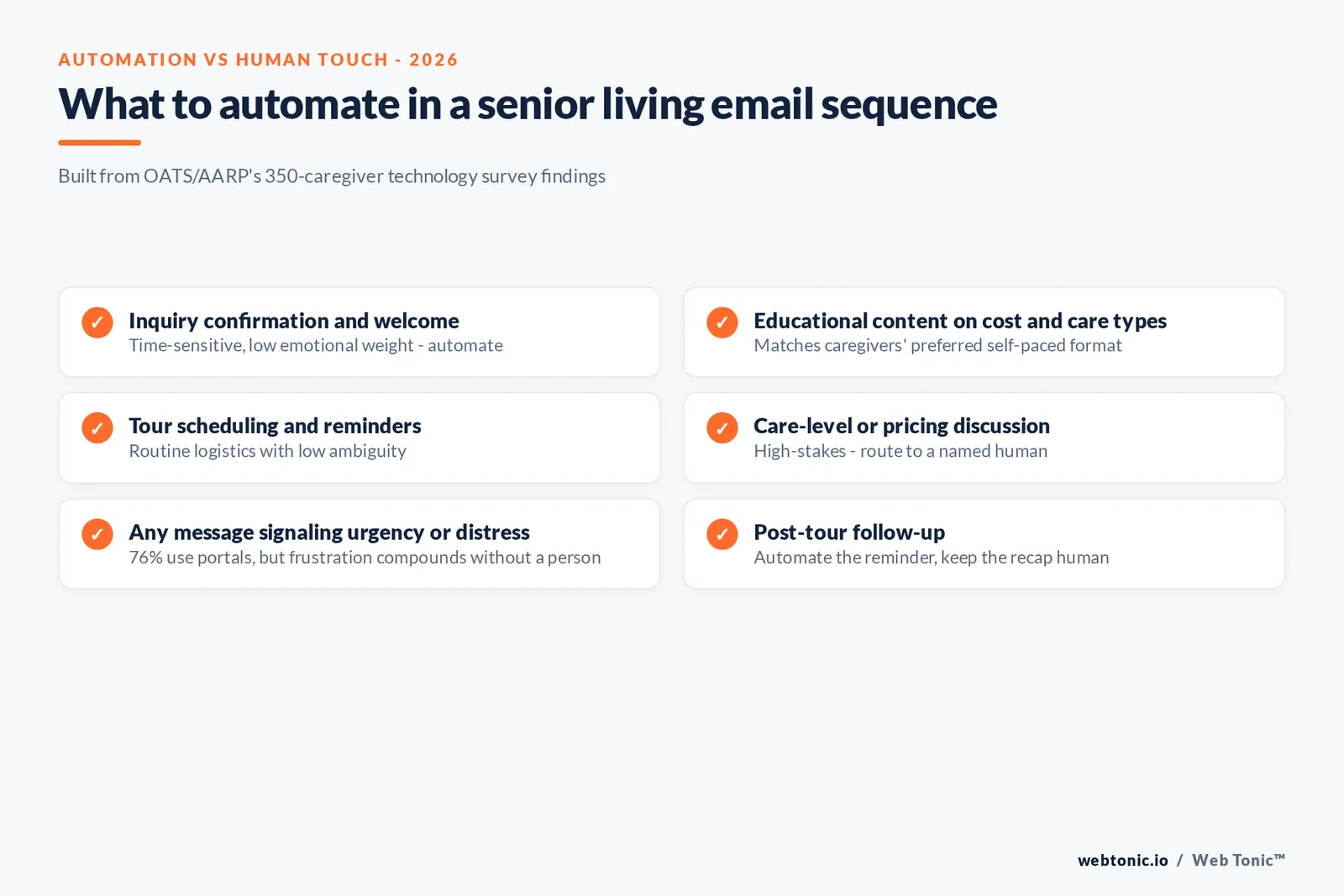
The OATS/AARP data draws a fairly clean line. Routine, predictable sequencing - tour confirmations, document checklists, move-in timelines, newsletter-style updates - matches the self-paced formats caregivers said they preferred over fixed in-person sessions. Anything that touches a care-level recommendation, a cost or contract negotiation, or a family signaling distress belongs with a named human contact, because the same survey found the highest-value digital tools were also the most frustrating when they left a caregiver without a clear next step.
| Sequence stage | Automate or route to a human? | Why |
|---|---|---|
| Inquiry confirmation and welcome | Automate | Time-sensitive, low emotional weight |
| Educational content (cost, care types, FAQs) | Automate | Matches preferred self-paced learning format |
| Tour scheduling and reminders | Automate | Routine logistics, low ambiguity |
| Care-level or pricing discussion | Human | High-stakes, individualized decision |
| Any message showing urgency or distress signals | Human | OATS/AARP: frustration compounds on unclear tools |
Why urgency messaging has to be handled carefully
Part of what makes this list volatile is that senior housing itself is tightening. NIC MAP data shows senior housing occupancy across the 31 Primary Markets crossing 90% in July 2026, a level last seen before the 2008 financial crisis. That is a legitimate reason to communicate urgency about waitlists and unit availability - but it is also exactly the kind of message that can read as pressure tactics to a caregiver already managing stress, per OATS/AARP's finding that even useful tools generate frustration when they add friction rather than clarity. Urgency belongs in the copy when it is true and specific (a named unit, a real waitlist position), not as a generic subject-line device.
| Signal | Figure | Source |
|---|---|---|
| Senior housing occupancy, 31 Primary Markets | 90%+ (July 2026) | NIC MAP, via National Investment Center |
| U.S. population 65 and older, 2025 | 18.9% | U.S. Census Bureau |
| Projected 65-and-older share by 2060 | 23.4% | U.S. Census Bureau |
| Assisted living communities nationwide | 41,465 | AHCA/NCAL, 2026 |
Where cost data belongs in the sequence
Cost is the most-searched, most-avoided topic in a senior living email sequence, and it deserves real numbers rather than a generic "contact us for pricing" line. AHCA/NCAL's 2026 fast facts put the average yearly cost of assisted living care at $74,400, a figure sourced from the Genworth/CareScout 2025 Cost of Care Survey. Giving a caregiver that number early, alongside a clear breakdown of what it includes, does more to build trust than deferring the topic to a phone call - especially given OATS/AARP's finding that caregivers already manage several opaque, high-stakes financial and medical systems and respond better to tools that are upfront about what they show.
Segmenting by who is actually reading
Given that most subscribers are adult children rather than future residents, segmentation by relationship to the prospective resident - not just care type - is worth building into the list from day one. A caregiver 6 to 12 months out from a decision reads differently than one searching under the time pressure of a hospital discharge, and Aline's data on rising paid-channel inquiry-to-tour conversion rates across care types suggests the industry overall is getting faster at recognizing that difference in its funnel design, even where email specifically is not broken out.
A practical segmentation model splits the list into at least three lanes: early researchers who opened a guide or checklist and have months of runway, active comparers who have requested pricing or toured a competing community, and urgent searchers arriving from a hospital discharge planner or a sudden change in a parent's condition. Each lane tolerates a different cadence - weekly educational content for the first, a faster response-time promise for the second, and same-day human contact for the third - and mailing all three on one calendar is a common way well-intentioned automation reads as indifferent to a family's actual situation.
Building the list against workforce reality
Staff time to answer the human-routed portion of this sequence is not free. Argentum and Activated Insights' 2026 Perceptions of Careers in Senior Living report, drawing on nearly 200 senior living professionals, found that 95% would stay in a role where they felt their work made a difference - a workforce that can absorb thoughtful, infrequent human touchpoints better than a flood of individually-answered inquiries a poorly automated sequence would otherwise generate. That finding argues for building the automated share of the sequence generously enough that the humans on staff are only pulled in for the messages that genuinely need judgment, rather than treating every reply as equally urgent regardless of what it actually asks.
The practical test for any senior living marketing team is whether a community's own sales counselors could read a week's worth of automated sequence copy and recognize the tone as their own. If the answer is no, the automation is probably optimizing for send volume rather than the caregiver on the other end of it.
Where this fits with the rest of the funnel
Email nurture rarely works in isolation from paid and organic acquisition; see our data on what Facebook ads cost across industries and our list of email marketing agencies for the broader toolset. A funnel audit is the fastest way to see where your own open and click rates sit against the Mailchimp cross-industry floor above.
Frequently Asked Questions
What is a good email open rate for senior living?
No study publishes a senior-living-specific email benchmark, so the honest starting point is Mailchimp's own cross-industry figures: an average open rate of 35.63% across all users, with non-profits (a category many CCRCs and faith-based communities fall into) averaging 40.04%. Treat both as a cross-industry floor, not a senior-living target, until you have your own list's baseline.
Should senior living email be automated or personal?
Both, applied to different tasks. OATS from AARP's 2026 survey of more than 350 caregivers found that 76% use patient portals and similar digital tools, and 65% call them the most useful caregiving technology - yet these same tools were also named among the most frustrating to navigate. That gap argues for automating routine sequencing (tour reminders, document requests, move-in checklists) while keeping a named human contact for anything emotionally weighted, like a care-level conversation.
Who actually reads senior living marketing emails?
Mostly the adult child managing the search, not the future resident. AARP's Valuing the Invaluable 2026 update counts 59 million family caregivers of adults, and Aline's own CRM data across 5,000-plus communities shows the web channel - which most email nurture sequences feed into or draw from - supplying 51% to 54% of inquiries for three of four care types, the largest single source it tracks.
How do caregivers prefer to learn to use new digital tools?
OATS/AARP's Caring for Caregivers report found caregivers preferred building digital skills through video tutorials, hotlines, newsletters and self-paced classes over fixed in-person sessions. That preference maps directly onto email as a channel: a well-sequenced automated series with clear next steps outperforms a single high-pressure call for an audience that wants to move at its own pace.
What should NOT be automated in a senior living email sequence?
Anything that touches a specific care-level decision, cost negotiation, or a family's emotional state around placing a parent. OATS/AARP's survey found the systems caregivers rated most useful - patient portals and electronic health records - were also among the most frustrating, precisely because they handle sensitive, high-stakes information with a generic interface. The same risk applies to a fully automated email sequence that never routes to a person once a family signals urgency or distress.
Sources
Mailchimp - Email Marketing Benchmarks & Industry Statistics, 2026
OATS from AARP - Caring for Caregivers Report, 2026
AARP - Valuing the Invaluable, 2026 update
Aline - Q2 2026 Sales & Marketing Benchmark Snapshot
Argentum & Activated Insights - Perceptions of Careers in Senior Living, 2026
NIC - Senior housing occupancy trends, 2026
U.S. Census Bureau - An Aging World, 2026 projections
AHCA/NCAL - Assisted Living Facts and Figures, 2026