Table of contents

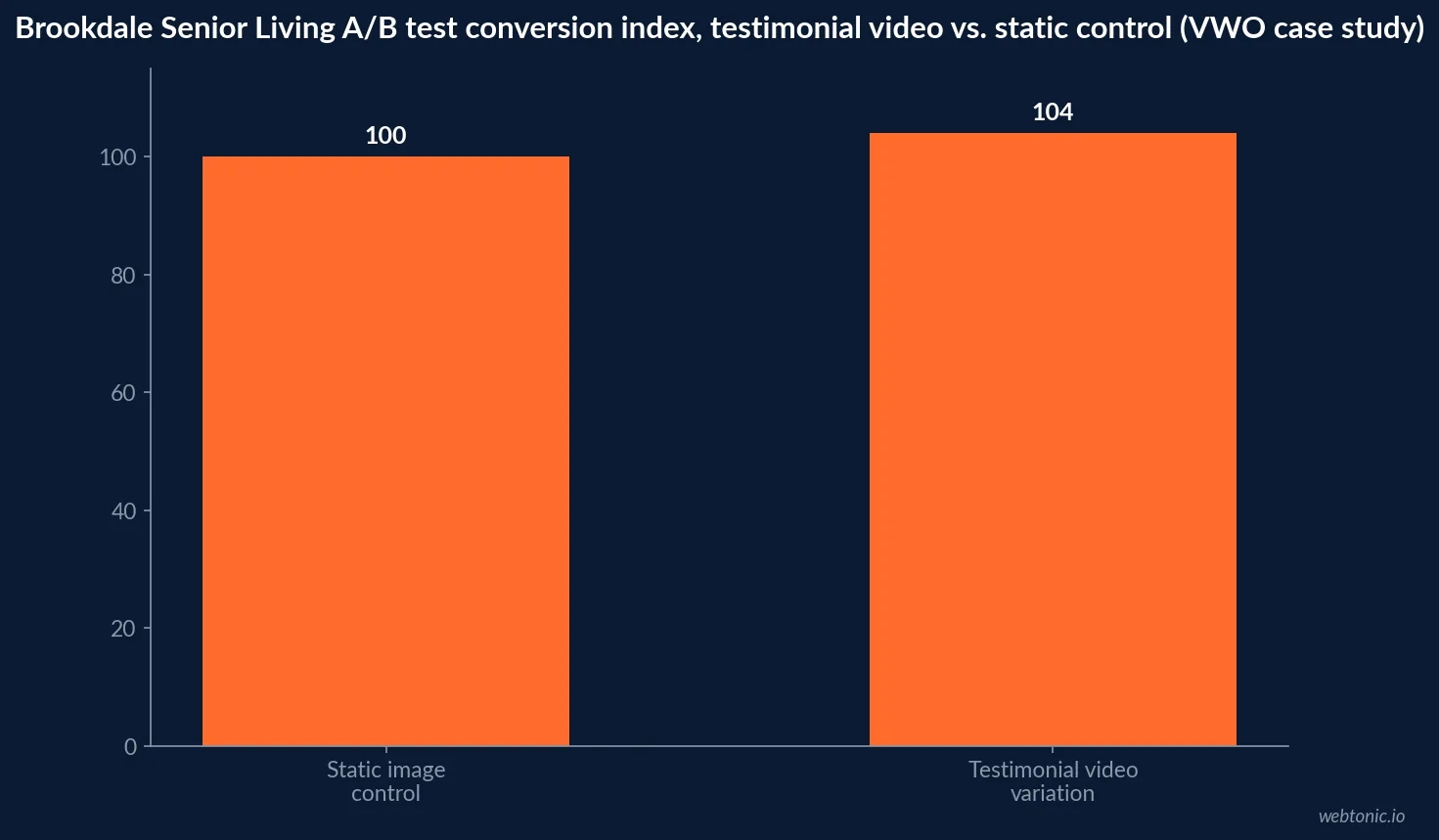
The one documented A/B test of senior living creative on public record — VWO's case study on Brookdale Senior Living — found a testimonial video beat a static-image control by 4%, a real but modest lift. No industry-specific study proves testimonial creative is the single best-performing format across senior living; this page states plainly what the Brookdale data shows, layers in Wyzowl's 2026 cross-industry video research and the FTC rules that govern what a testimonial or before-and-after claim can legally say, and flags every cross-industry figure as exactly that.
Key Takeaways
- A testimonial video beat a static control by 4% in Brookdale's own A/B test.
- 85% of consumers (cross-industry) say video quality affects brand trust.
- 63% would rather watch a short video than read text to learn about a service.
- 96% have watched an explainer video to learn about a product or service.
- Only 12% prefer text articles over video for learning about a service.
- 84% of consumers want to see more video from brands in 2026.
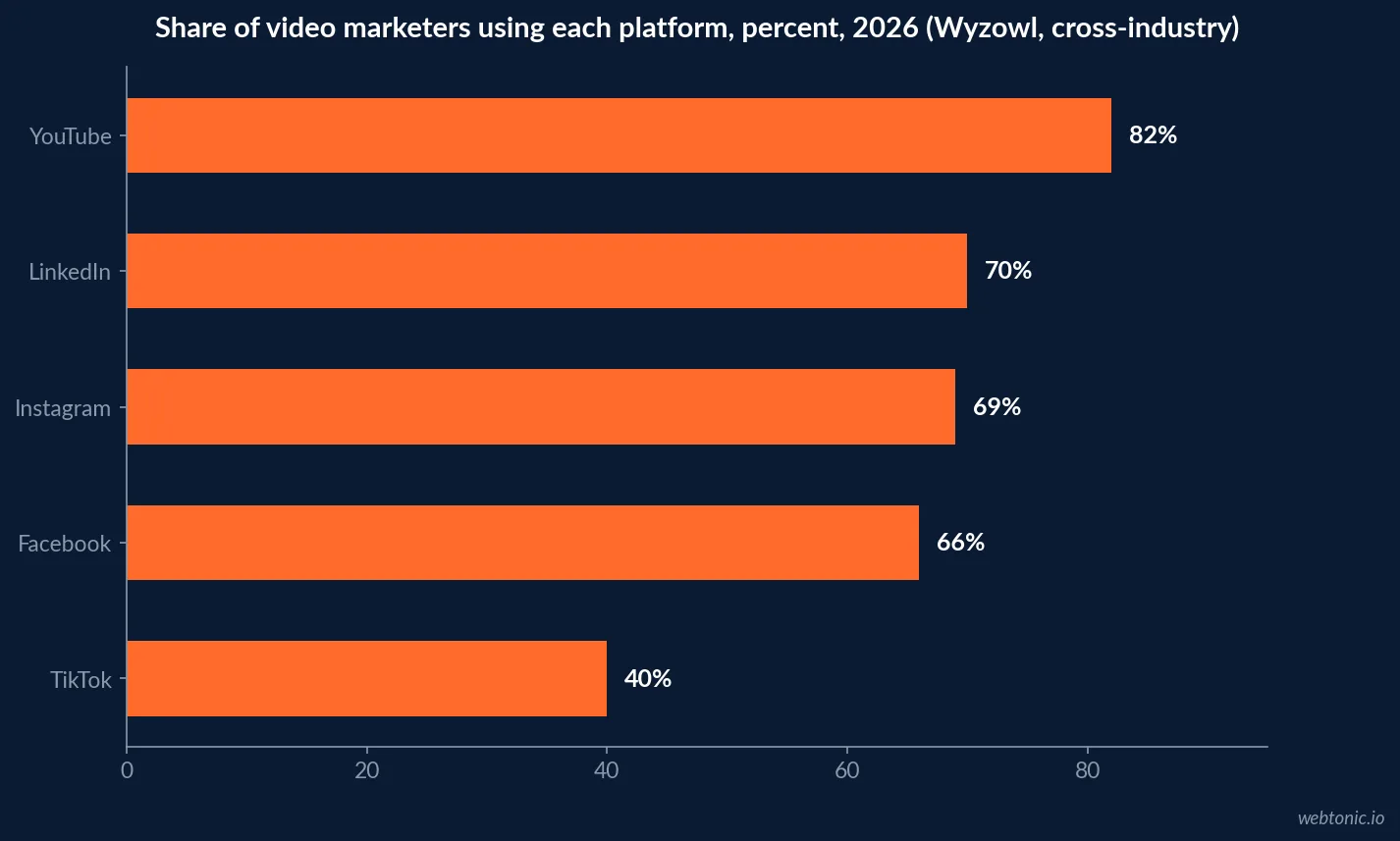
- YouTube is used by 82% of video marketers, the most of any platform.
- LinkedIn follows at 70%, ahead of Instagram (69%) and Facebook (66%).
- YouTube is rated effective by 69% of marketers who use it.
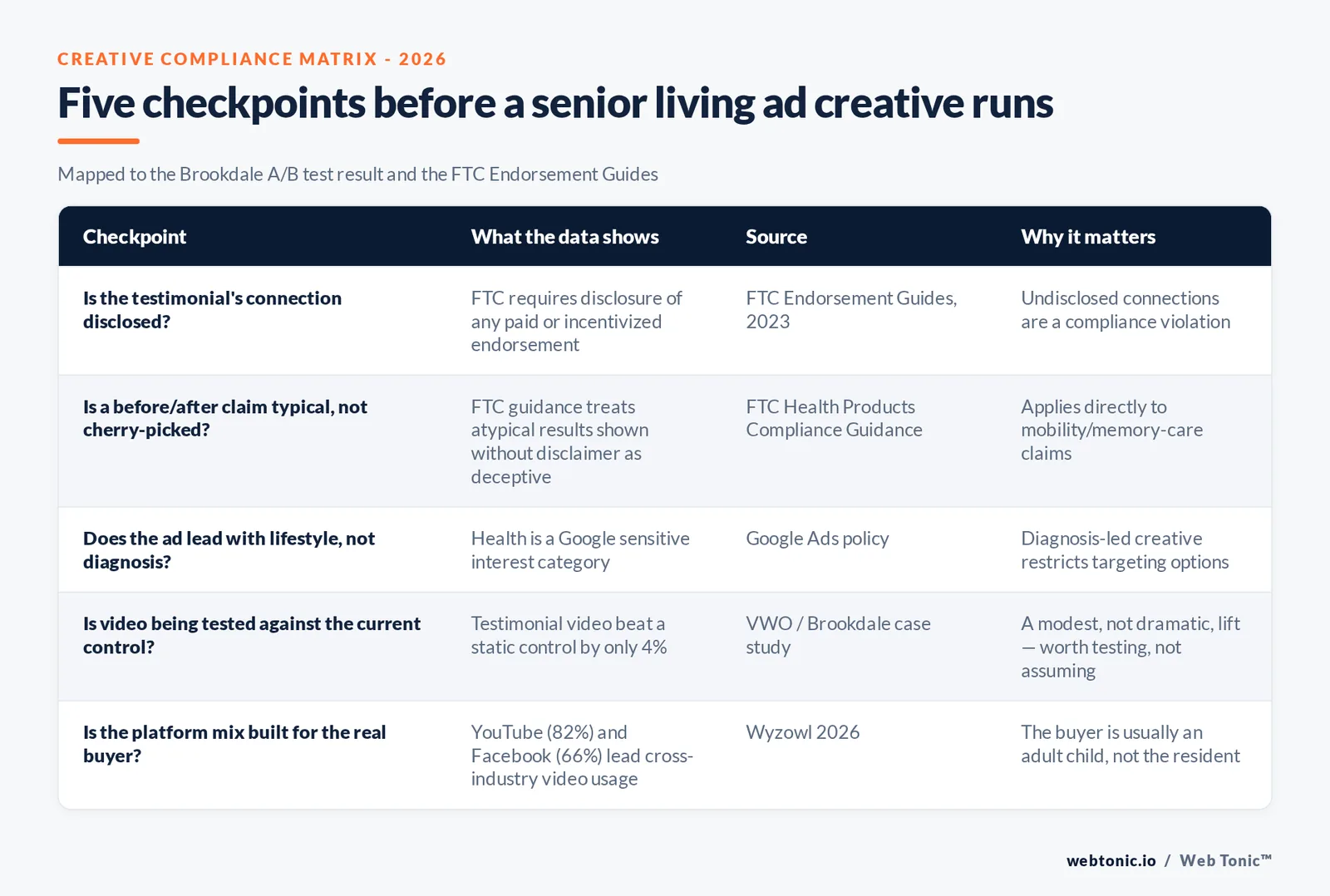
- The FTC's Endorsement Guides require disclosure of any paid or incentivized testimonial.
- Before-and-after claims must reflect typical results under FTC guidance.
- 31% of consumers (cross-industry) now require 4.5 stars or higher, up from 17%.
- 68% will only use a business rated 4 stars or higher.
- 85% are more likely to use a business after reading positive reviews.
- Senior housing occupancy sat at 89.9% in Q2 2026, raising the stakes on creative.
- Assisted living residents skew 85+ and female, per AHCA/NCAL data.
- The typical care decision is made by an adult daughter or daughter-in-law, not the resident.
The only real A/B test on record
VWO's case study on Brookdale Senior Living describes a landing page test in which the marketing team hypothesized that a variation containing a customer testimonial video would beat a static-image control because it offered clearer social proof. The testimonial video variation won, but by 4% — a real, statistically meaningful lift, but far from the dramatic multiplier that "testimonial video wins" claims often imply. That gap between the hypothesis and the actual result is the honest starting point for any creative claim in this category.
| Brookdale A/B test (VWO case study) | Result |
|---|---|
| Variation tested | Testimonial video vs. static image control |
| Hypothesis | Video would clearly outperform on social proof |
| Conversion lift, testimonial video | +4% |
| Interpretation | A real but modest edge, not a decisive win |
What the cross-industry video data adds (and does not prove)
Wyzowl's 2026 State of Video Marketing survey, based on 266 respondents split between marketers and consumers, is not senior-living specific, but it is the clearest cross-industry signal available on why video creative tends to outperform static formats: 85% say video quality affects their trust in a brand, 63% would rather watch a short video than read an article, an ebook, an infographic or attend a webinar to learn about a product or service, and 96% have watched an explainer video for that purpose. 84% want to see more video from brands in 2026, a figure Wyzowl says has held within 8 points for eight straight years.
None of that is proof that video outperforms in senior living specifically — it is evidence that the format preference underlying Brookdale's 4% result is not a fluke of that one brand, but part of a broad and stable consumer pattern this industry can reasonably expect to hold.
| Consumer preference (Wyzowl, cross-industry, 2026) | Share |
|---|---|
| Prefer short video to learn about a product/service | 63% |
| Say video quality affects trust in a brand | 85% |
| Have watched an explainer video | 96% |
| Want to see more brand video in 2026 | 84% |
| Prefer text articles instead | 12% |
Where the video should actually run
Wyzowl's platform breakdown is also cross-industry, but it maps cleanly onto senior living's real buyer: YouTube is used by 82% of video marketers and rated effective by 69% of those who use it, ahead of LinkedIn (70% usage, 50% effective), Instagram (69% usage, 56% effective) and Facebook (66% usage, 55% effective). TikTok sits at only 40% usage and 29% effective. Since the senior living buyer is almost always an adult child in their 40s to 60s researching on a laptop, not the resident, that platform mix — YouTube and Facebook over TikTok — already matches the audience without needing a senior-living-specific study to justify it.
| Platform | Used by video marketers | Rated effective | Fit for senior living's real buyer |
|---|---|---|---|
| YouTube | 82% | 69% | Strong — long-form tour and testimonial video |
| 70% | 50% | Moderate — referral partners, discharge planners | |
| 69% | 56% | Moderate — caregiver-age demographic present | |
| 66% | 55% | Strong — core caregiver demographic | |
| TikTok | 40% | 29% | Weak fit for this buyer, cross-industry data |
What the ad is legally allowed to claim
The FTC's Endorsement Guides, revised in 2023, require that any material connection between an advertiser and an endorser — a fee, a rent discount, a gift card — be clearly and conspicuously disclosed, and that the testimonial reflect that person's honest opinion rather than advertiser-scripted language. The FTC's separate Health Products Compliance Guidance sets the bar for before-and-after style claims: results shown have to be what consumers can generally expect, not an outlier dressed up with a small-print disclaimer, a standard the guidance illustrates with a weight-loss ad case where the discrepancy between the pictured result and the typical result was the violation, not the photo itself.
For senior living, the parallel risk is a "before/after" style memory-care or mobility-recovery story: if the resident's outcome is not typical, the ad needs a clear statement of what typical residents actually experience, not a footnote.
Why targeting restricts what the creative can say up front
Google's Health in personalized advertising policy classifies health as a sensitive interest category, meaning advertiser-curated audiences are off-limits for health-related targeting and only Google's predefined audiences can be used. Senior living creative that leads with a medical condition — dementia symptoms, a specific diagnosis — can trigger this restriction even for a housing product, which is why community-level creative testing often performs better when the ad leads with a lifestyle or amenity hook and the care-level specifics live on the landing page, where targeting rules do not constrain the copy the same way.
| Creative lead | Targeting exposure | Where care-level detail should live |
|---|---|---|
| Lifestyle / amenities (dining, activities, community) | Standard interest targeting available | Anywhere |
| Medical condition / diagnosis-specific messaging | Restricted to predefined health audiences | Landing page only |
| Testimonial without a named condition | Standard targeting available | Landing page for specifics |
| Before/after mobility or memory claim | Standard targeting, but FTC typicality rule applies | Disclaimer on the page, not buried in the ad |
Why the review layer matters as much as the ad itself
Cross-industry data from BrightLocal's 2026 Local Consumer Review Survey found 31% of consumers will only use a business rated 4.5 stars or higher, up sharply from 17% a year earlier, and 68% require at least 4 stars. 85% are more likely to use a business after reading positive reviews, while negative reviews deter 77% . None of this is senior-living-specific, but for a category where the decision-maker is almost always someone other than the person who will live there, the review layer functions as the testimonial the family reads before the ad ever gets a click.
What to test next
Given a real but modest 4% lift from testimonial video in the one documented case, and strong but cross-industry evidence that video outperforms static and text formats broadly, the defensible plan is to test a testimonial-led video against the current best-performing static creative on a per-community basis, disclose any material connection to the endorsing family per the FTC's guides, and keep condition-specific claims off the ad itself. Our performance creative team builds and tests that kind of format comparison directly against a community's own conversion data rather than against an industry average, and our growth marketing practice pairs it with the targeting structure above. Talk to us before assuming any one format wins by default.
What the occupancy backdrop does to creative stakes
NIC MAP data puts senior housing occupancy at 89.9% nationally in Q2 2026, the 20th consecutive quarter of gains, with construction stalled at fewer than 16,000 units under way. At near-capacity occupancy, the creative job shifts from filling empty beds broadly to converting the specific families already searching into a tour — which raises, rather than lowers, the value of every incremental percentage point a creative test can find, because the inventory to sell against is shrinking even as demand holds steady.
| Occupancy context (NIC MAP, Q2 2026) | Figure |
|---|---|
| National senior housing occupancy | 89.9% |
| Consecutive quarters of gains | 20 |
| Primary markets above 90% occupancy | 15 of 31 |
| Year-over-year inventory growth | 0.4% |
Who the creative is actually persuading
AHCA/NCAL data shows assisted living residents skew heavily toward the "oldest old" — women age 85 and older make up a large share of the roughly 1 million Americans residing in assisted living today, across 41,465 communities nationwide. But the person clicking the ad and reading the testimonial is very rarely that resident. Creative that addresses the caregiver's anxiety about the decision — cost, safety, whether staff will actually know their parent — tends to answer a different question than creative built to appeal to the resident's own lifestyle preferences, and testing should treat those as two audiences, not one.
| Resident profile fact (AHCA/NCAL) | Figure |
|---|---|
| Assisted living communities nationwide | 41,465 |
| Americans residing in assisted living | >1,000,000 |
| Share of residents age 85 or older | Large majority, per AHCA/NCAL |
| National median monthly cost | USD 6,200 |
What a Meta ad for this category is actually paying, cross-industry
WordStream's 2025 Facebook Ads Benchmarks (cross-industry, not senior-living specific) list Health and Fitness among the highest cost-per-lead categories on Meta, at USD 52.98, behind only Dentists and Dental Services at USD 76.71. Senior living campaigns typically bid into that same competitive band, since Meta's ad auction does not have a distinct rate card for the category — one more reason the creative itself, not just the targeting, has to carry more of the conversion weight when the click is already this expensive.
| Meta Ads cost per lead, cross-industry (WordStream, 2025) | Figure |
|---|---|
| Dentists and Dental Services | USD 76.71 |
| Health and Fitness | USD 52.98 |
| Beauty and Personal Care | USD 51.42 |
Frequently Asked Questions
What senior living ad creative actually works, according to real data?
The most direct evidence is a documented A/B test, not a survey: VWO's case study on Brookdale Senior Living found a landing page variation built around a resident/family testimonial video beat a static-image control by 4% in conversions, a modest but real lift on a page most marketers assumed the video would win decisively. Layered on top of that, Wyzowl's 2026 cross-industry survey found 85% of people say video quality affects their trust in a brand and 63% would rather watch a short video than read text to learn about a product or service, which supports testimonial video as a format worth testing, without proving it always wins by a wide margin.
Is that Brookdale result the only senior-living-specific creative data available?
It is the most concrete public case study of a senior living creative A/B test at time of writing. Everything else usable is either agency case-study claims without a published methodology (dropped here) or cross-industry benchmark data from WordStream, LocaliQ and Wyzowl that is not senior-living specific and is labeled that way throughout this page. Treat the 4% Brookdale lift as one data point, not as proof that testimonial video always outperforms other formats in this category.
Can a senior living ad legally use a resident testimonial?
Yes, but the FTC's Endorsement Guides, revised in 2023, require that any material connection between the advertiser and the endorser (free rent, a fee, a gift) be clearly disclosed, and that the testimonial reflect the honest opinion of that resident or family member rather than a manufactured quote. Before-and-after imagery carries the same scrutiny under the FTC's Health Products Compliance Guidance: results have to be typical, not cherry-picked, and any atypical result needs a clear, unhedged disclaimer rather than a small-print asterisk.
Does Meta or Google restrict senior living ad targeting the way they restrict health ads?
Google's Personalized Advertising policy treats "Health" as a sensitive interest category, which limits advertiser-curated audience targeting on health-adjacent messaging to predefined Google audiences rather than custom lists. Senior living creative that emphasizes memory care, dementia symptoms or medical conditions can trigger this restriction even though the community itself is a housing product, so campaigns are often safer built around lifestyle and amenity messaging with care-level detail moved to the landing page rather than the ad.
What creative format should get the next testing dollar?
Video, on the strength of two separate signals: Wyzowl's finding that video is the format 63% of people most want to learn from, and the Brookdale result showing a testimonial-led video edging out a static control. But 4% is not a dramatic lift, so the honest plan is to test video against the current control on a specific community's landing page rather than assume video wins everywhere by default.
Sources
VWO - Brookdale Senior Living case study: testimonial video A/B test
Wyzowl - Video Marketing Statistics 2026
FTC - Guides Concerning the Use of Endorsements and Testimonials in Advertising, 2023
FTC - Health Products Compliance Guidance
Google Ads - Health in personalized advertising policy
BrightLocal - Local Consumer Review Survey 2026
NIC - Senior housing occupancy, Q2 2026
AHCA/NCAL - Assisted Living Facts & Figures
WordStream - 2025 Facebook Ads Benchmarks