Table of contents
Search engine marketing (SEM) is the fastest way to put your business in front of people actively searching for what you sell. With U.S. digital ad spend projected to reach $325 billion in 2025 and Google holding over 86% of search engine market share, a disciplined SEM strategy is no longer optional.
Key Takeaways
- SEM combines paid search ads with search engine optimization (SEO) to maximize visibility across search engines — but most marketers use the term to mean pay-per-click advertising on Google Ads and Microsoft Ads.
- Quality score directly controls your cost per click — improving it from 5 to 8 can reduce CPCs by up to 37% without changing your bid.
- The average Google Ads conversion rate across industries is 4.4%, but top-performing SEM campaigns achieve 8–12% through disciplined keyword targeting and landing page alignment.
- Budget allocation should follow a 70/20/10 framework — 70% on proven keywords, 20% on testing, and 10% on brand defense.
- SEM and SEO work best together — businesses running both see 25–30% higher total click-through rates than those relying on either channel alone.
What Is Search Engine Marketing (SEM)?
Search engine marketing, often abbreviated SEM, is a digital marketing discipline focused on increasing a website's visibility on search engine results pages (SERPs) through paid advertising. While the term historically covered both paid search and search engine optimization (SEO), the industry now uses SEM primarily to describe pay-per-click (PPC) advertising on platforms like Google Ads and Microsoft Advertising.
The core mechanic behind SEM is the keyword auction. When a user types a query into a search engine, advertisers compete in a real-time auction for ad placement. The winner is not simply the highest bidder — Google Ads uses a combination of bid amount, quality score, and expected ad impact to determine which ads appear and in what order. This auction-based model means that a well-optimized SEM strategy can outperform competitors who spend significantly more but manage their campaigns poorly.
Unlike social media advertising or display ads, SEM targets users with active purchase intent. Someone searching "best CRM software for small business" is further along the buying journey than someone scrolling through a Facebook feed. This intent-driven nature is why search engine marketing consistently delivers among the highest return on ad spend (ROAS) across all digital marketing channels.
SEM vs. SEO: How They Work Together
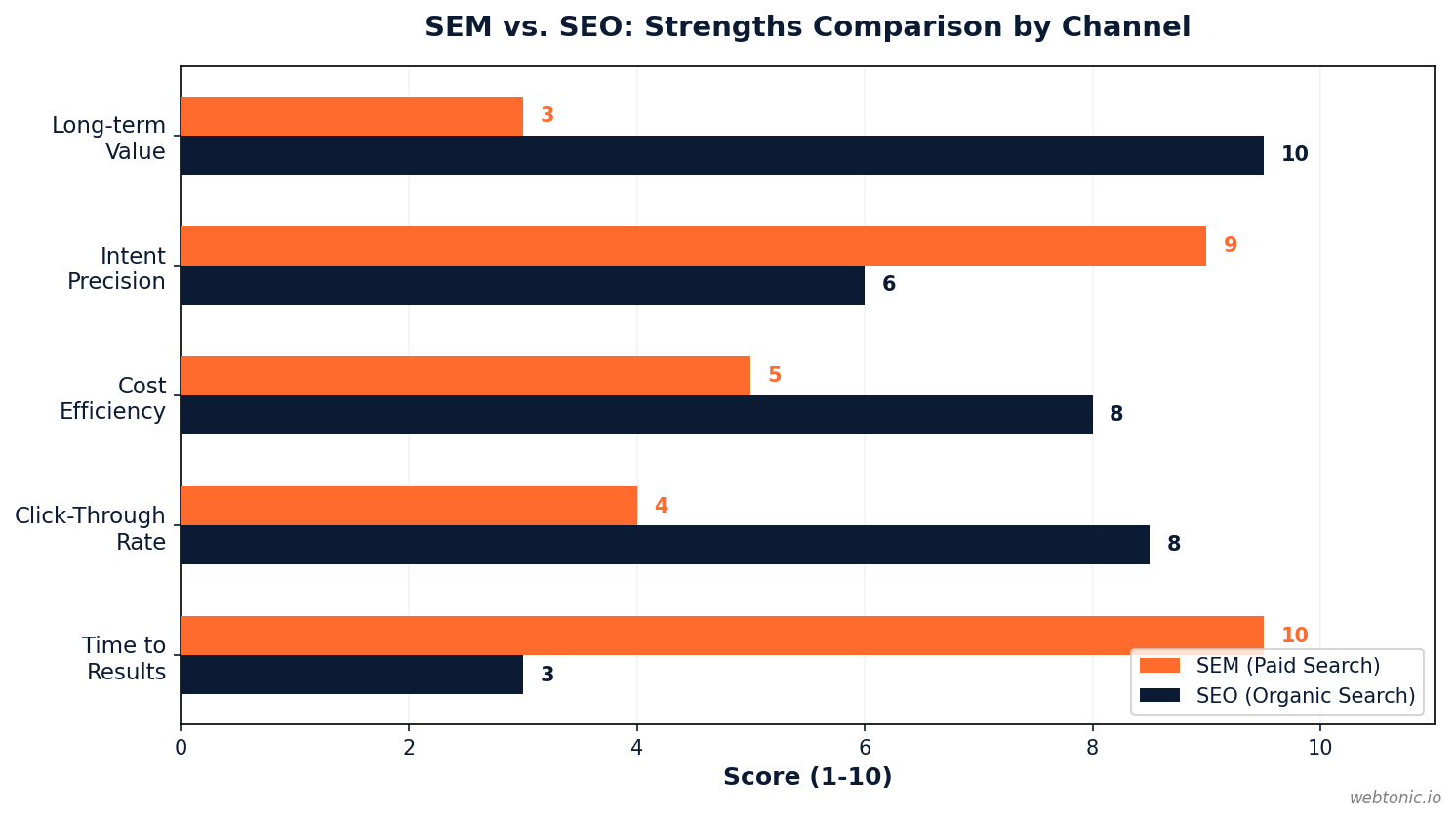
A common misconception is that SEM and SEO are competing strategies. In reality, combining paid search with search engine optimization creates a compounding effect that neither channel achieves alone.
| Factor | SEM (Paid Search) | SEO (Organic Search) |
|---|---|---|
| Time to Results | Immediate — ads appear within hours | 3–6 months for meaningful rankings |
| Cost Model | Pay per click (CPC) | Investment in content and technical work |
| Scalability | Scale instantly with budget increases | Scales gradually as authority builds |
| Click-Through Rate | 3–6% average for search ads | 27–39% for position 1 organic |
| Trust Signal | Lower — users know it is an ad | Higher — perceived as earned authority |
| Best For | New launches, competitive keywords, promotions | Long-term traffic, brand authority, cost efficiency |
The SEM best practice is to run paid ads for high-intent commercial keywords while building organic rankings through SEO for informational and long-tail queries. Businesses that combine both channels see 25–30% higher total SERP click-through rates because they occupy more visual real estate on the results page. Your SEM strategy covers immediate revenue capture, and search engine optimization builds the long-term asset.
7 Proven SEM Strategies for 2026
1. Build Your Keyword Architecture Around Intent
Effective keyword research is the foundation of every SEM strategy. Instead of chasing high-volume head terms, map your keywords to the buyer's journey:
- Awareness keywords — Informational queries like "what is CRM software" (low CPC, high volume, low conversion). Use these for top-of-funnel education and remarketing list building.
- Consideration keywords — Comparison queries like "best CRM for startups" (medium CPC, medium intent). These keywords signal active evaluation.
- Decision keywords — Transactional queries like "buy HubSpot CRM plan" (highest CPC, highest conversion rate). Allocate the largest share of your budget here.
Use Google Ads Keyword Planner, Google Keyword Planner, and your own search term reports to find keyword clusters with commercial intent. Group tightly related keywords into ad groups of 5–15 keywords maximum — this keeps your ads relevant and your scores high.
2. Master Quality Score Optimization
Quality score is Google Ads' rating of the overall quality and relevance of your keywords, ads, and landing pages. It is scored on a 1–10 scale and directly impacts your ad rank and cost per click. The three components are:
- Expected click-through rate — How likely users are to click your ad based on historical performance.
- Ad relevance — How closely your ad copy matches the search query and keyword intent.
- Landing page experience — How relevant, fast, and user-friendly your landing page is for the searcher.
Improving quality score from 5 to 8 can reduce your CPC by up to 37%. The most direct lever is ad-to-keyword alignment: write ad headlines that include the exact keyword the user searched, lead with a benefit, and match the landing page headline to the ad promise.
3. Structure Campaigns by Business Objective
A well-structured account separates campaigns by goal, match type, and audience segment. Here is a proven SEM campaign structure:
| Campaign Type | Objective | Keyword Match | Budget Share |
|---|---|---|---|
| Brand Defense | Protect branded searches from competitors | Exact + phrase match | 10% |
| Core Revenue | Drive conversions on proven keywords | Exact + phrase match | 50% |
| Expansion | Scale into adjacent keyword territories | Broad match + audience signals | 20% |
| Testing | Discover new keywords and audiences | Broad match | 10% |
| Remarketing | Re-engage past visitors and cart abandoners | RLSA audiences | 10% |
4. Write Ads That Win the Click
Your ad copy is the bridge between the keyword and the conversion. SEM best practices for Responsive Search Ads (RSAs) include:
- Pin your strongest headline to position 1 — include the primary keyword and a clear value proposition.
- Use numbers and specifics — "Save 40% on Enterprise CRM" outperforms "Affordable CRM Software" because specificity builds credibility.
- Include a clear CTA in at least two headlines — "Start Free Trial," "Get a Demo," or "See Pricing" give users a reason to click.
- Test 4–6 headline variations — The platform rotates combinations automatically, but providing diverse headlines gives the algorithm more material to optimize.
5. Optimize Bidding for Profitability, Not Volume
Smart bidding strategies use machine learning to set bids for every auction. The right strategy depends on your data maturity:
- Under 30 conversions/month — Use Maximize Clicks with a CPC cap to gather data. Automated bidding needs conversion volume to learn.
- 30–50 conversions/month — Switch to Maximize Conversions. The algorithm has enough signal to optimize toward conversions.
- 50+ conversions/month — Implement Target CPA or Target ROAS. Set targets based on historical performance, not aspirational goals.
A critical SEM strategy mistake is setting a target CPA that is 20%+ below your current average. This forces the algorithm to bid conservatively, reducing impression share and total conversions. Start with your current CPA as the target and lower it gradually by 5–10% every two weeks.
6. Build Landing Pages That Convert Search Traffic
Sending Google Ads traffic to your homepage is one of the most common SEM mistakes. Every ad group should point to a dedicated landing page that:
- Matches the search query headline — If the user searched "project management software pricing," the landing page headline should mirror that phrase exactly.
- Loads in under 3 seconds — Google factors page speed into its ranking signals, and 53% of mobile users abandon pages (Think with Google) that take longer than 3 seconds to load.
- Features one primary CTA — Multiple competing calls to action dilute focus and reduce conversion rates.
- Includes trust signals — Customer logos, review scores, security badges, and case study snippets reassure the searcher that they are in the right place.
7. Mine Search Terms for Hidden Opportunities
Your search term report is a goldmine of SEM insights that most marketers check too infrequently. Review it weekly and take three actions:
- Add high-performing search terms as exact match keywords — If a broad match keyword triggers a search term that converts well, promote it to its own keyword with a targeted ad.
- Negative out irrelevant queries — Search terms with clicks but zero conversions are wasting your budget. Add them as negative keywords at the campaign or account level.
- Identify new ad group opportunities — Clusters of related search terms often signal a need for a dedicated ad group with tailored ad copy and landing pages.
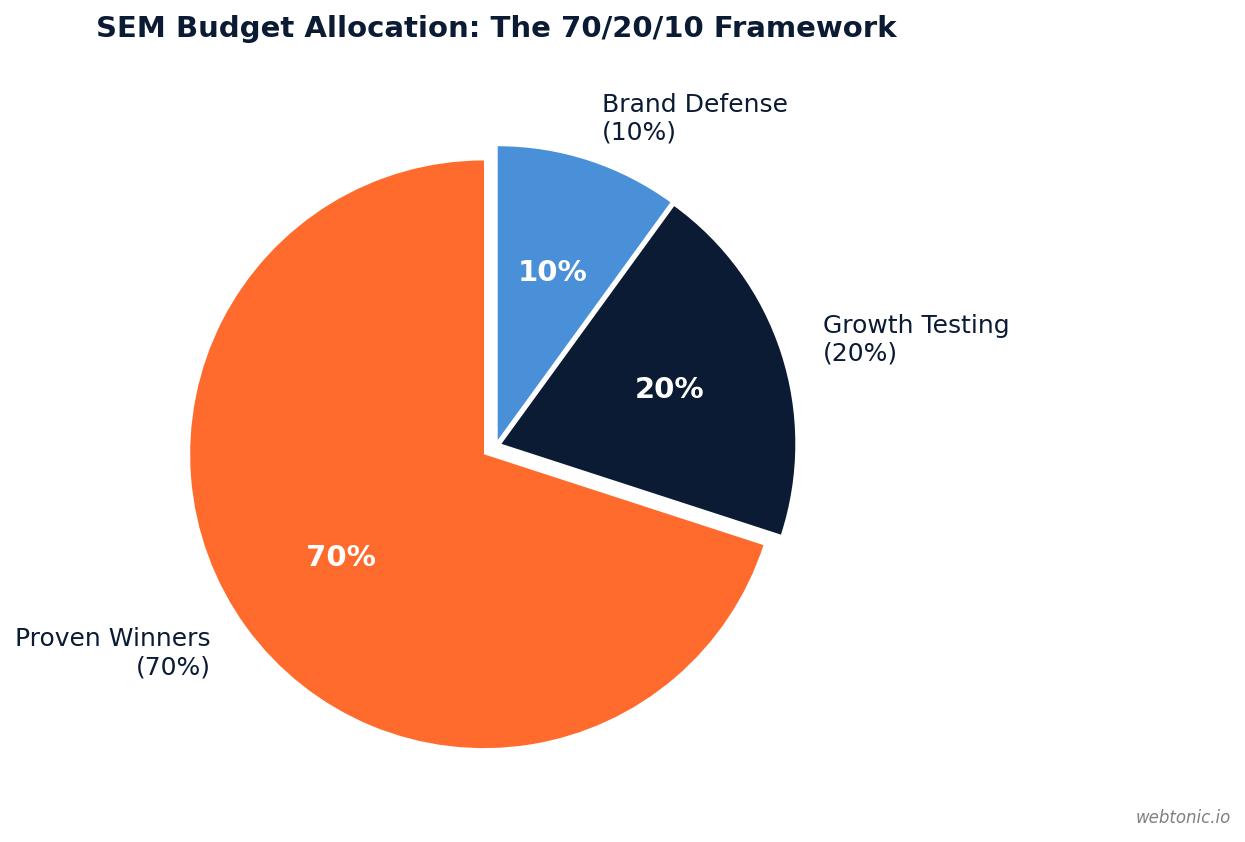
SEM Budget Allocation Framework
How you distribute your search engine marketing budget matters as much as how much you spend. The 70/20/10 framework provides a disciplined approach:
| Bucket | Budget Share | Purpose | Expected ROAS |
|---|---|---|---|
| Proven Winners | 70% | Keywords and campaigns with consistent positive ROI | 4–8× |
| Growth Testing | 20% | New keywords, audiences, and ad formats | 1–3× (learning phase) |
| Brand Defense | 10% | Branded keywords to block competitor conquesting | 10–20× |
The biggest budget mistake in search engine marketing is spreading spend too thin across too many campaigns. Consolidation is a core SEM best practice — fewer, well-funded campaigns with tight keyword groups outperform dozens of underfunded campaigns because The algorithm needs sufficient data to optimize bidding. A campaign with fewer than 10 conversions per week cannot reliably exit the learning phase.

Common SEM Mistakes to Avoid
- Ignoring negative keywords — Without a negative keyword strategy, up to 20% of your search engine marketing budget can go to irrelevant queries. Review search terms weekly.
- Sending traffic to the homepage — Generic pages convert at a fraction of the rate of intent-matched landing pages. Build dedicated pages for each core keyword theme.
- Setting-and-forgetting campaigns — SEM requires ongoing optimization — and growth marketing teams treat it as a continuous improvement process. Keyword performance shifts as competition, seasonality, and consumer behavior change.
- Bidding on vanity keywords — High-volume keywords with low commercial intent drain budget. Focus keyword selection on terms with transactional or commercial investigation intent.
- Not tracking conversions properly — If your conversion tracking is broken or incomplete, every smart bidding strategy will underperform. Audit your Google Ads conversion setup quarterly. Our data intelligence team can help diagnose tracking gaps.
Measuring SEM Performance: Metrics That Matter
| Metric | What It Tells You | Benchmark (Search Ads) |
|---|---|---|
| Click-Through Rate (CTR) | How well your ads match user intent | 3.5–6% average across industries |
| Cost Per Click (CPC) | Auction competitiveness for your keywords | $1.50–$4.50 (varies by industry) |
| Conversion Rate (CVR) | Landing page and offer effectiveness | 4.4% average, 8–12% top performers |
| Quality Score | Ad relevance and landing page quality | 7+ target for core keywords |
| Impression Share | Market coverage and budget adequacy | 80%+ for brand, 40–60% non-brand |
| ROAS | Revenue generated per dollar of ad spend | 4:1 minimum target for most businesses |

FAQ
What is the difference between SEM and PPC?
PPC (pay-per-click) is a subset of SEM. Search engine marketing encompasses all paid and organic strategies to gain visibility in search results, while PPC refers specifically to the paid advertising model where you pay each time someone clicks your ad. In practice, most digital marketing professionals use SEM and PPC interchangeably (explore more on our blog) when discussing Google Ads campaigns.
How much should I budget for SEM?
SEM budget depends on your industry, competition, and goals. A reasonable starting point for small businesses is $1,000–$5,000 per month on Google Ads, which provides enough data for meaningful optimization. Enterprise brands typically spend $20,000–$100,000+ monthly. The key is not the absolute spend but the budget-to-opportunity ratio — concentrate on keywords where your budget can achieve competitive impression share.
How long does it take for SEM campaigns to work?
SEM campaigns generate traffic immediately — ads can appear within hours of launch. However, meaningful optimization requires 2–4 weeks of data collection before making strategic changes. Automated bidding strategies need 30–50 conversions to exit the learning phase. Plan for a 60–90 day ramp-up period before judging campaign performance against final KPIs.
Is SEM still worth it with AI search changing results?
Yes. While AI-generated answers are changing how search engines display results, sponsored ads still appear prominently above organic and AI results on Google. Search engine marketing remains the most intent-driven advertising channel available. The key adaptation is focusing on high-commercial-intent keywords where AI answers are less likely to satisfy the user — queries like "buy," "pricing," "near me," and "best [product] for [use case]."
What are the best tools for managing SEM campaigns?
The essential SEM toolkit includes Google Ads for campaign management, Google Keyword Planner for keyword research, Google Analytics for conversion tracking, and a competitive intelligence tool like SEMrush or SpyFu for monitoring competitor strategies. For agencies managing multiple accounts, Google Ads Editor enables bulk changes offline.
Sources
Incremys — SEM Marketing Guide 2026
The Global Statistics — U.S. Search Engine Marketing Statistics 2025
WordStream — Google Ads Benchmarks 2026
Google — Smart Bidding Guide
Google Ads Keyword Planner
Google Ads