



Table of contents

Schema markup is structured data code added to your HTML that helps search engines understand your content. It enables rich results — star ratings, prices, FAQ dropdowns — that make listings stand out on the SERP.
Key Takeaways
- 73 % of Google search results page one features at least one rich result powered by structured data, according to HTTP Archive's 2024 Web Almanac.
- Websites with properly implemented schema markup see an average 30 % increase in click-through rate on search results that display rich snippets.
- Only 33 % of websites currently use any form of structured data, leaving a major competitive advantage on the table for those who implement it.
- JSON-LD is the recommended format by Google, used by over 64 % of pages with structured data — far ahead of Microdata (29 %) and RDFa (7 %).
- Google deprecated FAQ and HowTo rich results for most sites in 2023, but Product, LocalBusiness, Article, and Review schema remain fully supported and actively rendered.
What Is Schema Markup?
Schema markup — also called structured data — is a standardized vocabulary maintained by Schema.org, a joint initiative by Google, Microsoft, Yahoo, and Yandex. By adding schema to your HTML, you translate your content into a machine-readable format that search engines can parse without ambiguity.
Without schema, a search engine must infer that "4.8" on your page is a review rating, that "$49/month" is a price, or that "123 Main St" is an address. With schema, you declare each of these explicitly. The result: richer, more informative search listings and higher visibility in Google Search, Google Maps, and AI-powered search features.
There are three syntaxes for adding schema:
- JSON-LD — A JavaScript notation block placed in the
<head>or<body>. Google's recommended format because it separates structured data from HTML, making it easier to maintain. - Microdata — HTML attributes (
itemscope,itemprop) embedded directly in tags. Still supported but harder to manage at scale. - RDFa — Similar to Microdata but uses different attributes. Least common in practice.

Types of Schema Markup
Schema.org defines over 800 types, but only a handful trigger rich results on Google. The table below maps the most impactful schema types to their search visibility benefits.
| Schema Type | Rich Result | Best For | Status (2026) |
|---|---|---|---|
| LocalBusiness | Address, hours, ratings, map | Local businesses, service areas | Fully supported |
| Product | Price, availability, reviews | E-commerce, SaaS pricing pages | Fully supported |
| Review / AggregateRating | Star ratings in SERPs | Products, services, software | Fully supported |
| Article | Headline, date, author image | Blog posts, news, guides | Fully supported |
| FAQPage | Expandable Q&A dropdowns | Service pages, help centers | Limited (authoritative sites only) |
| HowTo | Step-by-step instructions | Tutorials, DIY guides | Deprecated for most sites |
| Event | Date, venue, ticket link | Conferences, webinars, concerts | Fully supported |
| Organization | Knowledge panel, social links | Brand homepages, about pages | Fully supported |
LocalBusiness Schema
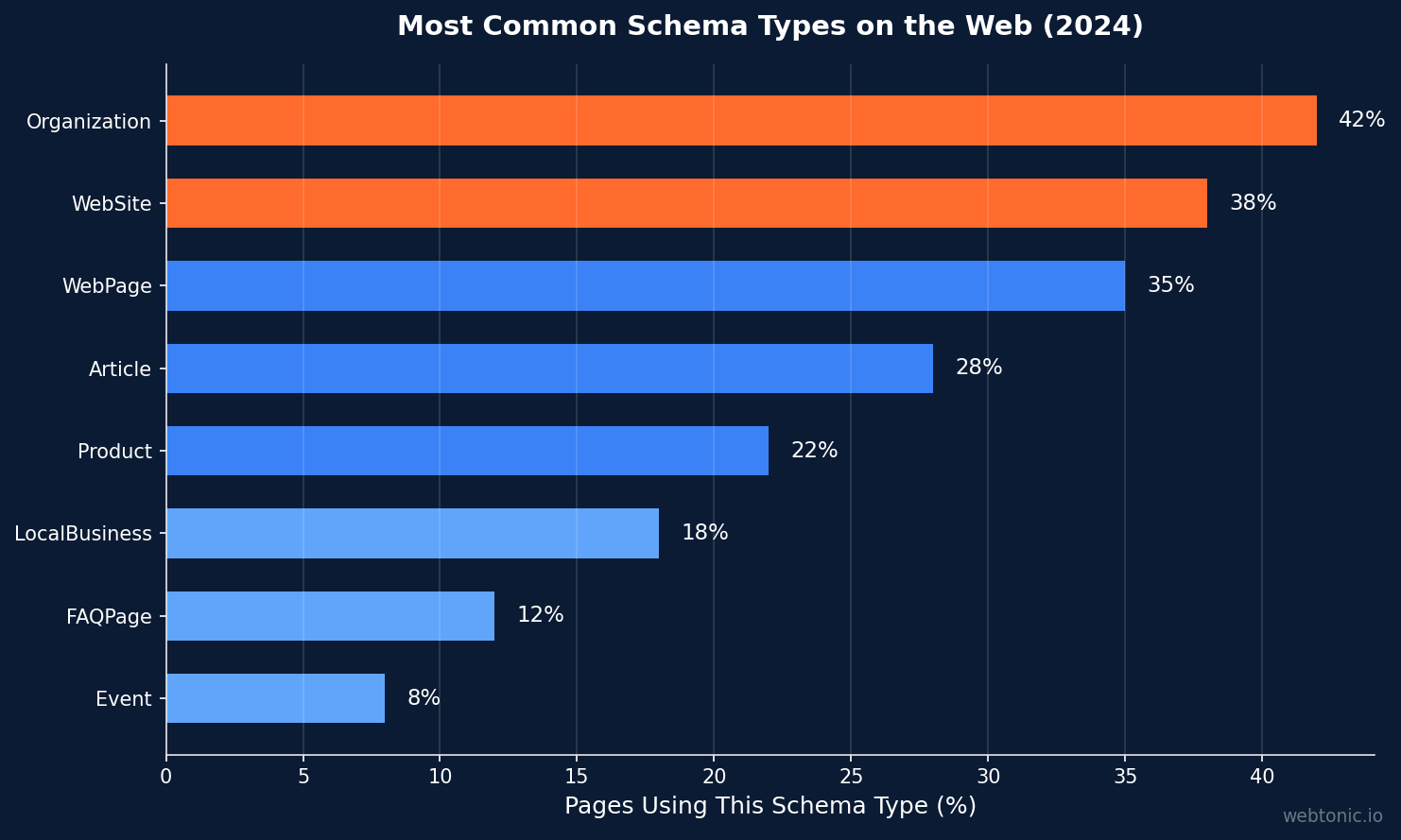
The most important schema type for local businesses. It tells Google your business name, address, phone number, operating hours, price range, and geographic coordinates. When implemented alongside Google Business Profile optimization, LocalBusiness schema can trigger the local pack — the map and 3-listing box that captures 44 % of clicks that appears for "near me" searches. Key properties include @type (use the most specific subtype, like Restaurant or Dentist), address, geo, openingHoursSpecification, and aggregateRating.
Product and Review Schema
Product schema is implemented on 22 % of e-commerce pages and enables Google to display price, availability, and review stars directly in search results. For e-commerce sites, this is the single highest-impact schema type — products with visible ratings and prices in the SERP earn significantly more clicks than plain blue links. Combine Product with AggregateRating and Offer to maximize rich result eligibility.
Article Schema
Used by 28 % of content-publishing sites, Article schema tells Google that a page is a news article, blog post, or in-depth guide. It enables enhanced search results showing the headline, publication date, author, and featured image. This schema type is fully supported and actively rendered in Google News, Discover, and standard search. Use Article for general content, NewsArticle for news, or BlogPosting for blog content.
How to Add Schema Markup to Your Website
The implementation path depends on your CMS and technical comfort level. Here is the step-by-step process for the most common scenarios:
Method 1: Manual JSON-LD (Any Website)
Write your JSON-LD code and add it within a <script type="application/ld+json"> tag in your page's HTML. This is the most flexible approach and works on any website.
- Identify the primary content type on the page (product, article, local business).
- Write JSON-LD using the Schema.org documentation as your reference.
- Validate using Google's Rich Results Test.
- Deploy to production and monitor in Google Search Console under the Enhancements section.
Method 2: CMS Plugins (WordPress, Shopify)
For WordPress, Yoast SEO and Rank Math automatically generate Article, Organization, and breadcrumb schema. For more advanced types (Product, Event, FAQ), dedicated plugins like Schema Pro or WP Schema handle the implementation without code. On Shopify, Product and Organization schema are built into most themes; review apps like Judge.me or Loox inject AggregateRating schema automatically.

Method 3: Google Tag Manager
For sites where you cannot edit HTML directly, Google Tag Manager lets you inject JSON-LD via a Custom HTML tag. GTM-based schema implementations now power over 12 % of structured data deployments on enterprise sites. This approach keeps your schema separate from your codebase and makes updates easier — but be aware that Google has confirmed it can process GTM-injected structured data, though direct HTML placement is still preferred.
Schema Markup Validation and Testing
Deploying schema without validation is like shipping code without tests. Use these tools to confirm your markup is correct:
| Tool | Purpose | Key Feature |
|---|---|---|
| Google Rich Results Test | Check rich result eligibility | Shows which rich results Google can generate from your page |
| Schema Markup Validator | General schema validation | Validates all Schema.org types, not just Google-supported ones |
| Google Search Console | Monitor live performance | Enhancements report shows errors, warnings, valid items |
| Yoast SEO (WordPress) | Auto-generated schema | Outputs Article, Organization, and breadcrumb schema automatically |
Always test both the live URL and your code snippet before deployment. The Rich Results Test accepts both. After deployment, monitor Google Search Console's Enhancements section weekly for the first month — errors often surface 2–3 days after Google recrawls the page. On average, Google processes schema changes within 5–7 days of crawling.
Common Schema Markup Mistakes
These are the errors that cause schema to fail validation or, worse, trigger a manual action from Google:

- Marking up invisible content — Schema must describe content visible to users. Adding Product schema with a $0 price or fake reviews that do not appear on the page violates Google's guidelines and can result in penalties.
- Using the wrong @type — Marking a blog post as
NewsArticlewhen your site is not a news publisher, or usingProductfor a service that has no physical SKU. Use the most specific and accurate type. - Missing required properties — Each schema type has required and recommended properties. Product schema without
offers(price) will not generate a rich result. LocalBusiness schema withoutaddresswill not trigger the local pack. - Outdated schema for deprecated features — FAQ and HowTo schema no longer generate rich results for most websites after Google's 2023 policy change. Keeping them is not harmful, but building implementation effort around them is wasted time.
- Duplicate or conflicting markup — Running Yoast SEO (which auto-generates schema) alongside a separate schema plugin often produces duplicate JSON-LD blocks with conflicting information. Audit your page source for multiple
application/ld+jsonscripts before assuming a plugin handles everything.
Schema Markup and AI Search
As search evolves toward AI-generated answers (Google AI Overviews, Bing Copilot), structured data becomes even more important. AI systems use schema markup to understand entity relationships, verify factual claims, and decide which sources to cite in generated responses.
The HTTP Archive's 2024 Structured Data report highlights that Schema.org is increasingly used beyond traditional SEO — as a data standard for APIs, feeds, and AI training datasets. Google's Data Commons initiative, for example, uses extended Schema.org vocabulary to integrate datasets from hundreds of organizations globally.
For growth-focused teams, this means schema markup is no longer just an SEO tactic — it is an infrastructure investment that positions your content for discoverability across both traditional search and AI-powered surfaces.
Schema Markup and Answer Engine Optimization (AEO)
Answer Engine Optimization — the practice of structuring content so AI systems can extract and cite it — relies heavily on schema markup. When a large language model generates a response, it draws from indexed content where entity relationships are clearly defined. Pages with Organization, Product, and Article schema are more likely to be referenced because the AI can verify the source's identity and the content's structure.
For practical implementation, start with these high-value schema types for AEO readiness:
- Organization schema — Establishes your brand as a verified entity with social profiles, founding date, and contact information.
- Article schema with author Person — Connects content to a named expert, which AI systems use to evaluate E-E-A-T signals (Experience, Expertise, Authoritativeness, Trust).
- speakable schema — Identifies sections of a page that are best suited for audio playback and voice assistant responses. Currently supported in Google Assistant for news content.
- Claim Review schema — Used by fact-checking sites, this type helps AI systems distinguish verified claims from unverified ones — an increasingly important signal as AI-generated content floods the web.
The convergence of traditional SEO and AEO means that schema markup now serves two audiences simultaneously: search engine crawlers building indexes and AI models building knowledge graphs. Sites that implement comprehensive schema today will have a structural advantage in both channels for years to come.
FAQ
Does schema markup directly improve SEO rankings?
Schema markup is not a direct ranking factor. However, it enables rich results that improve click-through rates, which can indirectly improve your search performance. Pages with visible stars and prices earn up to 30 % more clicks at the same ranking position, sending positive engagement signals back to Google.
What is the best format for schema markup?
JSON-LD is the recommended format by Google. It is used by over 64 % of pages with structured data because it separates the markup from HTML, making it easier to implement and maintain. JSON-LD adoption grew 18 % year-over-year from 2023 to 2024. Microdata and RDFa are still supported but are more complex to manage at scale.
Is FAQ schema still worth implementing?
Google deprecated FAQ rich results for most websites in August 2023. Only fewer than 3 % of sites — primarily government and health authorities — still receive FAQ dropdowns in search results. For all other sites, FAQ schema will validate correctly but will not generate visible rich results.
How do I test if my schema markup is working?
Use Google's Rich Results Test to check if your page is eligible for rich results, and the Schema Markup Validator for general syntax validation. After deployment, monitor the Enhancements section in Google Search Console for errors. Test both your live URL and code snippets before deploying to production.
Can schema markup get my site penalized?
Yes, if you use it deceptively. Marking up fake reviews, invisible content, or misleading prices violates Google's structured data guidelines and can trigger a manual action. Google's automated systems also detect spam markup — marking up content that does not match what users see on the page is a reliability issue.
Sources
https://almanac.httparchive.org/en/2024/structured-data
https://isaacbenyakar.com/blog/schema-markup-guide-local-businesses-2026
https://schema.org
https://search.google.com/test/rich-results
https://developers.google.cn/search/docs/appearance/structured-data


