Table of contents
Royalty free background music is music you licence once — by subscription, single purchase or an open licence — and then use in your videos without paying a further royalty for each play. "Royalty free" describes the payment model, not the copyright: almost every track still has an owner and a licence you must obey.
Here is what the term means, what tracks cost in 2026, where the safe libraries are, and how Content ID treats music.
Key Takeaways
- Royalty free is not copyright free. A licence still governs where, how long and in which media you may use the track.
- There are six Creative Commons licences plus CC0; only CC0 and public-domain work drop the attribution requirement.
- Subscription libraries start around $9.99/month, while one-off track licences run from $49 for personal use to $1,249+ for broadcast media.
- Music from YouTube's own Audio Library is never claimed through Content ID — the cheapest safe option for organic YouTube video.
- US statutory damages for infringement reach $30,000 per work, and $150,000 per work if the infringement is proven wilful.
- 3 copyright strikes on YouTube terminates a channel; Content ID claims are a separate, softer mechanism.
- Paid social ads need a commercial licence tier: platform sound libraries for organic posts do not cover advertising.
- Match BPM to pacing: roughly 60–90 BPM for testimonials, 100–120 BPM for explainers, 120–140 BPM for product and social hype cuts.
What "royalty free" actually means
Royalty free background music is a track licensed under a single up-front fee (or an open licence) that grants ongoing use without per-play, per-view or per-broadcast royalties. The phrase says nothing about ownership. The composer, the publisher and often a library still hold the copyright, and the licence terms decide whether you may use the track in a paid advertisement, a client project, a podcast or a TV spot.
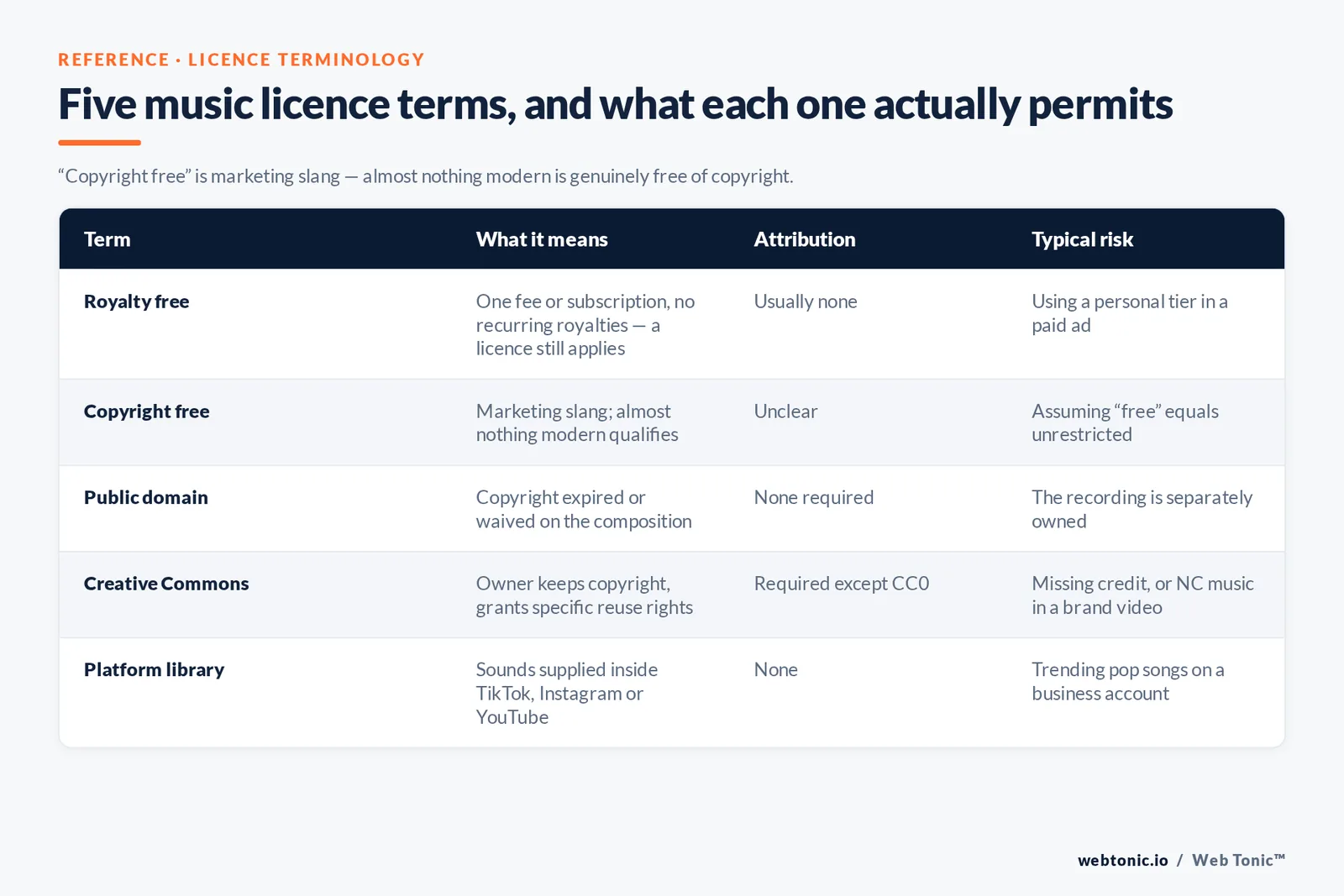
Three terms get muddled constantly, and the difference is what gets brands into trouble:
| Term | What it means | Attribution | Commercial use | Typical risk |
|---|---|---|---|---|
| Royalty free | One fee or subscription, no recurring royalties, licence still applies | Usually none | Depends on tier | Using a personal tier in a paid ad |
| Copyright free | Marketing slang; almost nothing modern is genuinely copyright free | Unclear | Unclear | Assuming "free" equals "unrestricted" |
| Public domain | Copyright expired or waived; the composition is free to use | None required | Yes | The recording of a public-domain work is separately owned |
| Creative Commons | Owner keeps copyright and grants specific reuse rights | Required except CC0 | Blocked by any NC licence | Missing credit, or NC music in a brand video |
| Platform library | Sounds supplied inside TikTok, Instagram or YouTube | None | Only via the commercial catalogue | Trending pop songs on a business account |
The public-domain trap deserves a line of its own. A Bach partita composed in 1720 is public domain, but the 2019 studio recording of it is a protected sound recording with its own owner. Under US law, works made for hire are protected for 95 years from publication or 120 years from creation, whichever is shorter, so "it is old" is not a defence. The US Copyright Office spells out the terms, and its fair-use FAQ makes clear that background music in a promotional video is essentially never fair use.
The licence types you will actually meet
Whatever library you use, a music licence is answering five questions: which media, which territory, for how long, on whose behalf, and with how much legal cover if a claim arrives. Subscription libraries answer them with plan tiers; single-track marketplaces answer them with licence names.
| Licence model | How you pay | Best for | Watch out for |
|---|---|---|---|
| Creator subscription | Monthly or annual, unlimited downloads | Ongoing social, YouTube and podcast output | Whether tracks stay cleared after you cancel |
| Business subscription | Monthly per seat or per organisation | In-house teams and small agencies | Market or territory limits on coverage |
| Enterprise / agency | Quoted annually | Client work, broadcast, OOH, indemnification | Whether client-name licensing is included |
| Single-track licence | One-time, per track, per use tier | A single hero film or campaign | Re-licensing if the cut is reused elsewhere |
| Creative Commons | Free, conditions attached | Low-budget organic content | NC and ND clauses, plus credit formatting |
| Platform catalogue | Free inside the app | Organic short-form posts | No coverage off-platform or in ads |
Creative Commons is the one model people misread most often. The six CC licences run from CC BY (attribution only) to CC BY-NC-ND (attribution, non-commercial, no derivatives). Any licence containing NC is off-limits for brand content, and ND forbids editing the track — which means you cannot even trim it to your edit. Only CC0 waives attribution outright. If you build a habit of copying the attribution string into the video description the moment you download a track, you have solved 90% of your CC exposure.
What royalty free background music costs in 2026
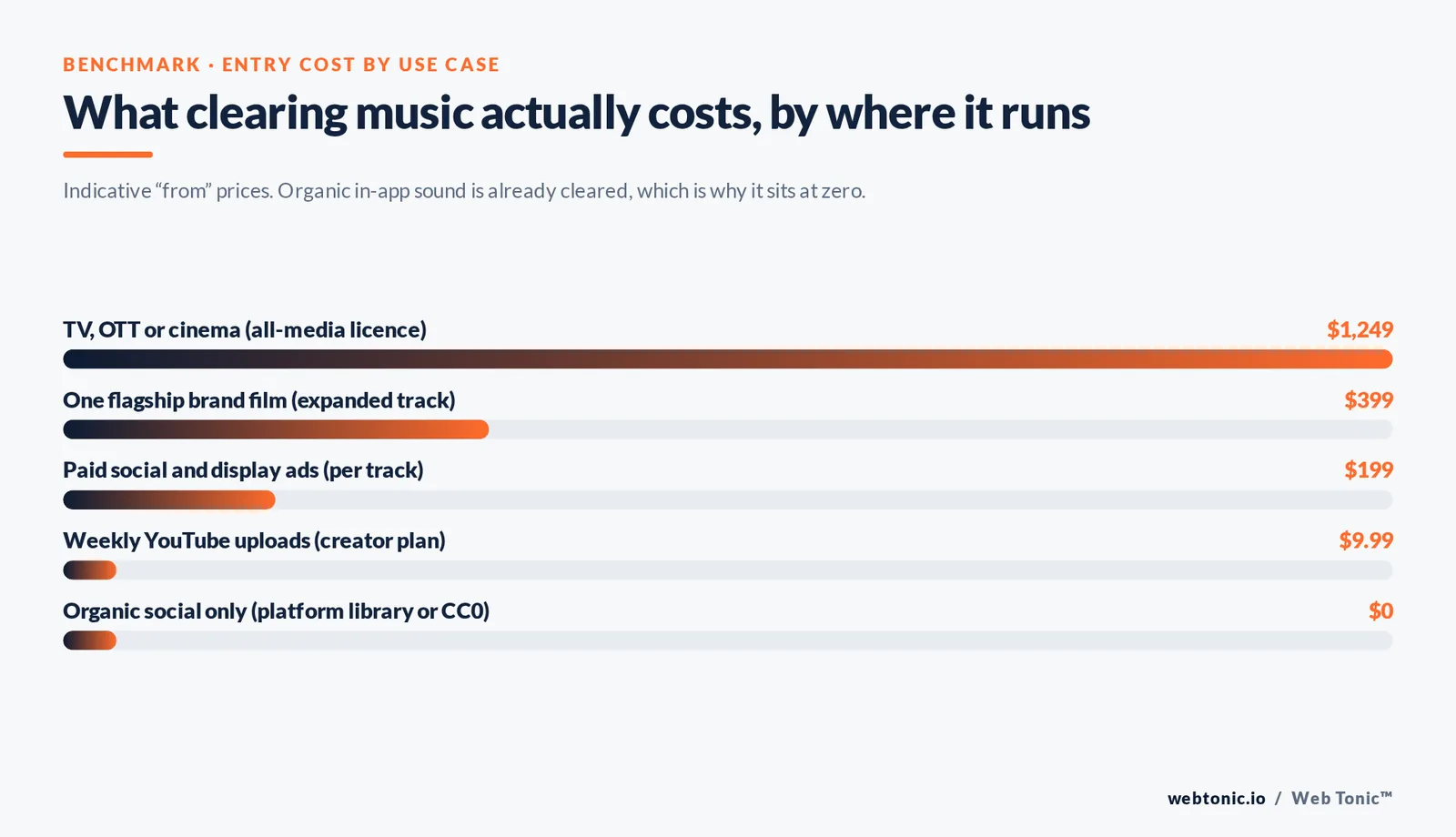
Prices split cleanly between "I publish constantly" and "I need one track for one film". Soundstripe publishes both models: subscriptions from $9.99/month for solo creators with access to 58,000+ tracks and close to 100,000 sound effects, and one-time track licences at $49 personal, $199 digital (which covers paid social and digital ads), from $399 expanded for OOH and internal use, and from $1,249 for broadcast and streaming distribution. Epidemic Sound uses a pure subscription model in which every plan includes unlimited downloads with no additional royalties on publication or monetisation.
| Use case | Right model | Indicative cost | Why |
|---|---|---|---|
| Weekly YouTube uploads | Creator subscription | From $9.99/mo | Volume plus channel-level clearance |
| Organic social posts only | Platform library or CC0 | $0 | In-app sound is already cleared for organic |
| Paid social and display ads | Digital single-track or business plan | From $199 per track | Advertising is a separate right |
| One flagship brand film | Expanded single-track | From $399 | Cheaper than a year of unused subscription |
| TV, OTT or cinema | All-media licence | From $1,249 | Broadcast distribution and indemnification |
| Agency client work | Enterprise plan | Quoted | Licensing on a client's behalf must be explicit |
The arithmetic is simple. A team publishing 4 videos a month spends roughly $120 a year on a creator subscription — less than one digital single-track licence. A team publishing two films a year should licence per track instead. The break-even sits at about 3 tracks per year.
Where to find high quality free tracks
Free does not have to mean bad, but it does mean reading terms. Four sources are genuinely dependable.
The YouTube Audio Library is the strongest free option for video, and the reason is mechanical rather than musical: Google states that music and sound effects downloaded from the Audio Library will not be claimed by a rights holder through Content ID. You can filter by title, genre, mood, artist, attribution requirement and duration, and toggle between "attribution required" and "attribution not required" so you never have to guess. Tracks under a Creative Commons licence still need the credit line pasted into your description.
Free Music Archive is a curated, licence-labelled catalogue that leans indie rather than corporate — useful when every competitor is using the same three library tracks. Filter aggressively: mixed CC licences sit side by side, and the NC ones are unusable for brand work.
Platform sound libraries cover organic short-form. On TikTok, the Commercial Music Library exists precisely because business accounts cannot use the mainstream chart catalogue. If your account is a business account, that library is your catalogue, and pulling a trending pop song into a brand post is exactly how videos get muted.
AI-generated music now sits alongside these, and it is genuinely useful for short stings and beds where nobody will hum the melody afterwards. Check the generator's terms for commercial rights and output ownership before it appears in an advertisement.
How YouTube's Content ID treats background music
Most panic about music licensing is really panic about a yellow icon in YouTube Studio. Two different systems exist, and confusing them is expensive.
A Content ID claim is generated automatically when an upload matches a reference file in the system. Depending on the rights holder's settings, the claim can block the video, monetise it on the claimant's behalf, or simply track its viewership. A claim is not a penalty: your channel standing is untouched. A copyright strike is different — it follows a formal legal removal request, and 3 strikes ends the channel.
| Situation | What happens | Channel impact | Your move |
|---|---|---|---|
| Licensed library track, false match | Content ID claim | None | Whitelist your channel in the library, then dispute the claim |
| Audio Library track | No claim expected | None | Keep the attribution line if CC-licensed |
| Commercial song, no licence | Claim, mute or block | Revenue lost | Replace the audio and re-upload |
| Formal removal request | Copyright strike | Severe — 3 = termination | Retraction, counter-notification or wait out expiry |
| Repeated bad disputes | Escalation to a strike | Severe | Never dispute without a real licence |
The practical habit: register your channel ID with your music library on the day you subscribe. Most libraries offer channel whitelisting or auto-clearance, and it prevents the claim rather than fixing it after publication.
Choosing the right track: BPM, mood and genre
Once the legal question is settled, music selection becomes a craft question. Background music has one job in marketing video: to make the edit feel inevitable. Tempo drives that more than genre does, because BPM sets your cutting rhythm.
| Content type | Target BPM | Mood | Genre that works | Mix level under voice |
|---|---|---|---|---|
| Customer testimonial | 60–90 | Warm, sincere | Acoustic, piano, ambient | −18 to −22 dB |
| Explainer or tutorial | 100–120 | Neutral, clear | Corporate, light electronic, chill hop | −18 dB |
| Product launch | 120–140 | Confident, driving | Indie pop, cinematic electronic | −14 dB |
| Social hype cut | 130–150 | High energy | Hip hop, trap, drum-led pop | −10 dB |
| Brand film | 70–100 building | Cinematic, emotional | Orchestral, post-rock, hybrid | −20 dB |
| Podcast intro | 95–115 | Recognisable, short | Funk, electronic, logo sting | Full then duck |
Three practical rules make free and paid tracks sound equally professional. First, cut the video to the music's structure — let the first visual beat land on the downbeat, not 0.4 seconds after it. Second, duck the bed under dialogue by 10–20 dB instead of lowering the whole track, so bass and drums stay audible in the gaps. Third, filter the low end of the music around 200 Hz when a voiceover sits on top, because muddiness — not volume — is what makes amateur audio sound amateur.
Sound effects deserve the same care as the music bed. A whoosh on a transition and a soft click on a UI reveal make a product demo read as deliberate. Most library subscriptions bundle sound effects with music, which is a reason to pick one subscription rather than assembling free tracks from five sources.
Licensing rules by platform and campaign type
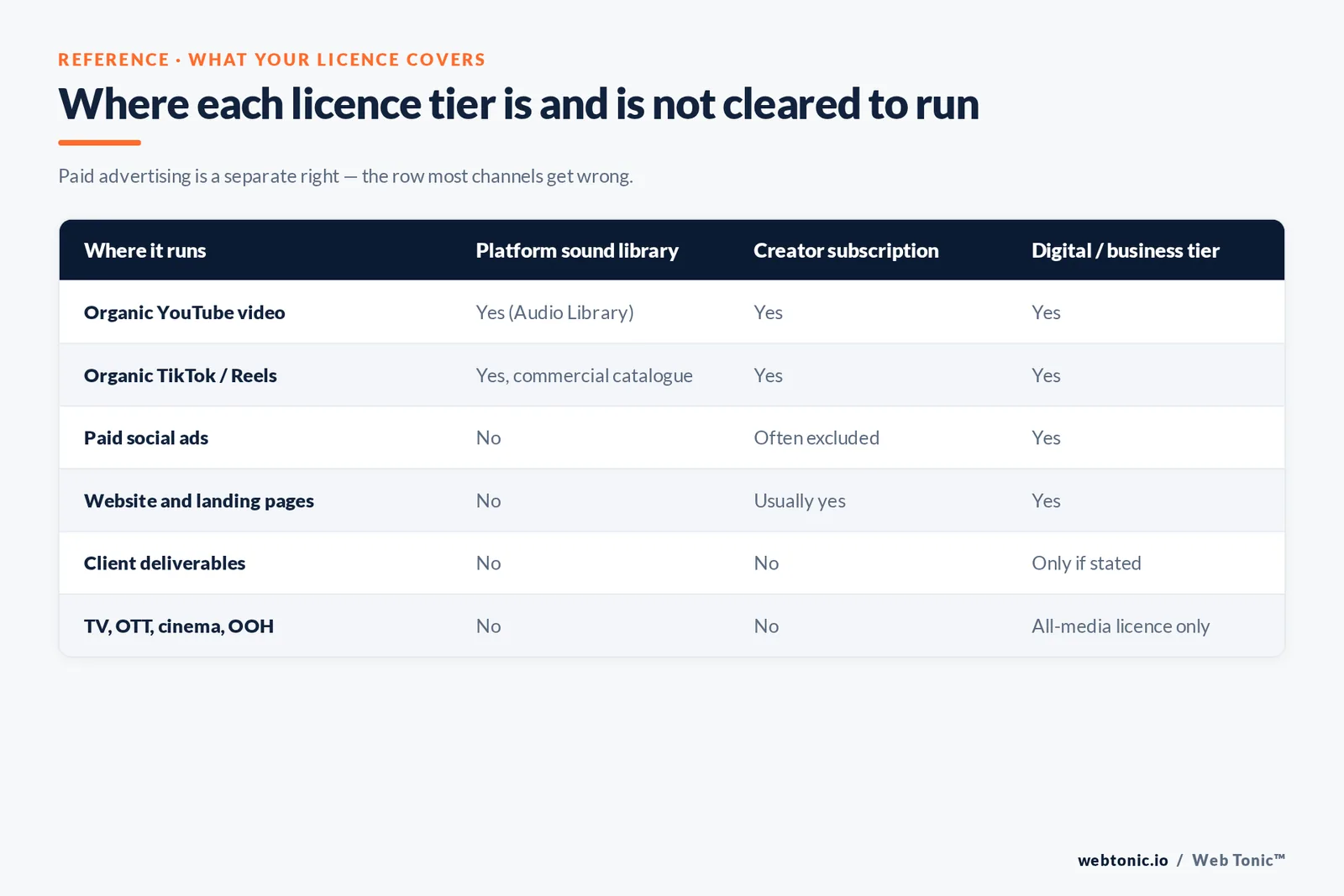
The same track can be perfectly legal in an organic post and a violation in the paid version of that post. Advertising, and any use where the content is boosted with media spend, is treated as a separate right by nearly every library and platform.
| Where it runs | Platform sound library | Creator subscription | Digital / business tier |
|---|---|---|---|
| Organic YouTube video | Yes (Audio Library) | Yes | Yes |
| Organic TikTok / Reels | Yes, commercial catalogue | Yes | Yes |
| Paid social ads | No | Often excluded | Yes |
| Website and landing pages | No | Usually yes | Yes |
| Client deliverables | No | No | Only if stated |
| TV, OTT, cinema, OOH | No | No | All-media licence only |
Two more rules save real money. If an organic video performs and you want to boost it, re-export it with a licensed track rather than paying for the boost on borrowed audio. And if an agency produces the video, the licence must be issued on the client's behalf or the client owns an asset it cannot legally keep running — a point worth checking before any handover. Our performance creative team licences per client for exactly that reason.
A pre-publish licensing checklist
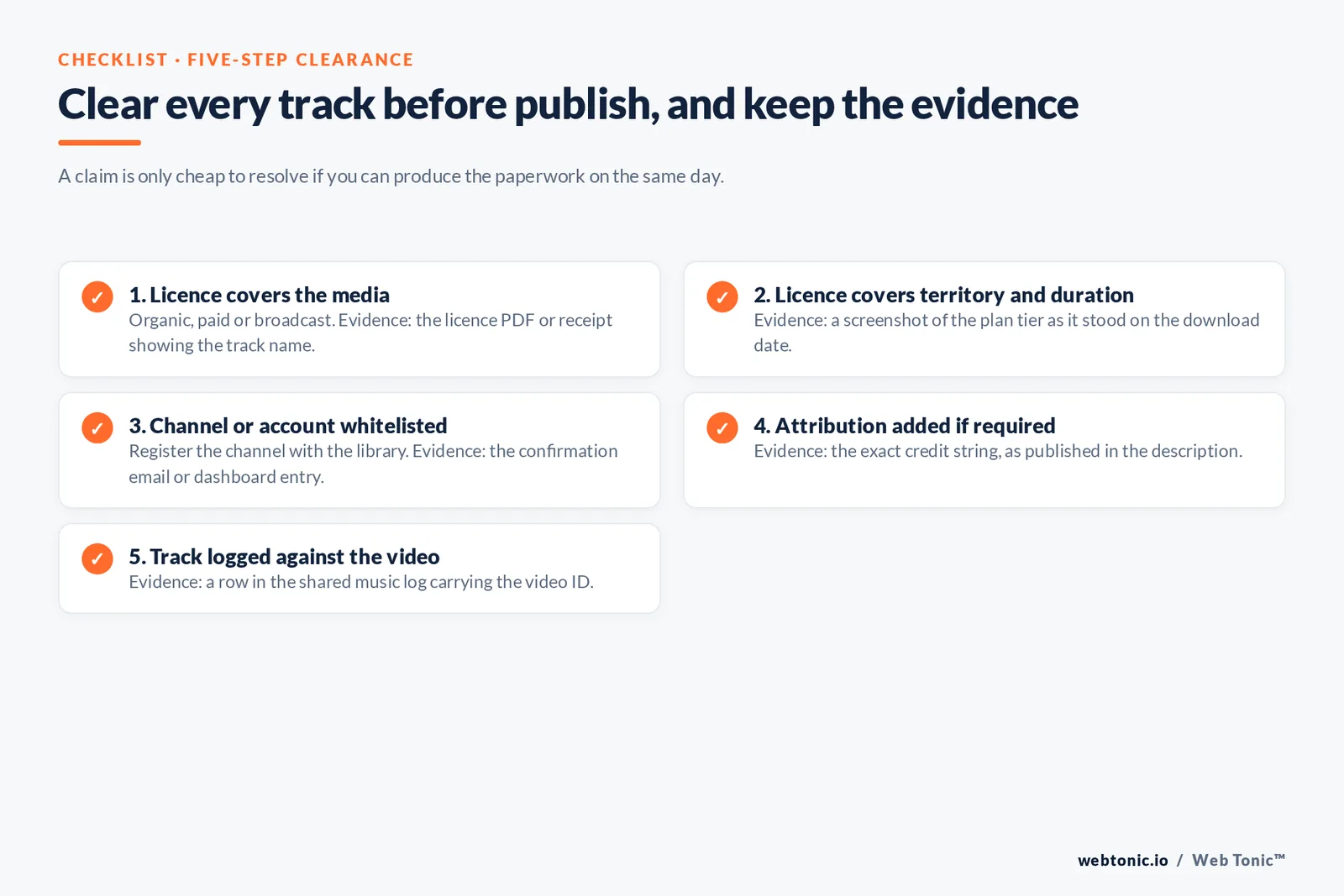
Before any video with music leaves the building, five checks take under two minutes and prevent almost every claim we have ever had to unwind for a client.
| Step | Check | Evidence to keep |
|---|---|---|
| 1 | Licence covers the media (organic, paid, broadcast) | Licence PDF or receipt with the track name |
| 2 | Licence covers the territory and duration | Screenshot of the plan tier at download date |
| 3 | Channel or account whitelisted with the library | Confirmation email or dashboard entry |
| 4 | Attribution added if the licence requires it | The exact credit string in the description |
| 5 | Track logged in the asset library with the video ID | Row in the shared music log |
Keep that log in the same place as your brand assets. When a claim arrives eighteen months later on a video nobody remembers making, the entire dispute becomes a two-minute copy-and-paste. Teams that treat audio as part of their content operations rather than a last-minute drag-and-drop simply stop having this problem.
FAQ
What does royalty free mean, and how is it different from copyright free?
Royalty free means you pay once — a subscription or a single fee — and owe no further royalties per view or per broadcast. The track is still copyrighted and still governed by a licence. Copyright free implies nobody owns the music at all, which is almost never true for modern recordings. Treat "copyright free" as marketing language and always read the actual licence.
Where can I find high quality royalty free background music for free?
The YouTube Audio Library is the safest starting point because its tracks are not claimed through Content ID, and it lets you filter for music that requires no attribution. Free Music Archive adds more distinctive, indie-leaning options under labelled Creative Commons licences. For organic short-form, use the platform's own commercial catalogue. For paid advertising, budget for a licence.
Can I use royalty free music in commercial projects without attribution?
Usually yes with a paid library licence, and always yes with CC0. Under a Creative Commons licence containing BY, attribution is mandatory and must appear where viewers can see it — normally the video description. Any licence containing NC blocks commercial use entirely, no matter how the credit is worded.
How do I choose the right BPM for background music?
Let the edit decide. Slow, emotional footage and testimonials sit best at 60–90 BPM; explainers around 100–120; product and social cuts at 120–150. Then cut visuals on the beat and duck the music 10–20 dB under any voiceover so the mix stays intelligible.
What happens if I get a Content ID claim on a track I licensed?
False matches happen, especially with popular library tracks. Register your channel with the library first so claims are auto-released, then dispute the claim in YouTube Studio with your licence as evidence. A claim on its own carries no penalty to your channel; only formal copyright strikes do, and three of those terminate a channel.
Do I need a different licence for paid ads than for organic posts?
Almost always, yes. Advertising is a separate right in most licences, and in-app sound libraries do not cover it. If a video will ever be boosted, licence it at the digital or business tier from the start — retro-fitting audio into a live campaign costs more than the licence did.
Working music into your content system
Music is the cheapest quality upgrade available to a marketing team and the easiest place to create legal debt. The fix is boring: one library that matches your publishing volume, one licence tier that matches your most aggressive use case, one whitelist on day one, and one log linking every track to every video. Everything else — genre, mood, BPM — is craft you can iterate on freely once the rights are settled. If you would rather hand the whole production and clearance workflow to a team that does it daily, talk to us, or browse more production guides on the Web Tonic blog.
Sources: US Copyright Office (copyright basics; fair-use FAQ) · Creative Commons (the six CC licences; CC0) · YouTube Help (Audio Library, Content ID claims, disputing claims, copyright strikes) · Soundstripe pricing · Epidemic Sound pricing · TikTok Commercial Music Library · Free Music Archive. All figures verified against the cited pages in 2026.