



Table of contents

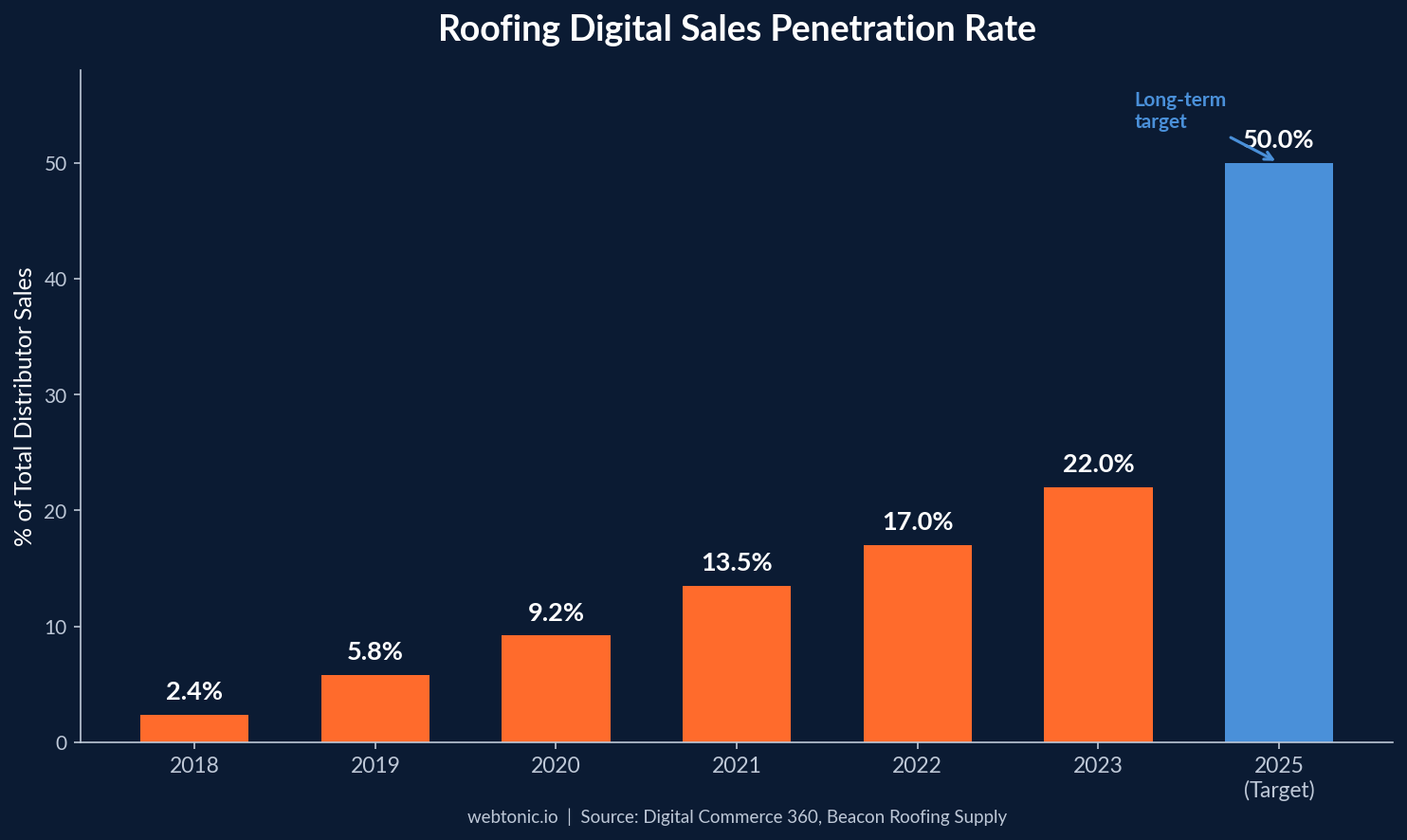
Roofing ecommerce penetration has surged from 2.4% of distributor sales in 2018 to more than 22% by late 2023, with the largest U.S. roofing distributor targeting 50% digital sales within the decade. Below are the most important roofing Shopify and ecommerce statistics for 2026, covering platform adoption, conversion benchmarks, B2B wholesale trends, and the market forces reshaping how roofing materials move from manufacturer to jobsite.
Key Takeaways
- Roofing digital commerce penetration jumped from 2.4% in 2018 to 22% in 2023, with Beacon Roofing Supply reporting a further 20% year-over-year online sales increase in Q4 2025 (Digital Commerce 360).
- Shopify B2B gross merchandise volume hit $9.4 billion in H1 2026, up 140% year-over-year, with average B2B order values reaching $1,840 compared to $130 for DTC orders (Ecommerce Times).
- 57.8% of contractor websites run on WordPress, while Shopify holds 4.0% of the small business CMS market — but Shopify's B2B features are pulling building-materials wholesalers onto the platform at an accelerating rate (Elevate Web Design).
- The global roofing materials market reached $88.9 billion in 2025 and is projected to hit $110.5 billion by 2035, with online channels capturing an increasing share of that growth (Future Market Insights).
- Traditional distributor networks still control 64.2% of roofing distribution, but direct-to-contractor ecommerce is eroding that dominance faster than any previous channel shift (DataIntelo).
- Average Shopify conversion rates sit at 1.8% on mobile and 2.85% on desktop, with home improvement stores seeing cart abandonment rates of 71.5% — slightly above the 70.19% platform average (DollarPocket).
- Roofing websites average a 13.9-second Largest Contentful Paint — 11.4 seconds over Google's 2.5-second passing threshold — making site speed the biggest ecommerce conversion killer in the industry (Borah Labs).
Roofing Ecommerce Benchmarks at a Glance
| Metric | Roofing / Home Improvement | All-Shopify Average | Source |
|---|---|---|---|
| Digital Sales Penetration | 22% (2023) | N/A | Digital Commerce 360 |
| YoY Online Sales Growth | +20% (Q4 2025) | +18% (platform-wide) | Digital Commerce 360 |
| Shopify B2B Avg Order Value | $1,840 | $130 (DTC) | Ecommerce Times |
| Mobile Conversion Rate | 1.8% | 2.85% | DollarPocket / Uxitt |
| Cart Abandonment Rate | 71.5% | 70.19% | Baymard / GrowthSuite |
| Average PageSpeed Score | 45/100 | N/A | Borah Labs |
| Avg LCP (Largest Contentful Paint) | 13.9s | 2.5s (Google threshold) | Borah Labs |
| WordPress CMS Share (Contractors) | 57.8% | 43.6% (all SMBs) | Elevate Web Design |
Roofing Digital Sales Growth Statistics
The roofing industry's shift to digital commerce is accelerating at a pace that would have been unimaginable a decade ago. The numbers tell a clear story of an industry in transition.
- Beacon Roofing Supply's digital sales comprised 22% of total revenue in Q3 2023, up from just 2.4% in 2018 and 13.5% in 2021. The company's long-term target is 50% of all sales through digital channels (Digital Commerce 360).
- Beacon reported a 20% year-over-year increase in online sales in Q4 2025, even while navigating a hostile takeover bid from QXO, demonstrating that digital adoption continues regardless of corporate uncertainty (Digital Commerce 360).
- The global roofing materials market was valued at $88.9 billion in 2025 and is forecast to reach $110.5 billion by 2035. Online channels are capturing a growing share of this expansion as contractors and property managers demand 24/7 ordering capabilities (Future Market Insights).
- Traditional distributor networks still hold 64.2% of roofing distribution market share, but direct-to-contractor platforms and B2B ecommerce marketplaces are compressing margins and reshaping supply chains (DataIntelo).
- The roofing retail market reached approximately $87.0 billion in 2024 and is projected to grow to $110.5 billion by 2035, driven by residential reroofing demand and commercial construction spending.
Shopify B2B and Platform Statistics for Building Materials
Shopify's aggressive B2B expansion is creating a new pathway for roofing material suppliers and distributors who need more than a basic catalog website.
- Shopify B2B gross merchandise volume reached $9.4 billion in H1 2026, surging 140% year-over-year. Net terms (30/60/90-day payment options) became available for approved buyers starting Q1 2026 (Ecommerce Times).
- Average B2B order value on Shopify is $1,840, compared to $130 for direct-to-consumer orders — a 14:1 ratio that reflects the wholesale nature of building material transactions (Ecommerce Times).
- Shopify holds 4.0% of the overall small business CMS market, but its share in construction and home improvement is growing as Shopify Plus adds B2B-specific features like quantity-based pricing, company accounts, and purchase orders (Elevate Web Design).
- Home improvement Shopify stores carry a median of 108 products, with the middle 50% ranging from 26 to 520 SKUs — reflecting the catalog complexity of building materials retailers.
- Shopify B2B stores offering net terms see 22–35% higher repeat purchase rates compared to payment-at-checkout-only stores, as contractors prefer ordering on account rather than swiping a card on every delivery.
Shopify B2B vs. DTC Performance Comparison
| Metric | Shopify B2B | Shopify DTC | Difference |
|---|---|---|---|
| Average Order Value | $1,840 | $130 | 14× higher |
| B2B GMV (H1 2026) | $9.4 billion | N/A | +140% YoY |
| Net Terms Available | 30/60/90-day | None | B2B advantage |
| Repeat Purchase Rate | 48%+ | 28.5% | 68% higher |
| Cart Abandonment | ~65% | 70.19% | 5pp lower |
| Mobile Order Share | ~25% | ~72% | B2B still desktop-heavy |
CMS and Platform Adoption Among Roofing Contractors
Understanding which platforms roofing companies actually use reveals both opportunities and inertia in the industry's digital infrastructure.
- 66.2% of roofing contractor websites run on WordPress, according to Fervor Studio's analysis of 130 roofing sites. Gutenberg Blocks is the most common page builder at 60.8% (Fervor Studio).
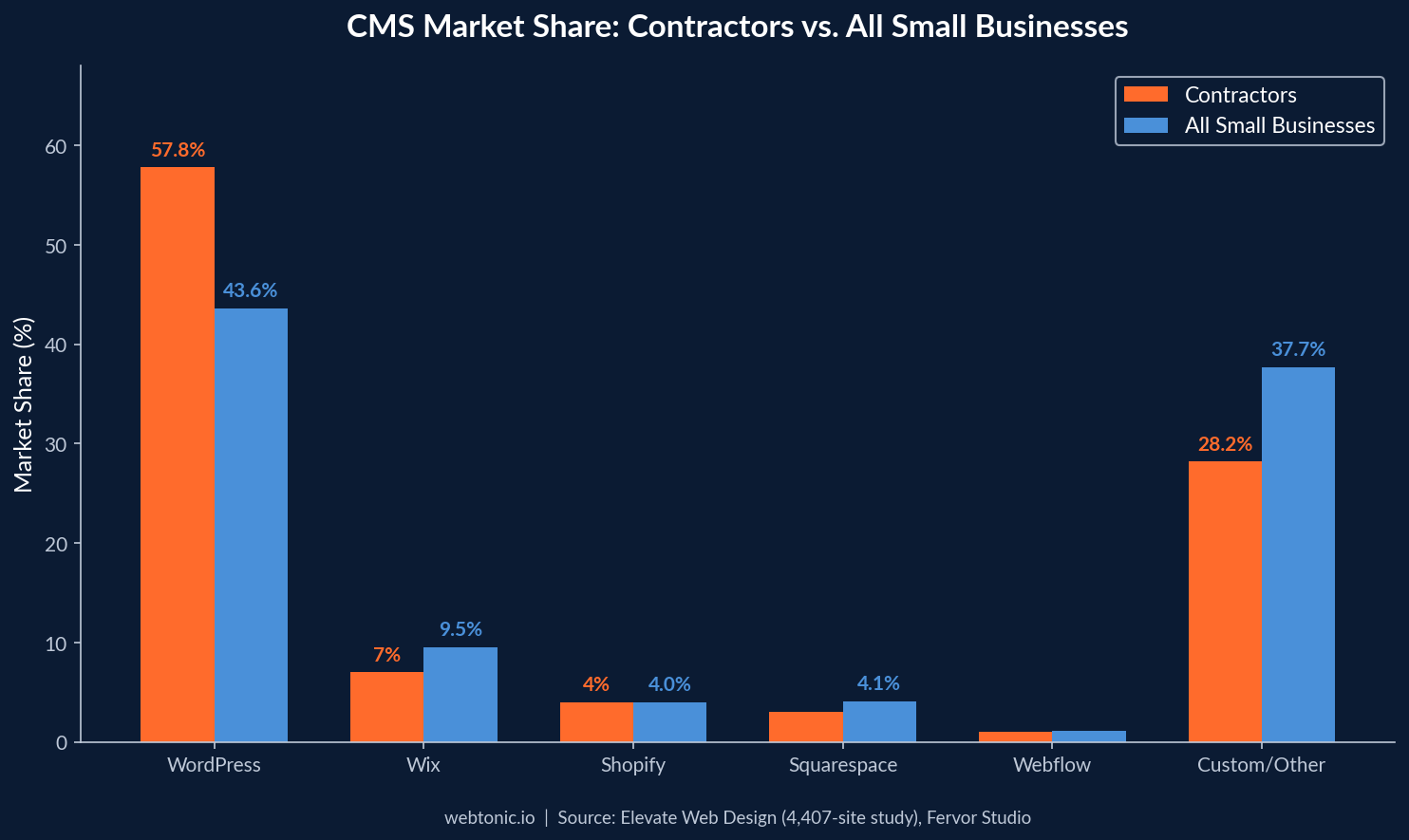
- Across all contractor verticals, WordPress holds 57.8% market share, well above the 43.6% share WordPress commands among small businesses overall (Elevate Web Design).
- Wix captures 9.5% and Squarespace 4.1% of the small business CMS market, primarily in visual-first industries like salons (29.3% WordPress) and restaurants (34.7% WordPress) — not in trades like roofing (Elevate Web Design).
- The remaining quarter of roofing websites are split across Shopify, Wix, Squarespace, Webflow, Duda, and custom builds — but Shopify's share is growing among companies that sell materials or parts directly to contractors and homeowners.
- Only 1.1% of small business websites use Webflow, despite its superior speed and design flexibility — cost and developer scarcity remain barriers for most roofing companies.
CMS Market Share Among Contractor Websites
| Platform | Contractor Share | All Small Business Share |
|---|---|---|
| WordPress | 57.8% | 43.6% |
| Wix | ~7% | 9.5% |
| Squarespace | ~3% | 4.1% |
| Shopify | ~4% | 4.0% |
| Webflow | ~1% | 1.1% |
| Custom / Other | ~28% | 37.7% |
Conversion Rate and Ecommerce Performance Statistics
Ecommerce conversion benchmarks tell roofing companies exactly where they stand — and where the biggest gains are hiding.
- Shopify's platform-wide average conversion rate is 1.8% on mobile and 2.85% on desktop, but home improvement stores tend to underperform these benchmarks due to complex product selection and high average order values (DollarPocket).
- Cart abandonment in home improvement ecommerce runs at 71.5%, slightly above the 70.19% Shopify-wide average. Mobile abandonment is 10–15 percentage points higher than desktop (DollarPocket).
- Mobile AOV (average order value) for home improvement is $50–$70, compared to $80–$100 on desktop — mobile browsers tend to be researching, not buying full material orders.
- Roofing websites average a PageSpeed score of just 45 out of 100, with an average Largest Contentful Paint of 13.9 seconds — 11.4 seconds over Google's 2.5-second passing threshold (Borah Labs).
- Sites loading under 2.5 seconds achieve 6.8% conversion rates, while those above 4.5 seconds drop to just 2.1% — a performance gap that compounds dramatically for ecommerce stores where every additional second costs sales (see our full Google Ads cost guide).
- 93.3% of roofing websites have SSL certificates, but the remaining 6.7% trigger Chrome security warnings that immediately destroy buyer trust on any store page (Borah Labs).
Website Performance and Technical Benchmarks
Technical performance directly determines whether a roofing ecommerce store converts visitors into buyers or bleeds traffic to competitors with faster sites.
| Core Web Vital | Roofing Average | Google Threshold | Status |
|---|---|---|---|
| Largest Contentful Paint | 13.9s | 2.5s | FAILING (5.6× over) |
| First Contentful Paint | 3.97s | 1.8s | FAILING (2.2× over) |
| Cumulative Layout Shift | 0.10 | 0.10 | BORDERLINE |
| Time to First Byte | 0.03s | 0.80s | PASSING |
| PageSpeed Score | 45/100 | 50/100 | FAILING |
| SEO Score | 94/100 | 90/100 | PASSING |
- The average roofing website takes 13.9 seconds to render its main content — 5.6 times longer than Google's 2.5-second LCP threshold. This single metric explains why most contractor ecommerce stores hemorrhage visitors before a product page even loads (Borah Labs).
- 40–60% of contractor websites sit on cheap shared hosting (Bluehost, GoDaddy), where 80+ sites share a single server. Page builders like WPBakery compound the problem with 400–600KB of extra JavaScript (PipelineOn).
- Roofing sites score an average of 94 out of 100 on Lighthouse SEO, meaning basic meta tags and structure are generally sound — the problem is almost entirely performance-related, not content-related (Borah Labs).
- Every 1-second improvement in page load time can increase conversions by 7%, meaning a roofing ecommerce site that cuts its LCP from 13.9 seconds to 2.5 seconds could theoretically see a dramatic conversion uplift.
Best Practices for Roofing Ecommerce on Shopify
The data points to a clear set of priorities for roofing companies considering or already operating on Shopify.
- Prioritize site speed above everything else. With average roofing LCP at 13.9 seconds, optimizing images, reducing JavaScript, and upgrading hosting will deliver more conversion lift than any marketing spend.
- Leverage B2B features for wholesale accounts. Shopify's B2B tools (net terms, company accounts, quantity pricing) reduce friction for contractors who order in bulk and prefer payment on account.
- Build for mobile research, desktop conversion. Mobile AOV in home improvement is 30–40% lower than desktop — optimize mobile for product discovery and comparison, then make desktop checkout frictionless.
- Invest in product data quality. Detailed specifications, installation guides, and compatibility matrices reduce returns and support costs while improving SEO for long-tail product queries.
- Integrate with contractor workflows. Connect Shopify to estimating software, CRM, and project management tools that contractors already use — the stores that embed into existing workflows see the highest repeat purchase rates.
- Address cart abandonment proactively. With 71.5% abandonment in home improvement, email recovery sequences, saved carts for logged-in B2B buyers, and clear shipping cost calculators can recover significant revenue.
Roofing Ecommerce vs. All-Industry Digital Commerce
| Metric | Roofing Industry | All Industries | Gap |
|---|---|---|---|
| Ecommerce Penetration | 22% of sales | ~30% of retail | 8pp behind |
| Digital Sales Growth | +20% YoY | +12% (U.S. average) | Outpacing overall |
| CMS Dominance (WordPress) | 66.2% | 43.6% | 22.6pp higher |
| Average LCP | 13.9s | ~4.5s (SMB avg) | 3× slower |
| Mobile Conversion Gap | 37% lower than desktop | 20% lower | Wider gap |
| B2B Share of Orders | Growing rapidly | ~23% of ecommerce | Catching up |
FAQ
How many roofing companies sell products through Shopify?
While exact numbers are not publicly disclosed, the home improvement category on Shopify has been growing rapidly, with Shopify B2B GMV surging 140% in H1 2026. Roofing material suppliers, replacement parts retailers, and accessory sellers represent a growing segment of this market. The platform's addition of B2B features like net terms and company accounts has accelerated adoption among building materials wholesalers.
What is the average conversion rate for roofing ecommerce stores?
Roofing ecommerce stores typically convert below the Shopify-wide average of 1.8% (mobile) and 2.85% (desktop). Home improvement stores see higher cart abandonment at 71.5% due to complex product selection and high order values. Stores that reduce page load times below 2.5 seconds and offer clear product specifications tend to outperform the category average significantly.
Is Shopify better than WordPress for a roofing supply store?
For pure ecommerce (selling roofing materials online), Shopify provides superior out-of-the-box checkout, payment processing, and B2B features. For a contractor website that also sells some products, WordPress with WooCommerce offers more flexibility but requires more maintenance and technical oversight. The 66.2% WordPress dominance among roofing sites reflects the industry's lead-generation focus rather than ecommerce focus.
What is the biggest obstacle for roofing ecommerce?
Site performance. With average roofing website LCP at 13.9 seconds (5.6× Google's threshold), most potential buyers abandon before product pages load. The second major obstacle is the industry's reliance on relationship-based distribution — 64.2% of roofing distribution still flows through traditional networks where personal relationships drive purchasing decisions.
How large is the roofing materials market?
The global roofing materials market was valued at approximately $88.9 billion in 2025 and is projected to reach $110.5 billion by 2035. Within the United States, roofing, siding, and insulation wholesaling represents a substantial portion of this market. Digital channels are capturing an increasing share, with leading distributors like Beacon targeting 50% of sales through online platforms.
Sources
Digital Commerce 360 — Roofing Ecommerce Sales Target
Digital Commerce 360 — Beacon Q4 2025 Digital Sales
Ecommerce Times — Shopify B2B GMV Surges 140%
Elevate Web Design — Small Business CMS Statistics 2026
Fervor Studio — Digital State of the Roofing Industry 2026
Borah Labs — Roofing Website Benchmarks
DollarPocket — Shopify Store Benchmarks 2026
DataIntelo — Global Roofing Distribution Market
Future Market Insights — Roofing Materials Market
PipelineOn — Contractor Website Speed Optimization


