Table of contents
A roofing company's review-management budget is not one line item - it is a stack of published 2026 vendor rates, from USD 1 a month for pure profile monitoring to a USD 999 platform-fee minimum for a bundled reputation suite. The unit of analysis here is monthly spend per crew or location, priced against what homeowners now actually require before they call.
Key Takeaways
- 62% of homeowners rate online reviews very or extremely important when picking a roofer.
- 47% of consumers will not use a business with fewer than 20 reviews.
- 68% of consumers now require at least a 4-star average, up from 55% a year earlier.
- 31% require 4.5 stars or higher, up from 17% the prior year.
- 74% of consumers only weigh reviews written in the last three months.
- 91%+ of roofing contractors already feature their own reviews on their websites.
- GBP monitoring alone is priced at USD 1 per location a month (Whitespark).
- A multi-location review-request tier runs USD 60 per location a month (GatherUp).
- A bundled reputation platform starts at a USD 99 a month minimum (Vendasta Starter).
- Higher Vendasta tiers require a USD 499 or USD 999 monthly minimum spend.
- Podium and Birdeye now publish no self-serve price - both are quote-only in 2026.
- A one-star rating gain causes a 5-9% revenue increase (Harvard/Luca, causal estimate).
- Businesses that respond to reviews earn up to 18% more revenue (Google/Wiser Review).
- Responding to over 30% of reviews correlates with roughly 2x more leads.
- 75% of businesses still do not respond to their negative reviews.
- The FTC's fake-review rule (16 CFR 465) has been enforceable since October 21, 2024.
Why the threshold moved: what homeowners require in 2026
Roofing Contractor's 2026 Homeowner Survey, run with Owens Corning, found 62% of homeowners rate online reviews very or extremely important in choosing a roofer, with just under 30% calling them merely important and only 9% dismissing reviews outright. On the supply side, more than 91% of the contractors who value reviews already display them on their own websites - so a roofer without a visible review presence is behind the median competitor, not just behind best practice.
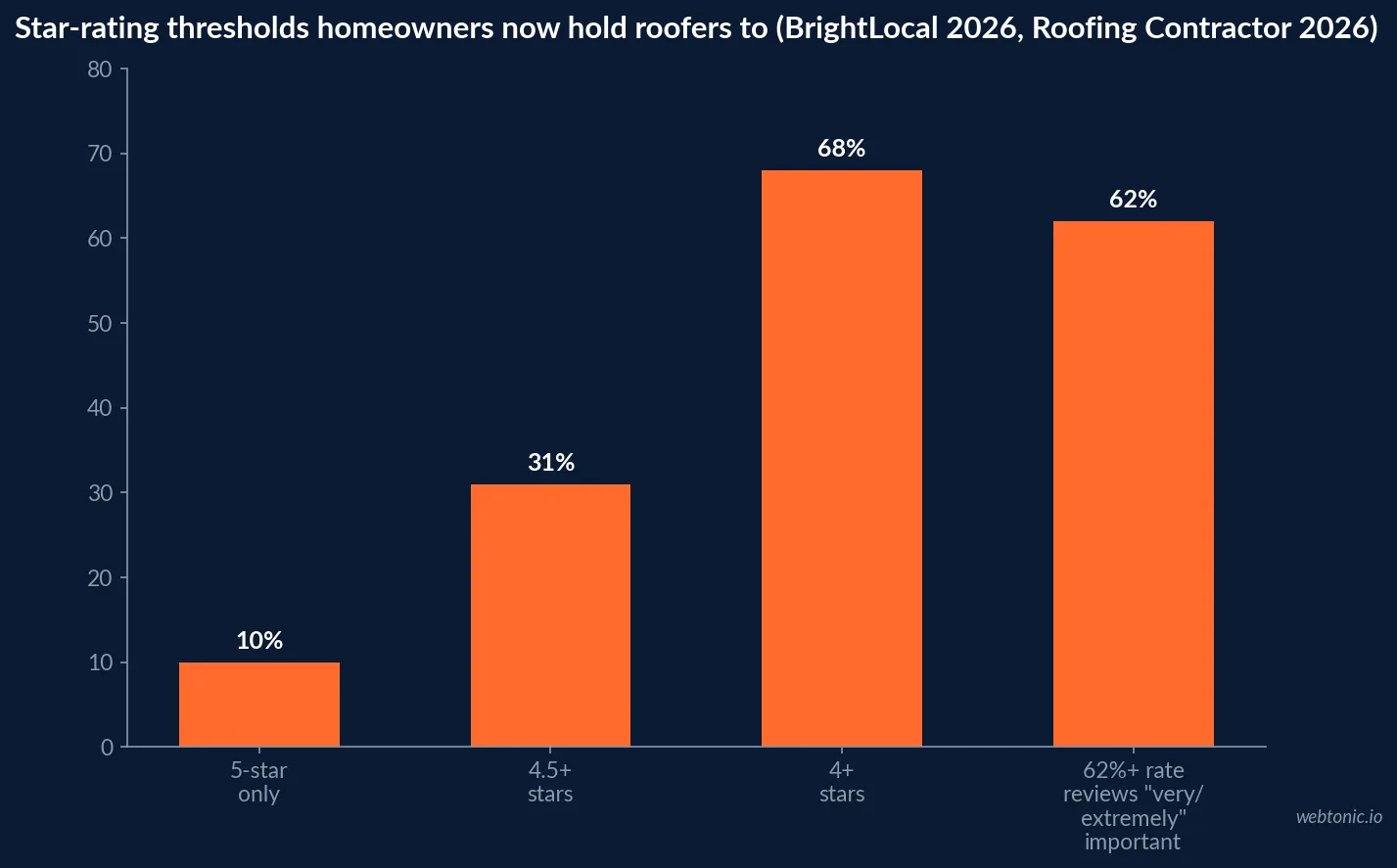
BrightLocal's 2026 Local Consumer Review Survey of 1,002 consumers sharpens the bar further: 47% will not use a business with fewer than 20 reviews, only 9% will accept five or fewer, and 68% now require at least a 4-star average, up from 55% the year before. Recency compounds the pressure - 74% only weigh reviews written in the last three months, and 32% look specifically for reviews from the last two weeks.
| Homeowner requirement (2026) | Share of homeowners | Source | What it means for the budget |
|---|---|---|---|
| Reviews very/extremely important | 62% | Roofing Contractor/Owens Corning | A silent profile costs calls |
| Will not use a business with <20 reviews | 47% | BrightLocal LCRS 2026 | Volume needs a request cadence |
| Require 4+ star average | 68% | BrightLocal LCRS 2026 | One bad batch of reviews is costly |
| Require 4.5+ stars | 31% | BrightLocal LCRS 2026 | Response quality now matters, not just volume |
| Only weigh reviews from last 3 months | 74% | BrightLocal LCRS 2026 | Requests must be continuous |
Pricing the software layer: four published 2026 rate cards
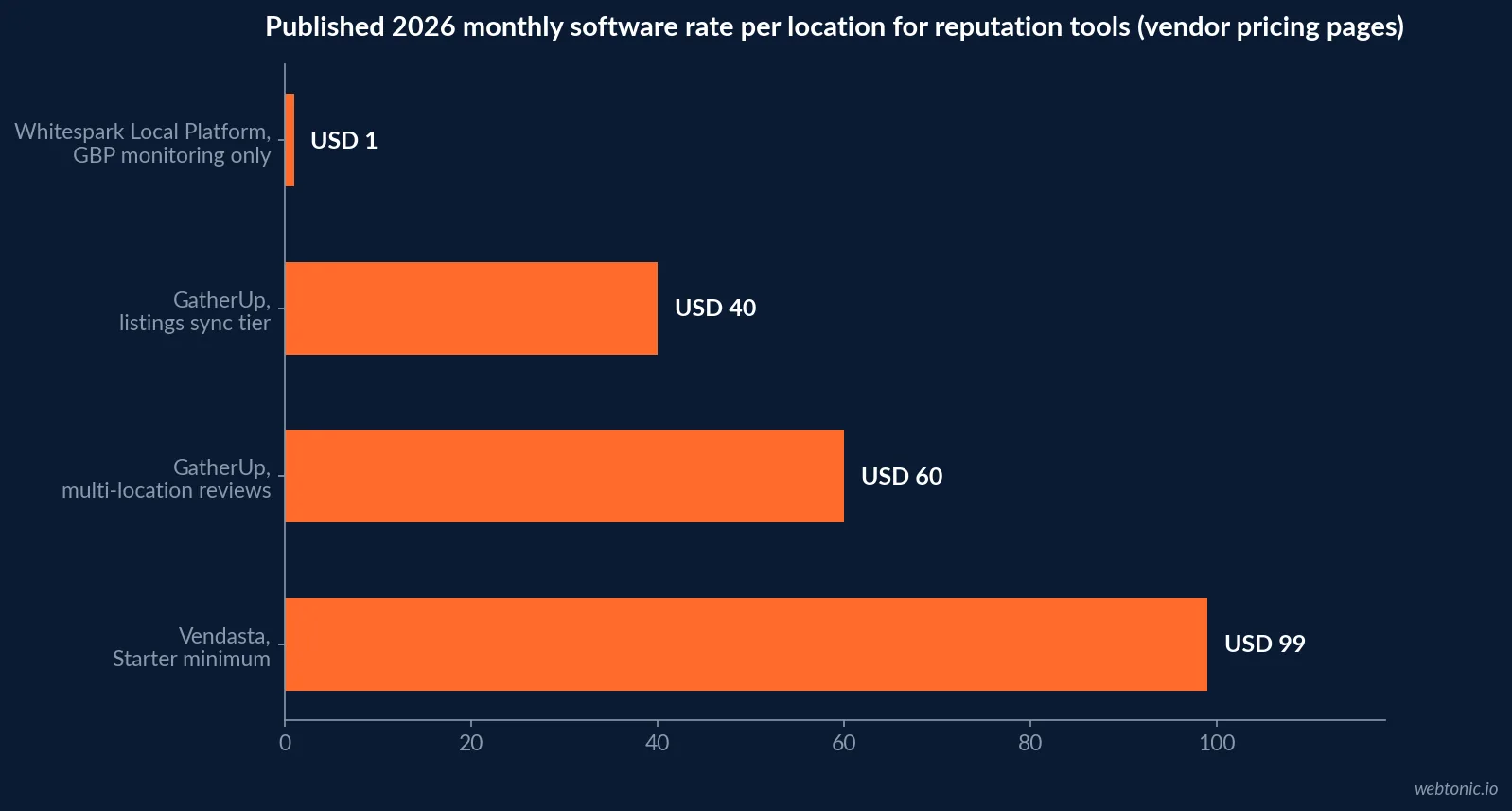
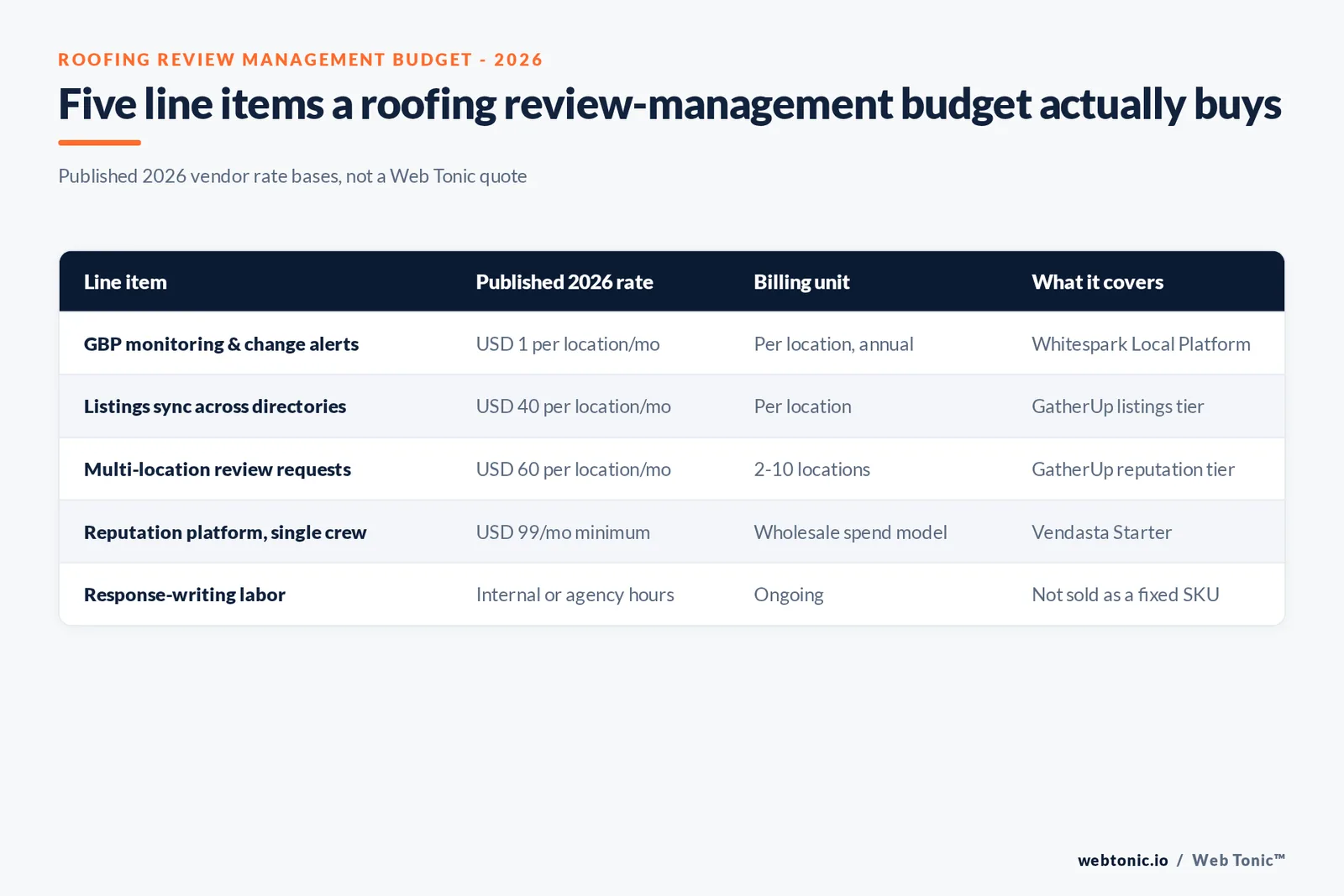
None of the major review-management vendors publish a single number that fits every roofing company, but four of them publish enough of a rate card to build a real budget from. Whitespark's Local Platform prices pure Google Business Profile monitoring and change-alerting at USD 1 per location a month, billed annually - the cheapest defensible line item, and one that only protects the profile rather than growing review volume.
GatherUp prices a single-location review and feedback plan at USD 99 a month, a multi-location review-request tier (2-10 locations) at USD 60 a month per location, and a separate listings-sync product at USD 40 a month per location. Vendasta runs on a platform-fee-plus-wholesale-spend model with published minimums of USD 99, USD 499 and USD 999 a month across its Starter, Pro and Premium tiers.
| Vendor & tier (2026) | Published rate | Billing unit | What it covers |
|---|---|---|---|
| Whitespark Local Platform | USD 1/mo | Per location, annual | GBP monitoring & alerts only |
| GatherUp listings sync | USD 40/mo | Per location | Directory listing accuracy |
| GatherUp multi-location reviews | USD 60/mo | Per location, 2-10 locations | Review requests & responses |
| Vendasta Starter | USD 99/mo minimum | Wholesale spend model | Reputation + listings bundle |
| Vendasta Pro | USD 499/mo minimum | Wholesale spend model | Adds AI response generation |
| Vendasta Premium | USD 999/mo minimum | Wholesale spend model | Automated request & response |
What the two biggest home-services brands actually charge
Podium and Birdeye are the two names most home-services roofers hear pitched first, and neither publishes a self-serve number on its own 2026 pricing page. Podium's pricing page now shows plan tiers and customer case studies - including its own published claim that Mountaineer Heating and Cooling saw 20% more weekly sales calls after adoption - but no published dollar figure; pricing is set on a sales call. Birdeye's pricing page is a location-count configurator with the same result: no public list price. Budgeting against either brand means requesting a written quote before committing a number to a plan, not repeating a third-party estimate as if it were published.
Where the revenue case for the spend comes from
The strongest causal evidence on star ratings comes from outside the review-vendor industry itself. Harvard economist Michael Luca matched Yelp ratings against audited restaurant revenue data from the Washington State Department of Revenue and found that a one-star rating increase causes a 5-9% revenue increase - a real, if modest, effect compared with the inflated multiples often quoted in vendor marketing. On response behavior specifically, Google/Wiser Review research found businesses that actively respond to reviews earn up to 18% more revenue than non-responders, and that businesses responding to more than 30% of their reviews generate roughly 2x more leads. The catch: an estimated 75% of businesses still do not respond to negative reviews at all, which is the single highest-ROI gap a budgeted program closes first.
| Revenue signal (verified study) | Effect size | Source | Budget implication |
|---|---|---|---|
| One-star rating increase | 5-9% revenue increase | Michael Luca (Harvard), Yelp/WA revenue data | Rating protection funds itself |
| Actively responding to reviews | Up to 18% more revenue | Google/Wiser Review research | Response labor is the ROI line |
| >30% of reviews answered | ~2x more leads | Google/Wiser Review research | A response cadence beats volume alone |
| Businesses ignoring negative reviews | 75% of businesses | Google/Wiser Review research | The gap most budgets should close first |
The market context behind the spend
Reputation management software is not a niche line item - the published vendor rate cards above show a real, current spread from single-location monitoring tools to full-service platforms, and the shift from simple review-monitoring toward AI-assisted response generation is visible directly in Vendasta's own pricing page and GatherUp's product tiers.
The compliance line every budget has to include
The cheapest way to blow a review budget is to buy the wrong kind of review. The FTC's Trade Regulation Rule on the Use of Consumer Reviews and Testimonials (16 CFR Part 465), effective October 21, 2024, prohibits buying or selling fake reviews, insider reviews from owners or employees without disclosure, and suppressing negative reviews. Google's own Maps user-generated content policy separately bans paid or incentivized reviews as Fake Engagement, and a violating profile can be restricted from receiving new reviews for a set period on top of having the reviews removed. Budgeting for review requests, not review purchases, is the only version of this spend that survives both rules.
| Rule or policy | Effective / status | What it bans | Who enforces it |
|---|---|---|---|
| FTC 16 CFR Part 465 | Effective Oct 21, 2024 | Buying/selling fake reviews, review suppression | Federal Trade Commission |
| Google Maps UGC policy - Fake Engagement | Ongoing | Paid/incentivized reviews, multi-account posting | Google (profile-level restrictions) |
| FTC Endorsement Guides, 16 CFR 255 | Ongoing | Undisclosed material relationships in reviews | Federal Trade Commission |
What a review-request cadence should look like month to month
The vendor pricing above buys a tool, not a process - the process is what makes the spend pay off. A workable cadence for a roofing crew mirrors the job cycle itself: a request goes out within 24-48 hours of final inspection, while the homeowner is still relieved the leak is fixed, rather than in a monthly batch that misses the emotional peak. BrightLocal's finding that 74% of consumers only weigh reviews from the last three months means a batch-and-wait cadence effectively ages out of relevance between each cycle.
| Cadence step | Timing | Owner | Tool tier that supports it |
|---|---|---|---|
| Request sent | 24-48 hrs after job completion | Office admin or automated trigger | GatherUp / Vendasta |
| First reminder | Day 5 if no response | Automated SMS/email | GatherUp / Vendasta |
| Response to new review | Within 24 hours | Owner or office manager | Any tier, manual or AI-assisted |
| Monthly profile audit | Once a month | Marketing lead or agency | Whitespark Local Platform |
| Quarterly volume check vs. BrightLocal thresholds | Quarterly | Marketing lead | Any tier's reporting dashboard |
Building the budget line by line
A defensible 2026 roofing review budget starts with the cheapest protective layer - GBP monitoring at roughly USD 1 a location a month - then adds a review-request tool sized to actual crew count, then reserves a fixed block of labor for writing responses, since none of the published vendor rates above include that time. The market data says the response labor is where the revenue actually shows up, not the software subscription itself.
Our growth marketing team builds that request cadence into a roofer's existing job-completion workflow rather than adding a second tool nobody logs into, and our data and analytics practice tracks review velocity against the same BrightLocal thresholds cited here. For the cross-industry benchmark behind those thresholds, see our reputation management statistics hub, or talk to us about scoping a program sized to your crew count.
Frequently Asked Questions
What should a roofing company budget for review management software?
Published 2026 vendor pricing runs from USD 1 a month per location for pure Google Business Profile monitoring (Whitespark Local Platform) to USD 40-60 a month per location for review-request and listings tools (GatherUp), up to a USD 99-999 a month platform-fee minimum for a bundled reputation suite (Vendasta). Podium and Birdeye, two of the biggest review-management brands sold to home services, have both moved to quote-only configurator pricing on their own sites, so their real cost only shows up after a sales call.
Why do roofing companies need a review-request program at all?
Because homeowners have raised the bar. Roofing Contractor's 2026 Homeowner Survey with Owens Corning found 62% of homeowners rate online reviews very or extremely important when picking a roofer, and BrightLocal's 2026 Local Consumer Review Survey found 47% of consumers will not use a business with fewer than 20 reviews and 68% require at least a 4-star average. A roofer that only gets reviews after a big job, instead of continuously, is competing against contractors who treat review requests as a standing process.
Is Google or a review platform the bigger budget line?
Google itself is free to claim and free to respond on - the cost sits in the software and labor layered on top: monitoring for unauthorized edits, routing review requests after every job, and writing responses. Whitespark prices pure GBP monitoring at USD 1 per location a month, which is the cheapest defensible line item; the bigger spend is the review-request and response layer, priced USD 40 to 999 a month depending on the vendor and location count.
Does responding to reviews actually move revenue for a roofing company?
The best causal evidence says yes, but modestly. Harvard economist Michael Luca matched Yelp ratings to audited restaurant revenue and found a one-star rating increase causes a 5-9% revenue increase - the same mechanism applies to any locally searched trade. Separately, Google/Wiser Review research found businesses that actively respond to reviews earn up to 18% more revenue than non-responders, and businesses responding to more than 30% of their reviews generate roughly 2x more leads. An estimated 75% of businesses still do not respond to negative reviews, which is the gap a budgeted program is meant to close.
What happens if a roofing company tries to buy reviews instead of earning them?
It becomes a federal violation, not just a platform violation. The FTC's Trade Regulation Rule on the Use of Consumer Reviews and Testimonials (16 CFR Part 465), effective October 21, 2024, bans buying or selling fake reviews, insider reviews without disclosure, and review suppression. Google's own Maps user-generated content policy separately treats paid or incentivized reviews as Fake Engagement and can restrict a profile from receiving new reviews for a set period on top of removing the violating content - so the compliant budget line is review requests, not review purchases.
Sources
Roofing Contractor / Owens Corning - 2026 Homeowner Survey
BrightLocal - Local Consumer Review Survey 2026
Whitespark - Local Platform pricing
GatherUp - Review software pricing
Vendasta - Pricing
Podium - Pricing
Birdeye - Pricing
Federal Trade Commission - 16 CFR Part 465 final rule
Google - Maps User Generated Content Policy: prohibited & restricted content
Google Business Profile Help - restrictions for policy violations