Table of contents
Roofing companies do not cold-email homeowners as a lead channel; the honest outbound target is B2B - property managers, general contractors and insurance adjusters - where the median cold email reply rate is 1.5% across 56,614 tracked campaigns. The unit of analysis on this page is a roofing company's commercial (not residential) outbound program.
Key Takeaways
- Roofing outbound targets property managers, GCs and adjusters, not homeowners.
- Median B2B cold email reply rate is 1.5% across 56,614 campaigns.
- Median cold email open rate is 26% across 37,000 campaigns.
- A separate 2026 benchmark puts the average reply rate at 3.43%.
- Top-decile senders in that dataset clear a 10.7% reply rate.
- 58% of replies come from the first email in a sequence.
- Best-performing sequences keep messages under 80 words.
- A prior cold call nearly doubles reply rate, 3.44% vs 1.81%.
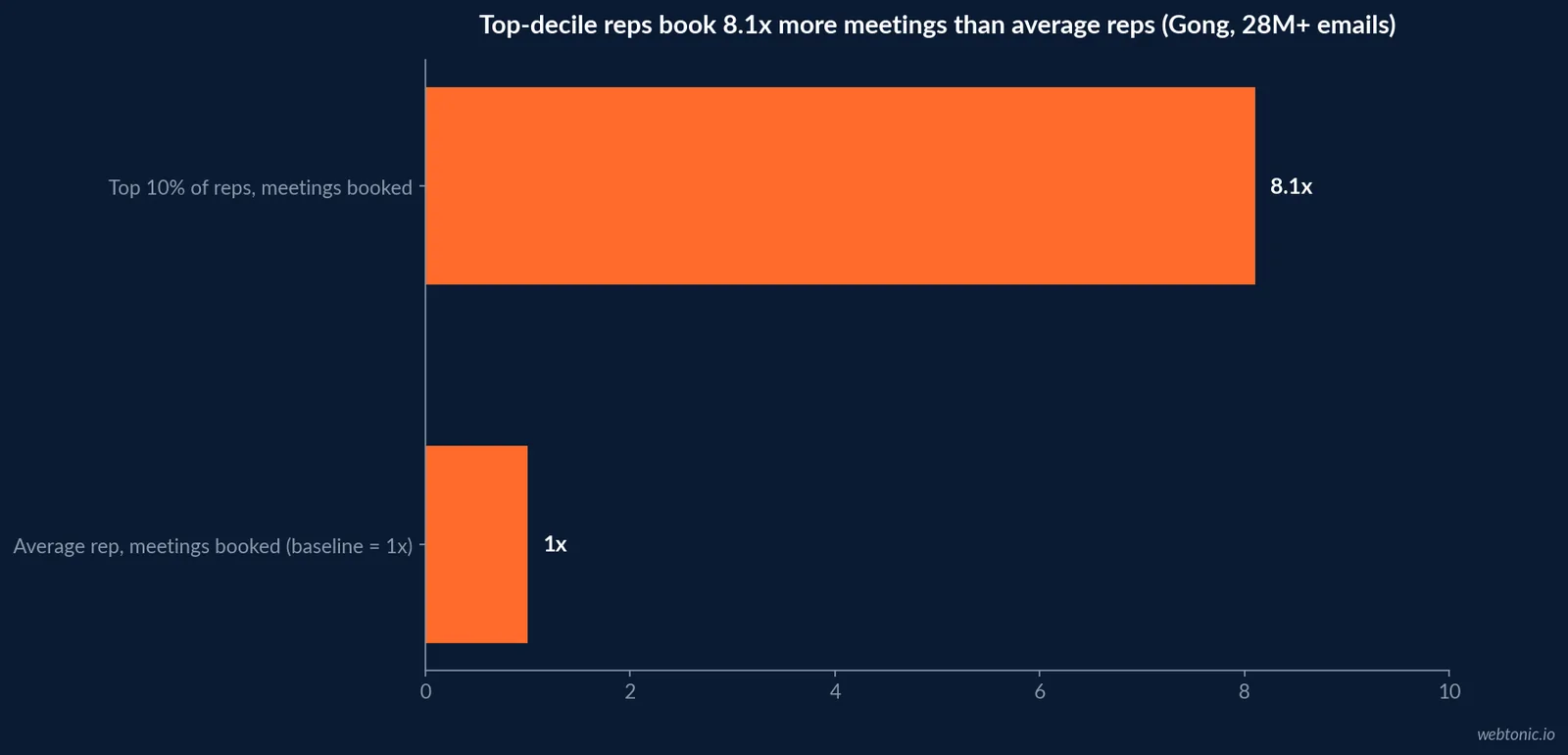
- Top 10% of reps land 8.1x more meetings than average reps.
- Google requires SPF/DKIM/DMARC for 5,000+ daily Gmail sends since Feb 1, 2024.
- Yahoo's Sender Hub applies matching bulk-sender authentication rules.
- CAN-SPAM requires a working opt-out honored within 10 business days.
- InMails are 3x more likely accepted than a cold call on LinkedIn's own data.
- A complete LinkedIn profile lifts InMail acceptance by 87%.
- C-level contacts reply 30.2% less often than non-executives.
Why the homeowner is the wrong cold-email target
A residential re-roof is a high-consideration purchase a homeowner researches locally, usually after a storm, a leak, or a neighbor's recommendation - not a category most people are receptive to hearing about from an unsolicited email. Consumer spam tolerance runs below even the modest B2B benchmarks: Woodpecker's own platform data shows a 1.5% median reply rate across 56,614 campaigns for outreach generally, and that figure is for B2B senders emailing named business contacts, not consumer inboxes. Homeowner-facing roofing lead generation is better served by local search, referrals and the lead marketplaces covered on our companion page.
The outbound motion that does fit roofing is commercial: property management companies overseeing multiple roofs, general contractors who subcontract the roofing scope on new builds, insurance and public adjusters who route storm-damage claims to a contractor, and facilities managers at retail, industrial or multifamily portfolios who buy maintenance contracts, not one-off jobs.
| Roofing outbound target | Why they fit cold email | Buying pattern |
|---|---|---|
| Property management company | Named, researchable business contact | Recurring maintenance contracts across a portfolio |
| General contractor (subcontracted roofing) | B2B vendor evaluation, not a spam-sensitive homeowner | Per-project bid relationships |
| Insurance / public adjuster | Refers storm-damage jobs as part of their own work | Referral-based, repeat volume |
| Facilities manager (retail/industrial/multifamily) | Procures maintenance vendors on a cycle | Annual or multi-year service agreements |
| Homeowner (residential re-roof) | Poor fit: low spam tolerance, one-off purchase | Local search, referral, storm response |
The reply-rate math a roofing outbound team should plan around
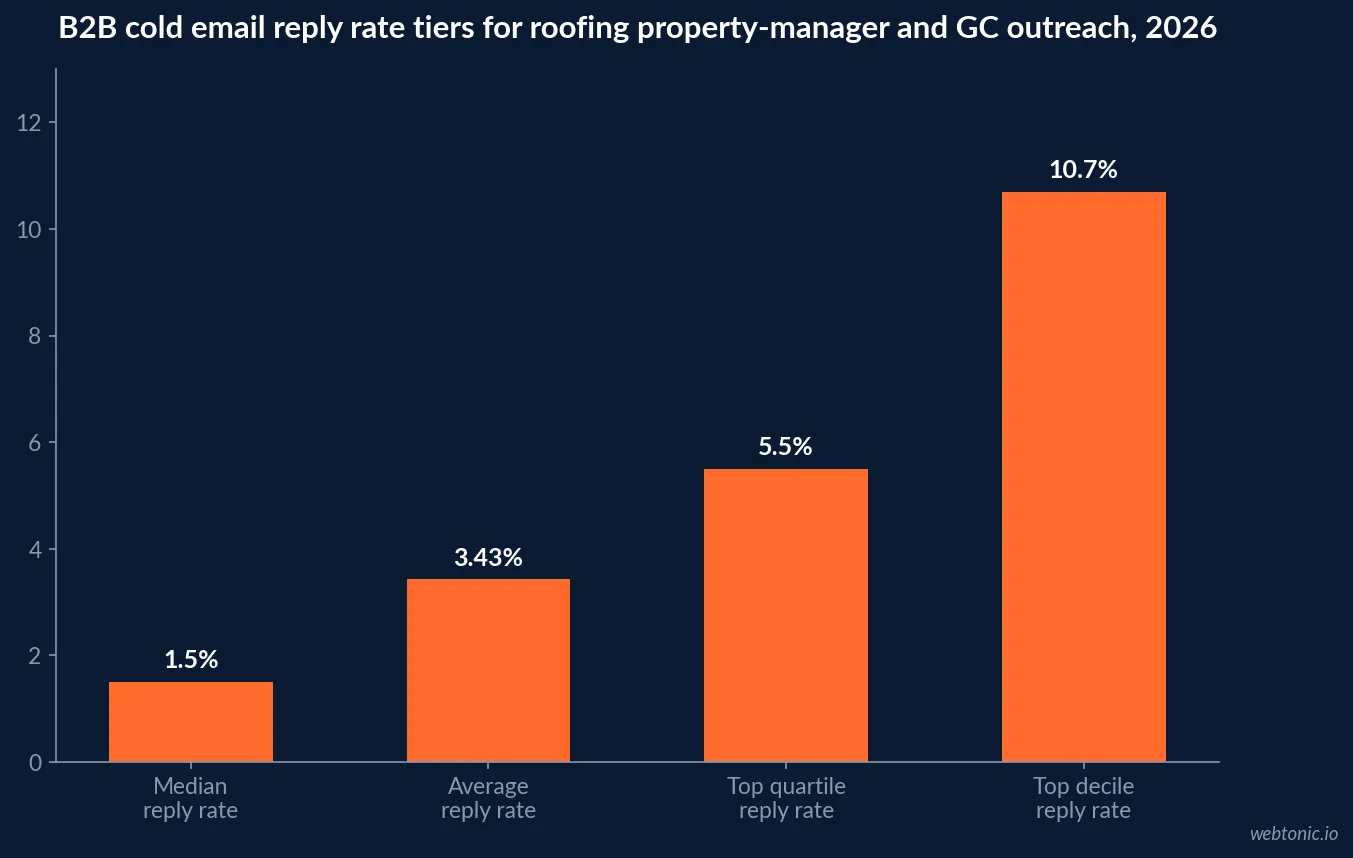
Once the target is a commercial buyer, roofing outbound behaves like any other B2B program. Woodpecker's platform data puts the median open rate at 26% (37,000 campaigns) and median reply rate at 1.5% (56,614 campaigns). Instantly's 2026 Cold Email Benchmark Report, built from billions of tracked interactions, puts the overall average reply rate at 3.43%, with the top 25% of senders at 5.5%+ and the top 10% (labelled "elite") above 10.7%. The same report found 58% of all replies come from the first email in a sequence and the remaining 42% from follow-ups - a single-touch outbound list forfeits nearly half its potential replies.
| Benchmark (2026) | Figure | Sample | Source |
|---|---|---|---|
| Median reply rate | 1.5% | 56,614 campaigns | Woodpecker platform data |
| Median open rate | 26% | 37,000 campaigns | Woodpecker platform data |
| Average reply rate | 3.43% | Billions of interactions | Instantly 2026 benchmark report |
| Top-quartile reply rate | 5.5%+ | Same dataset | Instantly 2026 benchmark report |
| Top-decile ('elite') reply rate | 10.7%+ | Same dataset | Instantly 2026 benchmark report |
| Share of replies from email 1 vs follow-ups | 58% / 42% | Same dataset | Instantly 2026 benchmark report |
Deliverability rules a roofing outbound sender cannot skip
Whether the recipient is a property manager or a SaaS VP, the platform-level rules are the same. Since February 1, 2024, Google's bulk sender guidelines require SPF and DKIM authentication, a published DMARC policy, and one-click unsubscribe for anyone sending 5,000-plus daily messages to Gmail accounts. Yahoo's Sender Hub requires the equivalent authentication stack and DMARC alignment for its own bulk-sender threshold. Below that volume, the FTC's CAN-SPAM compliance guide still applies to every single commercial email: accurate sender information, a clear ad identifier, a valid postal address, and an opt-out honored within 10 business days.
A roofing company running a smaller list (a few hundred property managers in a metro, for example) is unlikely to hit the 5,000-a-day bulk threshold, but CAN-SPAM has no volume floor - the compliance duty is the same for one email or ten thousand.
| Compliance requirement | Trigger | Source |
|---|---|---|
| SPF + DKIM authentication | 5,000+ daily messages to Gmail accounts | Google bulk sender guidelines |
| Published DMARC policy | Same 5,000/day Gmail threshold | Google bulk sender guidelines |
| One-click unsubscribe | Same 5,000/day Gmail threshold | Google bulk sender guidelines |
| SPF/DKIM + DMARC alignment | Yahoo's own bulk-sender threshold | Yahoo Sender Hub |
| Accurate headers, ad identifier, postal address, 10-day opt-out | Every commercial email, any volume | FTC CAN-SPAM guide |
Phone and LinkedIn as companions, not substitutes
Property managers and GCs are, unlike many SaaS buyers, reachable by phone during business hours, which makes the call-then-email pattern practical. Gong's analysis of 300 million-plus cold calls found a prior cold call nearly doubles the reply rate of the email that follows it, 3.44% versus 1.81% for email alone, and that the top 10% of reps land 8.1 times more meetings than average performers. Gong's executive-cycle data also found C-level contacts reply 30.2% less often than non-executives - relevant when the target is a regional facilities VP rather than a single-property manager.
Where the buyer is LinkedIn-active, LinkedIn's own data shows InMails accepted 3 times more often than a cold call and 6 times more than a cold email, with a complete profile lifting acceptance by 87%. Many property managers and GC estimators are not heavy LinkedIn users, so treat this as an added channel for the contacts who are active there, not a replacement for phone and email.
What roofing outbound costs against the lead marketplaces
A roofing company already buying homeowner leads from Angi or Thumbtack has a built-in cost comparison for commercial outbound. Woodpecker's own worked cost model - a low-volume sending plan plus a domain and mailbox - lands cold email cost per acquired lead in the USD 18 to 40 range at a typical reply rate. WordStream's 2026 PPC benchmarks, drawn from more than 13,000 US-based campaigns, put the average Google Ads cost per lead across all industries at USD 66.69. Commercial cold email to a named property manager or GC contact is not a replacement for local paid search - the buyer intent is different - but as a supplementary channel to build a maintenance-contract pipeline, its per-contact cost is materially lower than most paid alternatives.
| Channel (2026) | Reported cost per lead | Source |
|---|---|---|
| Cold email, B2B outbound (Woodpecker worked example) | USD 18-40 | Woodpecker cost model |
| Google Ads, all industries average | USD 66.69 | WordStream 2026 PPC Benchmarks (13,000+ campaigns) |
Sequencing a roofing commercial outbound campaign
The sequence structure that works for any B2B outbound program applies directly to a property manager or GC list: 3 to 5 touches mixing email and phone rather than a single blast, since Instantly's 2026 benchmark data shows 58% of replies come from the first email and the remaining 42% from follow-ups. For roofing specifically, the seasonal pattern matters more than in most B2B categories - a property manager evaluating a maintenance vendor ahead of storm season responds differently in March than in December, so timing the first touch to the buyer's budgeting cycle (many commercial portfolios plan capital repairs on a calendar-year or fiscal-year cycle) outperforms an evergreen always-on list.
Building a roofing B2B outbound list correctly
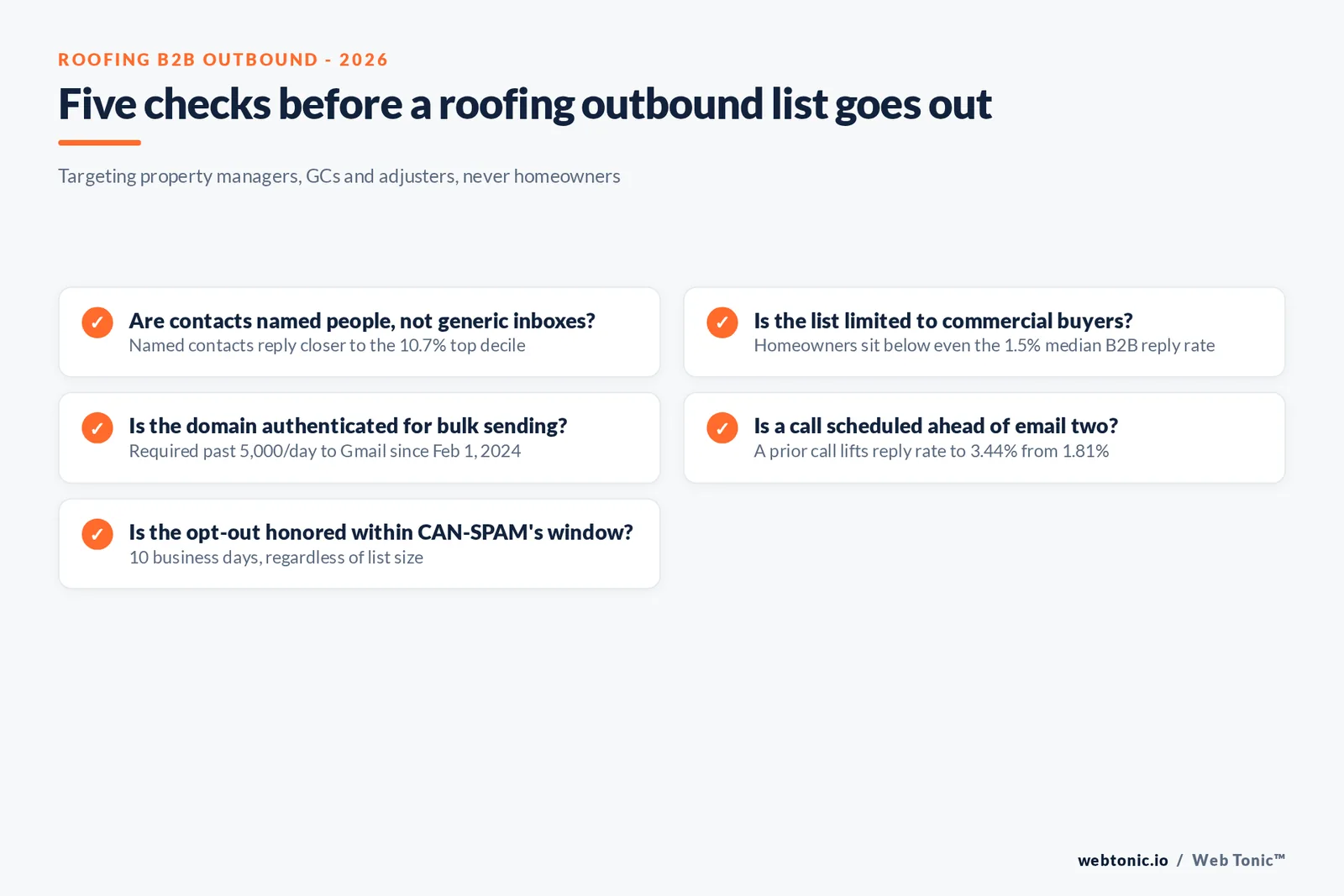
Build the list from named property managers, GC estimators and adjusters, not generic company inboxes - named contacts reply at rates closer to the top of the B2B range, generic aliases closer to the bottom. Authenticate the sending domain even below the bulk-sender threshold, since CAN-SPAM applies regardless of volume and authentication protects the sending domain's reputation for every other email the company sends. Sequence 3 to 5 touches with a call in the mix rather than a single email, since the data shows nearly half of all replies arrive after the first message. If you want this program built and instrumented for a roofing business specifically, our growth marketing practice can scope it, review our notes on channel strategy basics before splitting budget across channels, or talk to us directly.
Frequently Asked Questions
Can a roofing company cold-email homeowners to generate leads?
Legally it can, subject to CAN-SPAM, but it is a poor fit for the buyer: a homeowner replacing a roof is a high-consideration, local, trust-driven purchase, and unsolicited commercial email to a residential inbox converts far below the already-low B2B cold email benchmarks - Woodpecker's own platform data shows a 1.5% median reply rate even for targeted B2B outreach, and consumer spam tolerance is lower still. Most roofing companies generate homeowner leads through local search, referrals and lead marketplaces instead, and reserve cold email for commercial accounts.
Who is the realistic cold email target for a roofing company?
Commercial and repeat-business accounts: property management companies with multi-property roof maintenance needs, general contractors who subcontract roofing on new builds, insurance adjusters and public adjusters who refer storm-damage jobs, and facilities managers at retail, industrial or multifamily portfolios. These are B2B buyers researching a vendor relationship, which is exactly the profile cold email benchmarks are built around.
What reply rate should a roofing company's outbound team expect?
The same range as any other B2B outbound program, because the recipient - a property manager or GC, not a homeowner - behaves like any other B2B buyer. Woodpecker's platform data across 56,614 campaigns puts the median reply rate at 1.5%; Instantly's 2026 benchmark report puts the average at 3.43%, with top-quartile senders at 5.5%+ and the top 10% above 10%. A roofing outbound list built from named contacts (property manager, not 'info@') should land in the upper half of that range.
What compliance rules apply to a roofing company's commercial email list?
CAN-SPAM applies to every commercial email, B2B or consumer: accurate headers, a clear ad identifier, a valid postal address, and a working opt-out honored within 10 business days, per the FTC's own compliance guide. If the list is large enough to hit Google's or Yahoo's bulk-sender thresholds, the 2024 rules requiring SPF, DKIM and a published DMARC policy apply on top of CAN-SPAM, regardless of industry.
Is a phone call more effective than email for reaching a property manager or GC?
Gong's analysis of 300 million-plus cold calls found that placing a call before a follow-up email nearly doubles that email's reply rate (3.44% versus 1.81% for email alone), and property managers and GCs are reachable by phone during business hours in a way that makes a call-then-email sequence practical - more practical, in fact, than for many SaaS buyers who screen calls by default.
Sources
Woodpecker - Cold Email Benchmarks (platform data tool)
Instantly - Cold Email Benchmark Report 2026
Google Workspace Admin Help - Email sender guidelines
Yahoo Sender Hub - Sender Best Practices
Federal Trade Commission - CAN-SPAM Act Compliance Guide for Business
Gong - The hidden power of cold calling: insights from 300M calls
LinkedIn Sales Solutions - What every InMail sent in 2022 told us
WordStream - Digital Benchmarks by Industry: PPC (2026)