Table of contents
Retargeting brings back the visitors who already showed interest in your product but left without converting — and the 2026 benchmarks below show exactly why it outperforms every other paid media tactic on cost, click-through rate, and return on ad spend.
Key Takeaways
- Retargeting CTR is 10x higher than prospecting — display retargeting averages 0.7% CTR compared to 0.07% for cold prospecting, and cross-channel retargeting reaches 0.9–1.2% in 2026.
- Retargeting conversion rates average 3.8%, which is 70–150% higher than prospecting conversion rates of 1.5–2.2%, because the audience has already demonstrated intent.
- Retargeting ROAS averages 4.2x in 2026, up from 4.0x in 2024 and 71% higher than prospecting ROAS, making it the most efficient paid media channel dollar-for-dollar.
- Meta's Dynamic Product Ads deliver 56% lower CPA and 34% higher ROAS compared to static retargeting creatives, according to Meta's 2026 internal data.
- Up to 75% of retargeting conversions may be non-incremental — holdout tests show true incremental lift of 25–30%, which means measurement strategy matters as much as campaign execution.
What Is Retargeting and How Does It Work
Retargeting is a digital advertising strategy that serves paid ads to people who have already interacted with your brand — visited your website, viewed a product page, added an item to their cart, watched a video, or engaged with your social media content. As WordStream's 2026 benchmark data confirms, audiences that have already engaged with a brand convert at dramatically higher rates than cold traffic. The technology relies on tracking pixels, cookies, and server-side APIs that identify these previous visitors and create targetable audience segments across ad platforms.
Here is how the process works in practice. A visitor lands on your website, and a tracking pixel (such as the Meta Pixel or Google Ads tag) records their behavior. That visitor leaves without converting. Later, as they browse Instagram, scroll through the Google Display Network, watch YouTube, or read articles on publisher sites, your retargeting ads appear — reminding them of the product they viewed or the service they explored. Because these people already know your brand, they click and convert at dramatically higher rates than cold audiences.
The distinction between retargeting and remarketing matters. AdManage's 2026 guide draws a clean line: retargeting uses paid ads to reach previous visitors through display, social, and search channels. Remarketing uses owned channels — email sequences, SMS campaigns, push notifications — to re-engage known contacts. A cart abandonment ad on Meta is retargeting. A cart abandonment email to the same person is remarketing. Both work, but they serve different points in the customer journey. For a comprehensive approach to bringing back lost visitors, explore how growth marketing combines both tactics into a unified strategy.
Retargeting Performance Benchmarks for 2026
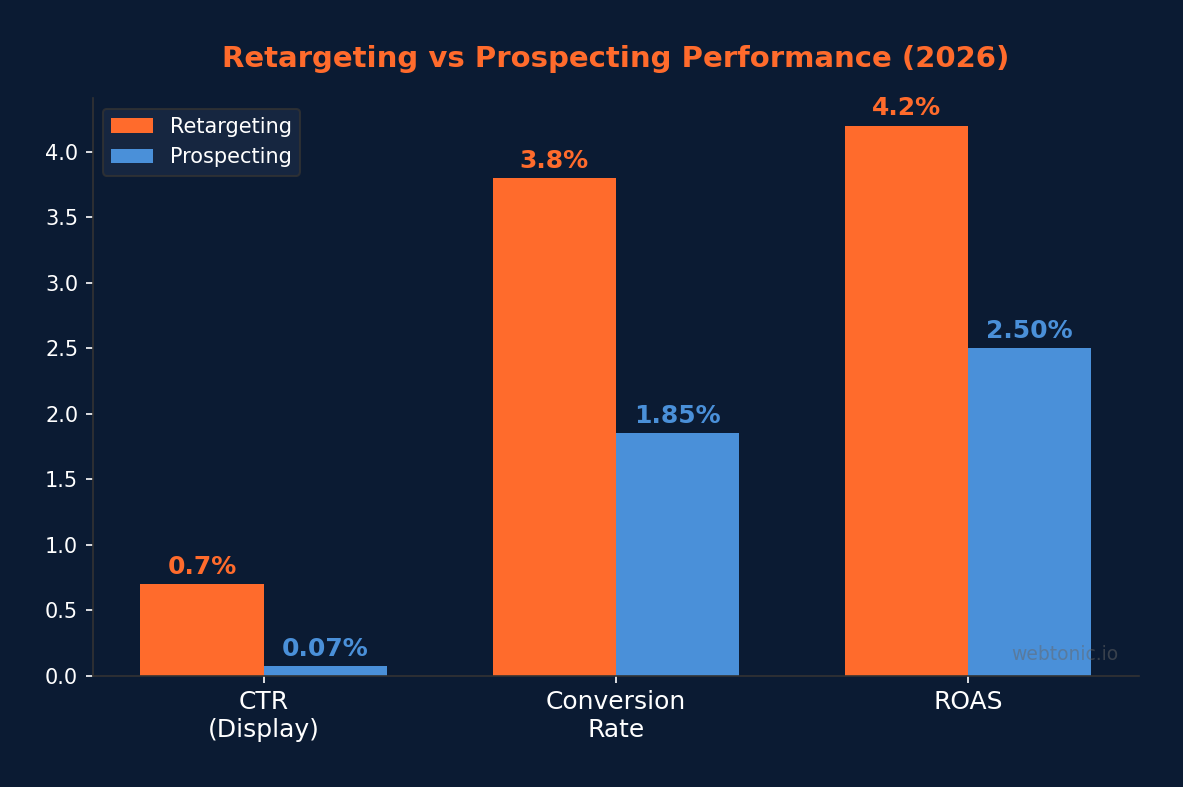
Foundry CRO's 2026 retargeting benchmark report organizes performance data by the Decay-Efficiency Model, which maps audience recency against platform cost-to-conversion ratios. The data confirms what every media buyer knows intuitively: retargeting audiences outperform prospecting audiences on every metric.
| Metric | Retargeting | Prospecting | Uplift |
|---|---|---|---|
| CTR (Display) | 0.7% | 0.07% | 10x higher |
| CTR (Cross-Channel) | 0.9–1.2% | 0.3–0.5% | 2–3x higher |
| Conversion Rate (Median) | 3.8% | 1.5–2.2% | 70–150% higher |
| CPA | 40–70% lower | Baseline | 40–70% savings |
| ROAS | 4.2x | 2.5x | 71% higher |
The CPA drops 40–70% for retargeting audiences compared to cold acquisition campaigns. This makes retargeting the highest-ROI line item in most paid media budgets. However, these averages mask an important pattern: audience recency determines everything. A cart abandoner from 2 hours ago converts at a completely different rate than a homepage visitor from 3 weeks ago. Building segments by recency — and allocating budget accordingly — is what separates profitable retargeting from wasteful frequency bombardment.

Retargeting by Platform: Google, Meta, and Beyond
Each ad platform offers different retargeting capabilities, audience match rates, and cost structures. SearchLab's 2026 retargeting statistics provide platform-specific benchmarks that help allocate budget across channels.
| Platform | Avg. CPC | CTR | Conversion Rate | Key Strength |
|---|---|---|---|---|
| Google Display | $0.65 | 0.7% | 3.2% | Massive reach across 2M+ sites |
| Google RLSA | $1.50–$4.00 | 37% higher than non-RLSA | 5.1% | Highest conversion quality, 13.83x ROAS in case studies |
| Meta (Facebook/Instagram) | $0.92 | 1.2% (Feed) | 4.1% | Highest CVR, detailed user data |
| $3.50–$6.00 | 0.4% | 2.8% | B2B targeting by title/industry | |
| Programmatic (DSP) | $0.30–$0.80 | 0.5% | 2.1% | Cross-device, privacy-safe contextual |
RLSA (Remarketing Lists for Search Ads) drives the highest conversion quality of any retargeting format. The 37% CTR uplift over non-RLSA campaigns makes sense: these are people who already visited your site and are now actively searching for your product category again. In documented case studies, RLSA campaigns achieved ROAS of 13.83x. Meta retargeting claims the highest average conversion rate at 4.1%, driven by Custom Audiences built from pixel data, email lists (with 70–85% match rates), and engagement audiences.
Meta's Advantage+ retargeting delivers 22% more efficient CPA than manually configured retargeting audiences. The algorithm automatically allocates budget between prospecting and retargeting, typically spending 35–45% on retargeting within Advantage+ campaigns. Server-side tracking through Conversions API (CAPI) improves match rates by 15–30% compared to pixel-only tracking, which is increasingly important as browser cookie restrictions tighten.
How to Structure a Retargeting Campaign
Effective retargeting requires audience segmentation by intent level, not a single "all visitors" list. GROAS's 2026 remarketing guide calls the single-list approach "actively harmful" because it treats a homepage bouncer the same as someone who spent five minutes on your pricing page.
According to HubSpot's 2026 marketing statistics, personalized ad experiences increase conversion rates by up to 202% — and segmented retargeting is the most direct path to that personalization. Build these four core retargeting segments:
- Cart/form abandoners (0–3 days). Highest intent, highest conversion rate. Show the specific product or service they considered. Dynamic Product Ads on Meta deliver 56% lower CPA for this segment compared to static creative.
- Product/service page viewers (0–14 days). These visitors explored specific offerings but did not reach the conversion point. Use category-level messaging with social proof — reviews, case studies, customer counts.
- Engaged visitors (0–30 days). People who viewed multiple pages, spent significant time on site, or engaged with content (video views, blog reads). Broader messaging about your value proposition works here.
- Lapsed customers (30–180 days). Previous buyers or converters who have not returned. Cross-sell, upsell, or win-back offers perform best. Exclude recent purchasers to avoid annoying customers who just bought.
For each segment, set frequency caps. 3–5 impressions per user per day is the recommended starting point for high-intent audiences. For lower-intent segments, cap at 1–2 impressions per day. Without frequency capping, Google and Meta will serve your ads to the same user 30–50 times in a week, which increases ad fatigue and brand damage without lifting conversions. Building audiences and matching creative to intent stage is core to performance creative strategy.


The Incrementality Problem in Retargeting
The biggest challenge with retargeting is not performance — it is measurement. As Neil Patel's remarketing guide warns, vanity metrics in retargeting campaigns routinely overstate true business impact. Retargeting campaigns consistently report the best metrics in any ad account because the audience was already likely to convert. The question is whether the ad actually changed their behavior, or whether they would have converted anyway.
Foundry CRO's benchmark data shows that up to 75% of retargeting conversions may be non-incremental. Holdout tests — where a random portion of the retargeting audience sees no ads — reveal that the true incremental lift from retargeting is typically 25–30% for Dynamic Product Ad campaigns. This does not mean retargeting is ineffective. A 25% incremental lift on a high-volume audience segment still generates significant revenue. But it does mean that raw ROAS numbers in your retargeting campaigns overstate the true impact.
Run incrementality tests by holding out 10–15% of your retargeting audience as a control group for 2–4 weeks. Compare conversion rates between the exposed and holdout groups. The delta is your true incremental lift. Use that number — not the reported ROAS — to determine how much budget retargeting actually deserves in your media mix. Review our latest insights on the Web Tonic blog for deeper measurement frameworks.
Retargeting in a Privacy-First World
Cookie deprecation, iOS App Tracking Transparency, and evolving privacy regulations have reshaped how retargeting works. According to Statista's 2026 display advertising outlook, privacy-driven signal loss is accelerating the shift toward first-party data strategies across every major ad platform. Third-party cookie-based retargeting on the Google Display Network faces diminishing match rates as Chrome implements Privacy Sandbox APIs. Meta's tracking ecosystem took a significant hit from iOS 14.5+ changes, though server-side tracking through CAPI has partially recovered signal quality.
Three strategies are adapting retargeting for the privacy-first era. First, first-party data collection — email signups, logged-in user experiences, and CRM integrations — creates retargeting audiences that do not depend on browser cookies. Second, server-side tracking through Google's Enhanced Conversions and Meta's CAPI sends conversion data directly from your server, bypassing browser-level restrictions. Third, contextual retargeting through programmatic DSPs targets users based on the content they are currently consuming rather than their browsing history, which requires no personal data collection.
The advertisers who invest in first-party data infrastructure now will have the most durable retargeting capability as third-party signals continue to erode. For hands-on guidance, contact our team to audit your current tracking setup and identify privacy-proof retargeting opportunities.
FAQ
What is the difference between retargeting and remarketing?
Retargeting uses paid ads (display, social, search) to reach people who previously interacted with your brand online. Remarketing uses owned channels (email, SMS, push notifications) to re-engage known contacts. A cart abandonment ad on Instagram is retargeting; a cart abandonment email is remarketing. Both aim to recover lost conversions, but through different channels and cost structures.
How much should I budget for retargeting campaigns?
According to Criteo's retargeting guide, most advertisers allocate 10–20% of their total paid media budget to retargeting. For eCommerce businesses with high site traffic, that percentage can climb to 25–30%. The key constraint is audience size — retargeting only works if you have enough website visitors to build meaningful audience segments. A site with fewer than 1,000 monthly visitors will struggle to generate sufficient retargeting volume.
How long should I retarget someone after they visit my site?
Audience windows should match the typical purchase cycle. For eCommerce impulse buys, 3–7 days captures most value. For considered purchases (B2B, real estate, education), 14–30 days is appropriate. For high-ticket services, extend to 60–90 days. Performance degrades rapidly after the first week — the highest conversion rates come from visitors retargeted within 0–72 hours of their initial visit.
Does retargeting work without third-party cookies?
Yes, but the approach is shifting. First-party data (email lists, CRM uploads) creates cookie-independent retargeting audiences on both Google and Meta with 70–85% match rates. Server-side tracking through CAPI and Enhanced Conversions recovers signal lost from browser restrictions. Contextual targeting through programmatic DSPs offers a privacy-safe alternative that targets based on content consumption rather than personal browsing history.
What retargeting creative formats convert best?
Dynamic Product Ads consistently outperform static creative for retargeting, delivering 56% lower CPA and 34% higher ROAS on Meta. For non-eCommerce businesses, carousel ads showing multiple service offerings or case studies outperform single-image formats. Video retargeting ads — especially 6–15 second clips — capture attention in feed environments where static images get scrolled past. The key principle is creative specificity: the more closely your ad matches what the visitor originally viewed, the higher the conversion rate.
Sources
Foundry CRO — Retargeting Benchmarks 2026
SearchLab — Retargeting Statistics 2026
AdManage — Retargeting vs Remarketing 2026
GROAS — Google Ads Display Remarketing Guide 2026