Table of contents
Real estate does not really run affiliate links - it runs referral-fee percentages. The programs that matter (HomeLight, Zillow Premier Agent Flex, agent-to-agent networks) all price as a share of the closing commission, and the ceiling on what that share can legally look like is set by a federal anti-kickback statute, not by a platform's terms of service.
Key Takeaways
- 88% of home buyers used a real estate agent in the 2025 NAR Profile of Home Buyers and Sellers.
- 91% of sellers used an agent, the highest share NAR has recorded.
- FSBO sales fell to an all-time-low 5% of transactions.
- HomeLight's referral fee rose from 25% to 33% nationally in October 2022.
- Six states moved to a 30% HomeLight referral rate in September 2023.
- Zillow Flex's success fee has risen to 40% in some markets, per Inman's reporting.
- Zillow Flex represents about 25% of Zillow's Premier Agent revenue.
- ReferralExchange's own report found over a third of agents pay 30% to 35% on agent-to-agent referrals.
- More than half of agents surveyed prefer a 25% referral fee as the norm.
- RESPA Section 8 (12 CFR 1024.14) bans referral fees tied to federally related mortgage loans.
- The CFPB's Rocket Homes complaint cited a roughly 35% brokerage referral fee as the alleged kickback.
- The CFPB dismissed that complaint in February 2025, per Inman.
- FTC 16 CFR 255 requires disclosure next to any compensated referral or recommendation.
- The cross-industry median affiliate cookie window is 60 days in 2026.
Why "CPL and CTR" means something different in real estate
Most affiliate verticals price on cost-per-lead or a commission percentage of a sale. Real estate referral programs collapse both into one number: a percentage of the eventual closing commission, paid only if the referred lead actually closes. There is effectively no separate CPL line item on the biggest programs - the "cost per lead" is deferred entirely into the back-end referral percentage, which is why every major program publishes a fee percentage rather than a dollar-per-click or dollar-per-lead rate.
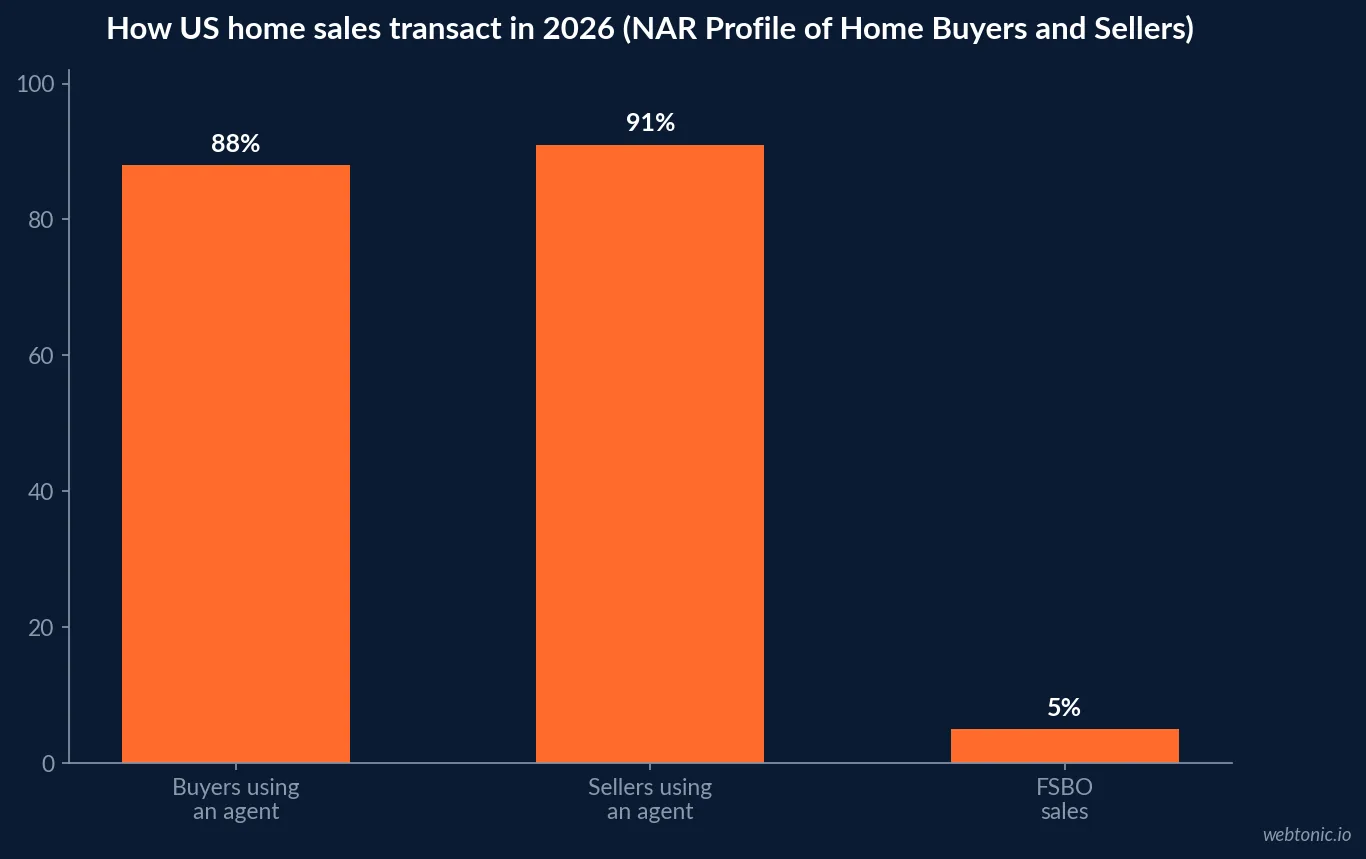
That structure only works because agent-mediated transactions still dominate the market: NAR's own 2025 Profile of Home Buyers and Sellers found 88% of buyers and 91% of sellers used an agent, with for-sale-by-owner activity at an all-time-low 5% of transactions.
What the major referral programs actually charge
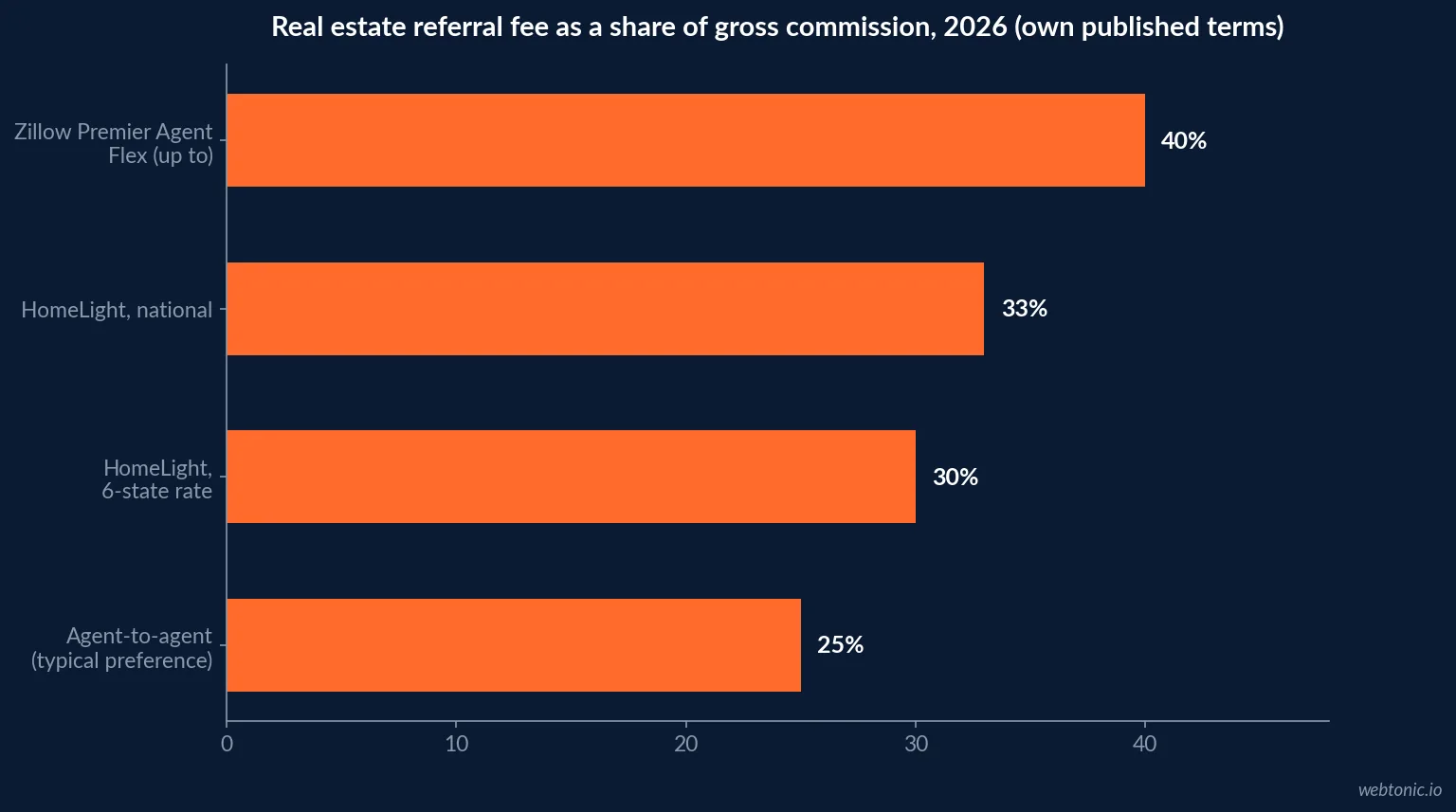
HomeLight's own published terms raised its national referral commission from 25% to 33% of gross commission in October 2022, then separately moved six states - Arizona, California, Colorado, Florida, Illinois and Texas - to a 30% rate the following year, per HomeLight's current agreement terms. Zillow's Premier Agent Flex program has publicly risen to a 40% success fee in some markets, according to Inman's reporting on Zillow's own disclosed model, and now represents roughly 25% of Zillow's total Premier Agent revenue.
Agent-to-agent referrals run lower on average: ReferralExchange's own agent-to-agent economy report found more than half of respondents prefer paying around 25%, while over a third are willing to pay 30% to 35% for the right referral source.
| Program (own/reported data) | Referral fee | Basis | Effective date/context |
|---|---|---|---|
| HomeLight, national | 25% -> 33% | Gross agent commission | October 2022 |
| HomeLight, 6 states (AZ/CA/CO/FL/IL/TX) | 25% -> 30% | Gross agent commission | September 2023 |
| Zillow Premier Agent Flex | Up to 40% | Success fee on gross commission | Some markets, 2023 (Inman) |
| Agent-to-agent (ReferralExchange survey) | ~25% preferred, 30-35% by a third | Gross commission | Own 2017-19 report |
The legal ceiling: RESPA Section 8
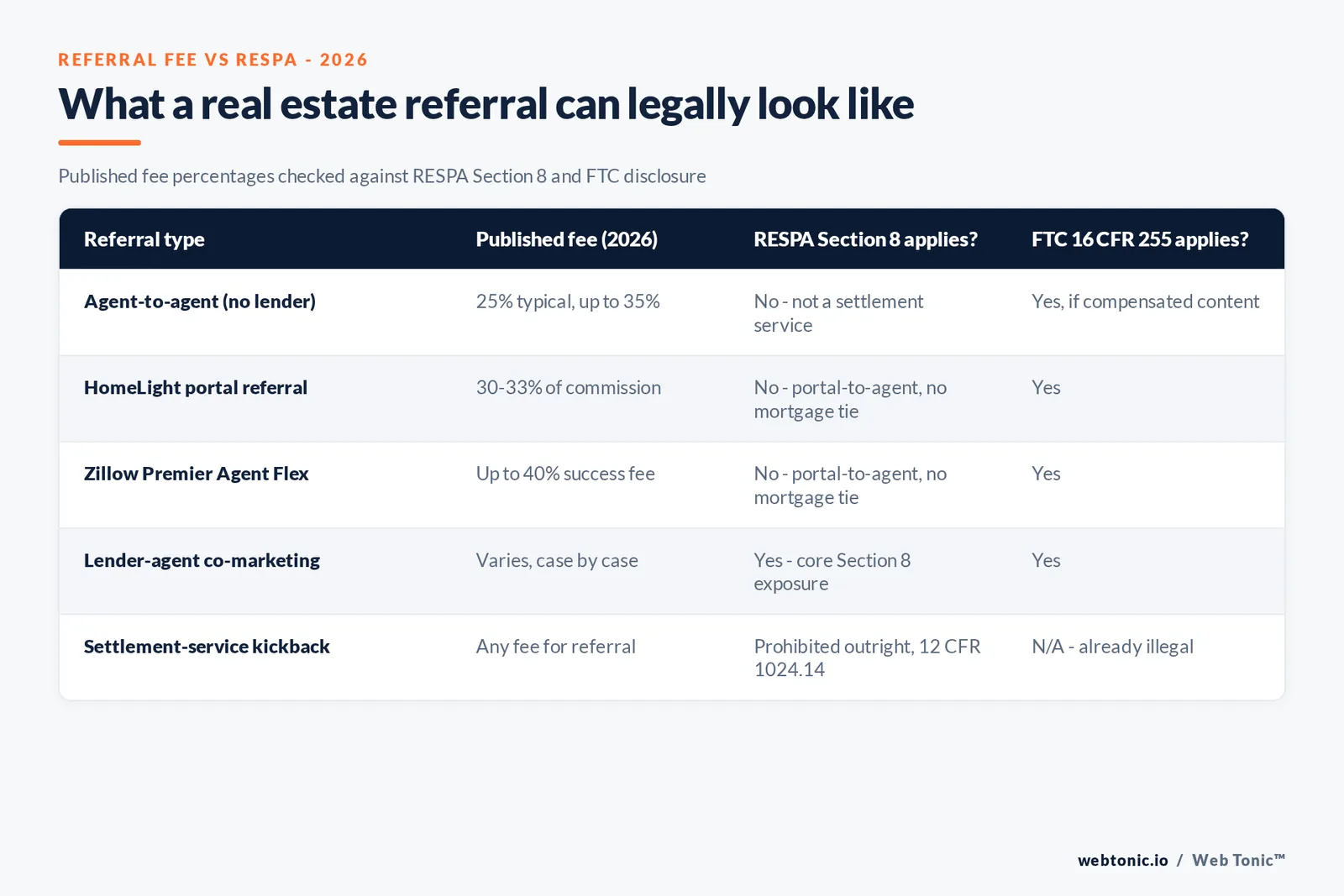
None of the percentages above are unlimited by choice - they stop where mortgage-adjacent settlement services begin. 12 CFR 1024.14, implementing RESPA Section 8, prohibits giving or accepting any fee, kickback or thing of value for referring business related to a federally related mortgage loan. The rule does not ban referral fees between real estate agents in general - it specifically targets the settlement-service side of a mortgage transaction, which is why lender-agent co-marketing arrangements draw far more regulatory scrutiny than a portal-to-agent referral fee does.
The CFPB's case against Rocket Homes, filed in December 2024 and voluntarily dismissed in February 2025, alleged that Rocket Homes' roughly 35% brokerage referral fee, tied to steering borrowers toward its own mortgage products, crossed that line. HousingWire's March 2026 coverage frames the dismissal as leaving real uncertainty rather than a clean bill of health for similar lender-agent partnership structures.
| RESPA compliance question | What the rule says | Source |
|---|---|---|
| Can two agents split a commission on referral? | Yes, ordinary cooperative brokerage practice | 12 CFR 1024.14(g) |
| Can a settlement-service referral tied to a mortgage be paid for? | No - Section 8(a) prohibits it | 12 USC 2607(a); 12 CFR 1024.14(a) |
| Was a ~35% brokerage fee alleged to violate this? | Yes, in the CFPB's Rocket Homes complaint | CFPB complaint, Dec. 2024 (via Inman) |
| Was that complaint upheld? | Voluntarily dismissed, Feb. 2025 | Inman, Feb. 2025 |
| Is enforcement direction settled for 2026? | No - described as uncertain | HousingWire, March 2026 |
Disclosure still applies regardless of the fee's legality
Separate from RESPA, the FTC's 16 CFR Part 255 Endorsement Guides require any compensated referral or recommendation - an agent-matching tool, a "find a lender" partner mention, a portal-driven agent referral - to disclose the material connection where the recommendation is actually presented. A referral fee being RESPA-compliant does not exempt the arrangement from FTC disclosure rules; they are separate compliance requirements that both apply at once.
How a portal's own concierge referral model compares
Realtor.com's own ReadyConnect Concierge program (formerly Opcity) advertises zero upfront cost to the agent, charging a referral fee only on a closed transaction. Realtor.com's own support documentation confirms the fee is calculated against gross commission paid to the brokerage, including any administrative or transaction fees and bonuses rolled into that figure - the same closing-percentage structure as HomeLight and Zillow Flex, even though the exact published rate is not disclosed on the public-facing page.
The pattern across all three major portal programs is consistent: none charge a separate, up-front cost-per-lead fee. All three defer the entire cost of the referral into a single percentage paid only when the transaction actually closes, which is the structural reason "CPL" as a standalone metric barely exists in this vertical.
| Portal referral program | Upfront fee | What triggers payment | Fee basis |
|---|---|---|---|
| Realtor.com ReadyConnect Concierge | None | Closed transaction only | Gross commission to brokerage |
| HomeLight referrals | None | Closed transaction only | Gross agent commission |
| Zillow Premier Agent Flex | None | Closed transaction only | Gross commission (success fee) |
The disclosure fight still playing out inside the industry
Referral-fee transparency to the actual home buyer or seller - not just between agents - remains contested. The Consumer Policy Center's February 2026 report notes that the National Association of Realtors' Delegate Body rejected a Board-approved proposal that would have required Realtors to disclose more referral fees directly to consumers, even as two major portals faced separate criticism over the same practice. The practical effect: a homebuyer referred through a portal or a HomeLight-style network is not guaranteed to see the referral percentage disclosed to them directly, even though the referring platform discloses it in full to the receiving agent.
What this means for CPL and CTR benchmarking
Because payout is deferred to a closing-commission percentage, the useful CPL number for a real estate affiliate or referral program is the effective cost per closed referral: fee percentage multiplied by average local commission, not a per-click or per-form-fill rate. A market with a typical 2.5% buy-side commission and a 33% HomeLight-style referral fee effectively costs the receiving agent roughly 0.8 percentage points of the sale price per closed deal - a number worth comparing directly against a paid-search cost-per-lead once average deal size is factored in, rather than treating the two channels as measured the same way.
Attribution matters here too: the cross-industry median affiliate cookie window is 60 days per 2026 Awin/CJ/Rakuten data compiled by TrackRev, which is short against a real estate sales cycle that frequently runs several months from first agent contact to close - a gap that argues for a longer or contract-based attribution window on any real estate referral partnership, not a standard e-commerce default.
| Effective cost model | Assumption used | What it approximates | Compare against |
|---|---|---|---|
| HomeLight-style referral, national rate | 33% of 2.5% commission | 0.8 pts of sale price / closed deal | Cost-per-closed-lead |
| Zillow Flex, high-end rate | 40% of 2.5% commission | 1.0 pt of sale price / closed deal | Cost-per-closed-lead |
| Agent-to-agent, typical preference | 25% of 2.5% commission | 0.6 pts of sale price / closed deal | Cost-per-closed-lead |
The market backdrop these fees sit inside
NAR's own 2025 Profile also reports 92% of buyers satisfied with the buying process and sale-by-owner activity at an all-time-low 5%, both signals that the agent-mediated transaction model these referral fees are built on top of is not eroding. That stability is exactly why HomeLight, Zillow and the agent-to-agent networks keep raising their percentage rather than competing it down: the total addressable pool of agent-closed transactions keeps growing, not shrinking, which is the same demand backdrop our paid-search benchmarking for real estate teams tracks on the direct-acquisition side.
What agents actually negotiate on the fee
The published rate is a starting point, not always the final number. ReferralExchange's own agent-to-agent economy data found agents choosing their own offered percentage in practice - 15%, 20% or 25% - rather than accepting a single fixed industry rate, with the receiving agent paying whichever rate the referring agent set at submission. HomeLight and Zillow-style portal programs are less negotiable: both publish a single rate schedule that applies uniformly, which is the tradeoff for the portal doing the lead qualification work upfront rather than leaving it to the receiving agent.
The practical negotiating lever left to an agent on a portal-driven referral is volume and market: portals routinely vary the percentage by zip code and price band, exactly as Zillow's own published pricing tiers do, so a high-value market can carry a materially different effective rate than a low-value one even inside the same program.
| Referral type | Is the rate negotiable? | What actually varies it |
|---|---|---|
| Agent-to-agent (ReferralExchange model) | Yes, set by the referring agent | Relationship, market, deal size |
| HomeLight portal referral | No, published rate schedule | State (national vs 6-state rate) |
| Zillow Premier Agent Flex | No, published rate schedule | Zip code and sale price band |
Building a compliant referral or partnership program
Structure the fee as a real estate-to-real estate cooperative arrangement wherever the relationship touches only brokerage services, keep any lender co-marketing arrangement strictly separate and reviewed for RESPA Section 8 exposure, and disclose the material connection under FTC rules regardless of which side of that line the arrangement sits on. Given the CFPB's unresolved enforcement posture described by HousingWire, treat 2024-era case files as the compliance floor, not the ceiling, when a lender is involved anywhere in the referral chain.
Our growth marketing team models the effective cost-per-closed-lead for a referral program against your own average commission and deal size before you sign a percentage - talk to us to run that comparison.
Frequently Asked Questions
What is a normal referral fee in real estate affiliate and partnership marketing?
Agent-to-agent and portal referral fees run 25% to 40% of the receiving agent's gross commission. HomeLight's own published terms moved from 25% to 33% nationally in October 2022, then to 30% in six states in September 2023. Zillow's Premier Agent Flex program has publicly risen to 40% in some markets, per Inman's reporting on Zillow's own disclosed model.
Is a percentage-of-commission referral fee legal in real estate?
Between two real estate agents or brokers, yes - that is a normal, disclosed cooperative-brokerage arrangement. The legal limit sits specifically at the mortgage and settlement-service line: RESPA Section 8, codified at 12 CFR 1024.14, prohibits giving or receiving a fee, kickback or anything of value for referring settlement-service business tied to a federally related mortgage loan. The CFPB's December 2024 complaint against Rocket Homes over its roughly 35% brokerage referral fee tested exactly that boundary.
What does the FTC require an affiliate or referral partner to disclose?
The FTC's 16 CFR Part 255 Endorsement Guides require any compensated recommendation - including an agent-referral link, a lender-partner mention or a portal's 'find an agent' tool - to clearly disclose the material connection next to the recommendation, in whatever format the audience actually sees it.
How much of the market still transacts through an agent rather than a referral platform?
NAR's own 2025 Profile of Home Buyers and Sellers reports 88% of buyers and 91% of sellers used a real estate agent, with first-time-sale-by-owner activity at an all-time low of 5%. That means referral and portal-lead programs are competing for a slice of an agent-mediated market, not replacing it.
Is CFPB enforcement of RESPA referral rules active in 2026?
Enforcement posture has shifted. The CFPB filed and then, in February 2025, voluntarily dismissed its kickback complaint against Rocket Homes and partners. HousingWire's March 2026 reporting describes continued uncertainty over how aggressively RESPA Section 8 will be enforced against agent-lender referral partnerships going forward, which raises rather than lowers the compliance bar for anyone structuring a new referral relationship.
Sources
National Association of Realtors - 2025 Profile of Home Buyers and Sellers
HomeLight - Referral agreement changes FAQ
HomeLight - Current referral agreement terms
Inman - Zillow Flex program's success fee rises to 40%
ReferralExchange - The Agent-to-Agent Referral Economy report
Cornell Law - 12 CFR 1024.14 (RESPA Section 8)
Inman - Rocket Homes off the hook as CFPB drops lawsuits
HousingWire - RESPA referral fee uncertainty, 2026
Federal Trade Commission - 16 CFR Part 255 Endorsement Guides
TrackRev - Affiliate program benchmarks 2026
Realtor.com - ReadyConnect Concierge program
Realtor.com support - Closing payment and documents FAQ
Consumer Policy Center - Commission-based home referral fees report, 2026