Table of contents
No study measures how fast a plumbing lead specifically goes cold - the honest answer borrows from cross-industry lead-response research and states its age. The numbers below come from a Harvard Business Review study extended with MIT and InsideSales.com data, Omnisend's own 2026 send-level report, and HubSpot's published pricing.
Key Takeaways
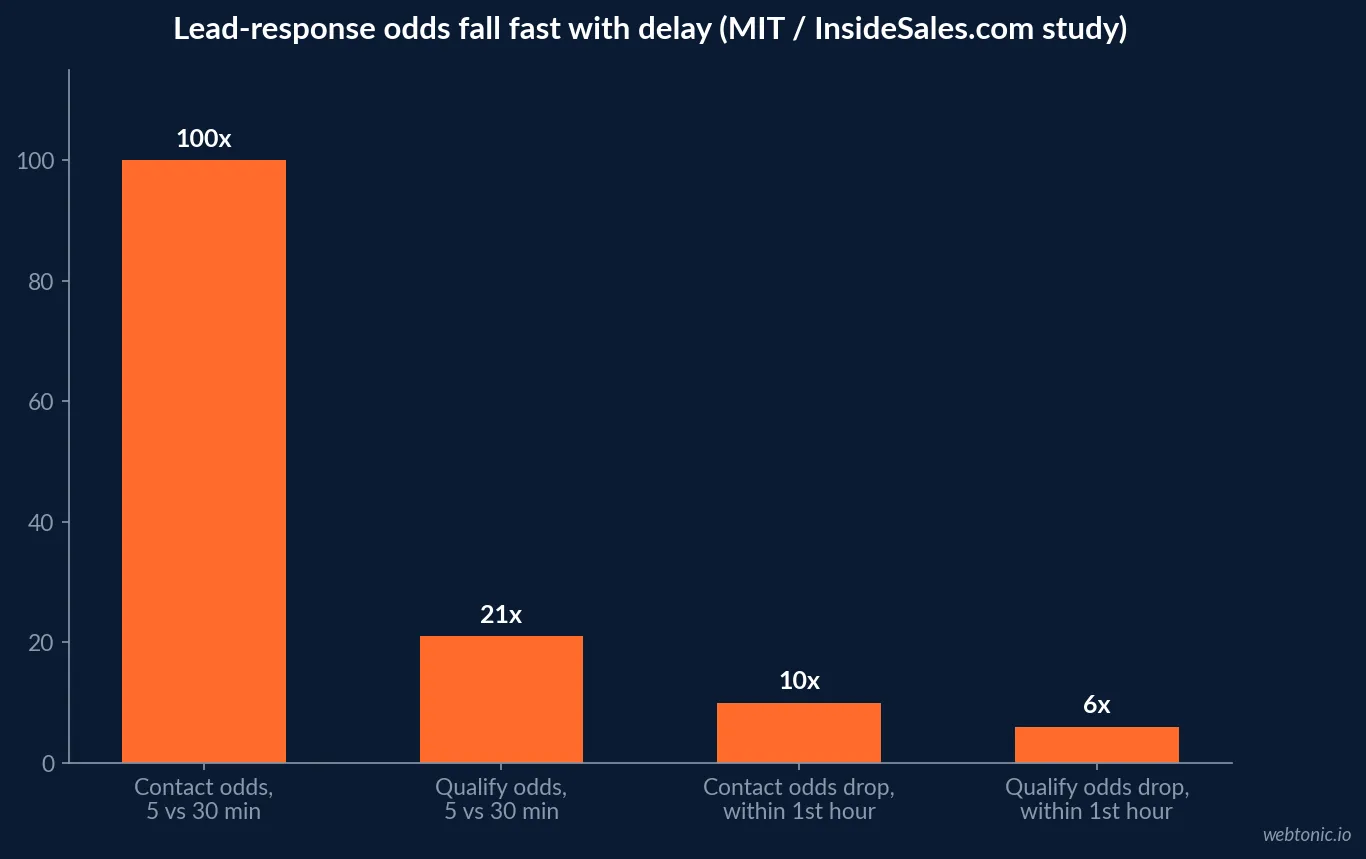
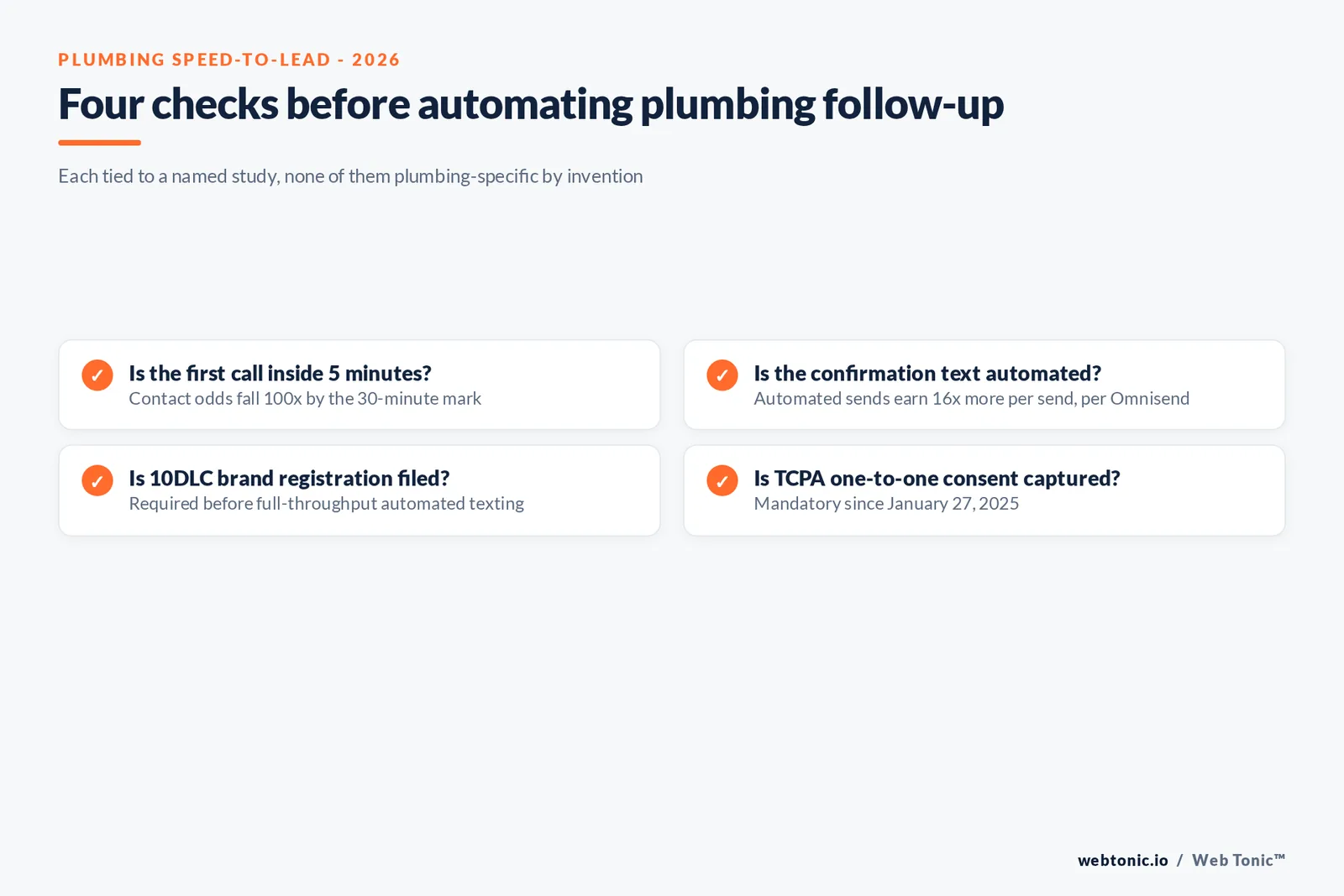
- The odds of making phone contact with a web lead fall by a factor of 100 when the callback waits 30 minutes instead of 5, per the MIT/InsideSales.com lead-response study.
- The odds of qualifying that same lead drop by a factor of 21 over the same 5-versus-30-minute window.
- Within the first hour, the odds of successfully calling a lead decrease by more than 10 times, and the odds of qualifying it decrease by more than 6 times.
- A 2017 Velocify study found more than 33% of sales leads never received a call at all.
- Only 7% of leads were called within the one-minute best-practice window in that same study.
- 35% of leads received a follow-up email in under one minute - faster than the 20-minute best practice, which reads as automated rather than personal.
- Google's Local Services Ads platform surfaces an estimated messaging response time - as fast as "a few minutes" - directly inside a plumbing contractor's ad once it logs 2 or more message leads.
- Automated messages made up just 2% of email sends but drove 30% of total revenue, per Omnisend's 2026 report across 150,000 brands.
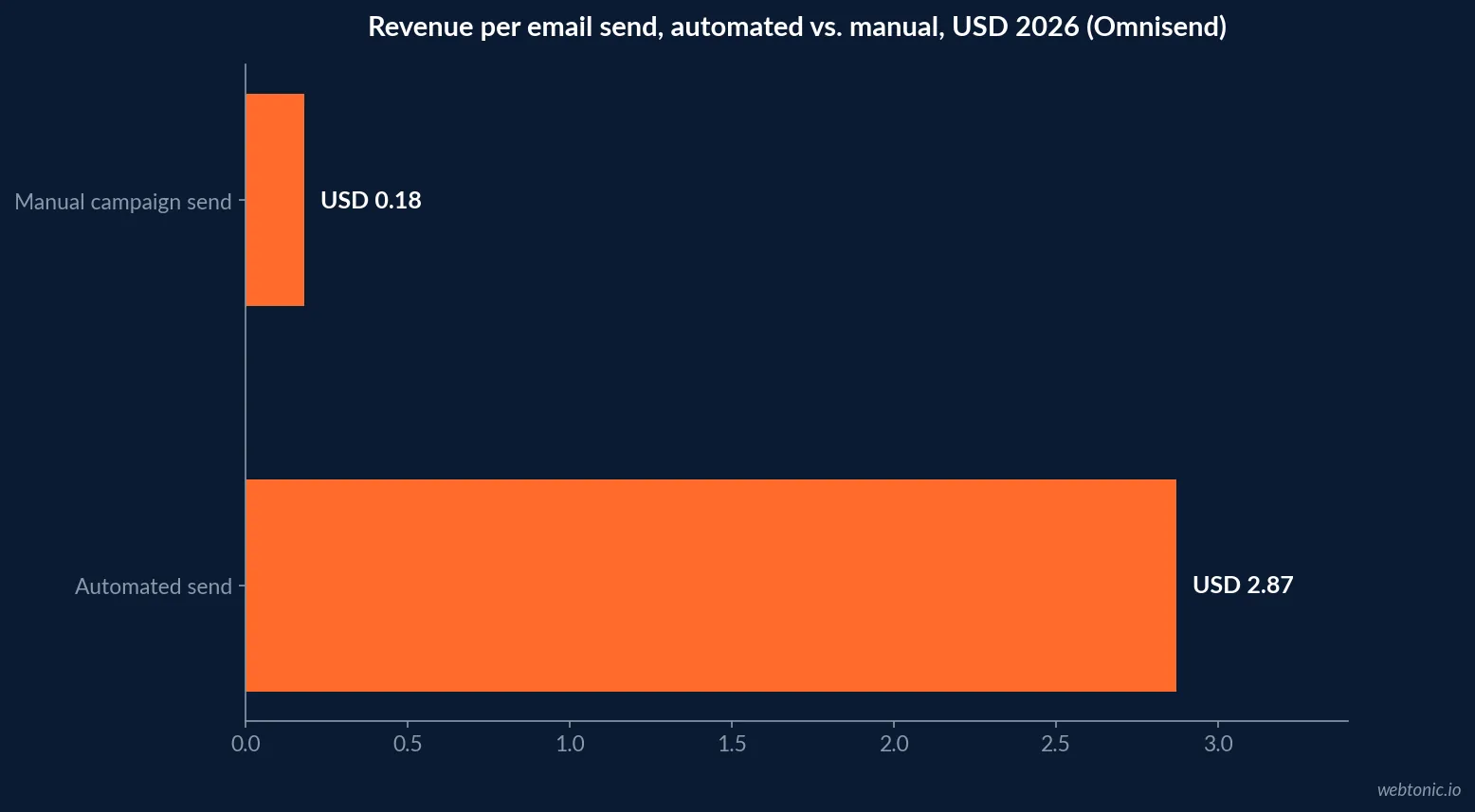
- Each automated send earned USD 2.87 versus USD 0.18 for a scheduled campaign send - a 16-times difference.
- Automated messages delivered 24% higher open rates, 6 times stronger click engagement and 19 times higher conversion rates than campaigns.
- HubSpot's Marketing Hub Starter runs USD 15/month billed monthly or USD 9/seat billed annually, per HubSpot's own pricing.
- HubSpot Marketing Hub Professional runs USD 800/month (3 seats) plus a one-time USD 3,000 onboarding fee.
- HubSpot Marketing Hub Enterprise runs USD 3,600/month (5 seats) plus a one-time USD 7,000 onboarding fee.
- January 24, 2025: the 11th Circuit vacated the FCC's one-to-one consent rule before it took effect; TCPA prior express written consent still gates automated texts.
- A2P 10DLC brand registration through The Campaign Registry typically clears in 2 to 3 business days.
- The core MIT/InsideSales.com response-time findings trace to 2007 research (HBR summarized related work in 2011) - still cited because no newer named study has replaced it.
- None of the automation-revenue or pricing figures above are plumbing-specific - every one is labelled by its actual source population.
Benchmarks at a glance
| Speed-to-lead metric | Figure | Source | Year |
|---|---|---|---|
| Contact-odds drop, 5 vs. 30 minutes | 100x | MIT/InsideSales.com lead-response study | 2011-2015 |
| Qualify-odds drop, 5 vs. 30 minutes | 21x | MIT/InsideSales.com lead-response study | 2011-2015 |
| Leads never called at all | 33%+ | Velocify sales-response study | 2017 |
| Automated email share of revenue (2% of sends) | 30% | Omnisend 2026 ecommerce report | 2026 |
| HubSpot Marketing Hub Starter (own pricing) | USD 15/mo | HubSpot | 2026 |
Why "vanish in minutes" is a fair headline, carefully sourced
The foundational research is "The Short Life of Online Sales Leads", published in Harvard Business Review in March 2011 by James Oldroyd, Kristina McElheran and David Elkington. The related, earlier (2007) Lead Response Management study run by InsideSales.com with MIT, which found the odds of making phone contact with a web-generated lead fall by a factor of 100 when the callback happens at 30 minutes rather than 5, and the odds of qualifying that lead drop by a factor of 21 over the same window. Within the first hour alone, contact odds fall more than 10 times and qualify odds fall more than 6 times.
The research is cross-industry and dated - 2011 for the original HBR article, with the MIT extension compiled from behavioral call data collected through the mid-2010s. No plumbing-specific version exists. What the data supports is the mechanism, not an invented plumbing number: a homeowner with an active leak is comparing quotes in real time, and the contractor who calls back first usually wins the job regardless of trade.
Most sales teams still do not call back fast enough
A 2017 Velocify study, "Sales Lead Response: The Ugly Truth," found more than 33% of leads never received a call, and only 7% were called within the recommended one-minute window. On email, 35% of leads received a follow-up in under one minute - faster than the 20-minute best practice the study recommends, which risks reading as an impersonal, automated blast rather than a human reply. The study is dated and cross-industry, but the behavior pattern - too slow on calls, too fast and impersonal on email - is exactly what a well-tuned automation workflow is built to fix.
| Response channel | Behavior found | Best practice | Source |
|---|---|---|---|
| Phone call | 33%+ of leads never called | Call within 1 minute | Velocify 2017 |
| Phone call timing | Only 7% called within 1 minute | Call within 1 minute | Velocify 2017 |
| Email follow-up | 35% sent in under 1 minute | Wait ~20 minutes | Velocify 2017 |
| Voicemail cadence | 85% did not receive the optimal number | Persistent, spaced cadence | Velocify 2017 |
What automated messages actually earn per send
Omnisend's 2026 ecommerce marketing report, based on 150,000 brands and 27 billion emails sent through its platform, found automated messages made up just 2% of all email sends yet drove 30% of total email-driven revenue - earning USD 2.87 per send versus USD 0.18 for a manually scheduled campaign, a 16-times difference. Automated messages also delivered 24% higher open rates, 6 times stronger click engagement and 19 times higher conversion rates.
That data is ecommerce-wide, not plumbing-specific - no vendor publishes a trades-only version - but the mechanism transfers directly: an automated dispatch confirmation or "on our way" text is triggered by real customer behavior, exactly the high-intent moment Omnisend's data shows automation is built to catch.
What the automation platform itself costs
HubSpot's own Marketing Hub pricing lists Starter at USD 15 a month billed monthly, or USD 9 per seat billed annually; Professional at USD 800 a month, including 3 core seats, plus a one-time USD 3,000 onboarding fee; and Enterprise at USD 3,600 a month, including 5 core seats, plus a one-time USD 7,000 onboarding fee. Additional seats run USD 45/month on Professional and USD 75/month on Enterprise. Those are HubSpot's list prices for the category a plumbing shop would use to automate follow-up sequences - not a plumbing-specific quote.
| HubSpot Marketing Hub tier (own pricing) | Monthly price | Seats included | One-time onboarding |
|---|---|---|---|
| Starter | USD 15 (monthly) / USD 9 per seat (annual) | 1 | None |
| Professional | USD 800 | 3 | USD 3,000 |
| Enterprise | USD 3,600 | 5 | USD 7,000 |
The compliance layer speed-to-lead automation runs inside
Automating the callback or confirmation text still has to clear the same two regimes as any other trade. The FCC's 2023 one-to-one consent rule was due to start on January 27, 2025, but the 11th Circuit vacated it on January 24, 2025 (Insurance Marketing Coalition v. FCC), so it never took effect; automated marketing texts still need the consumer's prior express written consent under the TCPA. Carriers separately require A2P 10DLC brand and campaign registration through The Campaign Registry, typically clearing in 2 to 3 business days, before automated texts reach full throughput without carrier filtering.
On the inbound side, Google's Local Services Ads help center confirms that once a plumbing contractor logs two or more message leads, an estimated response time can surface directly inside the ad - turning the speed metrics above into a visible trust signal, not just an internal dashboard number.
Where automation should intervene first
Read together, the response-time research and the Omnisend send-level data point to the same priority: automate the confirmation and first-reply message before automating anything else, because that is the message competing directly against the odds curve in the chart above. A growth marketing team that wires an instant text-back into the existing phone and web-form workflow is addressing the 100x contact-odds drop directly, not a downstream metric.
| Workflow | Automate first? | Evidence |
|---|---|---|
| Instant text-back on missed call / web form | Yes | 100x contact-odds drop by 30 minutes |
| Dispatch confirmation / ETA text | Yes | Automated sends earn 16x more per send (Omnisend) |
| Estimate follow-up email | Automated cadence, human-written content | Velocify: too-fast automated email reads as impersonal |
| Review request after job completion | Yes | High-intent, triggered moment |
| Win-back offer for a lapsed customer | Manual review, automated send | Blend of lifecycle and automation data |
Building the speed-to-lead scorecard
A plumbing dispatcher does not need a CRM overhaul to start measuring against the numbers on this page - the two figures worth tracking weekly are median first-response time (target: under 5 minutes on inbound web and phone leads) and the share of leads that receive any response at all (target: effectively 100%, given the Velocify study's 33%-never-called finding). Both come out of call-log and form-submission timestamps that most plumbing dispatch software already records.
A reporting layer that surfaces those two numbers on a weekly cadence turns the abstract "100x" statistic into an operational target a dispatcher can actually see move, and a growth marketing team can then decide which automation platform - HubSpot or a category alternative - fits the volume of leads that scorecard reveals.
| Scorecard metric | Target | Why it matters | Source |
|---|---|---|---|
| Median first-response time | Under 5 minutes | Contact odds are highest in this window | MIT/InsideSales.com |
| Share of leads receiving any response | ~100% | 33%+ currently get none at all | Velocify 2017 |
| Automated vs. manual send revenue | Track the gap, not the absolute number | 16x gap found industry-wide | Omnisend 2026 |
| 10DLC campaign registration status | Approved, not pending | Blocks full-throughput texting until cleared | The Campaign Registry |
Frequently Asked Questions
Is there a plumbing-specific study proving leads vanish in minutes?
No, and this page will not invent one. The closest verified evidence is cross-industry: a Harvard Business Review study by James Oldroyd, later extended with MIT and InsideSales.com data, found the odds of making phone contact with a web-generated lead fall by a factor of 100 when the callback waits until 30 minutes instead of 5, and the odds of qualifying that lead once contacted drop by a factor of 21 over the same window. It is not plumbing-specific, and the original study is from 2011 - but no newer named study has replaced its core finding.
How much do response delays compound in just the first hour?
The same MIT/InsideSales.com research found the odds of successfully calling a web lead decrease by more than 10 times within the first hour after submission, and the odds of qualifying it decrease by more than 6 times over that same hour. A 2017 Velocify study of sales-team behavior found more than 33% of leads never received a call at all, and only 7% were called within the one-minute best-practice window - both dated studies, both cross-industry.
Does automation actually change plumbing lead outcomes, or is that assumed?
No plumbing-specific automation study exists, but Omnisend's 2026 ecommerce report, drawn from 150,000 brands and 27 billion emails, found automated messages made up just 2% of sends yet drove 30% of total revenue - earning USD 2.87 per automated send versus USD 0.18 per manual campaign send, a 16-times difference. That evidence is ecommerce-wide, not plumbing-specific, but it is the clearest published proof that automated, triggered messages outperform manual ones.
What does plumbing marketing automation software cost?
HubSpot's own Marketing Hub pricing lists Starter at USD 15 a month billed monthly (or USD 9 per seat billed annually), Professional at USD 800 a month including 3 seats plus a one-time USD 3,000 onboarding fee, and Enterprise at USD 3,600 a month including 5 seats plus a USD 7,000 onboarding fee. Those are HubSpot's list prices for the category, not a plumbing-specific quote and not a Web Tonic price.
What compliance rules govern automated dispatch texts to plumbing customers?
The same two regimes that apply across trades: TCPA prior express written consent before an automated marketing text or robocall (the FCC's one-to-one consent rule was vacated by the 11th Circuit on January 24, 2025, before it took effect), and carrier-mandated A2P 10DLC brand and campaign registration through The Campaign Registry before automated texts clear carrier filtering at full throughput.
Sources
Harvard Business Review - The Short Life of Online Sales Leads (2011)
InsideSales.com / MIT - Lead Response Management study (2007, archived original)
Velocify - Sales Lead Response: The Ugly Truth (2017)
Omnisend - 2026 Ecommerce Marketing Report
HubSpot - Marketing Hub pricing guide (own data)
FCC - One-to-One Consent Rule for TCPA (2025)
Google - Local Services Ads: manage leads and jobs